United States (US) Coaxial Cables Market Summary
The united states (us) coaxial cables market was estimated at USD 136 Million in 2025 and is projected to reach USD 160 Million by 2032, growing at a CAGR of 3.1% from 2026 to 2032.
United States (US) Coaxial Cables Market Year-wise Growth Rate and Key Drivers
This graph highlights how the United States (US) Coaxial Cables Market has steadily grown over the past five years, supported by major growth factors.
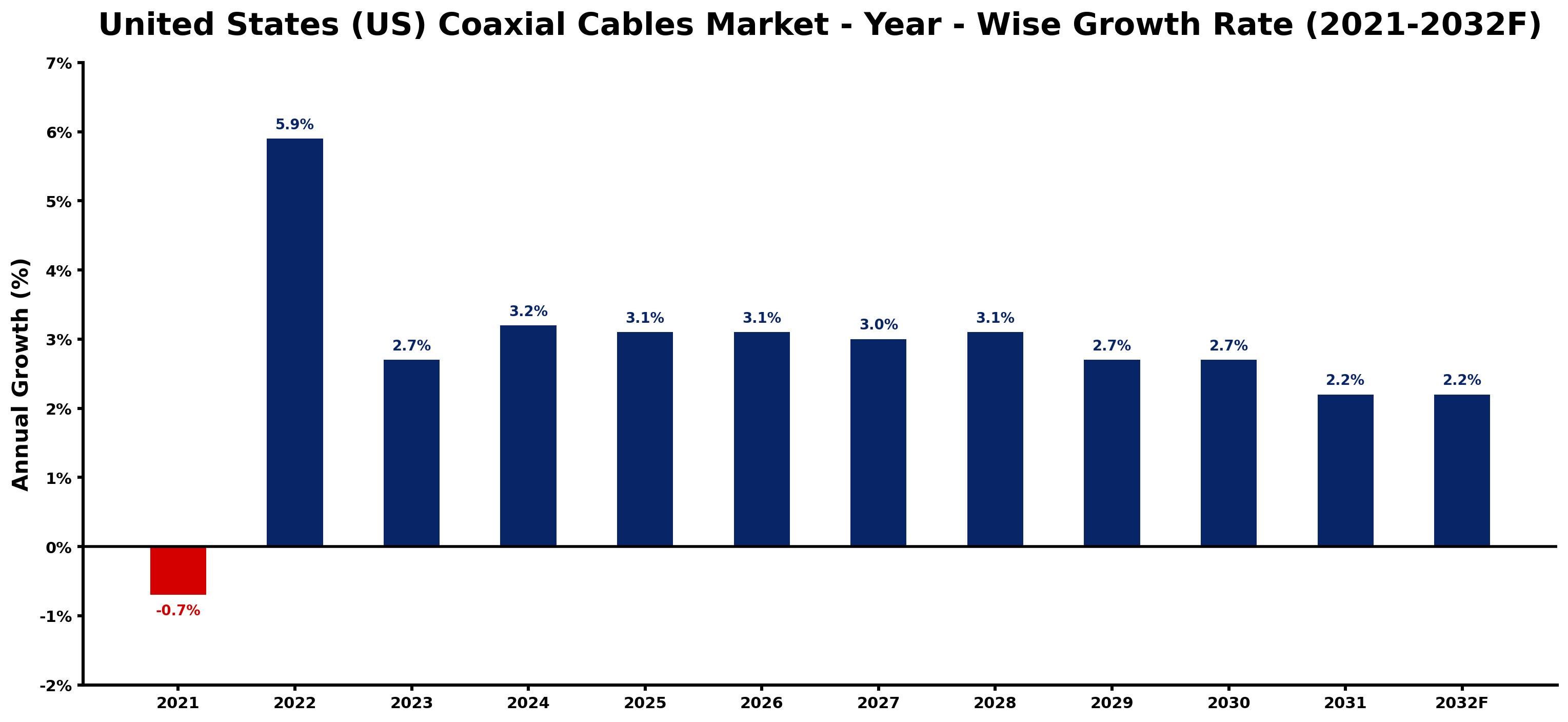
The table below presents the year wise growth rates along with the key drivers influencing the market
| Year | Growth Rate | Major Drivers |
| 2021 | -0.7% | Supply chain disruptions led to increased lead times and reduced availability, diminishing enduser confidence in procurement. |
| 2022 | 5.9% | Corporate budgets prioritized enhanced connectivity, benefiting coaxial cable demand significantly. |
| 2023 | 2.7% | Legacy copper grid failures prompted utilities to upgrade to fiber and coaxial solutions. |
| 2024 | 3.2% | Smart home technology proliferation increased need for reliable coaxial cable networks. |
| 2025 | 3.1% | Telecommunications companies expanded broadband services, boosting coaxial cable installations drastically. |
| 2026 | 3.1% | Remote work dynamics spurred home office installations requiring robust coaxial connections. |
| 2027 | 3.0% | Emerging technologies in streaming prompted higher demand for high-performance coaxial cables. |
| 2028 | 3.1% | Urbanization trends led to construction booms, necessitating extensive coaxial cable installations. |
| 2029 | 2.7% | Increased consumer electronics sales fostered enhanced coaxial cable usage in households. |
| 2030 | 2.7% | Tech giants investing in data centers sparked demand for advanced coaxial cable solutions. |
| 2031 | 2.2% | Evolving entertainment platforms demanded seamless coaxial cable integration within existing systems. |
| 2032 | 2.2% | Sustainability pressures encouraged manufacturers to innovate eco-friendly coaxial cable alternatives. |
Note - Market size estimations and growth projections presented in this report are based on 6Wresearch's advanced forecasting approach, validated with industry datasets as of June 2026.
United States (US) Coaxial Cables Market Synopsis
The United States (US) Coaxial Cables Market is projected to reach 3.1% and witness significant growth during the forecast period (2026-2032). This market is primarily driven by the increasing demand for high-speed data transmission across diverse sectors, including telecommunications, broadband networks, and cable television services. As the market matures, technological advancements and the integration of innovative solutions are set to play critical roles in shaping its trajectory.
United States (US) Coaxial Cables Market Growth Drivers
Several factors are propelling growth in the United States (US) Coaxial Cables Market. First, the surge in demand for reliable internet connectivity, particularly with the rise of digital streaming and online gaming, has enhanced the necessity for improved data transmission solutions. Second, the expansion of smart home technologies and the Internet of Things (IoT) mandates robust networking capabilities, further increasing the reliance on coaxial cables. Third, advancements in cable technology, such as enhanced shielding for better signal integrity and weather resistance, have made coaxial cables more appealing. Additionally, the ongoing rollout of 5G technology has generated a renewed interest in coaxial solutions to support telecommunications infrastructure. Lastly, infrastructure development initiatives across urban and rural regions are expected to contribute significantly to the market's growth.
United States (US) Coaxial Cables Market Trends and Opportunities
The United States (US) Coaxial Cables Market is currently witnessing several notable trends that indicate robust future opportunities. Increasing consumer demand for high-definition video content is driving the adoption of advanced coaxial cables that can handle higher bandwidths. The growth of smart technologies necessitates efficient networking solutions, promoting innovation within the industry. Additionally, as businesses and consumers continue shifting towards remote work and digital platforms, the need for reliable data transmission will expand further. There is also a trend towards eco-friendly manufacturing processes and materials, pushing companies to innovate while adhering to sustainability principles. These trends suggest multiple avenues for investment and product development in the coming years.
United States (US) Coaxial Cables Market Challenges and Restraints
Despite a positive growth outlook, the United States (US) Coaxial Cables Market faces several challenges. The increasing popularity of fiber optic cables, which offer superior data transmission speeds and bandwidth, has begun to encroach upon the traditional coaxial cable market share. This competition necessitates that manufacturers enhance their offerings and innovate continuously to remain relevant. Additionally, the adoption of wireless technologies, such as 5G, poses a potential threat as consumers and businesses alike gravitate towards less cumbersome alternatives. Furthermore, fluctuations in the prices of essential raw materials, such as copper, may impact operational costs and profitability. Lastly, evolving customer preferences towards streaming services over conventional cable TV may further affect demand dynamics.
United States (US) Coaxial Cables Market Investment Opportunities
Investment opportunities within the United States (US) Coaxial Cables Market are abundant, driven by various technological advancements and increasing connectivity demands. The growing reliance on broadband services presents a fertile ground for investors interested in companies that manufacture coaxial cables or related technologies. Furthermore, as more sectors embrace digital transformation, the need for high-performance coaxial cables will continue to rise. Investors could also target firms that focus on developing innovative products, such as cables engineered for improved signal quality and durability. The transition towards greener manufacturing processes can lead to long-term investment potential as sustainability becomes a critical focus for consumers and businesses alike.
United States (US) Coaxial Cables Market Government Investment and Initiatives
The regulatory landscape surrounding the United States (US) Coaxial Cables Market is significantly shaped by government policies aimed at ensuring high standards for telecommunications infrastructure. The Federal Communications Commission (FCC) plays a vital role in establishing regulations that govern the quality and safety of coaxial cables used across various applications. Additionally, public investment in broadband expansion initiatives is poised to enhance network capacities, especially in underserved areas. Through various development plans, the government aims to support technological advancements in the telecommunications sector, further driving the demand for reliable coaxial solutions. Trade policies affecting the importation of raw materials for cable manufacturing are also crucial, as they can influence market dynamics and production costs.
United States (US) Coaxial Cables Market Latest Developments (May 2025 - June 2026)
Recent developments in the United States (US) Coaxial Cables Market from May 2025 to June 2026 indicate a focused shift towards enhancing data transmission capabilities. Industry players are increasingly prioritizing the integration of advanced technologies to improve cable performance in line with growing consumer demand. Moreover, collaborations among technology firms and telecommunications providers have emerged to foster innovation within the sector. The trend towards sustainable practices continues to gain momentum, with companies exploring eco-friendly materials and production techniques. Additionally, as the government unveils new infrastructure projects aimed at bolstering broadband access, the market is expected to evolve, creating new channels for growth and investment.
United States (US) Coaxial Cables Market - Key Attractiveness of the Report
- 10 Years of Market Numbers
- Historical Data Starting from 2022 to 2025
- Base Year: 2025
- Forecast Data until 2032
- Key Performance Indicators Impacting the Market
- Major Upcoming Developments and Projects
Key Highlights of the Report:
- United States (US) Coaxial Cables Market Outlook
- Market Size of United States (US) Coaxial Cables Market, 2025
- Forecast of United States (US) Coaxial Cables Market, 2032F
- Historical Data and Forecast of United States (US) Coaxial Cables Revenues & Volume for the Period 2022-2032F
- United States (US) Coaxial Cables Market Trend Evolution
- United States (US) Coaxial Cables Market Drivers and Challenges
- United States (US) Coaxial Cables Price Trends
- United States (US) Coaxial Cables Porter's Five Forces
- United States (US) Coaxial Cables Industry Life Cycle
- Historical Data and Forecast of United States (US) Coaxial Cables Market Revenues & Volume By Types for the Period 2022-2032F
- Historical Data and Forecast of United States (US) Coaxial Cables Market Revenues & Volume By Hard-line Cable for the Period 2022-2032F
- Historical Data and Forecast of United States (US) Coaxial Cables Market Revenues & Volume By Triaxial Cable for the Period 2022-2032F
- Historical Data and Forecast of United States (US) Coaxial Cables Market Revenues & Volume By Twin Axial Cable for the Period 2022-2032F
- Historical Data and Forecast of United States (US) Coaxial Cables Market Revenues & Volume By Applications for the Period 2022-2032F
- Historical Data and Forecast of United States (US) Coaxial Cables Market Revenues & Volume By Internet Data Transfer for the Period 2022-2032F
- Historical Data and Forecast of United States (US) Coaxial Cables Market Revenues & Volume By Video Distribution for the Period 2022-2032F
- Historical Data and Forecast of United States (US) Coaxial Cables Market Revenues & Volume By Radio Distribution Frequency Transfer for the Period 2022-2032F
- Historical Data and Forecast of United States (US) Coaxial Cables Market Revenues & Volume By Others for the Period 2022-2032F
- Historical Data and Forecast of United States (US) Coaxial Cables Market Revenues & Volume By End-users for the Period 2022-2032F
- Historical Data and Forecast of United States (US) Coaxial Cables Market Revenues & Volume By Cable Television Industry for the Period 2022-2032F
- Historical Data and Forecast of United States (US) Coaxial Cables Market Revenues & Volume By Military and Aerospace for the Period 2022-2032F
- Historical Data and Forecast of United States (US) Coaxial Cables Market Revenues & Volume By Internet Service Providers for the Period 2022-2032F
- Historical Data and Forecast of United States (US) Coaxial Cables Market Revenues & Volume By Telephone Network Operators for the Period 2022-2032F
- Historical Data and Forecast of United States (US) Coaxial Cables Market Revenues & Volume By Communication Equipment Manufactures for the Period 2022-2032F
- United States (US) Coaxial Cables Import Export Trade Statistics
- Market Opportunity Assessment By Types
- Market Opportunity Assessment By Applications
- Market Opportunity Assessment By End-users
- United States (US) Coaxial Cables Top Companies Market Share
- United States (US) Coaxial Cables Competitive Benchmarking By Technical and Operational Parameters
- United States (US) Coaxial Cables Company Profiles
- United States (US) Coaxial Cables Key Strategic Recommendations






































