United States (US) Conveyors Systems Market Size, Share & Growth Rate
The United States (US) Conveyors Systems Market was estimated at USD 86 Million in 2025 and is projected to reach USD 101 Million by 2032, growing at a CAGR of 2.3% from 2026 to 2032. This growth trajectory is primarily driven by the surge in demand for automation across key sectors like manufacturing, food and beverage, and logistics. Additionally, the rise of e-commerce has necessitated efficient material handling systems, further propelling market advancements and adoption of cutting-edge technologies.
United States (US) Conveyors Systems Market Year-wise Growth Rate and Key Drivers
This graph highlights how the United States (US) Conveyors Systems Market has steadily grown over the years, supported by major growth factors.
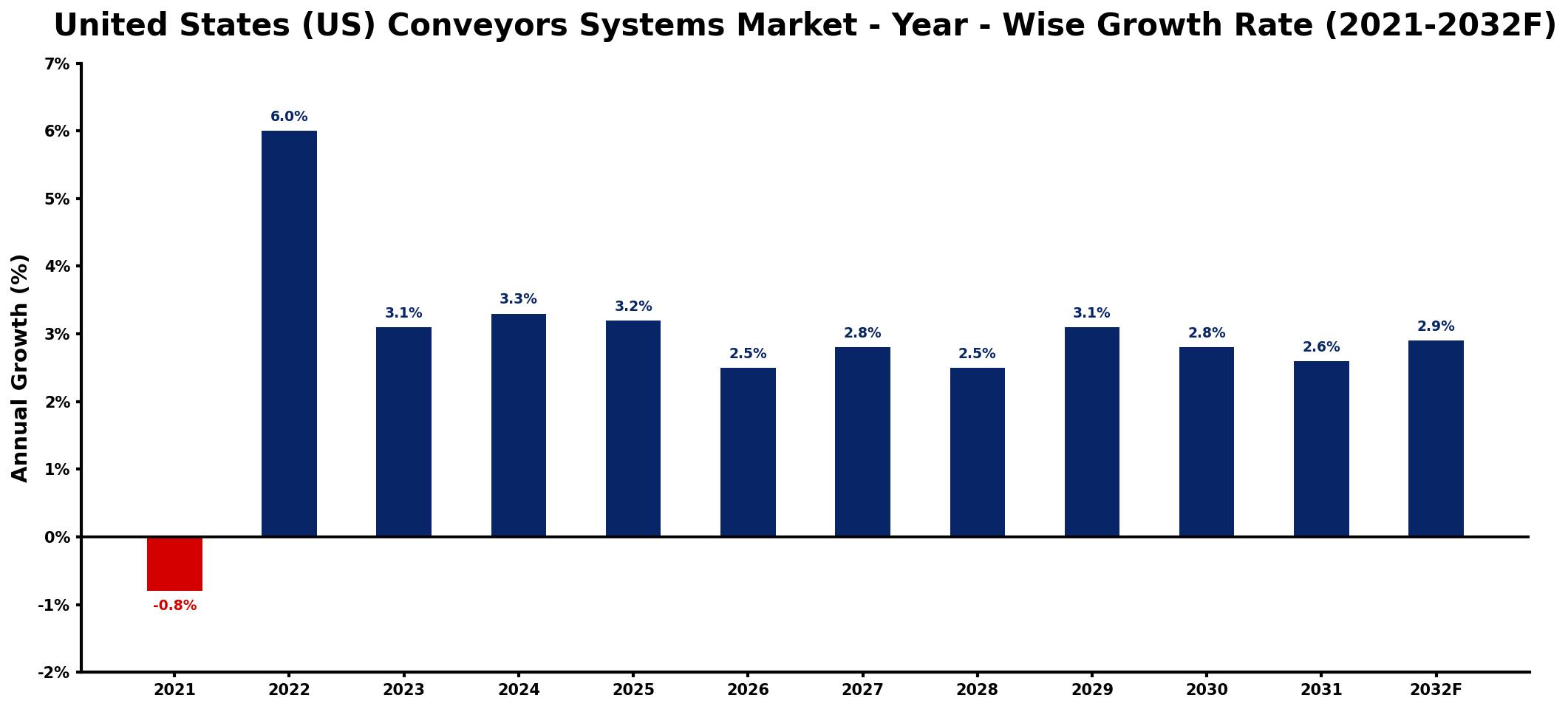
The table below presents the year‑wise growth rates along with the key drivers influencing the market
| Year | Growth Rate | Major Drivers |
| 2021 | -0.8% | decreased manufacturing output levels |
| 2022 | 6.0% | increased automation in warehouses |
| 2023 | 3.1% | growing e-commerce fulfillment demands |
| 2024 | 3.3% | expansion of logistics infrastructure projects |
| 2025 | 3.2% | rising investments in smart technology |
| 2026 | 2.5% | enhanced supply chain efficiency needs |
| 2027 | 2.8% | growing demand for sustainability solutions |
| 2028 | 2.5% | increased focus on operational efficiency |
| 2029 | 3.1% | expanding retail distribution networks |
| 2030 | 2.8% | advancements in robotics integration |
| 2031 | 2.6% | growing automotive sector requirements |
| 2032 | 2.9% | increased adoption of AI technologies |
Note: Market size estimations and growth projections presented in this report are based on 6Wresearch's proprietary forecasting methodology, utilizing the latest available industry data, government publications, and primary research inputs.
United States (US) Conveyors Systems Market Synopsis
The most significant force currently shaping the United States (US) Conveyors Systems Market is the increasing demand for automation and efficiency. As industries strive to optimize operations and reduce costs, conveyor systems that offer automation solutions are becoming vital components of production and distribution strategies.
Technological advancements are also pivotal in this market. Integration of IoT and AI capabilities within conveyor systems is not just enhancing operational efficiencies; its facilitating predictive maintenance and real-time performance monitoring. These innovations are setting a high benchmark for performance, sustainability, and safety in material handling.
United States (US) Conveyors Systems Market Key Takeaways
- The market is fueled by automation trends across various sectors, notably manufacturing and logistics.
- Technological innovations, including IoT and AI, are enhancing conveyor system efficiency and monitoring.
- Safety features and eco-friendly solutions are increasingly prioritized by consumers and businesses alike.
- Investment opportunities abound, particularly in software development and eco-friendly conveyor solutions.
- Government regulations surrounding safety and environmental standards continue to influence market dynamics.
Evaluation of Restraints in United States (US) Conveyors Systems Market
Despite the market's growth, several constraints hinder its full potential. Chief among these is the intense competition from international players, often offering lower-cost alternatives. This puts pressure on domestic manufacturers to innovate continuously and enhance their value propositions. Additionally, the variability in raw material prices can lead to production cost fluctuations, impacting overall pricing strategies. Compliance with stringent safety regulations demands constant updates and can strain resources for some companies, particularly smaller ones. As the market evolves, maintaining alignment with Industry 4.0 initiatives and ensuring operational efficacy presents ongoing challenges.
United States (US) Conveyors Systems Market Trends
Current trends indicate a clear shift towards automated conveyor solutions integrated with robotics, particularly in high-volume sectors such as e-commerce and manufacturing. Alongside this, there is a growing emphasis on sustainability, with many organizations seeking conveyor systems that minimize energy consumption and environmental impact. Safety innovations are also trending, as companies adopt technology that not only safeguards workers but also enhances operational reliability. The market is witnessing the integration of real-time data analytics, allowing businesses to leverage information for improved decision-making and efficiency.
United States (US) Conveyors Systems Market Opportunities
The United States Conveyors Systems Market is ripe with investment prospects, particularly in the area of automation and technology integration. As industries strive for greater operational efficiency, opportunities exist for manufacturers focusing on high-tech conveyor solutions equipped with IoT and AI capabilities. Additionally, investors can explore avenues in the maintenance services sector, where demand for expertise in advanced systems is surging. Furthermore, the ongoing shift towards sustainable practices opens doors for innovative designs that reduce energy use and enhance eco-friendliness.
Government Initiatives in the United States (US) Conveyors Systems Market
Government policies in the United States significantly shape the Conveyor Systems Market, particularly through regulations that emphasize workplace safety and environmental protections. The Occupational Safety and Health Administration (OSHA) enforces standards that compel businesses to ensure safe operation of conveyor systems, fostering a safer work environment. Additionally, environmental regulations necessitate that manufacturers adopt practices that minimize pollution, influencing design and operational methodologies within the sector. Trade policies and tariffs can also impact the market by affecting the importation and exportation of conveyor components.
Future Insights of the United States (US) Conveyors Systems Market
Looking ahead to 2026-2032, the outlook for the United States Conveyors Systems Market appears robust, buoyed by sustained demand for automation and material handling efficiency. Sectors like logistics, food and beverage, and manufacturing are expected to drive growth as companies continue to adopt advanced conveyor technologies. The focus on reducing labor costs while enhancing safety and operational efficiency will play a crucial role in shaping investment decisions. Overall, the market is poised for innovation and expansion, presenting a fertile ground for companies aiming to lead in automation and sustainability.
United States (US) Conveyors Systems Market Latest Developments (2025 - 2026)
In recent months, the conveyor systems industry has seen noteworthy advancements, particularly in automation technologies. Many companies are actively integrating AI and IoT solutions into their conveyor systems, enhancing their capabilities to monitor performance and predict maintenance needs. The push for eco-friendly operations has prompted some manufacturers to innovate in energy-efficient conveyor designs, aiming to reduce carbon footprints while maintaining productivity levels. Additionally, the focus on safety continues to prompt new designs and safety features that help mitigate workplace accidents.
United States (US) Conveyors Systems Market - Key Attractiveness of the Report
- 10 Years of Market Numbers
- Historical Data Starting from 2022 to 2025
- Base Year: 2025
- Forecast Data until 2032
- Key Performance Indicators Impacting the Market
- Major Upcoming Developments and Projects
Key Highlights of the Report:
- United States (US) Conveyors Systems Market Outlook
- Market Size of United States (US) Conveyors Systems Market, 2025
- Forecast of United States (US) Conveyors Systems Market, 2032
- Historical Data and Forecast of United States (US) Conveyors Systems Revenues & Volume for the Period 2022-2032F
- United States (US) Conveyors Systems Market Trend Evolution
- United States (US) Conveyors Systems Market Drivers and Challenges
- United States (US) Conveyors Systems Price Trends
- United States (US) Conveyors Systems Porter's Five Forces
- United States (US) Conveyors Systems Industry Life Cycle
- Historical Data and Forecast of United States (US) Conveyors Systems Market Revenues & Volume By Type for the Period 2022-2032F
- Historical Data and Forecast of United States (US) Conveyors Systems Market Revenues & Volume By Roller for the Period 2022-2032F
- Historical Data and Forecast of United States (US) Conveyors Systems Market Revenues & Volume By Flat Belt for the Period 2022-2032F
- Historical Data and Forecast of United States (US) Conveyors Systems Market Revenues & Volume By Wheel for the Period 2022-2032F
- Historical Data and Forecast of United States (US) Conveyors Systems Market Revenues & Volume By Vertical for the Period 2022-2032F
- Historical Data and Forecast of United States (US) Conveyors Systems Market Revenues & Volume By Others for the Period 2022-2032F
- Historical Data and Forecast of United States (US) Conveyors Systems Market Revenues & Volume By Location for the Period 2022-2032F
- Historical Data and Forecast of United States (US) Conveyors Systems Market Revenues & Volume By In-floor for the Period 2022-2032F
- Historical Data and Forecast of United States (US) Conveyors Systems Market Revenues & Volume By On-floor for the Period 2022-2032F
- Historical Data and Forecast of United States (US) Conveyors Systems Market Revenues & Volume By Overhead for the Period 2022-2032F
- Historical Data and Forecast of United States (US) Conveyors Systems Market Revenues & Volume By Load for the Period 2022-2032F
- Historical Data and Forecast of United States (US) Conveyors Systems Market Revenues & Volume By Unit Load for the Period 2022-2032F
- Historical Data and Forecast of United States (US) Conveyors Systems Market Revenues & Volume By Bulk Load for the Period 2022-2032F
- Historical Data and Forecast of United States (US) Conveyors Systems Market Revenues & Volume By Application for the Period 2022-2032F
- Historical Data and Forecast of United States (US) Conveyors Systems Market Revenues & Volume By Food & Beverages for the Period 2022-2032F
- Historical Data and Forecast of United States (US) Conveyors Systems Market Revenues & Volume By Pharmaceuticals for the Period 2022-2032F
- Historical Data and Forecast of United States (US) Conveyors Systems Market Revenues & Volume By Supply chain & Logistics for the Period 2022-2032F
- Historical Data and Forecast of United States (US) Conveyors Systems Market Revenues & Volume By Manufacturing for the Period 2022-2032F
- Historical Data and Forecast of United States (US) Conveyors Systems Market Revenues & Volume By Mining for the Period 2022-2032F
- Historical Data and Forecast of United States (US) Conveyors Systems Market Revenues & Volume By Others for the Period 2022-2032F
- United States (US) Conveyors Systems Import Export Trade Statistics
- Market Opportunity Assessment By Type
- Market Opportunity Assessment By Location
- Market Opportunity Assessment By Load
- Market Opportunity Assessment By Application
- United States (US) Conveyors Systems Top Companies Market Share
- United States (US) Conveyors Systems Competitive Benchmarking By Technical and Operational Parameters
- United States (US) Conveyors Systems Company Profiles
- United States (US) Conveyors Systems Key Strategic Recommendations






































