United States (US) Cultured Meat Market Size, Share & Growth Rate
The United States (US) Cultured Meat Market was estimated at USD 205 Million in 2025 and is projected to reach USD 241 Million by 2032, growing at a CAGR of 2.3% from 2026 to 2032. This growth is fueled by rising consumer demand for sustainable and ethically produced protein sources, driven by increased awareness of the environmental impacts associated with conventional meat production. As technological advancements reduce costs and enhance production efficiency, the market is poised for significant expansion.
United States (US) Cultured Meat Market Year-wise Growth Rate and Key Drivers
This graph highlights how the United States (US) Cultured Meat Market has steadily grown over the years, supported by major growth factors.
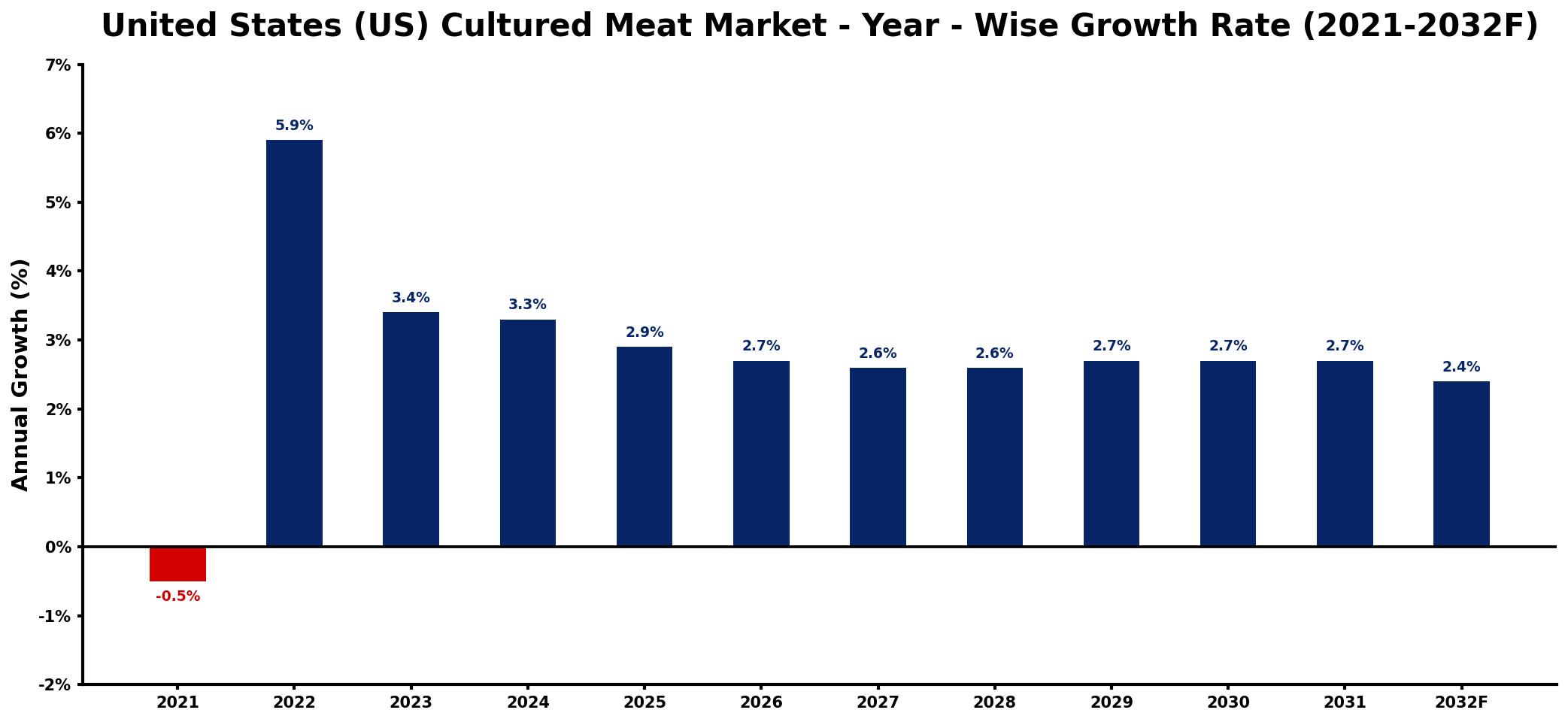
The table below presents the year‑wise growth rates along with the key drivers influencing the market
| Year | Growth Rate | Major Drivers |
| 2021 | -0.5% | Consumer interest in sustainability declines |
| 2022 | 5.9% | Investment in alternative protein technologies |
| 2023 | 3.4% | Increased awareness of health benefits |
| 2024 | 3.3% | Growth in plant-based food sector |
| 2025 | 2.9% | Expanding distribution channels for products |
| 2026 | 2.7% | stronger distribution network expansion |
| 2027 | 2.6% | Technological advancements in production processes |
| 2028 | 2.6% | Collaborations with food service providers |
| 2029 | 2.7% | Increased consumer acceptance of innovations |
| 2030 | 2.7% | Research funding for new applications |
| 2031 | 2.7% | Regulatory support for new investments |
| 2032 | 2.4% | Growing interest in sustainable solutions |
Note: Market size estimations and growth projections presented in this report are based on 6Wresearch's proprietary forecasting methodology, utilizing the latest available industry data, government publications, and primary research inputs.
United States (US) Cultured Meat Market Synopsis
The strongest force shaping the US Cultured Meat Market is the growing consumer consciousness surrounding sustainability and animal welfare. Increasing concerns over the environmental footprint of livestock farming are driving interest in alternatives, leading consumers to embrace lab-grown meat products as a solution to these pressing issues.
Additionally, the financial backing from both venture capital and established food companies indicates a robust future for the sector. Collaborative efforts between cultured meat producers and traditional meat manufacturers are fostering innovation, enhancing product offerings, and expanding market reach, further fueling growth in this transformative industry.
United States (US) Cultured Meat Market Key Takeaways
- The US Cultured Meat Market is set to experience steady growth as consumer preferences shift towards sustainable options.
- Technological advancements and increased investment are likely to address current production challenges and cost barriers.
- Regulatory frameworks are evolving to support market entry and ensure product safety, enhancing consumer trust.
- Consumer acceptance is rising due to educational efforts highlighting the environmental and ethical benefits of cultured meat.
- Investment opportunities in this sector are expanding, offering potential for substantial returns as the market matures.
Evaluation of Restraints in United States (US) Cultured Meat Market
Despite the positive outlook, several factors present challenges for the cultured meat sector in the United States. Regulatory hurdles remain significant, as navigating the complex landscape of food safety and labeling guidelines poses delays in product launches. Moreover, some consumers still have reservations about the taste, texture, and overall perception of lab-grown meat compared to traditional options. Furthermore, scaling production to meet rising demand while simultaneously managing costs is crucial, as current techniques often require substantial investment in research and infrastructure. These barriers must be overcome to facilitate broader acceptance and integration of cultured meat into the mainstream food market.
United States (US) Cultured Meat Market Trends
Key trends in the US Cultured Meat Market include increasing partnerships between cultured meat startups and established food corporations, which aim to leverage existing distribution networks and consumer bases. Innovations in cellular agriculture are rapidly advancing, focusing on improving production efficiency and product quality. Moreover, heightened awareness around the ethical treatment of animals and environmental sustainability is driving consumer interest. Regulatory advancements are also noteworthy, as clearer guidelines are being established to facilitate market entry and ensure safety, enhancing the overall credibility of cultured meat products.
United States (US) Cultured Meat Market Opportunities
The US Cultured Meat Market is ripe with investment opportunities, particularly as awareness grows around the need for sustainable food production methods. Companies are focusing on developing cost-effective production techniques, which is critical for scaling operations. Additionally, investment in technology that enhances the taste and texture of cultured meat products can significantly increase consumer acceptance. The ongoing quest for regulatory approval also opens avenues for investors looking to support companies that are striving to set industry standards, making this an attractive landscape for those interested in pioneering a shift towards ethical protein sources.
Government Initiatives in the United States (US) Cultured Meat Market
The US government is actively engaging with the cultured meat industry through supportive regulatory frameworks and funding initiatives. A joint regulatory framework established by the FDA and USDA aims to provide clarity on safety and labeling standards, fostering an environment conducive to innovation. Additionally, the government is investing in research and development projects designed to enhance production methods and promote sustainable practices. This proactive involvement reflects a commitment to advancing alternative protein sources and ensuring their successful integration into the food system.
Future Insights of the United States (US) Cultured Meat Market
Looking ahead to 2026-2032, the US Cultured Meat Market is poised for robust growth driven by shifting consumer preferences and technological innovations. As production methods become more cost-efficient and scalable, a wider array of cultured meat products will likely enter the market. Coupled with increasing consumer education on the benefits of lab-grown meat, the acceptance rate is expected to rise dramatically. Furthermore, as regulatory landscapes adapt to accommodate this emerging industry, the stage is set for cultured meat to play a pivotal role in the future of food, addressing pressing issues of sustainability and food security.
United States (US) Cultured Meat Market Latest Developments (2025 - 2026)
Recent developments in the cultured meat sector reflect a strong industry momentum, with several companies announcing partnerships aimed at enhancing production capabilities and market reach. Innovations in bioreactor technology have been reported, significantly improving the efficiency of cultured meat production processes. Additionally, new regulatory approvals have been granted for various lab-grown products, indicating a maturing market landscape. Industry stakeholders are also focusing on consumer education initiatives, aiming to build awareness and trust in cultured meat as a viable alternative.
United States (US) Cultured Meat Market - Key Attractiveness of the Report
- 10 Years of Market Numbers
- Historical Data Starting from 2022 to 2025
- Base Year: 2025
- Forecast Data until 2032
- Key Performance Indicators Impacting the Market
- Major Upcoming Developments and Projects
Key Highlights of the Report:
- United States (US) Cultured Meat Market Outlook
- Market Size of United States (US) Cultured Meat Market, 2025
- Forecast of United States (US) Cultured Meat Market, 2032
- Historical Data and Forecast of United States (US) Cultured Meat Revenues & Volume for the Period 2022-2032F
- United States (US) Cultured Meat Market Trend Evolution
- United States (US) Cultured Meat Market Drivers and Challenges
- United States (US) Cultured Meat Price Trends
- United States (US) Cultured Meat Porter's Five Forces
- United States (US) Cultured Meat Industry Life Cycle
- Historical Data and Forecast of United States (US) Cultured Meat Market Revenues & Volume By Product Type for the Period 2022-2032F
- Historical Data and Forecast of United States (US) Cultured Meat Market Revenues & Volume By Poultry for the Period 2022-2032F
- Historical Data and Forecast of United States (US) Cultured Meat Market Revenues & Volume By Beef for the Period 2022-2032F
- Historical Data and Forecast of United States (US) Cultured Meat Market Revenues & Volume By Seafood for the Period 2022-2032F
- Historical Data and Forecast of United States (US) Cultured Meat Market Revenues & Volume By Pork for the Period 2022-2032F
- Historical Data and Forecast of United States (US) Cultured Meat Market Revenues & Volume By Duck for the Period 2022-2032F
- Historical Data and Forecast of United States (US) Cultured Meat Market Revenues & Volume By End-Use for the Period 2022-2032F
- Historical Data and Forecast of United States (US) Cultured Meat Market Revenues & Volume By Nuggets for the Period 2022-2032F
- Historical Data and Forecast of United States (US) Cultured Meat Market Revenues & Volume By Burgers for the Period 2022-2032F
- Historical Data and Forecast of United States (US) Cultured Meat Market Revenues & Volume By Meatballs for the Period 2022-2032F
- Historical Data and Forecast of United States (US) Cultured Meat Market Revenues & Volume By Sausage for the Period 2022-2032F
- Historical Data and Forecast of United States (US) Cultured Meat Market Revenues & Volume By Hot dogs for the Period 2022-2032F
- Historical Data and Forecast of United States (US) Cultured Meat Market Revenues & Volume By Others for the Period 2022-2032F
- United States (US) Cultured Meat Import Export Trade Statistics
- Market Opportunity Assessment By Product Type
- Market Opportunity Assessment By End-Use
- United States (US) Cultured Meat Top Companies Market Share
- United States (US) Cultured Meat Competitive Benchmarking By Technical and Operational Parameters
- United States (US) Cultured Meat Company Profiles
- United States (US) Cultured Meat Key Strategic Recommendations






































