United States (US) Cybersecurity Market Growth Rate
According to 6Wresearch internal databases and industry insights, the United States (US) Cybersecurity Market is projected to expand at a compound annual growth rate (CAGR) of 10.8% during the forecast period 2026–2032.
United States (US) Cybersecurity Market Year-wise Growth Rate and Key Drivers (2022–2032)
The graph illustrates the annual growth rates of the United States (US) Cybersecurity Market from 2022 to 2032, highlighting a steady upward trajectory and projected market expansion over the forecast period.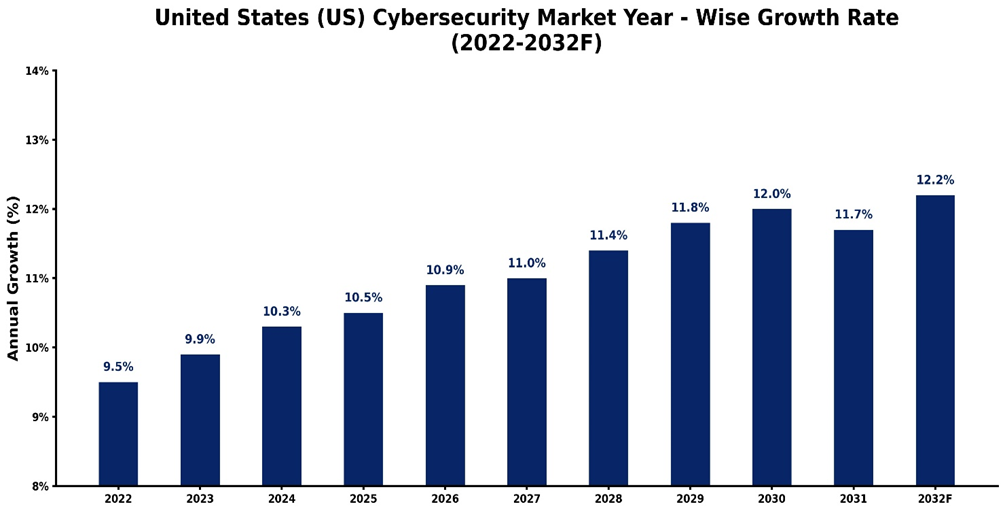
The following table summarizes historical and forecasted growth rates of the United States (US) Cybersecurity Market, along with the rationale behind each year’s performance.
| Year | Estimated Growth (%) | Market Rationale |
| 2022 | 9.5% | Increasing ransomware attacks and remote workforce security requirements accelerated cybersecurity spending. |
| 2023 | 9.9% | Growth was supported by higher adoption of cloud security solutions and regulatory-driven investments. |
| 2024 | 10.3% | Rising AI-enabled cyber threats and expanding zero-trust architecture adoption strengthened demand for advanced cybersecurity solutions. |
| 2025 | 10.5% | Enterprise security modernization, compliance requirements, and critical infrastructure protection investments supported market expansion. |
| 2026 | 10.9% | Increased adoption of AI-driven threat intelligence, managed security services, and cloud-native security platforms will drive growth. |
| 2027 | 11% | Growing cyber insurance requirements and stronger data protection regulations will encourage organizations to upgrade security infrastructure. |
| 2028 | 11.4% | Expansion of autonomous security solutions and increased spending from BFSI, healthcare, and government sectors will sustain demand. |
| 2029 | 11.8% | Market growth will continue through enterprise-wide security automation and increasing adoption of extended detection and response (XDR). |
| 2030 | 12% | Mature adoption of cybersecurity platforms and integrated security ecosystems will support steady market progression. |
| 2031 | 11.7% | Demand will remain strong due to increasing connected devices, cloud workloads, and advanced persistent threats. |
| 2032 | 12.2% | Continued investment in cyber resilience, AI security, and infrastructure protection will maintain market expansion. |
Topics Covered in the United States (US) Cybersecurity Market Report
The United States (US) Cybersecurity Industry Report provides a detailed assessment of market development by security type, deployment, and end-user. It offers detailed insights into key industry trends, growth drivers, emerging opportunities, competitive developments, and high-growth segments. The report presents an objective assessment of current dynamics and future prospects, enabling stakeholders to make informed business decisions and develop effective strategies aligned with the evolving industry landscape.
United States (US) Cybersecurity Market Highlights
| Report Name | United States (US) Cybersecurity Market |
| Forecast period | 2026-2032 |
| CAGR | 10.8% |
| Growing Sector | Cloud Security |
United States (US) Cybersecurity Market Synopsis
United States Cybersecurity Market is one of the most sophisticated and dynamically developing ecosystems globally, owing to the presence of a robust technological platform, high dependence on digitalization, and growing levels of cyber risks. Cybersecurity solutions encompass a diverse array of technologies that include network security, cloud security, IAM, endpoint security, data security, and threat intelligence technologies for protection from cyber threats. There is an emerging trend of usage of artificial intelligence-based cybersecurity technologies for detection of abnormal behaviour and automated threat handling in the ecosystem under consideration.
Evaluation of Growth Drivers in United States (US) Cybersecurity Market (2026–2032)
Below are some major growth drivers influencing the United States (US) Cybersecurity market:
| Drivers | Primary Segment Affected | Why It Matters (Evidence) |
| Growing ransomware and cyberattacks | Enterprises & Government | Recurrent ransomware incidents are forcing organizations to invest in advanced detection and recovery solutions. |
| Expansion of cloud computing environments | Cloud Security Providers | Shifting of workloads to cloud platforms is increasing demand for cloud-native security solutions. |
| Rising regulatory compliance requirements | BFSI & Healthcare | Strict data protection standards encourage firms to adopt security frameworks. |
| AI introduction in cybersecurity | Security Operations Centres | AI-based analytics improve real-time threat detection and automated incident response capabilities. |
| Growth of zero-trust security models | Government & Large Enterprises | Companies are shifting from perimeter-based security towards identity-focused protection models. |
United States (US) Cybersecurity Market is expected to experience expansion at a CAGR of 10.8% during the forecast period of 2026-2032. The growth of the market can be credited to rising cyber risks, growth of digital infrastructure, and continuous investment for advanced security technologies. With the increasing presence of cloud apps, connected devices and remote working environments, the need for proactive cybersecurity solutions is growing. Additionally, enterprises are turning to integrated platforms that combine threat intelligence, identity management, endpoint protection and automated response capabilities.
Evaluation of Restraints in United States (US) Cybersecurity Market
Below are some major restraints and their influence on the market dynamics:
| Restraints | Primary Segment Affected | What This Means (Evidence) |
| High operation and maintenance costs | Small and Medium Enterprises | Advanced cybersecurity platforms require heavy investment in technology and upgrades. |
| Shortage of skilled professionals | Enterprises & Security Operations Centres | Limited availability of skilled experts increases operational challenges and dependency on managed security providers. |
| Complex infrastructure integration | Large Enterprises | Integrating several security platforms creates compatibility and management problems. |
| Increasing privacy concerns | Consumer Security | Growing concerns regarding data collection and monitoring may influence adoption of security technologies. |
| Budget restrictions among smaller organizations | SMEs | Small-scale firms may delay cybersecurity upgrades due to limited financial resources. |
United States (US) Cybersecurity Market Challenges
The United States (US) cybersecurity market growth is undergoing various challenges, such as evolving cyber threats, workforce shortages and high implementation costs. With AI-driven attacks, ransomware and supply chain risks getting more complex, there is a global shortage of more than 4 million cybersecurity professionals.
Characteristically, enterprises deploy more than 40 cybersecurity tools in hybrid environments, while a limited cybersecurity budget is a struggle for nearly 40% of SMEs and remain an obstacle towards development. Moreover, companies are further burdened by the additional compliance requirements and the need for frequent technology updates.
United States (US) Cybersecurity Market Trends
Important trends shaping the United States (US) Cybersecurity Market are detailed below:
- Security Using AI Technology: Organizations are implementing technologies like AI and machine learning to detect and respond to security incidents automatically.
- Zero-Trust Security Approach: Enterprises are moving towards an approach where security is based on continuous verification of identities.
- Shift Towards Cloud-Based Security Solutions: Firms are rapidly adopting cloud environment, which leads to a greater adoption of workload protection and cloud security management solutions.
- Trend of Managed Security Services: Companies are turning to third-party organizations that provide managed security services, owing to their personnel shortages.
- Emphasis on Critical Infrastructure Security: Companies dealing with energy, transportation, defence, and healthcare are putting efforts into critical infrastructure security.
Investment Opportunities in the United States (US) Cybersecurity Market
Major investment opportunities in the United States (US) Cybersecurity Industry are presented below:
- AI-Enabled Threat Detection Systems: The capabilities of cybersecurity services are evolving with the use of generative AI, behavioural analytics and automation.
- Cloud Security Architecture: The growing adoption of cloud technology increases the potential for businesses in cloud workload security, identity security and cloud compliance services.
- SME Cybersecurity Solutions: SMEs have high growth opportunities, due to the availability of affordable subscription-based cybersecurity services.
- Critical Infrastructure Protection: Government is increasing its investments in critical infrastructure security, such as energy, defence, and transport infrastructure.
Top 5 Leading Players in United States (US) Cybersecurity Market
A detailed compilation of major players active in the United States (US) Cybersecurity market is presented below:
1. Palo Alto Networks
| Company Name | Palo Alto Networks |
|---|---|
| Established | 2005 |
| Headquarters | Santa Clara, California, United States |
| Official Website | Click Here |
Palo Alto Networks is a major cybersecurity provider offering next-generation firewalls, cloud security, endpoint protection, security operations platforms, and AI-driven threat intelligence solutions.
2. Cisco Systems
| Company Name | Cisco Systems |
|---|---|
| Established | 1984 |
| Headquarters | San Jose, California, United States |
| Official Website | Click Here |
Cisco provides comprehensive cybersecurity solutions including network security, secure access, identity management, zero-trust architecture, and security monitoring platforms.
3. CrowdStrike
| Company Name | CrowdStrike |
|---|---|
| Established | 2011 |
| Headquarters | Austin, Texas, United States |
| Official Website | Click Here |
CrowdStrike specializes in cloud-native endpoint security, threat intelligence, and extended detection and response (XDR) solutions.
4. Microsoft
| Company Name | Microsoft |
|---|---|
| Established | 1975 |
| Headquarters | Redmond, Washington, United States |
| Official Website | Click Here |
Microsoft provides cybersecurity solutions through its Microsoft Security portfolio, including identity protection, cloud security, endpoint defence, and security information and event management (SIEM) capabilities.
5. Fortinet
| Company Name | Fortinet |
|---|---|
| Established | 2000 |
| Headquarters | Sunnyvale, California, United States |
| Official Website | Click Here |
Fortinet offers network security, secure access solutions, firewall technologies, and cybersecurity management platforms.
Government Initiatives Being Implemented in the United States (US) Cybersecurity Market
The US government has created several programs to enhance the nation’s cyber security, protect critical infrastructure, and improve digital security standards. Programmes such as The National Cybersecurity Strategy seeks to strengthen cybersecurity requirements, enhance public-private sector cooperation, and shift more responsibility onto technology providers.
Federal agencies also are deploying zero-trust security architectures based on guidance from the Cybersecurity and Infrastructure Security Agency (CISA) and the Office of Management and Budget (OMB), that aim to enhance identity authentication, network monitoring and data safeguards.
The government further continues to invest in its cybersecurity modernization programs, such as the Federal Civilian Executive Branch cybersecurity initiatives, that facilitate cloud security adoption, advanced threat detection, and secure digital transformation.
Future Insights of the United States (US) Cybersecurity Market
The United States (US) Cybersecurity Market is estimated to experience significant growth in the coming years, as companies move towards automated and predictive security powered by artificial intelligence (AI). 2032 will see high demand for cloud security, identity access management, and extended detection and response (XDR) platforms, due to increasing use of hybrid clouds.
Industry estimates suggest that more than 90% of businesses globally are adopting cloud technology, and as a result, the need for cloud security is increasing substantially. In addition, the Internet of Things (IoT) connected devices are expected to exceed 29 billion in 2030, along with a 30% increase in demand for cybersecurity jobs.
Market Segmentation Analysis
This report presents a detailed analysis of the market segments along with their leading categories:
By Security Type – Cloud Security Dominates Market Growth
According to Vasudha, Senior Research Analyst, 6Wresearch, the US Cybersecurity Market is dominated by Cloud Security, and is expected to achieve a market revenue of 27.6% in 2025. This dominance is driven by rapid enterprise adoption of public and hybrid cloud environments. The segment is projected to grow at a CAGR of 12.4% during the forecast period (2026-2032), owing to the growing adoption of multi-cloud and the need for real-time visibility over cloud assets.
By Deployment – Cloud Deployment Leads Market Growth
Cloud Deployment Segment is leading the US Cybersecurity Market, by securing around 63.8% of revenue share in 2025. This segment is led by the migration of cybersecurity infrastructures from the hardware-based platform to flexible, scalable and subscription-based cloud cybersecurity solutions by enterprises.
By End User – BFSI Segment Maintains Market Leadership
The BFSI segment hold a market share of around 23.4% of the overall market in 2025, and expected to grow at a CAGR of 11.7% during the forecast period of (2026-2032), owing to the regulatory compliance requirements, growth of digital payments, and increasing investments in cyber resilience.
Note: Market size estimations and growth projections presented in this report are based on 6Wresearch's proprietary forecasting methodology, utilizing the latest available industry data, government publications, and primary research inputs.
Key Attractiveness of the Report:
- 10 Years of Market Numbers
- Historical Data Starting from 2022 to 2025
- Base Year: 2025
- Forecast Data until 2032
- Key Performance Indicators Impacting the Market
- Major Upcoming Developments and Projects
Key Highlights of the Report:
- United States (US) Cybersecurity Market Outlook
- Market Size of United States (US) Cybersecurity Market, 2025
- Forecast of United States (US) Cybersecurity Market, 2032
- Historical Data and Forecast of United States (US) Cybersecurity Revenues & Volume for the Period 2022-2032
- United States (US) Cybersecurity Market Trend Evolution
- United States (US) Cybersecurity Market Drivers and Challenges
- United States (US) Cybersecurity Price Trends
- United States (US) Cybersecurity Porter's Five Forces
- United States (US) Cybersecurity Industry Life Cycle
- Historical Data and Forecast of United States (US) Cybersecurity Market Revenues & Volume By Security Type for the Period 2022-2032
- Historical Data and Forecast of United States (US) Cybersecurity Market Revenues & Volume By Cloud Security for the Period 2022-2032
- Historical Data and Forecast of United States (US) Cybersecurity Market Revenues & Volume By Data Security for the Period 2022-2032
- Historical Data and Forecast of United States (US) Cybersecurity Market Revenues & Volume By Identity Access Management for the Period 2022-2032
- Historical Data and Forecast of United States (US) Cybersecurity Market Revenues & Volume By Network Security for the Period 2022-2032
- Historical Data and Forecast of United States (US) Cybersecurity Market Revenues & Volume By Consumer Security for the Period 2022-2032
- Historical Data and Forecast of United States (US) Cybersecurity Market Revenues & Volume By Infrastructure Protection for the Period 2022-2032
- Historical Data and Forecast of United States (US) Cybersecurity Market Revenues & Volume By Others for the Period 2022-2032
- Historical Data and Forecast of United States (US) Cybersecurity Market Revenues & Volume By Deployment for the Period 2022-2032
- Historical Data and Forecast of United States (US) Cybersecurity Market Revenues & Volume By Cloud for the Period 2022-2032
- Historical Data and Forecast of United States (US) Cybersecurity Market Revenues & Volume By On-Premise for the Period 2022-2032
- Historical Data and Forecast of United States (US) Cybersecurity Market Revenues & Volume By End-User for the Period 2022-2032
- Historical Data and Forecast of United States (US) Cybersecurity Market Revenues & Volume By BFSI for the Period 2022-2032
- Historical Data and Forecast of United States (US) Cybersecurity Market Revenues & Volume By Healthcare for the Period 2022-2032
- Historical Data and Forecast of United States (US) Cybersecurity Market Revenues & Volume By Manufacturing for the Period 2022-2032
- Historical Data and Forecast of United States (US) Cybersecurity Market Revenues & Volume By Government and Defense for the Period 2022-2032
- Historical Data and Forecast of United States (US) Cybersecurity Market Revenues & Volume By IT and Telecommunication for the Period 2022-2032
- Historical Data and Forecast of United States (US) Cybersecurity Market Revenues & Volume By Others for the Period 2022-2032
- United States (US) Cybersecurity Import Export Trade Statistics
- Market Opportunity Assessment By Security Type
- Market Opportunity Assessment By Deployment
- Market Opportunity Assessment By End-User
- United States (US) Cybersecurity Top Companies Market Share
- United States (US) Cybersecurity Competitive Benchmarking By Technical and Operational Parameters
- United States (US) Cybersecurity Company Profiles
- United States (US) Cybersecurity Key Strategic Recommendations
Market Covered
The report offers an extensive study of the following market segments:
By Security Type
- Cloud Security
- Data Security
- Identity Access Management
- Network Security
- Consumer Security
- Infrastructure Protection
- Others
By Deployment
- Cloud
- On-Premise
By End User
- BFSI
- Healthcare
- Manufacturing
- Government and Defence
- IT and Telecommunication
- Others






































