United States (US) Dill Seed Oil Market Size, Share & Growth Rate
The United States (US) Dill Seed Oil Market was estimated at USD 214 Million in 2025 and is projected to reach USD 250 Million by 2032, growing at a CAGR of 2.2% from 2026 to 2032. This growth is largely fueled by heightened consumer demand for natural and organic products across various sectors, including food and beverage, pharmaceuticals, and personal care. The increasing recognition of the health benefits associated with dill seed oil further enhances its appeal, positioning it as a key ingredient in numerous applications.
United States (US) Dill Seed Oil Market Year-wise Growth Rate and Key Drivers
This graph highlights how the United States (US) Dill Seed Oil Market has steadily grown over the years, supported by major growth factors.
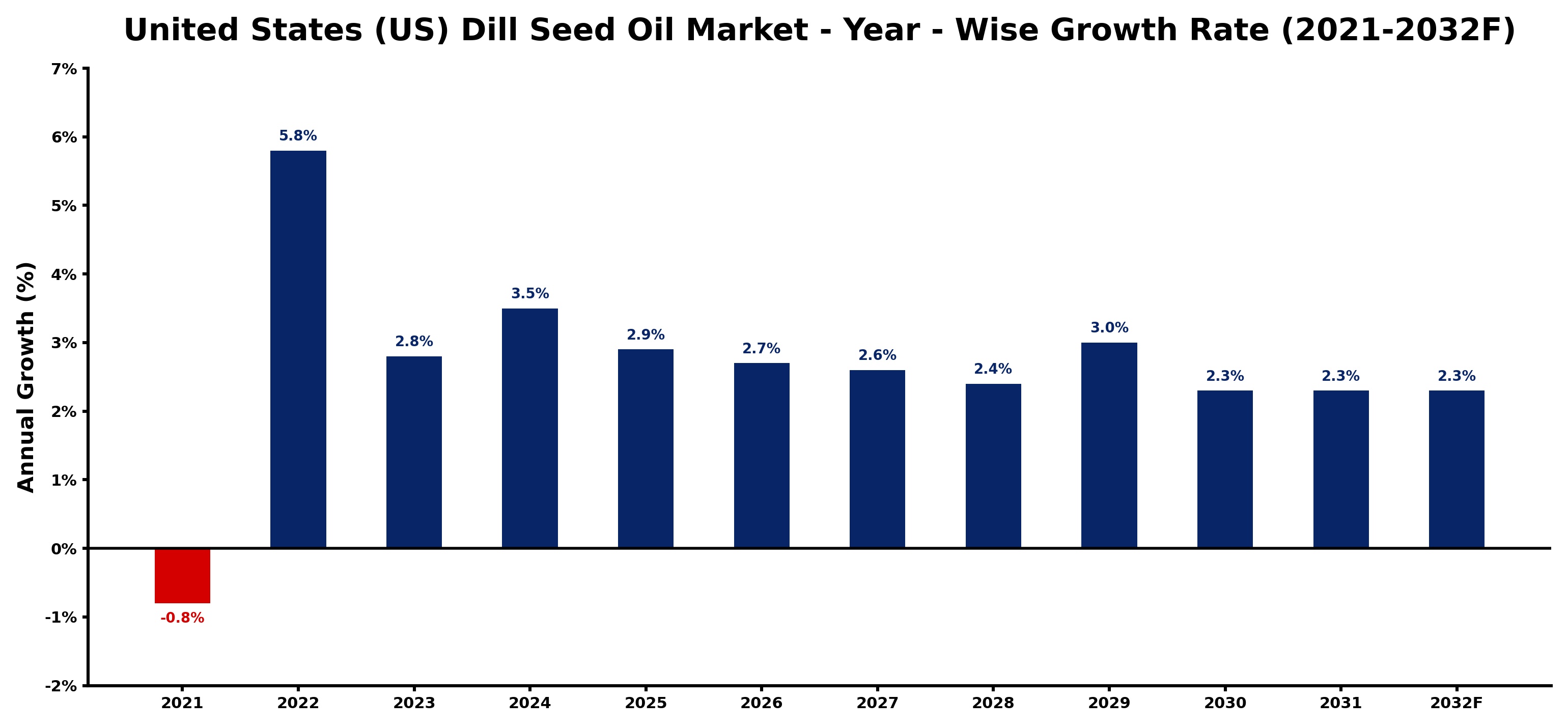
The table below presents the year‑wise growth rates along with the key drivers influencing the market
| Year | Growth Rate | Major Drivers |
| 2021 | -0.8% | Growing urbanization and commercial development |
| 2022 | 5.8% | Increasing smart city development projects |
| 2023 | 2.8% | Expansion of manufacturing activities |
| 2024 | 3.5% | Government infrastructure modernization initiatives |
| 2025 | 2.9% | Rising electricity demand across industries |
| 2026 | 2.7% | Increasing industrial automation investments |
| 2027 | 2.6% | Government infrastructure modernization initiatives |
| 2028 | 2.4% | Increasing industrial infrastructure investments |
| 2029 | 3.0% | Increasing smart city development projects |
| 2030 | 2.3% | Growing renewable energy integration projects |
| 2031 | 2.3% | Increasing adoption of advanced technologies |
| 2032 | 2.3% | Growing renewable energy integration projects |
Note - Market size estimations and growth projections presented in this report are based on 6Wresearch's advanced forecasting approach, validated with industry datasets as of June 2026.
United States (US) Dill Seed Oil Market Synopsis
The US Dill Seed Oil Market is currently experiencing a transformative phase, characterized by a significant shift towards health-conscious consumer behavior. As a result, dill seed oil is finding its way into an expanding array of products, underscoring its versatility and health benefits.
Growing awareness about its antimicrobial and anti-inflammatory properties is driving its adoption, particularly in the food, beverage, and personal care industries. This trend is complemented by a robust demand for clean-label products, thereby creating a conducive environment for market expansion.
United States (US) Dill Seed Oil Market Key Takeaways
- The market is driven by increasing consumer demand for natural and organic dill seed oil products.
- Health benefits associated with dill seed oil are elevating its usage in various sectors.
- Expansion into personal care products is a notable trend, highlighting its multifunctionality.
- Emerging applications in aromatherapy signify a broader scope for market growth.
- Investment opportunities are ripe for new entrants and established players alike.
Evaluation of Restraints in United States (US) Dill Seed Oil Market
The US Dill Seed Oil Market faces several constraints that can impact its potential. One of the primary challenges is the volatility in raw material prices, which is often influenced by unpredictable weather conditions affecting dill seed harvests. Additionally, consumer awareness about the health benefits of dill seed oil remains relatively low compared to more established essential oils, which can hinder broader market adoption. The presence of synthetic alternatives further complicates the landscape, as these products often compete on pricing, impacting the market for natural dill seed oil. Furthermore, regulatory compliance and quality assurance remain critical focal points that require manufacturers to navigate carefully to maintain market competitiveness.
United States (US) Dill Seed Oil Market Trends
Several key trends are shaping the US Dill Seed Oil Market today. The surging popularity of natural and organic products among consumers is resulting in a notable increase in demand for organic dill seed oil, particularly in the realms of food flavoring and essential oils. Another significant trend is the rising awareness of the health benefits associated with dill seed oil, notably its antimicrobial and digestive properties, leading to its greater inclusion in the healthcare and food industries.
Moreover, the beauty and personal care sectors are increasingly recognizing the anti-inflammatory and antioxidant benefits of dill seed oil, integrating it into skincare lines. These trends collectively point toward a robust trajectory for the market as it adapts to shifting consumer preferences.
United States (US) Dill Seed Oil Market Opportunities
The US Dill Seed Oil Market presents substantial investment opportunities, particularly as natural and organic products gain traction across multiple industries. With consumers increasingly seeking out the health benefits of dill seed oil, there's a rising opportunity for innovations in essential oil formulations, flavorings, and aromatherapy products. Investors can also explore potential ventures in extraction and production facilities. Strategic collaborations with established players, along with effective distribution networks, will be pivotal for capturing a significant share of the burgeoning market.
Government Initiatives in the United States (US) Dill Seed Oil Market
In the United States, government regulations significantly influence the Dill Seed Oil Market. The Food and Drug Administration (FDA) plays a crucial role in overseeing safety and labeling requirements for dill seed oil products intended for human consumption, ensuring adherence to established standards. Additionally, the United States Department of Agriculture (USDA) impacts agricultural practices related to the cultivation and production of dill seed oil to guarantee quality and compliance. Trade regulations established by the US Department of Commerce also shape the import and export dynamics of dill seed oil products, fostering fair trade practices and product safety across borders.
Future Insights of the United States (US) Dill Seed Oil Market
Looking ahead to the period between 2026 and 2032, the United States Dill Seed Oil Market is poised for steady growth, driven by the ongoing demand for natural and organic ingredients. As consumer awareness continues to grow concerning the benefits of dill seed oil, its application in food and beverage products, personal care items, and supplements is expected to expand significantly. Additionally, the increasing inclination towards clean-label products will further propel market growth. As the trend for aromatherapy and holistic health gains momentum, dill seed oil will likely find itself in a favorable position for enhanced market penetration.
United States (US) Dill Seed Oil Market Latest Developments (May 2025 - June 2026)
Recent developments in the US Dill Seed Oil Market indicate a notable increase in the number of companies focusing on sustainable extraction methods. Additionally, market players are innovating product formulations that highlight the health benefits of dill seed oil. There is also a growing trend among manufacturers to align with clean-label practices, thus appealing to the health-conscious consumer base. Collaboration initiatives for research and development in innovative applications are expected to intensify, enhancing the competitive landscape.
United States (US) Dill Seed Oil Market - Key Attractiveness of the Report
- 10 Years of Market Numbers
- Historical Data Starting from 2022 to 2025
- Base Year: 2025
- Forecast Data until 2032
- Key Performance Indicators Impacting the Market
- Major Upcoming Developments and Projects
Key Highlights of the Report:
- United States (US) Dill Seed Oil Market Outlook
- Market Size of United States (US) Dill Seed Oil Market, 2025
- Forecast of United States (US) Dill Seed Oil Market, 2032
- Historical Data and Forecast of United States (US) Dill Seed Oil Revenues & Volume for the Period 2022-2032F
- United States (US) Dill Seed Oil Market Trend Evolution
- United States (US) Dill Seed Oil Market Drivers and Challenges
- United States (US) Dill Seed Oil Price Trends
- United States (US) Dill Seed Oil Porter's Five Forces
- United States (US) Dill Seed Oil Industry Life Cycle
- Historical Data and Forecast of United States (US) Dill Seed Oil Market Revenues & Volume By Type for the Period 2022-2032F
- Historical Data and Forecast of United States (US) Dill Seed Oil Market Revenues & Volume By Anethum Graveolens Seed Oil for the Period 2022-2032F
- Historical Data and Forecast of United States (US) Dill Seed Oil Market Revenues & Volume By Anethum Sowa Seed Oil for the Period 2022-2032F
- Historical Data and Forecast of United States (US) Dill Seed Oil Market Revenues & Volume By Application for the Period 2022-2032F
- Historical Data and Forecast of United States (US) Dill Seed Oil Market Revenues & Volume By Flavor for the Period 2022-2032F
- Historical Data and Forecast of United States (US) Dill Seed Oil Market Revenues & Volume By Fragrance for the Period 2022-2032F
- Historical Data and Forecast of United States (US) Dill Seed Oil Market Revenues & Volume By Pharmaceutical for the Period 2022-2032F
- Historical Data and Forecast of United States (US) Dill Seed Oil Market Revenues & Volume By Skincare for the Period 2022-2032F
- Historical Data and Forecast of United States (US) Dill Seed Oil Market Revenues & Volume By Aromatherapy for the Period 2022-2032F
- United States (US) Dill Seed Oil Import Export Trade Statistics
- Market Opportunity Assessment By Type
- Market Opportunity Assessment By Application
- United States (US) Dill Seed Oil Top Companies Market Share
- United States (US) Dill Seed Oil Competitive Benchmarking By Technical and Operational Parameters
- United States (US) Dill Seed Oil Company Profiles
- United States (US) Dill Seed Oil Key Strategic Recommendations






































