United States (US) Electrical Steel Market Size, Share & Growth Rate
The United States (US) Electrical Steel Market was estimated at USD 121 Million in 2025 and is projected to reach USD 142 Million by 2032, growing at a CAGR of 2.3% from 2026 to 2032. This growth trajectory is propelled by the increasing demand for energy-efficient electrical equipment, driven by advancements in technology and a robust shift towards renewable energy sources. In particular, the automotive sectors transition to electric vehicles is significantly influencing demand, as is the heightened focus on sustainable practices across various industries.
United States (US) Electrical Steel Market Year-wise Growth Rate and Key Drivers
This graph highlights how the United States (US) Electrical Steel Market has steadily grown over the years, supported by major growth factors.
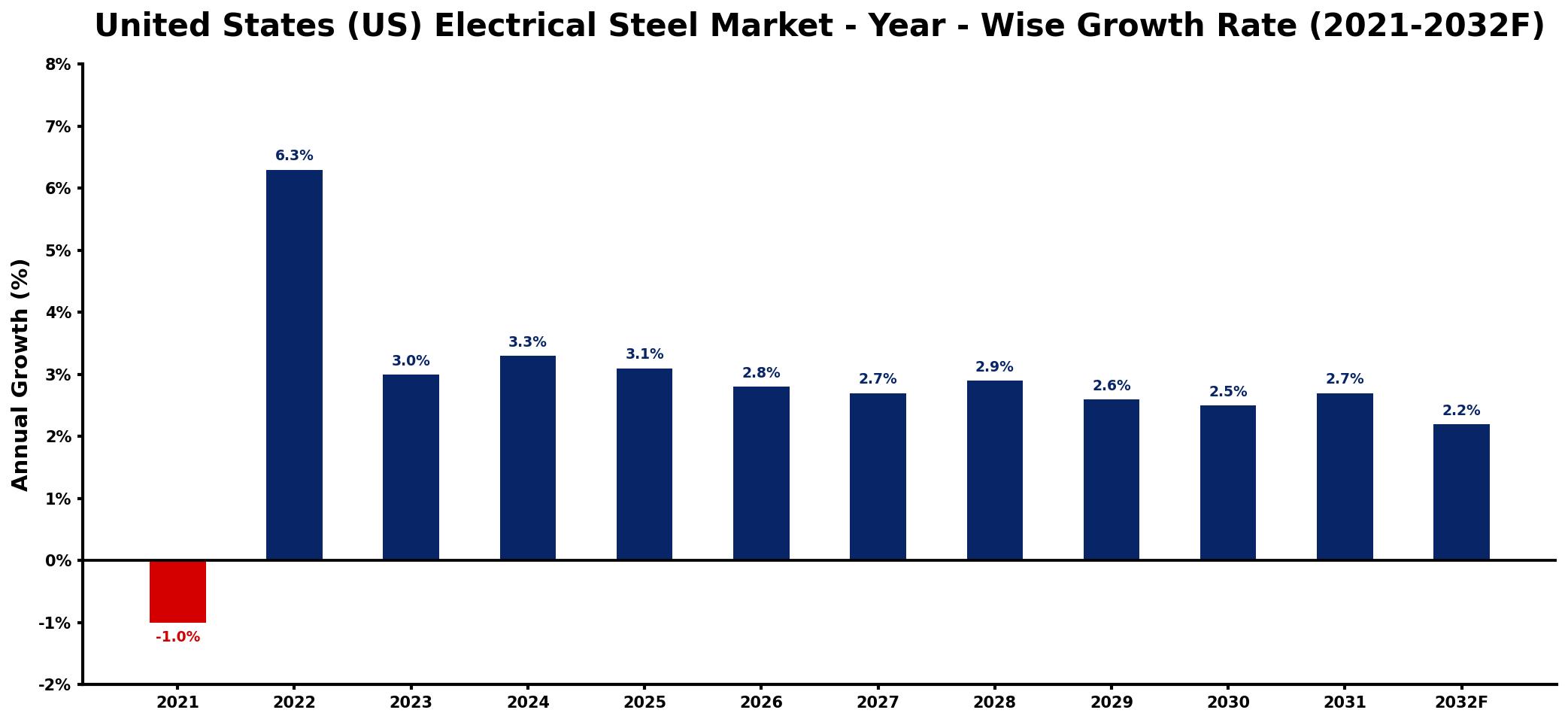
The table below presents the year‑wise growth rates along with the key drivers influencing the market
| Year | Growth Rate | Major Drivers |
| 2021 | -1.0% | decreased industrial manufacturing activity |
| 2022 | 6.3% | increased renewable energy investments |
| 2023 | 3.0% | growing automotive sector demand |
| 2024 | 3.3% | expansion in electric vehicle production |
| 2025 | 3.1% | rising demand for energy efficiency |
| 2026 | 2.8% | growth in wind power installations |
| 2027 | 2.7% | increased construction sector projects |
| 2028 | 2.9% | surge in data center investments |
| 2029 | 2.6% | expansion of telecommunications infrastructure |
| 2030 | 2.5% | rising end-use demand growth |
| 2031 | 2.7% | increased automation in manufacturing |
| 2032 | 2.2% | rising focus on sustainability initiatives |
Note: Market size estimations and growth projections presented in this report are based on 6Wresearch's proprietary forecasting methodology, utilizing the latest available industry data, government publications, and primary research inputs.
United States (US) Electrical Steel Market Synopsis
In the United States, electrical steel plays a crucial role in the manufacturing of transformers, electric motors, and generators. The market is witnessing a surge in demand as infrastructure investments ramp up and the automotive industry leans more heavily on electrical steel for electric and hybrid vehicle production.
Technological innovations are also transforming the landscape, as manufacturers strive to produce high-efficiency electrical steel products that meet stringent energy efficiency regulations. This emphasis on sustainability and performance is driving companies to invest in new product development and manufacturing processes.
United States (US) Electrical Steel Market Key Takeaways
- The market is bolstered by the growing demand from the renewable energy sector.
- Investments in electric vehicle manufacturing are increasing the need for electrical steel.
- Technological advancements are enhancing product efficiency and reducing losses.
- Government policies favor domestic production and the protection of local manufacturers.
- Pressure to innovate and adhere to environmental regulations is shaping market dynamics.
Evaluation of Restraints in United States (US) Electrical Steel Market
Despite the positive outlook, the US Electrical Steel Market faces several restraints that can impede growth. Fluctuating raw material prices remain a significant challenge, creating uncertainty for manufacturers. Furthermore, imported electrical steel is increasingly penetrating the market, leading to heightened competition. Companies must also navigate trade tensions that can disrupt the global supply chain. Additionally, maintaining compliance with strict environmental regulations requires continuous investment and innovation, putting pressure on operational efficiency.
United States (US) Electrical Steel Market Trends
A noticeable trend is the rising demand for electrical steel in the automotive sector, particularly regarding electric and hybrid vehicles. Manufacturers are prioritizing high-performance electrical steels to enhance the efficiency of motors and transformers. The ongoing transition to cleaner energy sources and the expansion of renewable energy projects are significantly impacting market dynamics, with a clear trend towards sustainability and energy efficiency becoming dominant themes in product development.
United States (US) Electrical Steel Market Opportunities
Investment opportunities within the US Electrical Steel Market are abundant, particularly as industries increasingly adopt innovative electrical steel products. The escalating focus on energy efficiency and the requirement for advanced electrical equipment drive the demand for high-quality electrical steel. Investment in companies that specialize in the manufacturing of electrical steel or that utilize it in their operations offers a promising avenue for growth, particularly in light of ongoing technological advancements.
Government Initiatives in the United States (US) Electrical Steel Market
Government policies significantly impact the US Electrical Steel Market, primarily through trade regulations and tariffs aimed at protecting domestic manufacturers. These initiatives include measures to promote the use of locally sourced electrical steel in infrastructure projects and to enhance domestic production capabilities. Furthermore, policies encouraging energy efficiency and sustainability are prompting a shift towards more eco-friendly materials in various applications, contributing to the markets evolution.
Future Insights of the United States (US) Electrical Steel Market
Looking ahead to 2026-2032, the US Electrical Steel Market is set for steady growth, fueled by an increased demand for energy-efficient equipment across various sectors. The automotive industry's adoption of electric vehicles and the greater emphasis on sustainable energy solutions will drive demand for electrical steel products. Additionally, ongoing innovations in manufacturing processes promise to enhance the quality and efficiency of electrical steel, positioning the market favorably for future expansion.
United States (US) Electrical Steel Market Latest Developments (2025 - 2026)
Recent developments in the US Electrical Steel Market indicate a strong focus on innovation and sustainability. Companies are increasingly investing in advanced manufacturing technologies to improve product performance and reduce energy losses. Furthermore, there has been a notable rise in collaborative efforts between manufacturers and technology providers to develop high-efficiency electrical steels that align with new energy standards and regulations.
United States (US) Electrical Steel Market - Key Attractiveness of the Report
- 10 Years of Market Numbers
- Historical Data Starting from 2022 to 2025
- Base Year: 2025
- Forecast Data until 2032
- Key Performance Indicators Impacting the Market
- Major Upcoming Developments and Projects
Key Highlights of the Report:
- United States (US) Electrical Steel Market Outlook
- Market Size of United States (US) Electrical Steel Market, 2025
- Forecast of United States (US) Electrical Steel Market, 2032
- Historical Data and Forecast of United States (US) Electrical Steel Revenues & Volume for the Period 2022-2032F
- United States (US) Electrical Steel Market Trend Evolution
- United States (US) Electrical Steel Market Drivers and Challenges
- United States (US) Electrical Steel Price Trends
- United States (US) Electrical Steel Porter's Five Forces
- United States (US) Electrical Steel Industry Life Cycle
- Historical Data and Forecast of United States (US) Electrical Steel Market Revenues & Volume By Type for the Period 2022-2032F
- Historical Data and Forecast of United States (US) Electrical Steel Market Revenues & Volume By Grain-oriented for the Period 2022-2032F
- Historical Data and Forecast of United States (US) Electrical Steel Market Revenues & Volume By Non-grain-oriented for the Period 2022-2032F
- Historical Data and Forecast of United States (US) Electrical Steel Market Revenues & Volume By End Use for the Period 2022-2032F
- Historical Data and Forecast of United States (US) Electrical Steel Market Revenues & Volume By Energy for the Period 2022-2032F
- Historical Data and Forecast of United States (US) Electrical Steel Market Revenues & Volume By Automotive for the Period 2022-2032F
- Historical Data and Forecast of United States (US) Electrical Steel Market Revenues & Volume By Household Appliances for the Period 2022-2032F
- Historical Data and Forecast of United States (US) Electrical Steel Market Revenues & Volume By Manufacturing for the Period 2022-2032F
- Historical Data and Forecast of United States (US) Electrical Steel Market Revenues & Volume By Others for the Period 2022-2032F
- Historical Data and Forecast of United States (US) Electrical Steel Market Revenues & Volume By Application for the Period 2022-2032F
- Historical Data and Forecast of United States (US) Electrical Steel Market Revenues & Volume By Transformers for the Period 2022-2032F
- Historical Data and Forecast of United States (US) Electrical Steel Market Revenues & Volume By Motors for the Period 2022-2032F
- Historical Data and Forecast of United States (US) Electrical Steel Market Revenues & Volume By Inductors for the Period 2022-2032F
- Historical Data and Forecast of United States (US) Electrical Steel Market Revenues & Volume By Others for the Period 2022-2032F
- United States (US) Electrical Steel Import Export Trade Statistics
- Market Opportunity Assessment By Type
- Market Opportunity Assessment By End Use
- Market Opportunity Assessment By Application
- United States (US) Electrical Steel Top Companies Market Share
- United States (US) Electrical Steel Competitive Benchmarking By Technical and Operational Parameters
- United States (US) Electrical Steel Company Profiles
- United States (US) Electrical Steel Key Strategic Recommendations






































