United States (US) Ev High Power Charger Market Top 5 Importing Countries and Market Competition (HHI) Analysis
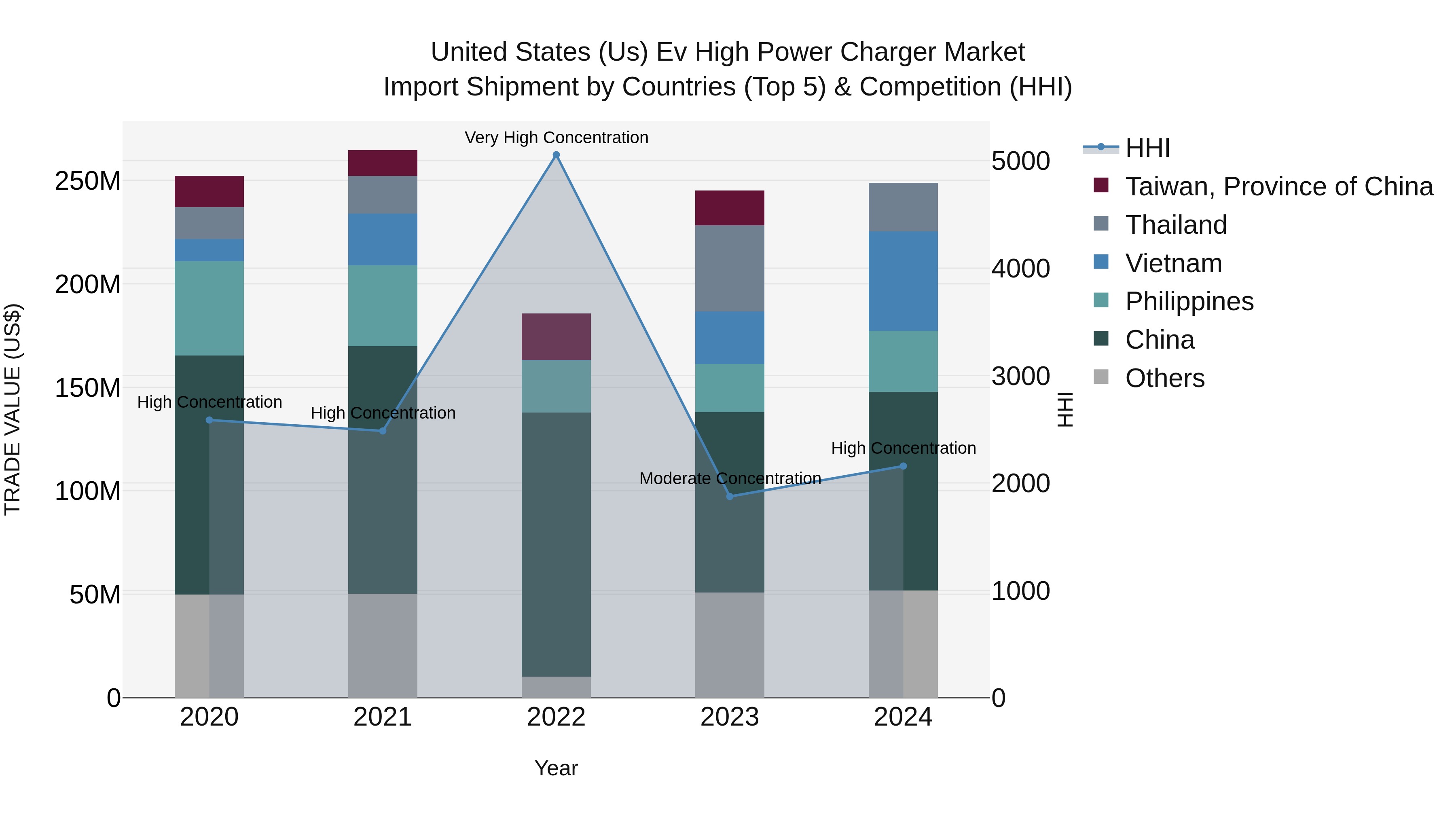
The United States saw an increase in high power EV charger imports in 2024, with China, Vietnam, Philippines, Thailand, and Malaysia emerging as the top exporting countries. The market experienced a shift from moderate to high concentration, indicating a more competitive landscape. Despite a slight decline in the CAGR from 2020 to 2024, there was a positive growth rate from 2023 to 2024, suggesting a potential rebound in the industry. This data highlights the importance of these key exporting countries in meeting the growing demand for EV chargers in the US market.
Key Highlights of the Report:
- United States (US) EV High Power Charger Market Outlook
- Market Size of United States (US) EV High Power Charger Market, 2025
- Forecast of United States (US) EV High Power Charger Market, 2032
- Historical Data and Forecast of United States (US) EV High Power Charger Revenues & Volume for the Period 2022 - 2032
- United States (US) EV High Power Charger Market Trend Evolution
- United States (US) EV High Power Charger Market Drivers and Challenges
- United States (US) EV High Power Charger Price Trends
- United States (US) EV High Power Charger Porter's Five Forces
- United States (US) EV High Power Charger Industry Life Cycle
- Historical Data and Forecast of United States (US) EV High Power Charger Market Revenues & Volume By Power Output Type for the Period 2022 - 2032
- Historical Data and Forecast of United States (US) EV High Power Charger Market Revenues & Volume By 50 KW - 150 KW for the Period 2022 - 2032
- Historical Data and Forecast of United States (US) EV High Power Charger Market Revenues & Volume By 150 KW - 350 KW for the Period 2022 - 2032
- Historical Data and Forecast of United States (US) EV High Power Charger Market Revenues & Volume By Above 350 KW for the Period 2022 - 2032
- Historical Data and Forecast of United States (US) EV High Power Charger Market Revenues & Volume By Vehicle Type for the Period 2022 - 2032
- Historical Data and Forecast of United States (US) EV High Power Charger Market Revenues & Volume By Plug-In Hybrid Electric Vehicle (PHEV) for the Period 2022 - 2032
- Historical Data and Forecast of United States (US) EV High Power Charger Market Revenues & Volume By Battery Electric Vehicle (BEV) for the Period 2022 - 2032
- United States (US) EV High Power Charger Import Export Trade Statistics
- Market Opportunity Assessment By Power Output Type
- Market Opportunity Assessment By Vehicle Type
- United States (US) EV High Power Charger Top Companies Market Share
- United States (US) EV High Power Charger Competitive Benchmarking By Technical and Operational Parameters
- United States (US) EV High Power Charger Company Profiles
- United States (US) EV High Power Charger Key Strategic Recommendations






































