United States (US) Glycerol Market Top 5 Importing Countries and Market Competition (HHI) Analysis
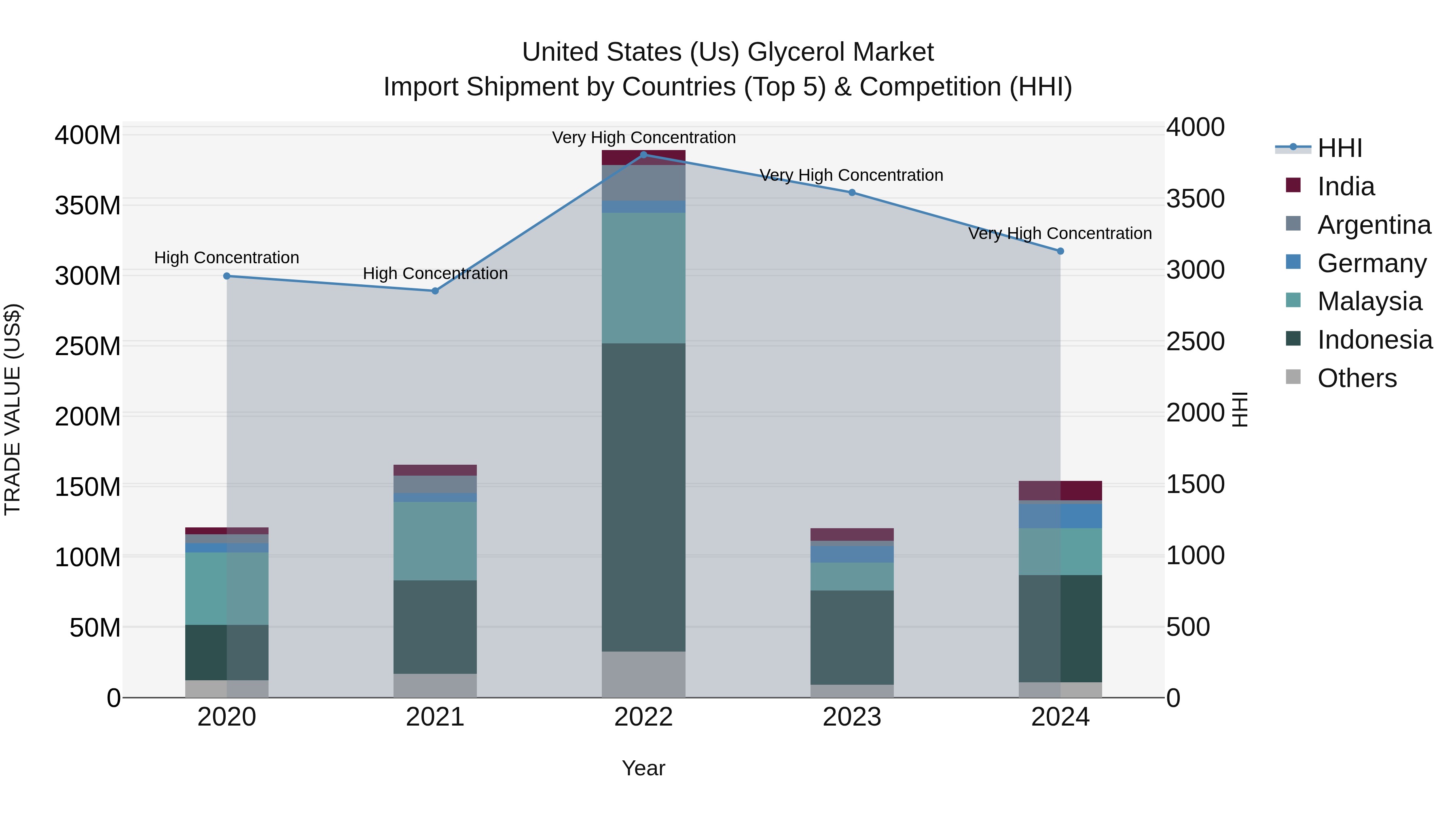
The United States continues to be a key destination for glycerol imports, with top suppliers including Indonesia, Malaysia, Germany, India, and Argentina in 2024. The market remains highly concentrated, as indicated by the high Herfindahl-Hirschman Index (HHI). The compound annual growth rate (CAGR) from 2020 to 2024 stands at a healthy 6.2%, with a notable growth spurt of 27.93% in 2024 alone. These statistics suggest a strong and growing demand for glycerol in the US, with potential opportunities for both domestic and international suppliers to capitalize on this trend.
USA Export Potential Assessment For Glycerol Market (Values in USD Thousand)
United States (US) Glycerol Market Overview
The United States glycerol market is experiencing steady growth driven by the increasing demand for glycerol in various industries such as pharmaceuticals, food and beverage, personal care, and healthcare. Glycerol, also known as glycerin, is widely used as a sweetener, thickening agent, and moisturizer in these industries. The market is also benefiting from the rising awareness about the benefits of glycerol in skincare products and as a non-toxic alternative in pharmaceutical formulations. Additionally, the market is witnessing innovations in glycerol production processes, with a focus on sustainable and eco-friendly methods to meet the growing consumer demand for environmentally friendly products. Overall, the US glycerol market is poised for further expansion in the coming years, driven by increasing applications and technological advancements.
United States (US) Glycerol Market Trends
In the US Glycerol market, there is a growing trend towards the use of bio-based glycerol derived from renewable sources such as vegetable oils and animal fats. This shift is driven by increasing environmental concerns and regulations promoting sustainable practices. Additionally, the demand for glycerol in the pharmaceutical, food and beverage, and personal care industries is on the rise due to its versatile properties as a moisturizer, sweetener, and solvent. Manufacturers are also focusing on developing innovative applications for glycerol, such as in biofuels and bioplastics, to expand its market reach. The market is expected to continue growing as companies invest in research and development to enhance the quality and sustainability of glycerol products.
United States (US) Glycerol Market Challenges
In the US Glycerol Market, one of the main challenges faced is the fluctuation in raw material prices, particularly from the biodiesel industry, which is a significant source of glycerol production. This volatility can impact the overall profitability and competitiveness of glycerol manufacturers. Another challenge is the increasing competition from alternative sources of glycerol, such as synthetic or bio-based alternatives, which can create pricing pressures in the market. Additionally, regulatory uncertainties and changing government policies around biofuels and renewable chemicals can also pose challenges for companies operating in the glycerol market. Adapting to these market dynamics, ensuring a stable supply chain, and innovating to differentiate products are key strategies for companies to navigate these challenges in the US glycerol market.
United States (US) Glycerol Market Investment Opportunities
Investment opportunities in the US Glycerol Market are promising due to the increasing demand for glycerol across various industries such as pharmaceuticals, personal care, food and beverage, and more. With glycerol`s versatile applications as a humectant, solvent, sweetener, and in the production of biofuels, the market is expected to witness steady growth. Investors can consider opportunities in glycerol production facilities, research and development of innovative glycerol-based products, or investing in companies involved in the distribution and marketing of glycerol. Additionally, with the growing trend towards sustainability and eco-friendly products, investing in bio-based glycerol production could be a lucrative option. Overall, the US Glycerol Market presents a range of investment avenues for those looking to capitalize on the increasing demand and diverse applications of glycerol.
United States (US) Glycerol Market Government Policy
In the United States, the Glycerol Market is influenced by various government policies aimed at promoting sustainability and reducing environmental impact. The Environmental Protection Agency (EPA) regulates the production and use of glycerol as a byproduct of biodiesel production, setting standards to ensure safe handling and disposal. Additionally, the Department of Agriculture (USDA) supports research and development efforts to find new applications for glycerol, particularly in the biofuels and pharmaceutical industries. The US government also provides incentives such as tax credits and grants to encourage the production and use of renewable glycerol, further driving market growth. Overall, government policies in the US Glycerol Market focus on fostering innovation, sustainability, and economic growth within the industry.
United States (US) Glycerol Market Future Outlook
The United States glycerol market is expected to witness steady growth in the coming years due to increasing demand across various industries such as pharmaceuticals, personal care, food and beverage, and automotive among others. The rising awareness about the benefits of glycerol as a sustainable and environmentally friendly ingredient is driving its usage in various applications. Additionally, the growing trend towards natural and organic products is further fueling the demand for glycerol as a key ingredient in many formulations. Technological advancements and innovations in glycerol production processes are also anticipated to contribute to market growth. However, factors such as fluctuating raw material prices and regulatory constraints may pose challenges to market expansion. Overall, the US glycerol market is projected to show a positive trajectory in the foreseeable future.
Key Highlights of the Report:
- United States (US) Glycerol Market Outlook
- Market Size of United States (US) Glycerol Market, 2021
- Forecast of United States (US) Glycerol Market, 2031
- Historical Data and Forecast of United States (US) Glycerol Revenues & Volume for the Period 2018 - 2031
- United States (US) Glycerol Market Trend Evolution
- United States (US) Glycerol Market Drivers and Challenges
- United States (US) Glycerol Price Trends
- United States (US) Glycerol Porter's Five Forces
- United States (US) Glycerol Industry Life Cycle
- Historical Data and Forecast of United States (US) Glycerol Market Revenues & Volume By Source for the Period 2018 - 2031
- Historical Data and Forecast of United States (US) Glycerol Market Revenues & Volume By Biodiesel for the Period 2018 - 2031
- Historical Data and Forecast of United States (US) Glycerol Market Revenues & Volume By Fatty Alcohols for the Period 2018 - 2031
- Historical Data and Forecast of United States (US) Glycerol Market Revenues & Volume By Fatty Acids for the Period 2018 - 2031
- Historical Data and Forecast of United States (US) Glycerol Market Revenues & Volume By Soap for the Period 2018 - 2031
- Historical Data and Forecast of United States (US) Glycerol Market Revenues & Volume By Type for the Period 2018 - 2031
- Historical Data and Forecast of United States (US) Glycerol Market Revenues & Volume By Crude for the Period 2018 - 2031
- Historical Data and Forecast of United States (US) Glycerol Market Revenues & Volume By Refined for the Period 2018 - 2031
- Historical Data and Forecast of United States (US) Glycerol Market Revenues & Volume By End-use for the Period 2018 - 2031
- Historical Data and Forecast of United States (US) Glycerol Market Revenues & Volume By Food & Beverage for the Period 2018 - 2031
- Historical Data and Forecast of United States (US) Glycerol Market Revenues & Volume By Pharmaceutical for the Period 2018 - 2031
- Historical Data and Forecast of United States (US) Glycerol Market Revenues & Volume By Nutraceutical for the Period 2018 - 2031
- Historical Data and Forecast of United States (US) Glycerol Market Revenues & Volume By Personal Care & Cosmetics for the Period 2018 - 2031
- Historical Data and Forecast of United States (US) Glycerol Market Revenues & Volume By Industrial for the Period 2018 - 2031
- Historical Data and Forecast of United States (US) Glycerol Market Revenues & Volume By Others for the Period 2018 - 2031
- United States (US) Glycerol Import Export Trade Statistics
- Market Opportunity Assessment By Source
- Market Opportunity Assessment By Type
- Market Opportunity Assessment By End-use
- United States (US) Glycerol Top Companies Market Share
- United States (US) Glycerol Competitive Benchmarking By Technical and Operational Parameters
- United States (US) Glycerol Company Profiles
- United States (US) Glycerol Key Strategic Recommendations






































