United States (US) Golf Ball Market Top 5 Importing Countries and Market Competition (HHI) Analysis
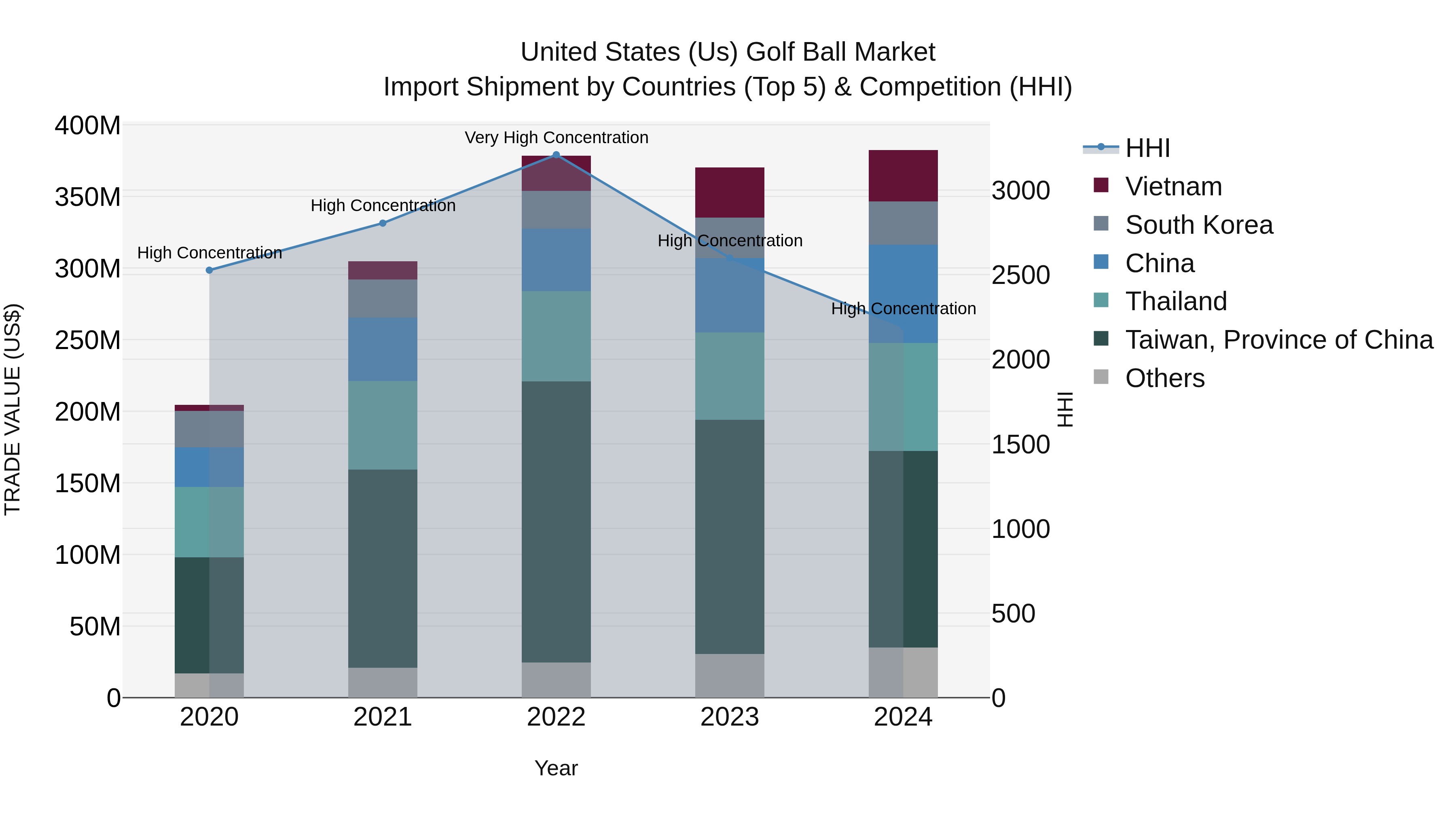
The United States continued to see significant growth in golf ball import shipments in 2024, with top exporting countries being Taiwan, Thailand, China, Vietnam, and South Korea. The high Herfindahl-Hirschman Index (HHI) indicates a concentrated market. The compound annual growth rate (CAGR) from 2020 to 2024 was an impressive 16.96%, with a continued growth rate of 3.26% from 2023 to 2024. This data suggests a strong and steady demand for golf balls in the US market, driven by imports from key Asian suppliers.
USA Export Potential Assessment For Golf Ball Market (Values in USD Thousand)
United States (US) Golf Ball Market Overview
The United States golf ball market is a mature and competitive industry characterized by a strong consumer demand driven by the popularity of golf as a recreational sport. Major players in the market include well-established brands such as Titleist, Callaway, and Bridgestone, among others. The market is segmented based on factors like price range, performance features, and target consumer demographics. Technological advancements in golf ball design, such as multi-layer construction and aerodynamic dimple patterns, continue to drive product innovation and differentiation among competitors. Distribution channels for golf balls in the US market include specialty golf stores, sporting goods retailers, online platforms, and golf course pro shops. Promotions, sponsorships, and endorsements by professional golfers also play a significant role in influencing consumer purchasing decisions in this market.
United States (US) Golf Ball Market Trends
Currently, in the US Golf Ball Market, there is a growing trend towards environmentally friendly and sustainable golf balls. Consumers are increasingly looking for options that reduce the environmental impact of their game, leading to a rise in demand for biodegradable and recyclable golf balls. Another notable trend is the emphasis on customization and personalization, with many players opting for personalized golf balls to stand out on the course. Additionally, there is a shift towards high-performance golf balls that offer advanced technology for improved distance, control, and feel. Major players in the market are focusing on innovation to meet these evolving consumer preferences and to stay competitive in the industry.
United States (US) Golf Ball Market Challenges
The US Golf Ball Market faces several challenges, including intense competition among established brands and emerging players, fluctuating consumer preferences, and the impact of external factors such as economic conditions and weather patterns on consumer spending. Additionally, advancements in golf ball technology and materials require constant innovation to stay competitive, leading to increased research and development costs. Distribution channels also present challenges, with the need to balance traditional brick-and-mortar retail outlets with the growing trend of online sales. Furthermore, sustainability and environmental concerns are becoming increasingly important in the market, with consumers demanding eco-friendly and biodegradable options. Overall, navigating these challenges requires market players to stay agile, innovative, and customer-focused to succeed in the competitive US Golf Ball Market.
United States (US) Golf Ball Market Investment Opportunities
The United States Golf Ball Market presents several investment opportunities due to the growing popularity of golf as a recreational sport. Key areas for investment include technological advancements in golf ball design to enhance performance and durability, environmentally sustainable materials in production to cater to eco-conscious consumers, and customization options to meet individual player preferences. Additionally, investing in marketing strategies to target new demographics, such as youth and women, can further expand market reach. With the increasing number of golf courses and players in the US, there is a demand for innovative and high-quality golf balls, making it a promising sector for investors looking to capitalize on the thriving golf industry.
United States (US) Golf Ball Market Government Policy
Government policies related to the US Golf Ball Market primarily focus on regulations related to environmental impact and consumer safety. The US government enforces regulations on the manufacturing processes of golf balls to ensure they meet quality standards and do not pose health risks to consumers. Additionally, there are regulations in place to monitor the disposal of waste generated from the production of golf balls to minimize environmental harm. The government also plays a role in trade policies that may impact the import and export of golf balls, affecting market dynamics. Overall, government policies in the US Golf Ball Market aim to promote fair competition, protect consumer interests, and maintain environmental sustainability within the industry.
United States (US) Golf Ball Market Future Outlook
The future outlook for the United States Golf Ball Market appears positive, with projected growth driven by factors such as increasing participation in golf, technological advancements in golf ball design, and a growing trend towards customization and personalization. The market is expected to witness a rise in demand for high-performance golf balls that offer improved distance, accuracy, and feel to cater to the needs of diverse player segments. Additionally, the shift towards eco-friendly and sustainable golf ball options is likely to gain traction among environmentally conscious consumers. As key players continue to innovate and introduce new product offerings, the US Golf Ball Market is poised for continued expansion and innovation, presenting opportunities for market growth and development in the coming years.
Key Highlights of the Report:
- United States (US) Golf Ball Market Outlook
- Market Size of United States (US) Golf Ball Market, 2021
- Forecast of United States (US) Golf Ball Market, 2031
- Historical Data and Forecast of United States (US) Golf Ball Revenues & Volume for the Period 2018 - 2031
- United States (US) Golf Ball Market Trend Evolution
- United States (US) Golf Ball Market Drivers and Challenges
- United States (US) Golf Ball Price Trends
- United States (US) Golf Ball Porter's Five Forces
- United States (US) Golf Ball Industry Life Cycle
- Historical Data and Forecast of United States (US) Golf Ball Market Revenues & Volume By Product for the Period 2018 - 2031
- Historical Data and Forecast of United States (US) Golf Ball Market Revenues & Volume By 2-piece for the Period 2018 - 2031
- Historical Data and Forecast of United States (US) Golf Ball Market Revenues & Volume By 3-piece for the Period 2018 - 2031
- Historical Data and Forecast of United States (US) Golf Ball Market Revenues & Volume By 4-piece for the Period 2018 - 2031
- Historical Data and Forecast of United States (US) Golf Ball Market Revenues & Volume By Application for the Period 2018 - 2031
- Historical Data and Forecast of United States (US) Golf Ball Market Revenues & Volume By Leisure for the Period 2018 - 2031
- Historical Data and Forecast of United States (US) Golf Ball Market Revenues & Volume By Professional for the Period 2018 - 2031
- United States (US) Golf Ball Import Export Trade Statistics
- Market Opportunity Assessment By Product
- Market Opportunity Assessment By Application
- United States (US) Golf Ball Top Companies Market Share
- United States (US) Golf Ball Competitive Benchmarking By Technical and Operational Parameters
- United States (US) Golf Ball Company Profiles
- United States (US) Golf Ball Key Strategic Recommendations






































