United States (US) Greaseproof Paper Market Top 5 Importing Countries and Market Competition (HHI) Analysis
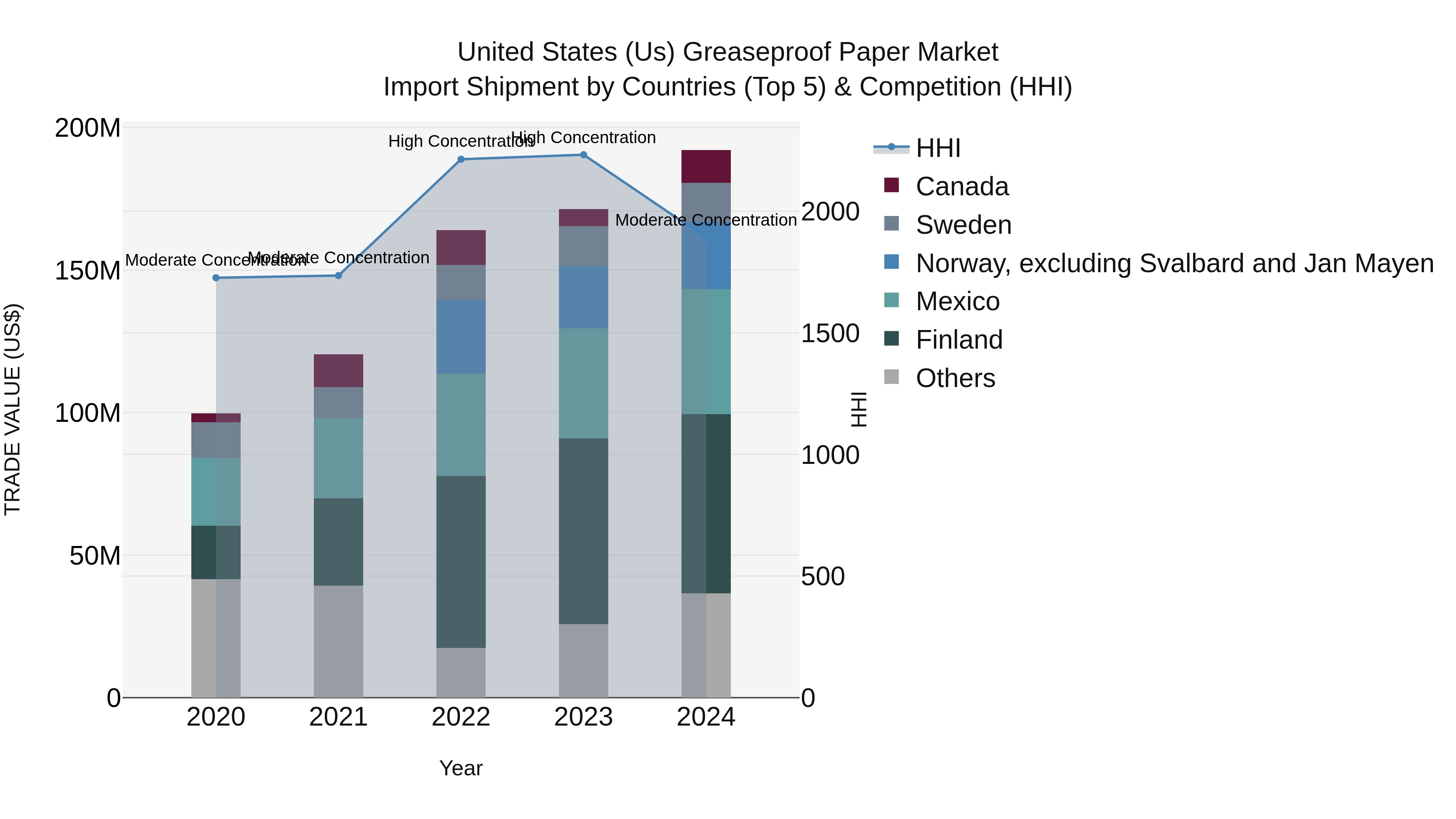
The United States saw a significant increase in greaseproof paper import shipments in 2024, with top exporting countries including Finland, Mexico, Norway, Sweden, and Canada. The market showed a transition from high to moderate concentration, indicating a more diversified import landscape. With a strong compound annual growth rate (CAGR) of 17.8% from 2020 to 2024 and a notable growth rate of 12.06% in 2024, the greaseproof paper import sector in the US is demonstrating robust expansion and potential for continued growth in the coming years.
USA Export Potential Assessment For Greaseproof Paper Market (Values in USD Thousand)
United States (US) Greaseproof Paper Market Synopsis
The United States Greaseproof Paper Market is witnessing steady growth, driven by the increasing demand for eco-friendly and sustainable packaging solutions across various industries such as foodservice, bakery, and confectionery. Greaseproof paper offers excellent resistance to oil and grease, making it ideal for packaging oily or greasy food products while maintaining their quality and freshness. The market is also benefiting from the growing trend of online food delivery services and takeaway options, where greaseproof paper is commonly used for packaging convenience foods. Key players in the US greaseproof paper market are focusing on product innovation, such as offering customizable and biodegradable options, to cater to changing consumer preferences and stringent environmental regulations. Overall, the market is projected to continue its growth trajectory as businesses prioritize sustainable packaging solutions.
United States (US) Greaseproof Paper Market Trends
The US Greaseproof Paper Market is experiencing growth driven by increasing demand from the food and beverage industry. Consumers are increasingly opting for convenient and sustainable packaging solutions, leading to a rise in the use of greaseproof paper for wrapping fast food, baked goods, and other oily products. The market is also benefiting from the growing preference for eco-friendly and recyclable materials, as greaseproof paper is biodegradable and can help reduce plastic waste. Manufacturers are focusing on innovation to develop greaseproof paper with enhanced properties such as improved grease resistance and heat retention. Additionally, the rise of online food delivery services and takeaway orders is further boosting the demand for greaseproof paper packaging solutions in the US market.
United States (US) Greaseproof Paper Market Challenges
In the US Greaseproof Paper Market, several challenges are faced by manufacturers and suppliers. One significant challenge is the increasing demand for sustainable and eco-friendly packaging solutions. As consumers become more environmentally conscious, there is a growing need for greaseproof paper products that are biodegradable and recyclable. Manufacturers in the US must invest in research and development to create innovative, sustainable greaseproof paper options to meet this demand while maintaining the necessary grease resistance properties. Additionally, fluctuations in raw material prices, competition from alternative packaging materials, and stringent regulations on food contact materials also pose challenges to the growth of the US greaseproof paper market. To stay competitive, companies need to adapt to these market dynamics and focus on developing sustainable solutions to meet evolving consumer preferences.
United States (US) Greaseproof Paper Market Investment Opportunities
The US Greaseproof Paper Market presents several investment opportunities for potential investors. With the growing trend towards sustainable and eco-friendly packaging solutions, there is a rising demand for greaseproof paper as an alternative to traditional packaging materials. This market offers opportunities for manufacturers to innovate and develop new products that cater to changing consumer preferences. Additionally, the foodservice industry, including restaurants and fast-food chains, is a key consumer of greaseproof paper, providing a stable demand for the product. Investing in research and development to improve the quality and functionality of greaseproof paper, as well as expanding production capacity to meet the increasing demand, could be lucrative strategies for investors looking to capitalize on the growth of the US Greaseproof Paper Market.
Jordan Agar Market Government Policies
The United States government has various policies related to the Greaseproof Paper Market, including regulations on food packaging materials to ensure consumer safety and environmental protection. The Food and Drug Administration (FDA) oversees the safety of food contact substances, which includes greaseproof paper, to prevent harmful chemicals from leaching into food products. Additionally, the Environmental Protection Agency (EPA) enforces regulations on waste management and pollution control to minimize the environmental impact of paper production and disposal. The US government also supports initiatives to promote sustainable practices in the paper industry, such as recycling and use of eco-friendly materials, through tax incentives and grants. Overall, these policies aim to balance consumer protection, environmental sustainability, and industry growth in the Greaseproof Paper Market.
United States (US) Greaseproof Paper Market Future Outlook
The United States Greaseproof Paper Market is expected to witness steady growth in the coming years, driven by the increasing demand for eco-friendly and sustainable packaging solutions across various industries such as food and beverage, bakery, and quick-service restaurants. The growing awareness among consumers regarding the environmental benefits of using greaseproof paper, along with stringent regulations promoting sustainable practices, will further fuel market growth. Additionally, the rise in online food delivery services and the shift towards takeaway and on-the-go food consumption are likely to boost the demand for greaseproof paper packaging. Manufacturers are focusing on product innovations, such as enhanced barrier properties and customization options, to cater to evolving consumer preferences. Overall, the US Greaseproof Paper Market is poised for expansion, supported by the ongoing trend towards sustainable packaging solutions.
Key Highlights of the Report:
- United States (US) Greaseproof Paper Market Outlook
- Market Size of United States (US) Greaseproof Paper Market, 2021
- Forecast of United States (US) Greaseproof Paper Market, 2031
- Historical Data and Forecast of United States (US) Greaseproof Paper Revenues & Volume for the Period 2018 - 2031
- United States (US) Greaseproof Paper Market Trend Evolution
- United States (US) Greaseproof Paper Market Drivers and Challenges
- United States (US) Greaseproof Paper Price Trends
- United States (US) Greaseproof Paper Porter's Five Forces
- United States (US) Greaseproof Paper Industry Life Cycle
- Historical Data and Forecast of United States (US) Greaseproof Paper Market Revenues & Volume By End-use for the Period 2018 - 2031
- Historical Data and Forecast of United States (US) Greaseproof Paper Market Revenues & Volume By Release Papers For Technical Lamination for the Period 2018 - 2031
- Historical Data and Forecast of United States (US) Greaseproof Paper Market Revenues & Volume By Graphic Papers for the Period 2018 - 2031
- Historical Data and Forecast of United States (US) Greaseproof Paper Market Revenues & Volume By Baking Paper for the Period 2018 - 2031
- Historical Data and Forecast of United States (US) Greaseproof Paper Market Revenues & Volume By Pet-food Bags for the Period 2018 - 2031
- Historical Data and Forecast of United States (US) Greaseproof Paper Market Revenues & Volume By Pan Liners for the Period 2018 - 2031
- Historical Data and Forecast of United States (US) Greaseproof Paper Market Revenues & Volume By Papers For Textile Cores for the Period 2018 - 2031
- Historical Data and Forecast of United States (US) Greaseproof Paper Market Revenues & Volume By Pulp Composition for the Period 2018 - 2031
- Historical Data and Forecast of United States (US) Greaseproof Paper Market Revenues & Volume By 100 % Sulphite for the Period 2018 - 2031
- Historical Data and Forecast of United States (US) Greaseproof Paper Market Revenues & Volume By 50 % Sulphite, 50 % Sulphate for the Period 2018 - 2031
- Historical Data and Forecast of United States (US) Greaseproof Paper Market Revenues & Volume By 100 % Sulphate for the Period 2018 - 2031
- Historical Data and Forecast of United States (US) Greaseproof Paper Market Revenues & Volume By Paper Treatment for the Period 2018 - 2031
- Historical Data and Forecast of United States (US) Greaseproof Paper Market Revenues & Volume By Starches for the Period 2018 - 2031
- Historical Data and Forecast of United States (US) Greaseproof Paper Market Revenues & Volume By Alginates for the Period 2018 - 2031
- Historical Data and Forecast of United States (US) Greaseproof Paper Market Revenues & Volume By Carboxymethyl Cellulose for the Period 2018 - 2031
- Historical Data and Forecast of United States (US) Greaseproof Paper Market Revenues & Volume By Sales Channel for the Period 2018 - 2031
- Historical Data and Forecast of United States (US) Greaseproof Paper Market Revenues & Volume By Offline for the Period 2018 - 2031
- Historical Data and Forecast of United States (US) Greaseproof Paper Market Revenues & Volume By Online for the Period 2018 - 2031
- United States (US) Greaseproof Paper Import Export Trade Statistics
- Market Opportunity Assessment By End-use
- Market Opportunity Assessment By Pulp Composition
- Market Opportunity Assessment By Paper Treatment
- Market Opportunity Assessment By Sales Channel
- United States (US) Greaseproof Paper Top Companies Market Share
- United States (US) Greaseproof Paper Competitive Benchmarking By Technical and Operational Parameters
- United States (US) Greaseproof Paper Company Profiles
- United States (US) Greaseproof Paper Key Strategic Recommendations






































