United States Handbag Market Year-wise Growth Rate (2021-2031F)
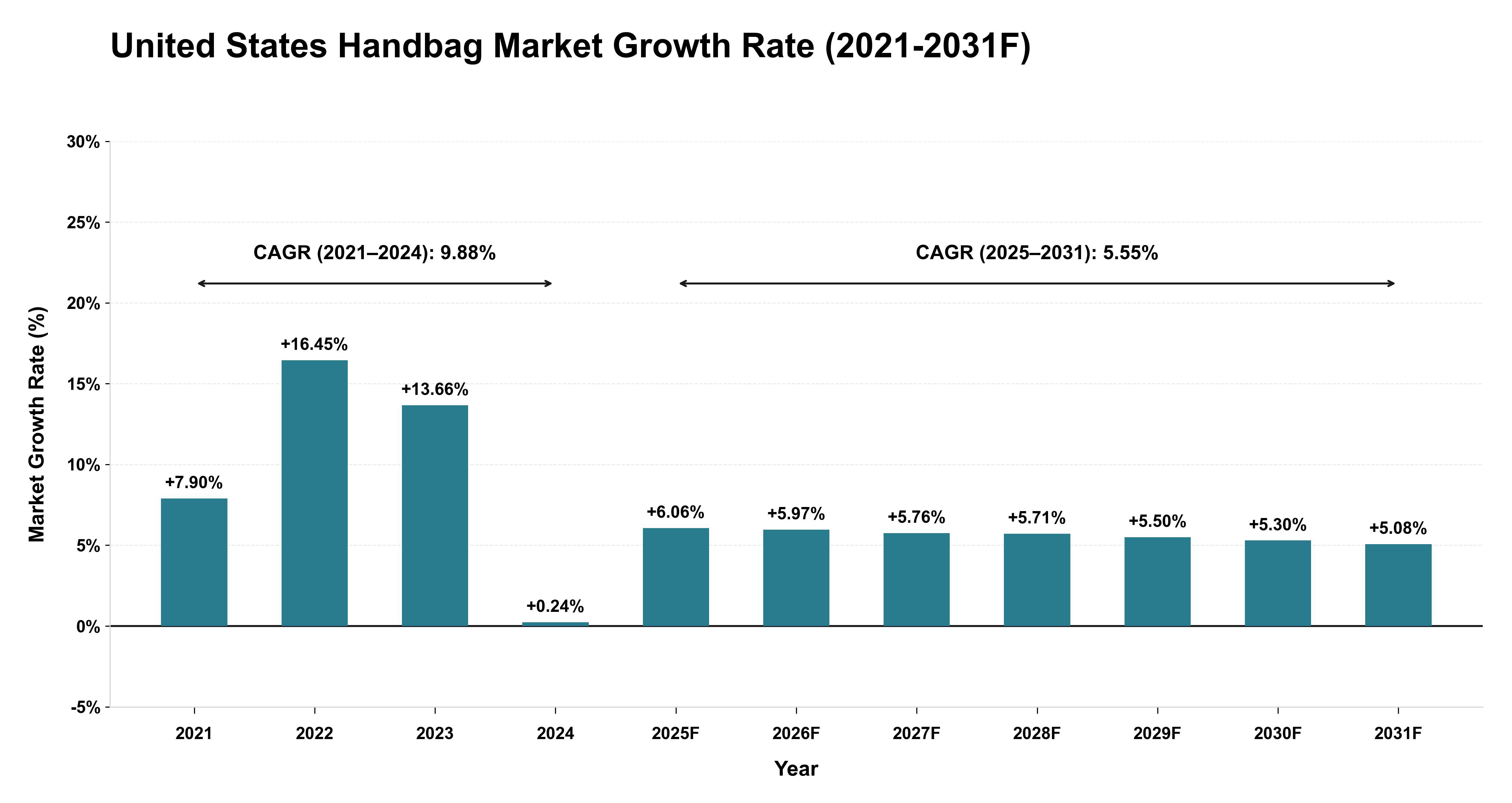
In the United States Handbag Market, from 2021 to 2024, we witnessed a robust historical trend with a CAGR of 9.88%. This growth trajectory was characterized by significant fluctuations, starting with a solid growth of 7.90% in 2021, followed by a remarkable spike of 16.45% in 2022 and sustained growth in 2023 at 13.66%. However, the market experienced a slight slowdown in 2024 with growth dipping to 0.24%, indicating possible saturation in certain segments or external economic shocks. Looking ahead to the forecast period of 2025-2031, the expected CAGR of 5.55% suggests a more stable and moderate growth phase. This forecast reflects a maturing market where demand stabilizes, supply chains optimize efficiencies, and consumer preferences evolve towards sustainable and timeless designs rather than fast fashion trends.
United States (US) Handbag Market Overview
The United States handbag market is a prominent sector within the fashion industry, characterized by a diverse range of products catering to various consumer preferences and price points. Key players in the market include luxury brands such as Louis Vuitton, Gucci, and Coach, as well as more affordable options from brands like Kate Spade and Michael Kors. Consumer trends in the US handbag market are influenced by factors such as fashion trends, brand reputation, and functionality. The market is also increasingly impacted by sustainability concerns, with a growing demand for eco-friendly materials and production practices. Online retail channels have seen significant growth in recent years, offering consumers greater accessibility and convenience when shopping for handbags. Overall, the US handbag market remains dynamic and competitive, with opportunities for both established brands and emerging designers to succeed.
United States (US) Handbag Market Trends
The United States handbag market is experiencing several key trends. One prominent trend is the growing demand for sustainable and ethically-made handbags, driven by increasing consumer awareness of environmental issues and social responsibility. Another trend is the rising popularity of versatile and functional handbag designs that cater to the needs of modern consumers who seek both style and practicality in their accessories. Additionally, the market is seeing a shift towards personalized and customizable handbags, as consumers seek unique and individualized pieces to express their personal style. Lastly, the influence of social media and celebrity endorsements continues to play a significant role in shaping consumer preferences and driving trends in the US handbag market.
United States (US) Handbag Market Challenges
In the US Handbag Market, some of the key challenges faced include intense competition from both domestic and international brands, which leads to price wars and margin pressures. Another challenge is shifting consumer preferences and trends, making it crucial for brands to constantly innovate and stay updated with the latest styles to remain relevant. Counterfeiting is also a significant issue in the handbag market, affecting both brand reputation and sales. Additionally, the increasing focus on sustainability and ethical practices in manufacturing processes presents a challenge for brands to adopt more environmentally friendly practices while ensuring cost-effectiveness. Lastly, the rise of e-commerce has disrupted traditional retail channels, requiring handbag brands to have a strong online presence and omnichannel strategy to reach consumers effectively.
United States (US) Handbag Market Investment Opportunities
The US Handbag Market presents several appealing investment opportunities due to its continued growth and consumer demand for fashionable accessories. One opportunity lies in the luxury handbag segment, where premium brands like Louis Vuitton and Gucci continue to thrive by catering to affluent customers seeking high-quality, status-symbol products. Another opportunity is in the growing trend of sustainable and vegan handbags, as more consumers prioritize ethical and environmentally friendly options. Additionally, the rise of direct-to-consumer brands and online marketplaces offers avenues for investment, as digital channels provide broader reach and lower operational costs. Investing in innovative materials, technologies, and designs that cater to evolving consumer preferences can also be a lucrative opportunity in the US Handbag Market.
United States (US) Handbag Market Government Policy
Government policies related to the US Handbag Market primarily revolve around trade regulations, intellectual property rights enforcement, and consumer safety standards. The US imposes tariffs on imported handbags to protect domestic manufacturers and maintain a level playing field. Additionally, intellectual property laws help prevent counterfeit products from entering the market, safeguarding the interests of both consumers and legitimate businesses. Government agencies also regulate the use of certain materials in handbag production to ensure compliance with safety standards and environmental regulations. Overall, government policies in the US Handbag Market aim to promote fair competition, protect consumer interests, and uphold industry standards.
United States (US) Handbag Market Future Outlook
The United States handbag market is expected to continue its growth trajectory in the coming years, driven by factors such as increasing consumer disposable income, changing fashion trends, and the growing preference for luxury and designer handbags. The market is also benefiting from the rising popularity of online shopping and the increasing influence of social media on consumer purchasing behavior. Additionally, the growing awareness of sustainable and ethically produced handbags is likely to shape consumer preferences in the future. With key players focusing on innovation, sustainability, and digital marketing strategies, the US handbag market is poised for steady growth and is expected to offer opportunities for both established brands and emerging players to capitalize on evolving consumer preferences and market trends.
Key Highlights of the Report:
- United States (US) Handbag Market Outlook
- Market Size of United States (US) Handbag Market, 2021
- Forecast of United States (US) Handbag Market, 2031
- Historical Data and Forecast of United States (US) Handbag Revenues & Volume for the Period 2018 - 2031
- United States (US) Handbag Market Trend Evolution
- United States (US) Handbag Market Drivers and Challenges
- United States (US) Handbag Price Trends
- United States (US) Handbag Porter's Five Forces
- United States (US) Handbag Industry Life Cycle
- Historical Data and Forecast of United States (US) Handbag Market Revenues & Volume By Product Type for the Period 2018 - 2031
- Historical Data and Forecast of United States (US) Handbag Market Revenues & Volume By Satchel for the Period 2018 - 2031
- Historical Data and Forecast of United States (US) Handbag Market Revenues & Volume By Bucket Bag for the Period 2018 - 2031
- Historical Data and Forecast of United States (US) Handbag Market Revenues & Volume By Clutch for the Period 2018 - 2031
- Historical Data and Forecast of United States (US) Handbag Market Revenues & Volume By Tote Bag for the Period 2018 - 2031
- Historical Data and Forecast of United States (US) Handbag Market Revenues & Volume By Other Product Types for the Period 2018 - 2031
- Historical Data and Forecast of United States (US) Handbag Market Revenues & Volume By Distribution Channel for the Period 2018 - 2031
- Historical Data and Forecast of United States (US) Handbag Market Revenues & Volume By Online Retail Stores for the Period 2018 - 2031
- Historical Data and Forecast of United States (US) Handbag Market Revenues & Volume By Offline Retail Stores for the Period 2018 - 2031
- United States (US) Handbag Import Export Trade Statistics
- Market Opportunity Assessment By Product Type
- Market Opportunity Assessment By Distribution Channel
- United States (US) Handbag Top Companies Market Share
- United States (US) Handbag Competitive Benchmarking By Technical and Operational Parameters
- United States (US) Handbag Company Profiles
- United States (US) Handbag Key Strategic Recommendations






































