United States (US) IndUStrial Burner Market Top 5 Importing Countries and Market Competition (HHI) Analysis
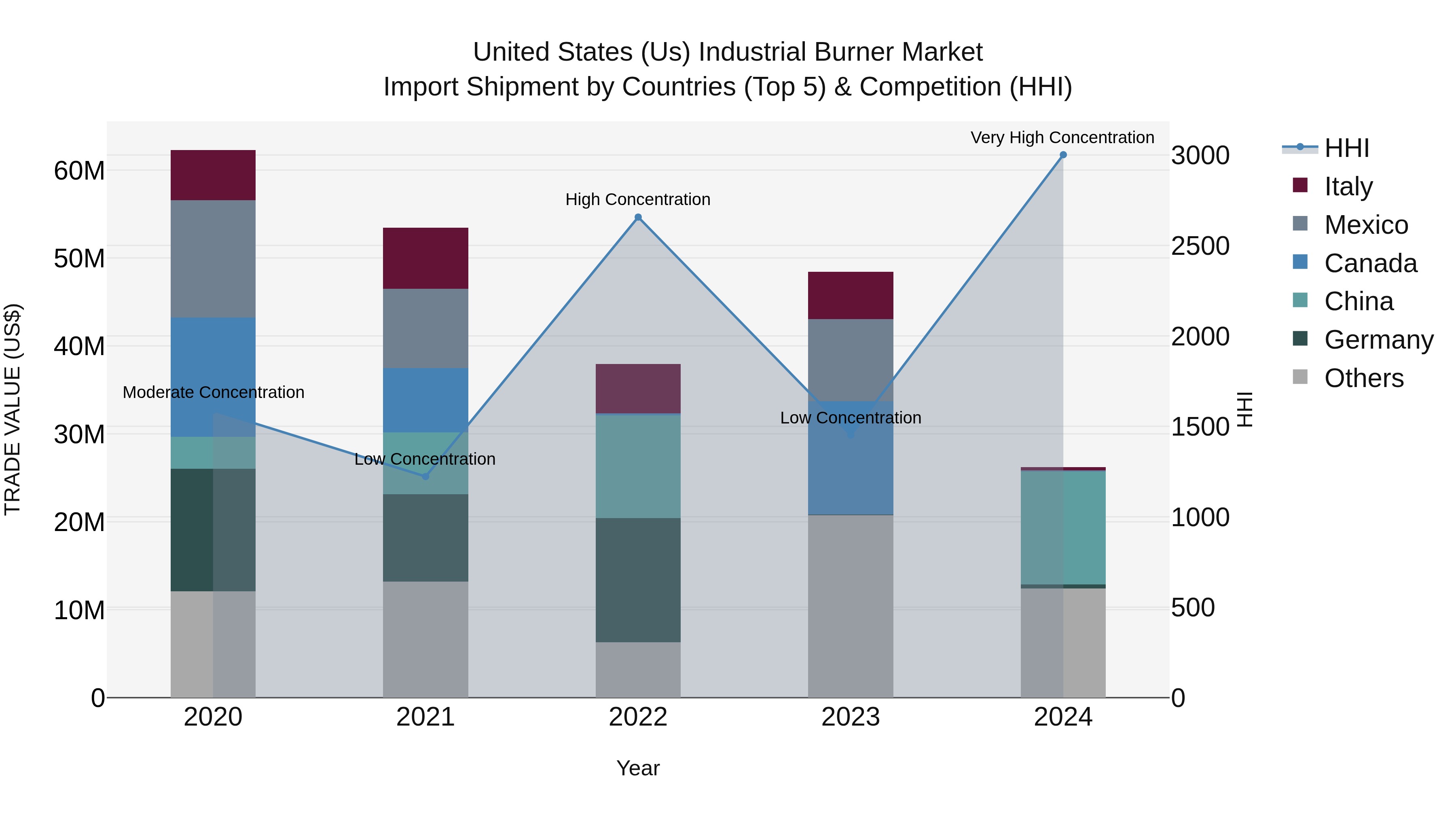
The United States saw a significant shift in industrial burner import shipments in 2024, with a notable increase in concentration as indicated by the high Herfindahl-Hirschman Index (HHI). Top exporting countries such as China, Austria, UK, Finland, and Brazil played a crucial role in shaping the market dynamics. Despite a steep decline in the Compound Annual Growth Rate (CAGR) from 2020 to 2024, the year-on-year growth rate in 2024 plummeted even further. These trends suggest a challenging landscape for industrial burner imports in the US market, highlighting the need for strategic analysis and adaptation by industry stakeholders.
United States (US) Industrial Burner Market Overview
The United States industrial burner market is experiencing steady growth driven by increasing industrialization, stringent environmental regulations, and the need for energy-efficient heating solutions. Key trends include the adoption of low-emission burners to comply with emissions standards, a shift towards renewable energy sources, and the integration of digital technologies for improved efficiency and control. Major players in the market offer a wide range of products catering to various industries such as oil & gas, chemical, food processing, and power generation. The market is competitive, with companies focusing on innovation, product development, and strategic partnerships to gain a competitive edge. As industries continue to prioritize sustainability and operational efficiency, the industrial burner market in the US is expected to witness further growth in the coming years.
United States (US) Industrial Burner Market Trends
The US Industrial Burner Market is experiencing several trends. One key trend is the increasing adoption of low-emission burners to comply with stringent environmental regulations and reduce carbon footprint. Manufacturers are focusing on developing innovative burner technologies that are energy-efficient and environmentally friendly. Another trend is the growing demand for smart burners equipped with advanced control systems and remote monitoring capabilities to enhance operational efficiency and control. Additionally, the market is witnessing a shift towards the use of alternative fuels such as natural gas, biofuels, and hydrogen to reduce reliance on traditional fossil fuels. Overall, the US Industrial Burner Market is evolving towards sustainability, efficiency, and digitalization to meet the needs of modern industrial applications.
United States (US) Industrial Burner Market Challenges
In the US Industrial Burner Market, challenges include increasing regulations and environmental concerns surrounding emissions, which require burner manufacturers to develop more efficient and cleaner burning solutions. Additionally, the market faces competition from low-cost manufacturers in other countries, putting pressure on pricing and margins for US companies. Technological advancements and the need to constantly innovate to meet customer demands for energy efficiency and sustainability also present challenges for industrial burner manufacturers in the US. Furthermore, the fluctuating costs of raw materials and energy sources can impact production costs and profitability in the market. Overall, staying competitive in a rapidly evolving industry while adhering to stringent regulations and meeting customer expectations for performance and sustainability are key challenges faced by companies in the US Industrial Burner Market.
United States (US) Industrial Burner Market Investment Opportunities
The United States Industrial Burner Market presents promising investment opportunities due to factors such as the increasing focus on energy efficiency and stringent environmental regulations driving the demand for advanced burner technologies. Companies involved in manufacturing and supplying industrial burners, particularly those offering innovative and sustainable solutions, are well-positioned for growth. Additionally, the expansion of industries like oil and gas, chemicals, and food processing in the US further boosts the demand for industrial burners. Investing in research and development to enhance burner efficiency, reduce emissions, and improve overall performance can be a strategic move for investors looking to capitalize on the evolving market trends and opportunities in the US Industrial Burner Market.
United States (US) Industrial Burner Market Government Policy
In the United States, government policies related to the Industrial Burner Market primarily focus on environmental regulations and energy efficiency standards. The Environmental Protection Agency (EPA) enforces emissions limits on industrial burners to reduce air pollution and promote clean air quality. Additionally, the Department of Energy (DOE) sets energy efficiency standards to encourage the use of high-efficiency industrial burners, aiming to reduce energy consumption and greenhouse gas emissions. Government incentives and tax credits are also available to encourage businesses to invest in energy-efficient burner technologies. Overall, the US government`s policies aim to balance environmental protection with industrial productivity in the Industrial Burner Market.
United States (US) Industrial Burner Market Future Outlook
The future outlook for the United States Industrial Burner Market appears promising, with growth expected driven by increasing industrialization, adoption of cleaner and more efficient burning technologies, and stringent environmental regulations. Key trends shaping the market include the shift towards energy-efficient burners, advancements in digitalization and automation for improved control and monitoring capabilities, and the growing demand for industrial burners in sectors such as chemicals, refineries, and food processing. Additionally, the emphasis on reducing carbon emissions and enhancing sustainability practices is likely to propel the market further. Overall, the US Industrial Burner Market is anticipated to witness steady growth in the coming years, offering opportunities for market players to innovate and expand their product portfolios to meet evolving industry needs.
Key Highlights of the Report:
- United States (US) Industrial Burner Market Outlook
- Market Size of United States (US) Industrial Burner Market, 2024
- Forecast of United States (US) Industrial Burner Market, 2031
- Historical Data and Forecast of United States (US) Industrial Burner Revenues & Volume for the Period 2021 - 2031
- United States (US) Industrial Burner Market Trend Evolution
- United States (US) Industrial Burner Market Drivers and Challenges
- United States (US) Industrial Burner Price Trends
- United States (US) Industrial Burner Porter's Five Forces
- United States (US) Industrial Burner Industry Life Cycle
- Historical Data and Forecast of United States (US) Industrial Burner Market Revenues & Volume By Type for the Period 2021 - 2031
- Historical Data and Forecast of United States (US) Industrial Burner Market Revenues & Volume By Cold Chamber Die Casting Machine for the Period 2021 - 2031
- Historical Data and Forecast of United States (US) Industrial Burner Market Revenues & Volume By Hot Chamber Die Casting Machine for the Period 2021 - 2031
- Historical Data and Forecast of United States (US) Industrial Burner Market Revenues & Volume By Gravity Die Casting Machine for the Period 2021 - 2031
- Historical Data and Forecast of United States (US) Industrial Burner Market Revenues & Volume By Material for the Period 2021 - 2031
- Historical Data and Forecast of United States (US) Industrial Burner Market Revenues & Volume By Aluminum for the Period 2021 - 2031
- Historical Data and Forecast of United States (US) Industrial Burner Market Revenues & Volume By Zinc for the Period 2021 - 2031
- Historical Data and Forecast of United States (US) Industrial Burner Market Revenues & Volume By Magnesium for the Period 2021 - 2031
- Historical Data and Forecast of United States (US) Industrial Burner Market Revenues & Volume By End User for the Period 2021 - 2031
- Historical Data and Forecast of United States (US) Industrial Burner Market Revenues & Volume By Transportation for the Period 2021 - 2031
- Historical Data and Forecast of United States (US) Industrial Burner Market Revenues & Volume By Mechanical & Manufacturing Equipment for the Period 2021 - 2031
- Historical Data and Forecast of United States (US) Industrial Burner Market Revenues & Volume By Building & Construction for the Period 2021 - 2031
- United States (US) Industrial Burner Import Export Trade Statistics
- Market Opportunity Assessment By Type
- Market Opportunity Assessment By Material
- Market Opportunity Assessment By End User
- United States (US) Industrial Burner Top Companies Market Share
- United States (US) Industrial Burner Competitive Benchmarking By Technical and Operational Parameters
- United States (US) Industrial Burner Company Profiles
- United States (US) Industrial Burner Key Strategic Recommendations






































