United States (US) Knife Market Top 5 Importing Countries and Market Competition (HHI) Analysis
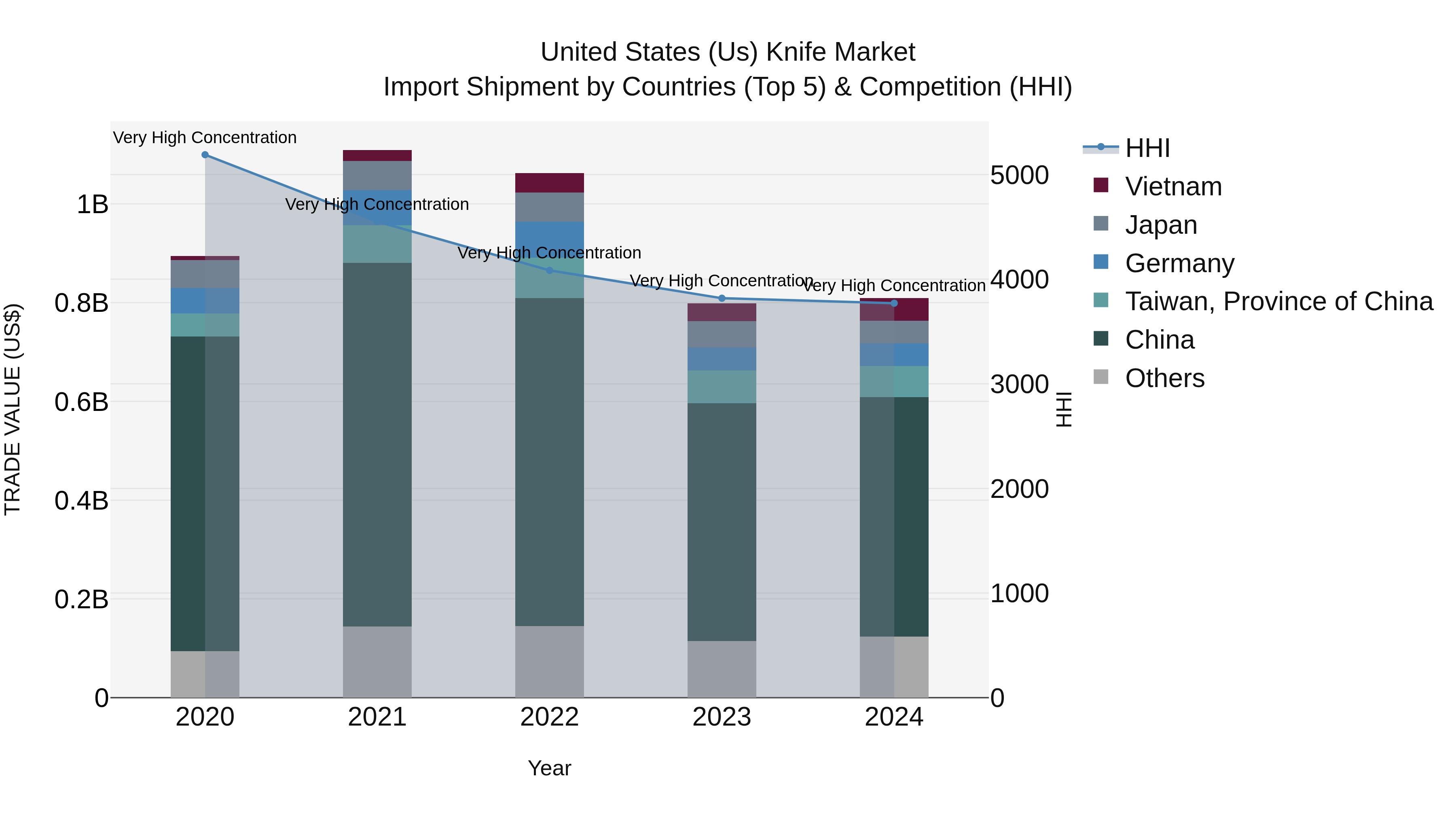
In 2024, the United States continued to rely heavily on imports of knives, with China, Taiwan, Japan, Germany, and Vietnam leading the way. The high Herfindahl-Hirschman Index (HHI) indicates a concentrated market, potentially posing challenges for competition. The negative compound annual growth rate (CAGR) from 2020 to 2024 suggests a decline in overall import demand, although a slight uptick in the growth rate from 2023 to 2024 offers a glimmer of hope for the market`s future trajectory. The dynamics of the global knife trade warrant close monitoring for stakeholders in the industry.
US Knife Market Highlights
| Report Name | US Knife Market |
| Forecast period | 2025-2031 |
| CAGR | 12.4% |
| Growing Sector | Food and Beverage |
Topics Covered in the US Knife Market Report
The US Knife market report thoroughly covers the market by product type, by end user and competitive Landscape. The report provides an unbiased and detailed analysis of the on-going market trends, opportunities/high growth areas, and market drivers which would help the stakeholders to devise and align their market strategies according to the current and future market dynamics.
US Knife Market Synopsis
Knives have been an integral part of human life for centuries, serving different purposes like hunting, cooking, and self-defense. The US Knife Market is one of the biggest in the world, with various factors contributing to its growth. The market has evolved with time, and new technologies and innovations have helped in creating a diverse range of knives. Additionally, the US Knife Market has come a long way from being a traditional cutting tool used solely for hunting and outdoor activities. The market has witnessed a lot of innovations and advancements, and knives are now being designed for specific activities like cooking, fishing, and survival. Japanese style knives are gaining more popularity due to their precision and delicate designs. Customized knives are also making a mark in the market with consumers wanting personalized features like unique blade designs, handle materials, and engravings. However, one of the main challenges facing the US knife industry is the increasing competition from imported knives. With the advent of global trade, foreign-made knives have made their way into the US market, gaining increasing popularity. This is putting pressure on domestic knife manufacturers to keep up with the competition, in terms of pricing, quality, and marketing.
According to 6Wresearch, US Knife market size is projected to grow at a CAGR of 12.4% during 2025-2031. The increased interest in culinary arts, innovation in design, e-commerce penetration, and the growing focus on local manufacturing are the most significant drivers of the industry. Further, the internet has revolutionized the way we shop. Online retailers have become central players in the growth of almost every industry. The US knife market has also felt the impact of e-commerce as many customers are now turning to online sources for their various knife needs. Knife companies such as KnivesShipFree and BladeHQ have become industry stars, using their digital presence to promote and sell a wide range of knives. As such, the e-commerce sector is a major growth driver for the US Knife Market. Moreover, the US is known for its love of craftsmanship, and this has translated into knife-making, with many consumers now showing interest in custom knives. The market for personalized or customized knives is increasing, as more customers want to showcase their individual style and establish a sense of identity. The rise of artisans that specialize in knife-making is testament to this trend, as more consumers prefer to invest in unique and high-quality knives that can range in price from hundreds to thousands of dollars.
Government Initiatives Introduced in the US Knife Market
Government initiatives have played a significant role in the growth of the US knife market. One of the most prominent initiatives is the Knife Owners' Protection Act (KOPA) of 2013, which safeguards the rights of knife owners and ensures that the law is consistent across the US. The act ensures that knives are not classified as dangerous weapons, allowing for more freedom in carrying and using them. This has led to an increased demand for knives for everyday use, thus contributing to the growth of the market. Also, these plans have enhanced the US Knife Market Share. Additionally, initiatives like the Outdoor Recreation Jobs and Economic Impact Act of 2016 have also helped to promote outdoor recreational activities, indirectly contributing to the growth of the knife market.
Key Players in the US Knife Market
The US knife market is highly competitive, with both established and new players vying for market share. Some of the key players in the market include Benchmade Knife Company, Buck Knives, CRKT, Gerber Gear, KAI USA Ltd., Ontario Knife Company, Spyderco, and Wüsthof GmbH. These companies offer a wide range of knives for different uses, price points, and target audiences. While some focus on traditional designs and craftsmanship, others embrace innovation and technology in their products. In addition, the companies’ clasp enormous US Knife Market Revenues. Additionally, online retail channels such as Amazon, BladeHQ, and KnifeCenter have disrupted the traditional brick-and-mortar distribution channels, making it easier for consumers to access a wide selection of knives at competitive prices.
Future Insights of the US Knife Market
The future outlook of the US knife market looks bright and promising, despite the challenges and uncertainties. The outdoor and tactical knife markets are also expected to grow, as more people engage in recreational activities and self-defense. The adoption of new materials such as ceramic, titanium, and stainless steel alloys, as well as the integration of advanced features such as assisted opening, locking mechanisms, and ergonomic handles, will continue to shape the knife market and enhance its value proposition for consumers.
Market Analysis by Product Type
According to Ravi Bhandari, Research Head, 6Wresearch, when it comes to knives, stainless steel is a top pick for many due to its high corrosion resistance and low maintenance requirements. Stainless steel blades are generally tougher and more durable than carbon steel blades. The US knife market offers a wide selection of stainless steel knives, from affordable options to high-end ones that use premium stainless steel such as VG-10. Some popular stainless steel knife brands in the US market are Wusthof, Henckels, and Shun. Further, the knives made of carbon steel are sought after for their sharp edges and easy sharpening capabilities. However, they are prone to rust and staining, and require more maintenance compared to stainless steel knives. Carbon steel knives are popular among chefs and butchers, favored for their precision and control. Some well-known carbon steel knife brands in the US market include Morakniv, Opinel, and ESEE.
Market Analysis by End User
Knives serve countless purposes in the kitchen and have continued to evolve over time. The design and material of the blade have a significant impact on the knife’s performance and durability, two key aspects that are important in the kitchen. Kitchen knives are classified into several types based on their functionality, including chef’s knives, paring knives, slicing knives, bread knives, and utility knives. One of the leading brands in the US, Wüsthof, offers a range of knives with varying degrees of performance, strength, and design. They range from the premium, which is made of high-quality materials, to the classic range, which is more affordable. Additionally, knives are also used as weapons and are designed to inflict harm to the user’s target. The most popular type of knife used as a weapon is a fixed blade knife, with a single cutting edge. Knives as weapons come in different shapes and designs, including push daggers, switchblades, and bowie knives. Bowie knives, in particular, are popular in the US and are often used for survival and outdoor activities. However, there are strict laws in the US regarding the use of knives for self-defense, which varies depending on the state jurisdiction.
Key Attractiveness of the Report
- 10 Years Market Numbers.
- Historical Data Starting from 2021 to 2024.
- Base Year: 2024.
- Forecast Data until 2031.
- Key Performance Indicators Impacting the Market.
- Major Upcoming Developments and Projects.
Key Highlights of the Report:
- US Knife Market Overview
- US Knife Market Outlook
- US Knife Market Forecast
- Market Size of US Knife Market, 2024
- Forecast of US Knife Market, 2031
- Historical Data and Forecast of US Knife Revenues & Volume for the Period 2021 - 2031
- US Knife Market Trend Evolution
- US Knife Market Drivers and Challenges
- US Knife Price Trends
- US Knife Porter's Five Forces
- US Knife Industry Life Cycle
- Historical Data and Forecast of US Knife Market Revenues & Volume By Product Type for the Period 2021 - 2031
- Historical Data and Forecast of US Knife Market Revenues & Volume By Stainless Steel for the Period 2021 - 2031
- Historical Data and Forecast of US Knife Market Revenues & Volume By Carbon Steel for the Period 2021 - 2031
- Historical Data and Forecast of US Knife Market Revenues & Volume By Alloy Steel for the Period 2021 - 2031
- Historical Data and Forecast of US Knife Market Revenues & Volume By Other Materials for the Period 2021 - 2031
- Historical Data and Forecast of US Knife Market Revenues & Volume, By End-Users for the Period 2021 - 2031
- Historical Data and Forecast of US Knife Market Revenues & Volume, By Utensils& Kitchen Tools for the Period 2021 - 2031
- Historical Data and Forecast of US Knife Market Revenues & Volume, By Weapons& Defence for the Period 2021 - 2031
- Historical Data and Forecast of US Knife Market Revenues & Volume, By Others for the Period 2021 - 2031
- US Knife Import Export Trade Statistics
- Market Opportunity Assessment, By Product Type
- Market Opportunity Assessment, By End-Users
- US Knife Top Companies Market Share
- US Knife Competitive Benchmarking, By Technical and Operational Parameters
- US Knife Company Profiles
- US Knife Key Strategic Recommendations
Markets Covered
The US Knife market report provides a detailed analysis of the following market segments:
By Product Type
- Stainless Steel
- Carbon Steel
- Alloy Steel
- Other Materials
By End User
- Utensils& Kitchen Tools
- Weapons& Defence
- Others






































