United States (US) Minimal Residual Disease Testing Market Size, Share & Growth Rate
The United States (US) Minimal Residual Disease Testing Market was estimated at USD 233 Million in 2025 and is projected to reach USD 274 Million by 2032, growing at a CAGR of 2.3% from 2026 to 2032. This upward trajectory is primarily fueled by the increasing prevalence of cancer, coupled with a strong shift towards personalized treatment approaches. Additionally, advancements in testing technologies are enhancing the accuracy and reliability of MRD tests, making them more integral to cancer management strategies.
United States (US) Minimal Residual Disease Testing Market Year-wise Growth Rate and Key Drivers
This graph highlights how the United States (US) Minimal Residual Disease Testing Market has steadily grown over the years, supported by major growth factors.
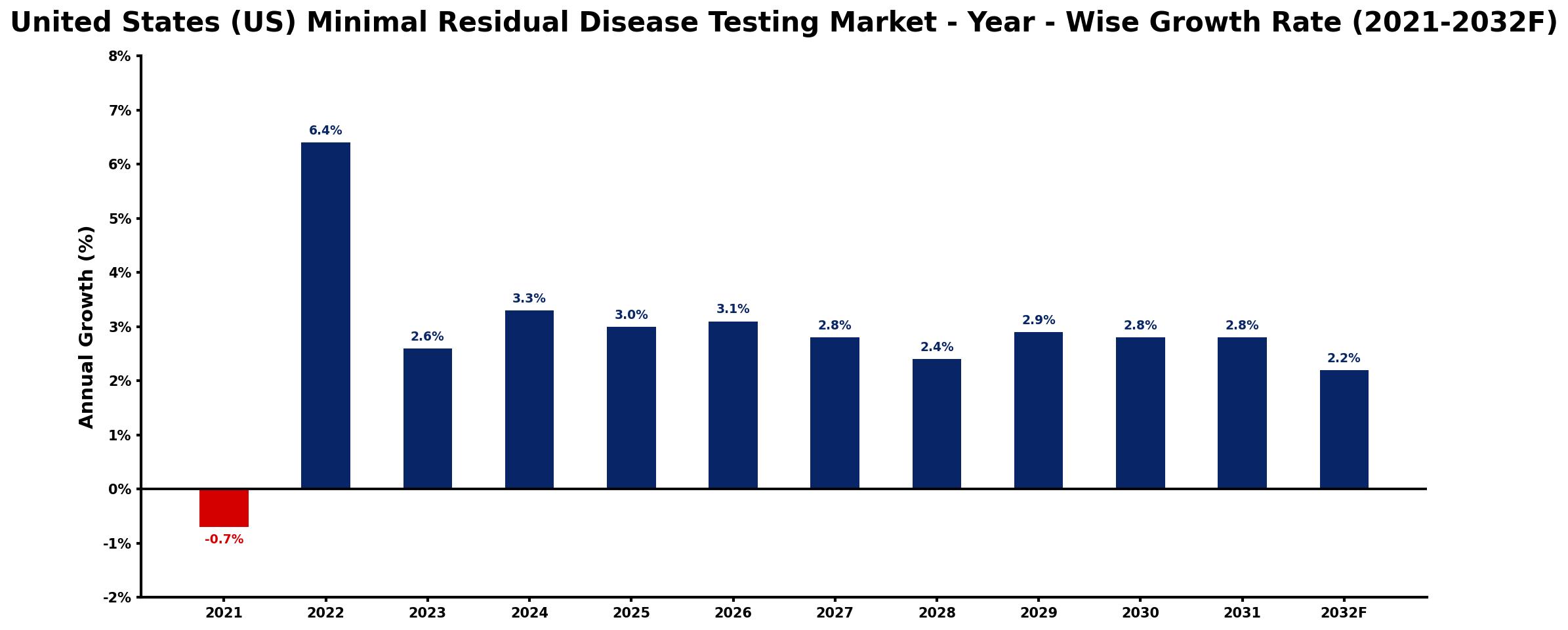
The table below presents the year‑wise growth rates along with the key drivers influencing the market
| Year | Growth Rate | Major Drivers |
| 2021 | -0.7% | decreased healthcare funding initiatives |
| 2022 | 6.4% | growing investment in diagnostics |
| 2023 | 2.6% | rising prevalence of cancers |
| 2024 | 3.3% | increased awareness among patients |
| 2025 | 3.0% | expansion of healthcare technologies |
| 2026 | 3.1% | advancements in laboratory capabilities |
| 2027 | 2.8% | enhanced clinical trial participation |
| 2028 | 2.4% | growing demand for precision medicine |
| 2029 | 2.9% | strengthened regulatory support initiatives |
| 2030 | 2.8% | improved reimbursement policies enacted |
| 2031 | 2.8% | increased collaboration among stakeholders |
| 2032 | 2.2% | broadened access to healthcare services |
Note: Market size estimations and growth projections presented in this report are based on 6Wresearch's proprietary forecasting methodology, utilizing the latest available industry data, government publications, and primary research inputs.
United States (US) Minimal Residual Disease Testing Market Synopsis
The strongest force currently shaping the US Minimal Residual Disease Testing Market is the rising emphasis on precision medicine. As healthcare providers recognize the critical role of MRD testing in early detection of disease recurrence, these tests are increasingly becoming a standard component of cancer treatment plans.
Moreover, the integration of advanced technologies, such as next-generation sequencing and digital PCR, is revolutionizing the accuracy and sensitivity of MRD assessments. This shift not only boosts diagnostic confidence but also enhances patient outcomes by facilitating timely treatment adjustments based on MRD results.
United States (US) Minimal Residual Disease Testing Market Key Takeaways
- The MRD testing market in the US is gaining traction due to the growing focus on personalized medicine in oncology.
- Advancements in testing technologies are significantly improving the sensitivity and specificity of MRD assessments.
- Collaborations between diagnostic companies and pharmaceutical firms are enhancing MRD's role in clinical trials.
- Despite challenges like limited awareness and reimbursement issues, market growth is projected to continue robustly.
- Investment in innovative MRD solutions and partnerships with healthcare providers are key to market expansion.
Evaluation of Restraints in United States (US) Minimal Residual Disease Testing Market
Several restraints are currently limiting the US MRD testing market's growth. A major issue is the lack of standardization in testing methodologies across laboratories, which can lead to variability in test results. This inconsistency can undermine the confidence of healthcare providers and patients in MRD testing as a reliable tool for treatment decisions. Furthermore, there is often insufficient awareness of MRD testing's potential among both physicians and patients, leading to its underutilization in cancer care. Additionally, high testing costs and complex reimbursement policies remain significant barriers to broader adoption, necessitating targeted efforts to enhance understanding and access.
United States (US) Minimal Residual Disease Testing Market Trends
The US Minimal Residual Disease Testing Market is characterized by several emerging trends that are reshaping its landscape. There is a pronounced shift towards developing more sensitive MRD testing technologies, such as next-generation sequencing (NGS) and digital PCR. These innovations are driven by the need for accuracy in monitoring treatment responses and predicting disease recurrence. Furthermore, the integration of MRD testing in clinical trials, particularly for targeted therapies, is becoming increasingly common, fostering a collaborative environment between pharmaceutical and diagnostic sectors. This trend signals a growing recognition of MRD testing as a vital component of modern cancer management.
United States (US) Minimal Residual Disease Testing Market Opportunities
The US Minimal Residual Disease Testing Market presents numerous investment opportunities, especially as healthcare transitions further toward personalized treatment paradigms. Key growth areas include the development of cutting-edge technologies that enhance the accuracy of MRD detection, such as advanced digital PCR methods. Additionally, forming strategic partnerships with healthcare providers can facilitate broader market penetration and promote the adoption of MRD testing as a routine part of cancer care. Expanding testing capabilities to encompass a wider range of cancer types will also unlock significant market potential.
Government Initiatives in the United States (US) Minimal Residual Disease Testing Market
While there are no specific government policies focused solely on the Minimal Residual Disease Testing Market, existing regulations and initiatives indirectly influence its development. Agencies such as the Food and Drug Administration (FDA) oversee the approval and quality control of diagnostic tests, ensuring their safety and efficacy. Furthermore, reimbursement policies set by the Centers for Medicare & Medicaid Services (CMS) play a pivotal role in shaping market adoption by determining coverage and payment structures. Additionally, government-funded research initiatives support the advancement of MRD testing technologies, contributing to the market's growth.
Future Insights of the United States (US) Minimal Residual Disease Testing Market
Looking ahead to the period between 2026 and 2032, the future of the US Minimal Residual Disease Testing Market appears bright. Continued advancements in testing technologies, combined with an increasing acceptance of precision medicine, will likely drive further market growth. As healthcare providers and patients alike become more aware of the benefits of MRD testing, its integration into clinical practice is expected to deepen. Enhanced understanding of MRD's role in treatment monitoring and disease management will solidify its place as an essential tool in oncology.
United States (US) Minimal Residual Disease Testing Market Latest Developments (2025 - 2026)
Recent developments in the US MRD testing market indicate a dynamic shift towards incorporating advanced technologies into routine testing protocols. Industry players are increasingly focusing on collaborations to develop comprehensive testing platforms that enhance the accuracy of MRD detection. Additionally, there's a notable push for educational initiatives aimed at healthcare providers to increase awareness about the clinical significance of MRD testing. As these trends evolve, the market is set to undergo substantial transformation, aligning with the broader goals of precision medicine.
United States (US) Minimal Residual Disease Testing Market - Key Attractiveness of the Report
- 10 Years of Market Numbers
- Historical Data Starting from 2022 to 2025
- Base Year: 2025
- Forecast Data until 2032
- Key Performance Indicators Impacting the Market
- Major Upcoming Developments and Projects
Key Highlights of the Report:
- United States (US) Minimal Residual Disease Testing Market Outlook
- Market Size of United States (US) Minimal Residual Disease Testing Market, 2025
- Forecast of United States (US) Minimal Residual Disease Testing Market, 2032
- Historical Data and Forecast of United States (US) Minimal Residual Disease Testing Revenues & Volume for the Period 2022-2032F
- United States (US) Minimal Residual Disease Testing Market Trend Evolution
- United States (US) Minimal Residual Disease Testing Market Drivers and Challenges
- United States (US) Minimal Residual Disease Testing Price Trends
- United States (US) Minimal Residual Disease Testing Porter's Five Forces
- United States (US) Minimal Residual Disease Testing Industry Life Cycle
- Historical Data and Forecast of United States (US) Minimal Residual Disease Testing Market Revenues & Volume By Application for the Period 2022-2032F
- Historical Data and Forecast of United States (US) Minimal Residual Disease Testing Market Revenues & Volume By Hematological Malignancy for the Period 2022-2032F
- Historical Data and Forecast of United States (US) Minimal Residual Disease Testing Market Revenues & Volume By Solid Tumor for the Period 2022-2032F
- Historical Data and Forecast of United States (US) Minimal Residual Disease Testing Market Revenues & Volume By End User for the Period 2022-2032F
- Historical Data and Forecast of United States (US) Minimal Residual Disease Testing Market Revenues & Volume By Hospital and Specialty Clinics for the Period 2022-2032F
- Historical Data and Forecast of United States (US) Minimal Residual Disease Testing Market Revenues & Volume By Diagnostic Laboratories for the Period 2022-2032F
- Historical Data and Forecast of United States (US) Minimal Residual Disease Testing Market Revenues & Volume By Research Institutions for the Period 2022-2032F
- Historical Data and Forecast of United States (US) Minimal Residual Disease Testing Market Revenues & Volume By Other for the Period 2022-2032F
- United States (US) Minimal Residual Disease Testing Import Export Trade Statistics
- Market Opportunity Assessment By Application
- Market Opportunity Assessment By End User
- United States (US) Minimal Residual Disease Testing Top Companies Market Share
- United States (US) Minimal Residual Disease Testing Competitive Benchmarking By Technical and Operational Parameters
- United States (US) Minimal Residual Disease Testing Company Profiles
- United States (US) Minimal Residual Disease Testing Key Strategic Recommendations






































