United States (US) MUSical Instrument Market Top 5 Importing Countries and Market Competition (HHI) Analysis
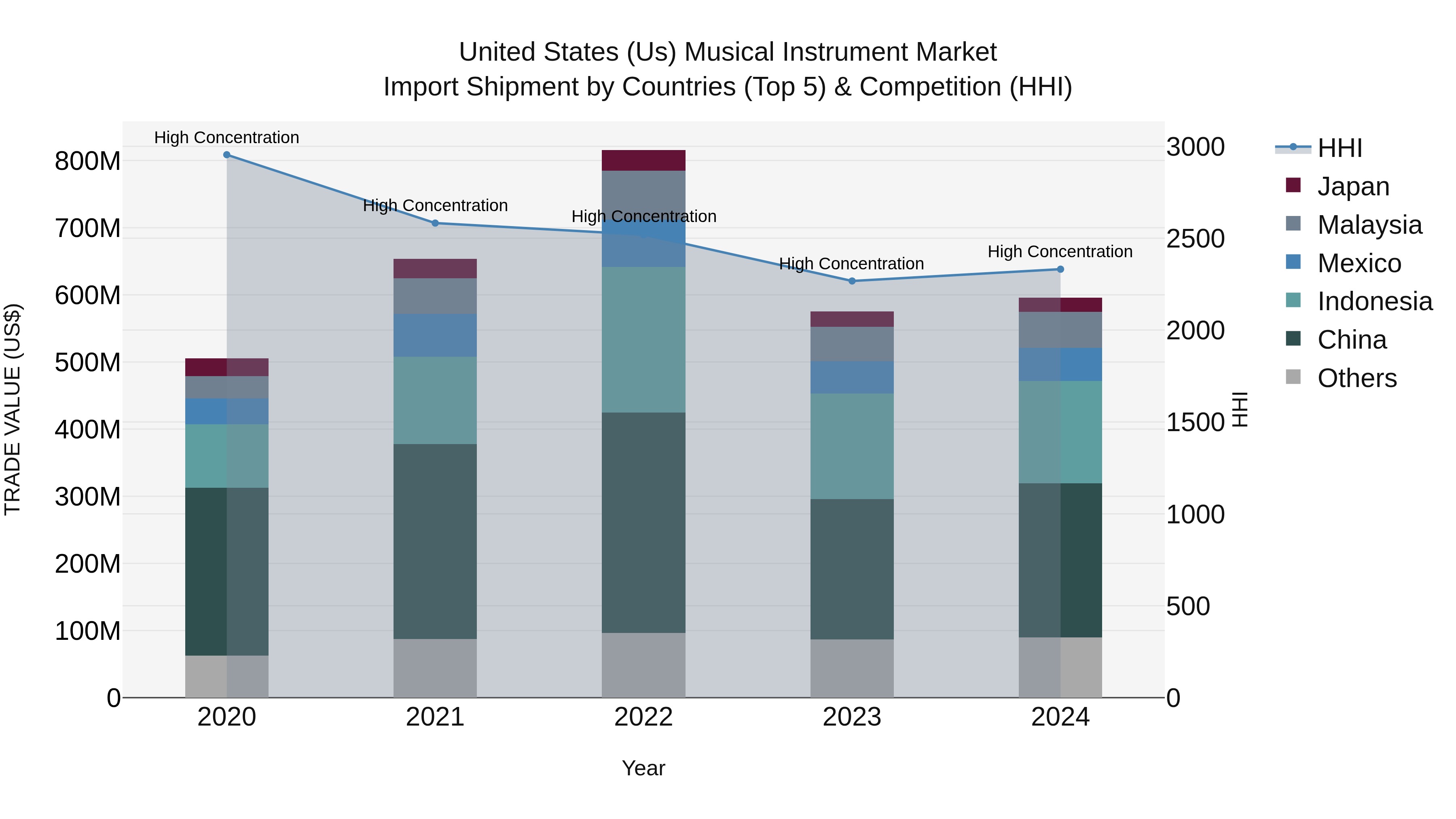
In 2024, the United States continued to see a high concentration of musical instrument imports, with top exporting countries being China, Indonesia, Malaysia, Mexico, and South Korea. The Compound Annual Growth Rate (CAGR) for the period 2020-2024 stood at 4.2%, indicating steady growth in the market. Additionally, the growth rate from 2023 to 2024 was 3.62%, suggesting a positive trajectory for the industry. This data highlights the strong presence of these key exporting countries in the U.S. musical instrument market and the consistent growth experienced in recent years.
United States (US) Musical Instrument Market Synopsis
The United States musical instrument market is a dynamic and diverse industry, encompassing a wide range of products including guitars, pianos, drums, brass and woodwind instruments, and electronic keyboards. With a strong cultural emphasis on music and a large population of music enthusiasts, the market is characterized by a high demand for both traditional acoustic instruments and modern electronic equipment. Major players in the market include well-known brands such as Fender, Gibson, Yamaha, and Roland, along with a plethora of smaller manufacturers and retailers. The market is influenced by trends in music genres, technological advancements in digital music production, and consumer preferences for high-quality sound and innovative features. Online sales channels are gaining prominence, providing consumers with a convenient way to browse and purchase musical instruments.
United States (US) Musical Instrument Market Trends
The US Musical Instrument Market is experiencing several key trends. Firstly, there is a growing demand for digital and electronic instruments, such as electronic keyboards and synthesizers, driven by advancements in technology and the popularity of electronic music genres. Secondly, there is a noticeable increase in the interest in vintage and retro instruments, with consumers seeking out classic guitars, synthesizers, and drum machines for their unique sound and aesthetic appeal. Additionally, there is a rising focus on sustainability and eco-friendly instruments, leading to the development of instruments made from reclaimed or recycled materials. Lastly, online sales of musical instruments continue to grow, with more consumers opting to purchase instruments through e-commerce platforms for convenience and a wider selection.
United States (US) Musical Instrument Market Challenges
In the US Musical Instrument Market, some challenges faced include increasing competition from online retailers impacting brick-and-mortar stores, shifting consumer preferences towards digital music production equipment over traditional instruments, and the impact of economic downturns on discretionary spending for musical instruments. Additionally, fluctuations in raw material prices can affect manufacturing costs for instrument makers. Another challenge is the presence of counterfeit instruments in the market, leading to concerns about quality and authenticity. To stay competitive, companies in the US Musical Instrument Market need to adapt to changing consumer trends, invest in digital marketing strategies, enhance customer experience both online and in-store, and ensure product quality to differentiate themselves in a crowded market.
United States (US) Musical Instrument Market Investment Opportunities
The US Musical Instrument Market offers various investment opportunities across different segments. Investing in renowned musical instrument manufacturers such as Fender, Gibson, or Yamaha can be lucrative due to the strong brand recognition and consistent demand for high-quality instruments. Additionally, there is a growing trend towards online music lessons and virtual music production, presenting opportunities in digital platforms and software tailored for musicians. Investing in music retail chains or online marketplaces that cater to musicians can also be profitable. Furthermore, the demand for vintage and collectible instruments continues to rise, making them attractive investment options for those interested in the antique market. Overall, the US Musical Instrument Market provides diverse investment opportunities for both traditional and innovative ventures.
Jordan Agar Market Government Policies
Government policies related to the US Musical Instrument Market primarily involve regulations on manufacturing standards, safety requirements, and trade agreements. The US government enforces quality control measures to ensure that musical instruments meet certain standards for performance and safety, particularly for products aimed at children. Additionally, trade agreements may impact the import and export of musical instruments, affecting market dynamics and competition. Some policies also focus on supporting music education in schools and communities through funding programs and grants. Overall, government policies in the US Musical Instrument Market aim to promote consumer protection, fair competition, and access to music education while ensuring compliance with regulatory standards.
United States (US) Musical Instrument Market Future Outlook
The United States Musical Instrument Market is expected to experience steady growth in the coming years, driven by factors such as increasing disposable income, growing interest in music education, and the popularity of music streaming services that encourage music consumption. The market is also benefiting from technological advancements in musical instruments, such as digital interfaces and connectivity options. The rise of online retail channels and e-commerce is expected to further boost market growth by providing consumers with easy access to a wide range of musical instruments. Overall, the future outlook for the US Musical Instrument Market appears promising, with opportunities for growth and innovation in line with evolving consumer preferences and technological advancements.
Key Highlights of the Report:
- United States (US) Musical Instrument Market Outlook
- Market Size of United States (US) Musical Instrument Market, 2021
- Forecast of United States (US) Musical Instrument Market, 2031
- Historical Data and Forecast of United States (US) Musical Instrument Revenues & Volume for the Period 2018 - 2031
- United States (US) Musical Instrument Market Trend Evolution
- United States (US) Musical Instrument Market Drivers and Challenges
- United States (US) Musical Instrument Price Trends
- United States (US) Musical Instrument Porter's Five Forces
- United States (US) Musical Instrument Industry Life Cycle
- Historical Data and Forecast of United States (US) Musical Instrument Market Revenues & Volume By Product for the Period 2018 - 2031
- Historical Data and Forecast of United States (US) Musical Instrument Market Revenues & Volume By String Instruments for the Period 2018 - 2031
- Historical Data and Forecast of United States (US) Musical Instrument Market Revenues & Volume By Pianos And Keyboards for the Period 2018 - 2031
- Historical Data and Forecast of United States (US) Musical Instrument Market Revenues & Volume By Drums And Percussion Instruments for the Period 2018 - 2031
- Historical Data and Forecast of United States (US) Musical Instrument Market Revenues & Volume By Others for the Period 2018 - 2031
- United States (US) Musical Instrument Import Export Trade Statistics
- Market Opportunity Assessment By Product
- United States (US) Musical Instrument Top Companies Market Share
- United States (US) Musical Instrument Competitive Benchmarking By Technical and Operational Parameters
- United States (US) Musical Instrument Company Profiles
- United States (US) Musical Instrument Key Strategic Recommendations






































