Global Musical Instrument Market Highlights
| Market Size (2025) | USD 9.7 Billion |
| Forecast Size (2032) | USD 13.3 Billion |
| CAGR | 5.10% |
| Base Year | 2025 |
| Forecast Period | 2026-2032 |
| Largest Region | North America |
| Fastest Growing Region | Asia |
| Largest Segment | String Instruments |
| Fastest Growing Segment | Drums And Percussion Instruments |
| Leading Companies | Fender Musical Instruments Corporation, Yamaha Corporation, Roland Corporation, Korg Inc., Gibson Brands Inc. |
Global Musical Instrument Market Size & Growth Rate (2026-2032)
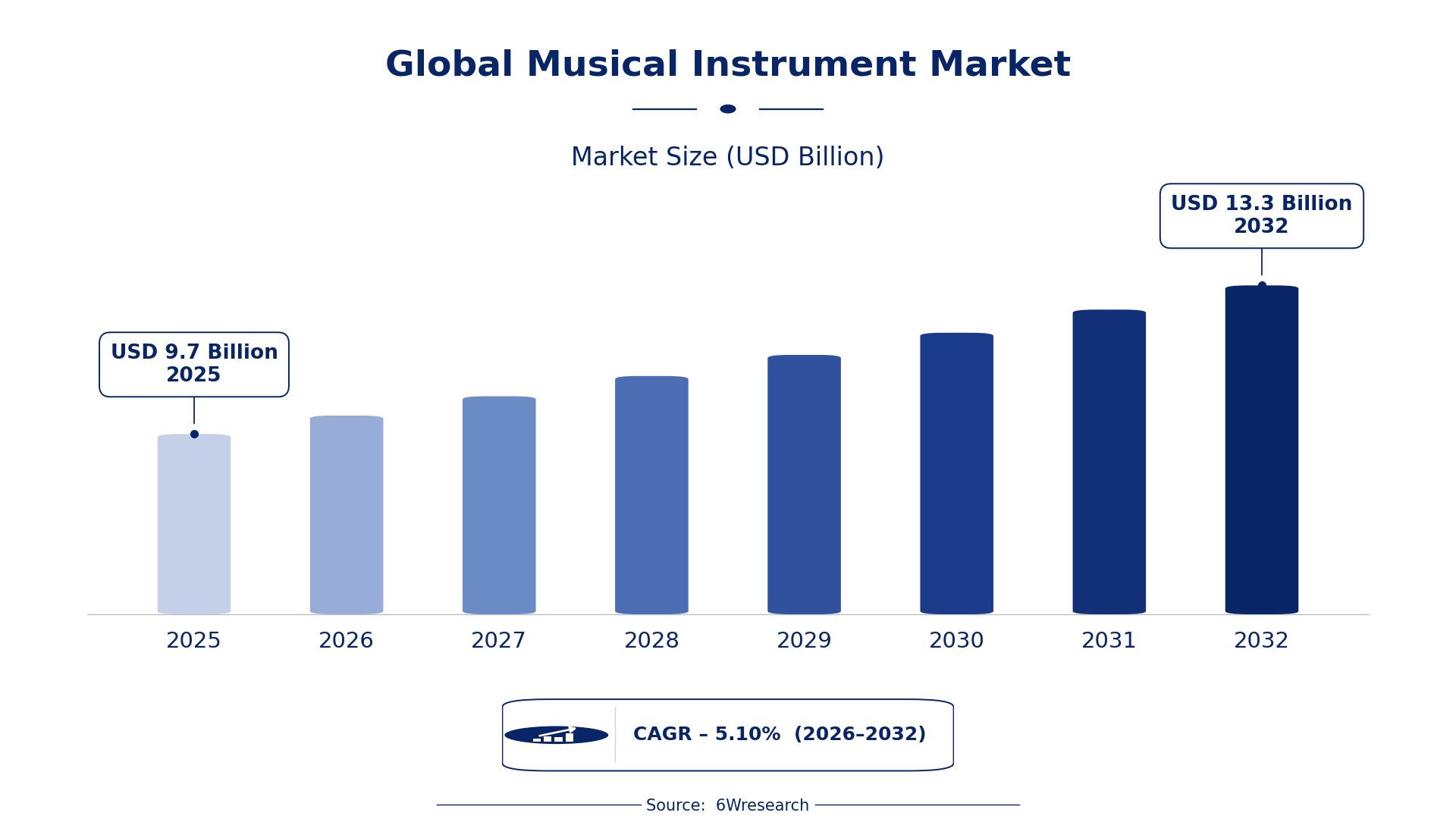
The Global Musical Instrument Market was estimated at USD 9.7 Billion in 2025 and is projected to reach USD 13.3 Billion by 2032, growing at a CAGR of 5.10% from 2026 to 2032.
Global Musical Instrument Market Synopsis
The Global Musical Instrument Market is currently witnessing a transformation, driven by an increasing number of individuals pursuing music as a hobby or profession. This shift is supported by ongoing innovations and the integration of technology into musical instruments, thereby broadening the appeal of music education worldwide. The industry's diversification into digital formats and products continues to redefine consumer engagement and interactions with music.
As consumers seek tools that adapt to their lifestyles, manufacturers are developing portable instruments and software applications. The shift towards online platforms for music lessons and community-driven music production also underscores the dynamic nature of this market. Such changes not only enhance accessibility but also contribute to the sustained growth trajectory of the Global Musical Instrument Market.
Global Musical Instrument Market Year-wise Growth Rate and Key Drivers
This graph illustrates the annual growth rates of the Global Musical Instrument Market from 2022 to 2032, highlighting a steady upward trajectory and projected expansion over the forecast period.
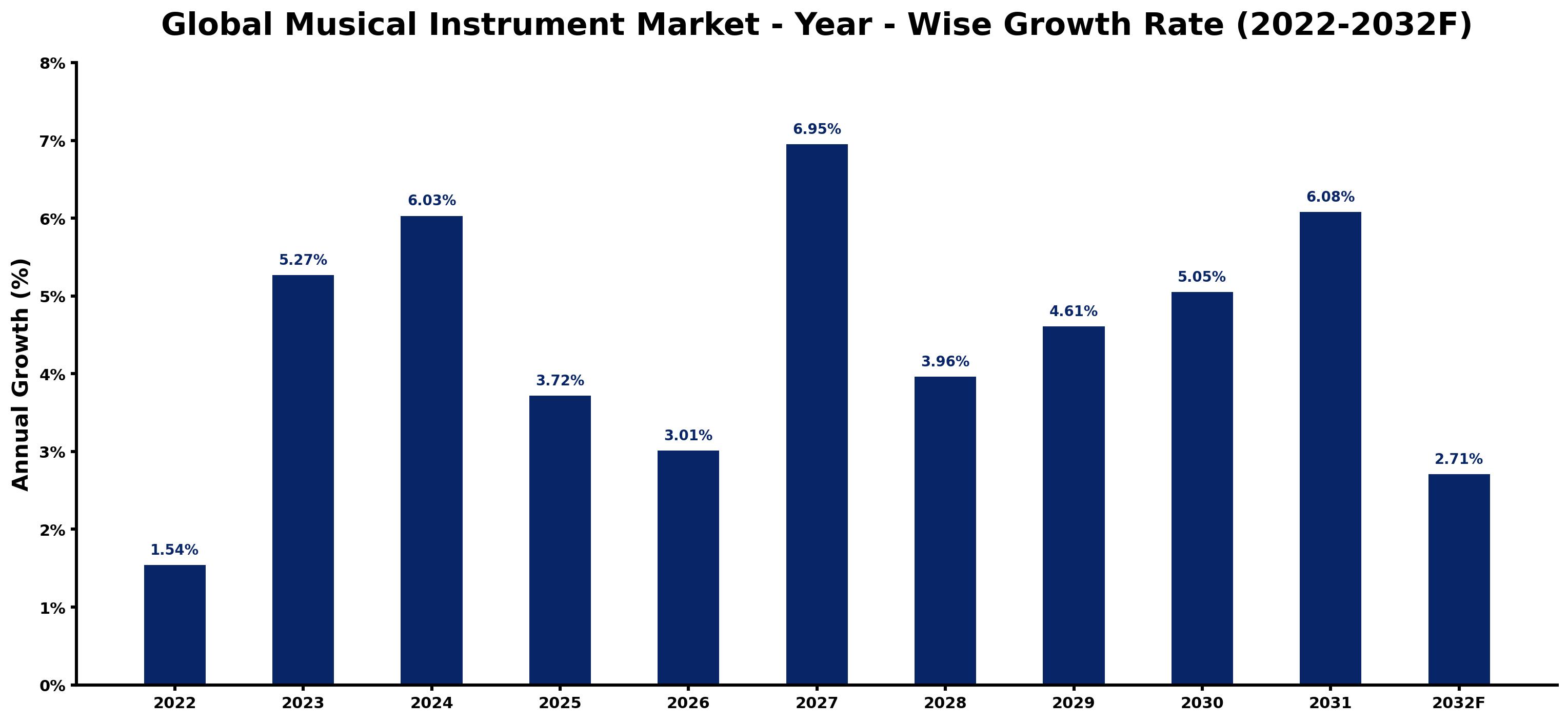
The table below presents the year‑wise growth rates along with the key drivers influencing the market
| Year | Growth Rate (%) | Major Drivers |
| 2022 | 1.54 | A growing skilled workforce in music production establishes fundamental support for the musical instrument market. |
| 2023 | 5.27 | Consumers are increasingly impacted by fluctuating raw material costs affecting musical instrument prices. |
| 2024 | 6.03 | Integrating sustainable practices into instrument manufacturing enhances market appeal to eco-conscious consumers. |
| 2025 | 3.72 | Manufacturers are adapting to increased competition by diversifying their musical instrument product offerings. |
| 2026 | 3.01 | In North America, evolving consumer preferences drive investment in unique and innovative musical instruments. |
| 2027 | 6.95 | While more musicians seek personalized experiences, demand for custom musical instruments is surging. |
| 2028 | 3.96 | Retail channels are compelled to comply with new policy changes affecting musical instrument sales. |
| 2029 | 4.61 | A growing focus on advanced digital technology redefines user interaction with innovative musical instruments. |
| 2030 | 5.05 | A shift toward international markets changes the distribution strategies for musical instruments companies. |
| 2031 | 6.08 | Streamlined supply chain processes enhance efficiency in delivering musical instruments to various retailers. |
| 2032 | 2.71 | The introduction of digital synthesizers and virtual instruments drives significant investment in the musical instrument market. |
Note - Market size estimations and growth projections presented in this report are based on 6Wresearch's proprietary research methodology, combining internal industry data, secondary research, and primary validation, updated periodically to reflect current market conditions. As markets evolve rapidly, figures for certain industries may vary slightly and are intended as informed estimates rather than absolute figures. For the most current market sizing, we recommend validating figures with a 6Wresearch analyst.
Global Musical Instrument Market Key Takeaways
Below are some of the specific key takeaways from the market, including:
- As of 2025, North America commands approximately 40% share of the Global Musical Instrument Market, highlighting its substantial consumer base.
- The Drums And Percussion Instruments segment is forecasted to grow at a CAGR of 6.5% from 2026 to 2032, reflecting a rising trend in rhythm-based music genres.
- In 2021, Fender sold over 400,000 electric guitars globally, underscoring their strong market presence and consumer interest.
- The digitization of music education tools is estimated to reach $3 billion in 2027, capturing the interest of institutions and independent learners alike.
Evaluation of Restraints in Global Musical Instrument Market
The Global Musical Instrument Market faces several challenges, particularly from the increasing competition posed by digital music platforms. For instance, software applications offering virtual instruments can cost as little as $20, significantly undercutting traditional instruments, which often exceed $300. A survey found that approximately 25% of musicians reported prioritizing digital solutions over purchasing physical instruments due to budget constraints. Additionally, counterfeiting remains a concern, impacting brand trust and recognition while complicating pricing structures across regions.
Global Musical Instrument Market Trends
A notable trend within the Global Musical Instrument Market is the rise of hybrid instruments that blend acoustic and electronic elements. Companies like Yamaha are now producing models, such as the silent piano, which enhance practice convenience while retaining traditional sound qualities. Similarly, the COVID-19 pandemic has accelerated the demand for online music lessons, with platforms reporting increases in user participation by 150% in 2020. Furthermore, the integration of mobile app functionalities with instruments, allowing live performance sharing and collaboration, is further reshaping the consumer experience, particularly among younger musicians seeking interconnectedness.
Global Musical Instrument Market Opportunities
The future of the Global Musical Instrument Market presents several revenue-generating opportunities, particularly in the realms of portable instruments and eco-friendly designs. For instance, Korg has successfully launched a line of compact synthesizers that integrate Bluetooth technology, which appeals to on-the-go musicians. This segment is expected to capture around 15% of the market by 2030. Another burgeoning opportunity lies in sustainable instrument production, which is projected to grow by 20% annually as consumer preferences lean towards environmentally responsible choices. This direction not only meets buyer demands but aligns with global eco-initiatives, ensuring long-term viability.
Global Musical Instrument Market by Product
String Instruments dominate the market, accounting for approximately 52% share in 2025. This popularity can be attributed to widespread consumer demand for guitars and violins, prevalent in various musical genres. In contrast, the Drums And Percussion Instruments segment is anticipated to have the fastest growth rate, with a CAGR of 6.5% from 2026 to 2032. The rising interest in rhythm-based music and ensemble performances positions this segment favorably for expansion, attracting both hobbyists and professionals alike.
Global Musical Instrument Market by Region
North America remains the largest region for the Global Musical Instrument Market, holding around 40% share in 2025, supported by a robust manufacturing ecosystem and music education institutions. Meanwhile, Asia is projected to be the fastest-growing region, fostering a CAGR of 7% from 2026 to 2032, driven by an expanding middle class eager to pursue musical education and leisure. Investments in local music programs and retail expansions further contribute to this growth dynamic, positioning Asia as a key player in the market's future.
Government Initiatives in the Global Musical Instrument Market
The regulatory environment surrounding the Global Musical Instrument Market plays a crucial role in shaping industry dynamics. Various government initiatives aim to support music education, enhance cultural participation, and promote local manufacturing. These initiatives often provide funding to encourage innovation and accessibility in music-making.
- The National Endowment for the Arts launched the “Creative Forces” initiative in 2020 to provide music therapy resources, fostering musicianship among veterans and military families.
- The UK’s Arts Council announced a £25 million investment in 2021 aimed at supporting music education programs across schools, helping to develop future generations of musicians.
- In 2023, the Ministry of Culture in India introduced the “Music for Development” scheme to provide grants for music education in underserved areas, promoting inclusivity in musical training.
- The Canadian Council for the Arts is preparing to implement a funding program in 2024 specifically for local instrument manufacturers to boost craftsmanship and sustainability in production.
Future Insights of the Global Musical Instrument Market
As the Global Musical Instrument Market evolves, a substantial transition towards sustainability and digital integration is anticipated. This evolution is illustrated by Yamaha's development of eco-friendly wood sourcing initiatives, which address both consumer preferences and environmental concerns. As connectivity through mobile applications becomes standard, the shift towards instruments that can easily integrate with technology will create new usage patterns. Enhanced production methods, particularly focused on portable instruments, are also expected to emerge, responding to the lifestyle changes of modern musicians.
Global Musical Instrument Market Latest Developments
Recent advancements within the Global Musical Instrument Market highlight innovation and strategic expansion among key players. The following developments showcase significant movements in the industry:
- In September 2023, Roland Corporation launched a line of MIDI-enabled acoustic pianos, enhancing compositional capabilities for musicians.
- Recently, Fender Musical Instruments Corporation expanded its manufacturing facility in Mexico to increase production capacity, addressing higher demand for electric guitars.
- In August 2023, Korg Inc. introduced a limited edition synthesizer model, appealing to collectors and electronic musicians, generating significant buzz in the market.
- Upcoming in early 2024, Gibson Brands Inc. plans to unveil a new custom shop series that incorporates sustainable materials, aligning its product offerings with eco-conscious consumer trends.
Global Musical Instrument Market Key Players and Industry Positioning
The Global Musical Instrument Market is characterized by a fragmented competitive structure, with numerous companies vying for market share across various segments. Each company differentiates itself through a combination of product innovation, regional presence, and unique brand positioning, catering to distinct consumer preferences.
| Leading Company | Core Strength | Strategic Focus |
|---|---|---|
| Fender Musical Instruments Corporation | Iconic brand known for electric guitars | Expanding production capabilities and product diversity |
| Yamaha Corporation | Broad range of high-quality instruments | Sustainability and innovation in manufacturing processes |
| Roland Corporation | Leadership in electronic instruments and technology | Integration of digital technologies into traditional sound |
| Korg Inc. | Pioneering synthesizers and electronic instruments | Targeting niche markets with unique product offerings |
| Gibson Brands Inc. | Reputation for quality and craftsmanship in guitars | Focus on premium and sustainable instrument options |
The interplay among these companies fosters innovation and drives competition, creating a vibrant environment for the Global Musical Instrument Market to thrive.
Key Attractiveness of the Report
- 10 Years of Market Numbers
- Historical Data Starting from 2022 to 2025
- Base Year: 2025
- Forecast Data until 2032
- Key Performance Indicators Impacting the Market
- Major Upcoming Developments and Projects
Key Highlights of the Report:
- Global Musical Instrument Market Outlook
- Market Size of Global Musical Instrument Market, 2025
- Forecast of Global Musical Instrument Market, 2032
- Historical Data and Forecast of Global Musical Instrument Revenues & Volume for the Period 2022-2032
- Global Musical Instrument Market Trend Evolution
- Global Musical Instrument Market Drivers and Challenges
- Global Musical Instrument Price Trends
- Global Musical Instrument Porter's Five Forces
- Global Musical Instrument Industry Life Cycle
- Historical Data and Forecast of Global Musical Instrument Market Revenues & Volume
- Historical Data and Forecast of Global Musical Instrument Market Revenues & Volume By Product for the Period 2022-2032
- Historical Data and Forecast of Global Musical Instrument Market Revenues & Volume By String Instruments for the Period 2022-2032
- Historical Data and Forecast of Global Musical Instrument Market Revenues & Volume By Pianos And Keyboards for the Period 2022-2032
- Historical Data and Forecast of Global Musical Instrument Market Revenues & Volume By Drums And Percussion Instruments for the Period 2022-2032
- Historical Data and Forecast of Global Musical Instrument Market Revenues & Volume By Others for the Period 2022-2032
- Historical Data and Forecast of North America Musical Instrument Market Revenues & Volume By Product for the Period 2022-2032
- Historical Data and Forecast of North America Musical Instrument Market Revenues & Volume By String Instruments for the Period 2022-2032
- Historical Data and Forecast of North America Musical Instrument Market Revenues & Volume By Pianos And Keyboards for the Period 2022-2032
- Historical Data and Forecast of North America Musical Instrument Market Revenues & Volume By Drums And Percussion Instruments for the Period 2022-2032
- Historical Data and Forecast of North America Musical Instrument Market Revenues & Volume By Others for the Period 2022-2032
- Historical Data and Forecast of United States of America Musical Instrument Market Revenues & Volume for the Period 2022-2032
- Historical Data and Forecast of Canada Musical Instrument Market Revenues & Volume for the Period 2022-2032
- Historical Data and Forecast of Rest of North America Musical Instrument Market Revenues & Volume for the Period 2022-2032
- Historical Data and Forecast of Latin America (LATAM) Musical Instrument Market Revenues & Volume By Product for the Period 2022-2032
- Historical Data and Forecast of Latin America (LATAM) Musical Instrument Market Revenues & Volume By String Instruments for the Period 2022-2032
- Historical Data and Forecast of Latin America (LATAM) Musical Instrument Market Revenues & Volume By Pianos And Keyboards for the Period 2022-2032
- Historical Data and Forecast of Latin America (LATAM) Musical Instrument Market Revenues & Volume By Drums And Percussion Instruments for the Period 2022-2032
- Historical Data and Forecast of Latin America (LATAM) Musical Instrument Market Revenues & Volume By Others for the Period 2022-2032
- Historical Data and Forecast of Brazil Musical Instrument Market Revenues & Volume for the Period 2022-2032
- Historical Data and Forecast of Mexico Musical Instrument Market Revenues & Volume for the Period 2022-2032
- Historical Data and Forecast of Argentina Musical Instrument Market Revenues & Volume for the Period 2022-2032
- Historical Data and Forecast of Rest of LATAM Musical Instrument Market Revenues & Volume for the Period 2022-2032
- Historical Data and Forecast of Asia Musical Instrument Market Revenues & Volume By Product for the Period 2022-2032
- Historical Data and Forecast of Asia Musical Instrument Market Revenues & Volume By String Instruments for the Period 2022-2032
- Historical Data and Forecast of Asia Musical Instrument Market Revenues & Volume By Pianos And Keyboards for the Period 2022-2032
- Historical Data and Forecast of Asia Musical Instrument Market Revenues & Volume By Drums And Percussion Instruments for the Period 2022-2032
- Historical Data and Forecast of Asia Musical Instrument Market Revenues & Volume By Others for the Period 2022-2032
- Historical Data and Forecast of China Musical Instrument Market Revenues & Volume for the Period 2022-2032
- Historical Data and Forecast of India Musical Instrument Market Revenues & Volume for the Period 2022-2032
- Historical Data and Forecast of Japan Musical Instrument Market Revenues & Volume for the Period 2022-2032
- Historical Data and Forecast of Rest of Asia Musical Instrument Market Revenues & Volume for the Period 2022-2032
- Historical Data and Forecast of Africa Musical Instrument Market Revenues & Volume By Product for the Period 2022-2032
- Historical Data and Forecast of Africa Musical Instrument Market Revenues & Volume By String Instruments for the Period 2022-2032
- Historical Data and Forecast of Africa Musical Instrument Market Revenues & Volume By Pianos And Keyboards for the Period 2022-2032
- Historical Data and Forecast of Africa Musical Instrument Market Revenues & Volume By Drums And Percussion Instruments for the Period 2022-2032
- Historical Data and Forecast of Africa Musical Instrument Market Revenues & Volume By Others for the Period 2022-2032
- Historical Data and Forecast of South Africa Musical Instrument Market Revenues & Volume for the Period 2022-2032
- Historical Data and Forecast of Nigeria Musical Instrument Market Revenues & Volume for the Period 2022-2032
- Historical Data and Forecast of Egypt Musical Instrument Market Revenues & Volume for the Period 2022-2032
- Historical Data and Forecast of Rest of Africa Musical Instrument Market Revenues & Volume for the Period 2022-2032
- Historical Data and Forecast of Europe Musical Instrument Market Revenues & Volume By Product for the Period 2022-2032
- Historical Data and Forecast of Europe Musical Instrument Market Revenues & Volume By String Instruments for the Period 2022-2032
- Historical Data and Forecast of Europe Musical Instrument Market Revenues & Volume By Pianos And Keyboards for the Period 2022-2032
- Historical Data and Forecast of Europe Musical Instrument Market Revenues & Volume By Drums And Percussion Instruments for the Period 2022-2032
- Historical Data and Forecast of Europe Musical Instrument Market Revenues & Volume By Others for the Period 2022-2032
- Historical Data and Forecast of United Kingdom Musical Instrument Market Revenues & Volume for the Period 2022-2032
- Historical Data and Forecast of France Musical Instrument Market Revenues & Volume for the Period 2022-2032
- Historical Data and Forecast of Germany Musical Instrument Market Revenues & Volume for the Period 2022-2032
- Historical Data and Forecast of Rest of Europe Musical Instrument Market Revenues & Volume for the Period 2022-2032
- Historical Data and Forecast of Middle East Musical Instrument Market Revenues & Volume By Product for the Period 2022-2032
- Historical Data and Forecast of Middle East Musical Instrument Market Revenues & Volume By String Instruments for the Period 2022-2032
- Historical Data and Forecast of Middle East Musical Instrument Market Revenues & Volume By Pianos And Keyboards for the Period 2022-2032
- Historical Data and Forecast of Middle East Musical Instrument Market Revenues & Volume By Drums And Percussion Instruments for the Period 2022-2032
- Historical Data and Forecast of Middle East Musical Instrument Market Revenues & Volume By Others for the Period 2022-2032
- Historical Data and Forecast of Saudi Arabia Musical Instrument Market Revenues & Volume for the Period 2022-2032
- Historical Data and Forecast of UAE Musical Instrument Market Revenues & Volume for the Period 2022-2032
- Historical Data and Forecast of Turkey Musical Instrument Market Revenues & Volume for the Period 2022-2032
- Historical Data and Forecast of Rest of Middle East Musical Instrument Market Revenues & Volume for the Period 2022-2032
- Global Musical Instrument Market - Key Performance Indicators
- Global Musical Instrument Market - Import Export Trade Statistics
- Global Musical Instrument Market - Opportunity Assessment By Countries
- Global Musical Instrument Market - Opportunity Assessment By Product
- 0
- Global Musical Instrument Market - Top Companies Market Share
- Global Musical Instrument Market - Top Companies Profiles
- Global Musical Instrument Market - Comparison of Players in Technical and Operating Parameters
- Global Musical Instrument Market - Strategic Recommendations
Markets Covered
The Global Musical Instrument Market report provides a detailed analysis of the following market segments:
By Regions and Countries:
- North America
- Europe
- LATAM
- Middle East
- Asia
- Africa
By Product:
- String Instruments
- Pianos And Keyboards
- Drums And Percussion Instruments
- Others






































