United States (US) Nail Gun Market Size, Share & Growth Rate
The United States (US) Nail Gun Market was estimated at USD 484 Million in 2025 and is projected to reach USD 658 Million by 2032, growing at a CAGR of 4.5% from 2026 to 2032. This upward trend is primarily fueled by heightened activity within the construction sector, alongside a surge in home renovation initiatives that have gained traction. Additionally, the adoption of innovative technologies in nail gun designs—most notably cordless and lightweight models—continues to reshape the landscape, catering to the evolving preferences of both professionals and DIY enthusiasts.
United States (US) Nail Gun Market Year-wise Growth Rate and Key Drivers
This graph highlights how the United States (US) Nail Gun Market has steadily grown over the years, supported by major growth factors.
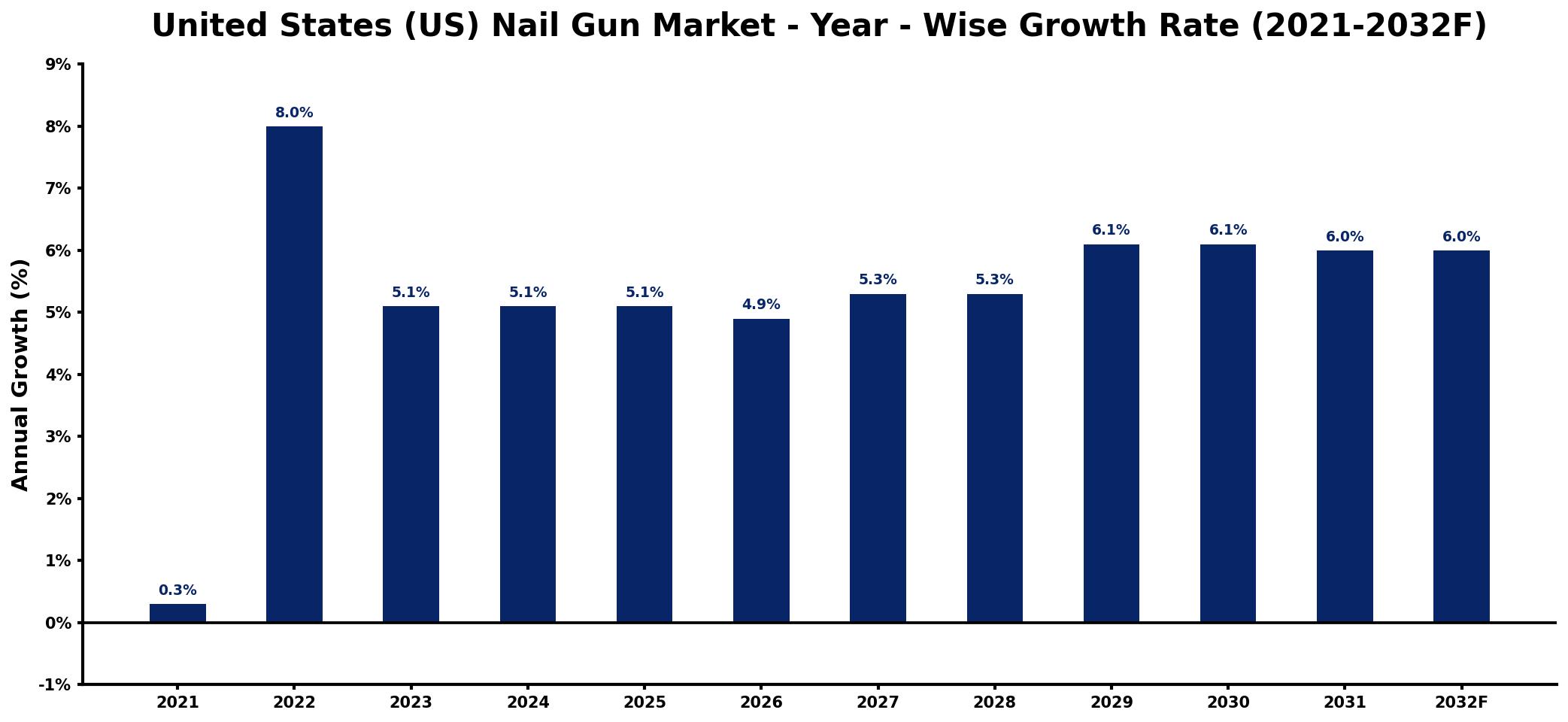
The table below presents the year‑wise growth rates along with the key drivers influencing the market
| Year | Growth Rate | Major Drivers |
| 2021 | 0.3% | Construction sector recovery momentum |
| 2022 | 8.0% | Rising residential renovation projects |
| 2023 | 5.1% | Increased infrastructure investment initiatives |
| 2024 | 5.1% | Growth in commercial construction activities |
| 2025 | 5.1% | Surge in DIY home improvement |
| 2026 | 4.9% | Expansion of manufacturing capabilities |
| 2027 | 5.3% | Technological advancements in automation |
| 2028 | 5.3% | Growing demand from woodworking industry |
| 2029 | 6.1% | Strengthening e-commerce distribution channels |
| 2030 | 6.1% | Rising popularity of sustainable building |
| 2031 | 6.0% | Increasing focus on safety standards |
| 2032 | 6.0% | Enhanced training programs for workforce |
Note: Market size estimations and growth projections presented in this report are based on 6Wresearch's proprietary forecasting methodology, utilizing the latest available industry data, government publications, and primary research inputs.
United States (US) Nail Gun Market Synopsis
While the US Nail Gun Market has recently benefited from a construction boom, it is now transitioning towards more advanced solutions to meet the changing needs of the industry. Increased awareness of safety and ergonomics is propelling manufacturers to innovate, focusing on enhanced features and design improvements.
As the demand for efficient tools rises, the market is expected to shift towards sustainable practices and environmentally friendly options. The trends indicate a positive trajectory, with investments in product development likely to drive growth in the coming years.
United States (US) Nail Gun Market Key Takeaways
- The market is driven by a robust construction sector and increasing home renovation activities.
- Cordless nail guns are becoming a preferred choice due to their portability and ease of use.
- Safety features and ergonomic designs are pivotal in shaping consumer preferences.
- Technological advancements are leading to a demand for more efficient, lightweight models.
- The emphasis on environmentally friendly products is creating new avenues for market growth.
Evaluation of Restraints in United States (US) Nail Gun Market
The United States Nail Gun Market encounters several restraints that could impede its growth trajectory. Increasing competition from international manufacturers that offer cost-effective alternatives poses a significant challenge. Additionally, evolving safety regulations compel manufacturers to invest heavily in research and development to enhance safety features, which can impact profit margins. The fluctuating economic landscape further complicates demand predictability, as downturns in construction activity can directly affect nail gun sales.
United States (US) Nail Gun Market Trends
A notable trend in the US Nail Gun Market is the rising demand for cordless models. These tools offer unmatched convenience and mobility, appealing to both professionals and DIY enthusiasts. Additionally, users are increasingly gravitating towards nail guns equipped with advanced technologies, such as brushless motors that provide greater efficiency and durability. The ongoing pursuit of lightweight, compact designs is also prevalent, as it aids in minimizing user fatigue, particularly during extended projects. This focus on comfort and performance is expected to drive innovation and sales in the market.
United States (US) Nail Gun Market Opportunities
The United States Nail Gun Market offers numerous opportunities for growth, particularly through investments in innovative technologies. As construction companies prioritize efficiency, demand for advanced tools that enhance productivity will likely increase. Furthermore, the trend toward sustainable building practices is leading to a surge in interest for eco-friendly nail guns with lower carbon footprints. Companies that leverage effective marketing and distribution channels can tap into diverse customer segments, ranging from professional contractors to DIY hobbyists, expanding their market reach significantly.
Government Initiatives in the United States (US) Nail Gun Market
While there are no specific policies targeting the nail gun market, the Occupational Safety and Health Administration (OSHA) regulates workplace safety to ensure the safe use of nail guns. Employers are mandated to provide adequate training for employees on handling and operating these tools to prevent accidents. Additionally, OSHA guidelines necessitate the incorporation of safety mechanisms, such as sequential triggers, to reduce the risk of unintended discharges. Adhering to these regulations is essential for market players to maintain compliance and ensure worker safety.
Future Insights of the United States (US) Nail Gun Market
Looking ahead to the period from 2026 to 2032, the United States Nail Gun Market is poised for continued growth, primarily due to the thriving construction sector, increased renovation activities, and a burgeoning DIY culture. The ongoing advancements in nail gun technology will further drive demand, particularly for battery-powered and cordless models that offer enhanced portability and user convenience. Moreover, infrastructure development projects at the federal and state levels are expected to provide an additional boost to market prospects, making it an exciting time for industry stakeholders.
United States (US) Nail Gun Market Latest Developments (2025 - 2026)
Recent industry developments indicate a growing focus on product innovation, with manufacturers unveiling new nail gun models that prioritize safety and efficiency. There is an increasing trend of integrating smart technologies, allowing for improved performance monitoring and enhanced user experience. Additionally, as sustainability becomes a central theme in construction, some companies are exploring ways to reduce the environmental impact of nail gun production, including sourcing eco-friendly materials and adopting greener manufacturing processes.
United States (US) Nail Gun Market - Key Attractiveness of the Report
- 10 Years of Market Numbers
- Historical Data Starting from 2022 to 2025
- Base Year: 2025
- Forecast Data until 2032
- Key Performance Indicators Impacting the Market
- Major Upcoming Developments and Projects
Key Highlights of the Report:
- United States (US) Nail Gun Market Outlook
- Market Size of United States (US) Nail Gun Market, 2025
- Forecast of United States (US) Nail Gun Market, 2032
- Historical Data and Forecast of United States (US) Nail Gun Revenues & Volume for the Period 2022-2032F
- United States (US) Nail Gun Market Trend Evolution
- United States (US) Nail Gun Market Drivers and Challenges
- United States (US) Nail Gun Price Trends
- United States (US) Nail Gun Porter's Five Forces
- United States (US) Nail Gun Industry Life Cycle
- Historical Data and Forecast of United States (US) Nail Gun Market Revenues & Volume By Product Type for the Period 2022-2032F
- Historical Data and Forecast of United States (US) Nail Gun Market Revenues & Volume By Pneumatic Nail Gun for the Period 2022-2032F
- Historical Data and Forecast of United States (US) Nail Gun Market Revenues & Volume By Combustion Powered Nail Gun for the Period 2022-2032F
- Historical Data and Forecast of United States (US) Nail Gun Market Revenues & Volume By Electric Nail Gun for the Period 2022-2032F
- Historical Data and Forecast of United States (US) Nail Gun Market Revenues & Volume By others for the Period 2022-2032F
- Historical Data and Forecast of United States (US) Nail Gun Market Revenues & Volume By Application for the Period 2022-2032F
- Historical Data and Forecast of United States (US) Nail Gun Market Revenues & Volume By Construction Engineering for the Period 2022-2032F
- Historical Data and Forecast of United States (US) Nail Gun Market Revenues & Volume By Residential Decoration for the Period 2022-2032F
- United States (US) Nail Gun Import Export Trade Statistics
- Market Opportunity Assessment By Product Type
- Market Opportunity Assessment By Application
- United States (US) Nail Gun Top Companies Market Share
- United States (US) Nail Gun Competitive Benchmarking By Technical and Operational Parameters
- United States (US) Nail Gun Company Profiles
- United States (US) Nail Gun Key Strategic Recommendations






































