United States (US) Nuclear Imaging Market Size, Share & Growth Rate
The United States (US) Nuclear Imaging Market was estimated at USD 182 Million in 2025 and is projected to reach USD 213 Million by 2032, growing at a CAGR of 2.3% from 2026 to 2032. This growth trajectory is primarily driven by the rising incidence of chronic diseases, particularly cancer and cardiovascular ailments, which necessitate advanced diagnostic tools. Furthermore, continuous advancements in imaging technologies, alongside an increasing patient preference for minimally invasive procedures, are contributing significantly to the markets expansion.
United States (US) Nuclear Imaging Market Year-wise Growth Rate and Key Drivers
This graph highlights how the United States (US) Nuclear Imaging Market has steadily grown over the years, supported by major growth factors.
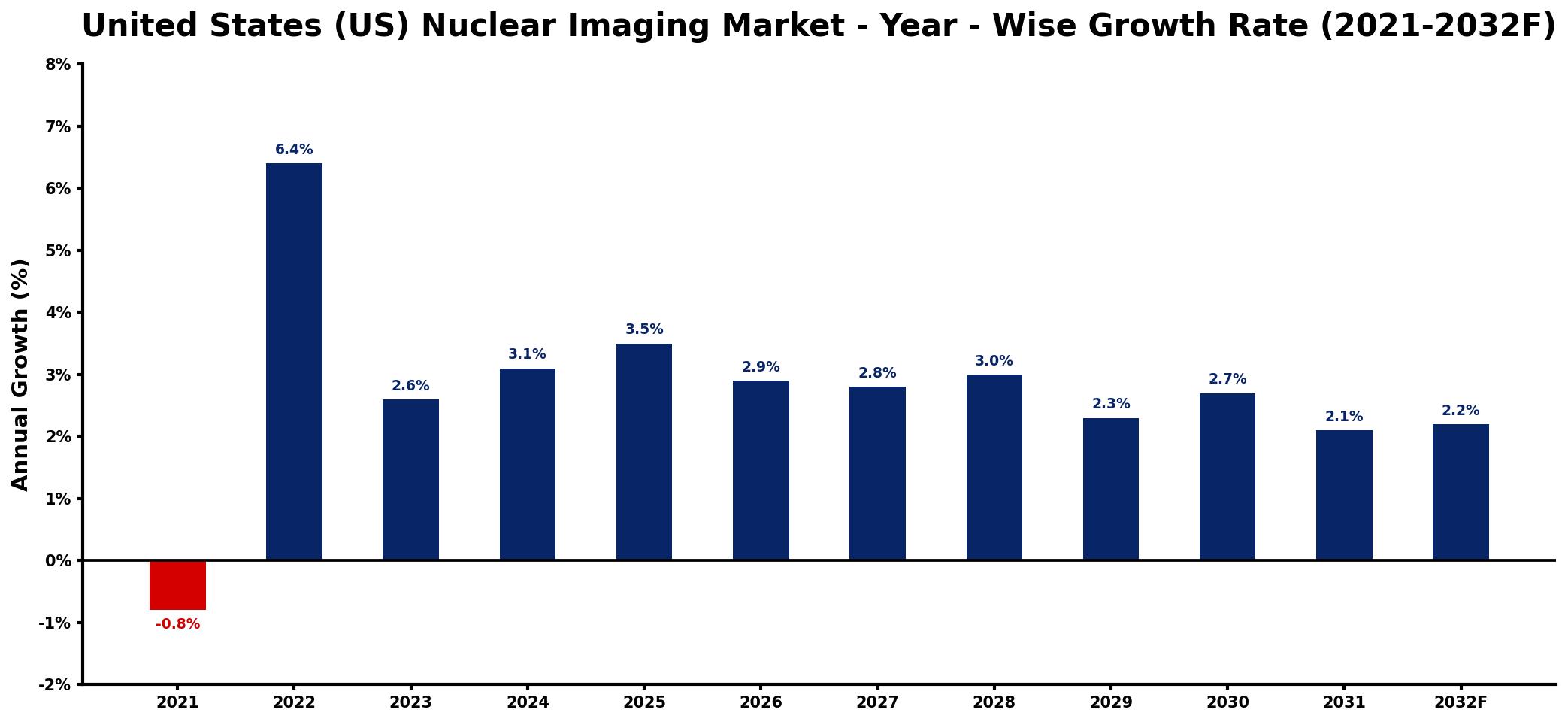
The table below presents the year‑wise growth rates along with the key drivers influencing the market
| Year | Growth Rate | Major Drivers |
| 2021 | -0.8% | decreased healthcare funding and investments |
| 2022 | 6.4% | increased demand for diagnostics |
| 2023 | 2.6% | growing prevalence of chronic diseases |
| 2024 | 3.1% | advancements in technology adoption |
| 2025 | 3.5% | rising healthcare expenditure nationwide |
| 2026 | 2.9% | expansion of healthcare facilities |
| 2027 | 2.8% | enhanced patient awareness and education |
| 2028 | 3.0% | increased collaborations in research |
| 2029 | 2.3% | growing number of specialists |
| 2030 | 2.7% | rising support for preventive care |
| 2031 | 2.1% | increased focus on personalized medicine |
| 2032 | 2.2% | expanding telehealth service offerings |
Note: Market size estimations and growth projections presented in this report are based on 6Wresearch's proprietary forecasting methodology, utilizing the latest available industry data, government publications, and primary research inputs.
United States (US) Nuclear Imaging Market Synopsis
The demand for nuclear imaging in the US is underscored by a significant increase in diagnostic procedures that leverage SPECT and PET technologies. These modalities are integral in providing precise imaging for conditions such as oncology and cardiology, facilitating timely and effective treatment decisions.
Additionally, the market is bolstered by heightened awareness regarding early disease detection and monitoring, prompting healthcare providers to integrate nuclear imaging into routine diagnostic protocols. This growing integration reflects an overall trend toward enhancing patient outcomes through improved imaging methodologies.
United States (US) Nuclear Imaging Market Key Takeaways
- The rising prevalence of chronic diseases is a primary driver of nuclear imaging demand.
- Technological advancements are leading to more efficient and accurate imaging systems.
- There is a noticeable trend toward hybrid imaging systems, enhancing diagnostic capabilities.
- Government policies are supporting the safe use of nuclear imaging through regulatory oversight.
- Investment in research and development is crucial for future innovations in the market.
Evaluation of Restraints in United States (US) Nuclear Imaging Market
Despite the promising outlook, the US Nuclear Imaging Market grapples with several restraints. Stringent regulatory requirements for the use of radioactive materials complicate operational workflows and increase costs for healthcare providers. Additionally, the reimbursement landscape poses challenges; the policies governing nuclear imaging services can be inconsistent and frequently altered, affecting financial planning. Furthermore, competition from alternative imaging modalities like MRI and CT scans, which do not involve radiation exposure, adds pressure on the nuclear imaging segment to demonstrate clear advantages in diagnostic efficacy.
United States (US) Nuclear Imaging Market Trends
The landscape of the US Nuclear Imaging Market is evolving rapidly, with several key trends emerging. The shift towards hybrid imaging technologies, notably SPECT/CT and PET/CT, is gaining traction as these systems provide superior image resolution and accuracy. Moreover, the development of digital detectors and sophisticated software for image reconstruction is enhancing the overall diagnostic capabilities. There's also an increasing focus on personalized medicine, driving demand for tailored nuclear imaging procedures that align with patient-specific needs.
United States (US) Nuclear Imaging Market Opportunities
Investment opportunities abound in the US Nuclear Imaging Market, particularly in the realm of technological advancements. The creation of innovative imaging systems, characterized by enhanced image quality and reduced scan durations, holds significant promise. Additionally, the production of advanced radiopharmaceuticals presents a lucrative avenue for growth. The industry is poised for expansion, particularly in response to the rising elderly population and the demand for precise diagnostic tools.
Government Initiatives in the United States (US) Nuclear Imaging Market
In the United States, government policies play a pivotal role in shaping the Nuclear Imaging Market. The Nuclear Regulatory Commission (NRC) is responsible for overseeing the application of radioactive materials in medical imaging, ensuring compliance with safety standards. Meanwhile, the Centers for Medicare & Medicaid Services (CMS) influence market dynamics through their reimbursement guidelines, which significantly affect healthcare providers' use of nuclear imaging services. Moreover, ongoing public funding for research and technological advancements further supports innovation within the sector.
Future Insights of the United States (US) Nuclear Imaging Market
Looking ahead to 2026-2032, the US Nuclear Imaging Market is expected to maintain a steady growth trajectory. With an increasing burden of chronic diseases and an aging population, the need for accurate diagnostic tools is anticipated to soar. The rising popularity of hybrid systems, integrating nuclear imaging with other modalities, is likely to drive further adoption. Although challenges remain, particularly in regulatory and reimbursement areas, the markets potential for innovation and investment presents a bright outlook for stakeholders.
United States (US) Nuclear Imaging Market Latest Developments (2025 - 2026)
Recent developments in the US Nuclear Imaging Market include advancements in imaging technology and the adoption of digital platforms for improved diagnostic workflows. There is a notable increase in collaborations among research institutions and healthcare providers aimed at developing next-generation imaging systems. Furthermore, industry stakeholders are focusing on enhancing patient comfort and safety by optimizing dose levels during imaging procedures, aligning with a broader movement towards patient-centered care.
United States (US) Nuclear Imaging Market - Key Attractiveness of the Report
- 10 Years of Market Numbers
- Historical Data Starting from 2022 to 2025
- Base Year: 2025
- Forecast Data until 2032
- Key Performance Indicators Impacting the Market
- Major Upcoming Developments and Projects
Key Highlights of the Report:
- United States (US) Nuclear Imaging Market Outlook
- Market Size of United States (US) Nuclear Imaging Market, 2025
- Forecast of United States (US) Nuclear Imaging Market, 2032
- Historical Data and Forecast of United States (US) Nuclear Imaging Revenues & Volume for the Period 2022-2032F
- United States (US) Nuclear Imaging Market Trend Evolution
- United States (US) Nuclear Imaging Market Drivers and Challenges
- United States (US) Nuclear Imaging Price Trends
- United States (US) Nuclear Imaging Porter's Five Forces
- United States (US) Nuclear Imaging Industry Life Cycle
- Historical Data and Forecast of United States (US) Nuclear Imaging Market Revenues & Volume By Product for the Period 2022-2032F
- Historical Data and Forecast of United States (US) Nuclear Imaging Market Revenues & Volume By Single Photon-Emission Computed Tomography (SPECT) for the Period 2022-2032F
- Historical Data and Forecast of United States (US) Nuclear Imaging Market Revenues & Volume By Hybrid Pet for the Period 2022-2032F
- Historical Data and Forecast of United States (US) Nuclear Imaging Market Revenues & Volume By Planar Scintigraphy for the Period 2022-2032F
- Historical Data and Forecast of United States (US) Nuclear Imaging Market Revenues & Volume By Application for the Period 2022-2032F
- Historical Data and Forecast of United States (US) Nuclear Imaging Market Revenues & Volume By Oncology for the Period 2022-2032F
- Historical Data and Forecast of United States (US) Nuclear Imaging Market Revenues & Volume By Cardiology for the Period 2022-2032F
- Historical Data and Forecast of United States (US) Nuclear Imaging Market Revenues & Volume By Neurology for the Period 2022-2032F
- Historical Data and Forecast of United States (US) Nuclear Imaging Market Revenues & Volume By Others for the Period 2022-2032F
- Historical Data and Forecast of United States (US) Nuclear Imaging Market Revenues & Volume By Portability for the Period 2022-2032F
- Historical Data and Forecast of United States (US) Nuclear Imaging Market Revenues & Volume By Pocket-Sized/Handheld Device for the Period 2022-2032F
- Historical Data and Forecast of United States (US) Nuclear Imaging Market Revenues & Volume By Fixed for the Period 2022-2032F
- Historical Data and Forecast of United States (US) Nuclear Imaging Market Revenues & Volume By End user for the Period 2022-2032F
- Historical Data and Forecast of United States (US) Nuclear Imaging Market Revenues & Volume By Hospitals for the Period 2022-2032F
- Historical Data and Forecast of United States (US) Nuclear Imaging Market Revenues & Volume By Imaging Centers for the Period 2022-2032F
- Historical Data and Forecast of United States (US) Nuclear Imaging Market Revenues & Volume By Academic and Research Centers for the Period 2022-2032F
- Historical Data and Forecast of United States (US) Nuclear Imaging Market Revenues & Volume By Others for the Period 2022-2032F
- United States (US) Nuclear Imaging Import Export Trade Statistics
- Market Opportunity Assessment By Product
- Market Opportunity Assessment By Application
- Market Opportunity Assessment By Portability
- Market Opportunity Assessment By End user
- United States (US) Nuclear Imaging Top Companies Market Share
- United States (US) Nuclear Imaging Competitive Benchmarking By Technical and Operational Parameters
- United States (US) Nuclear Imaging Company Profiles
- United States (US) Nuclear Imaging Key Strategic Recommendations






































