United States Perfumes & Deodorants Market Growth Rate Analysis (2025 - 2031)
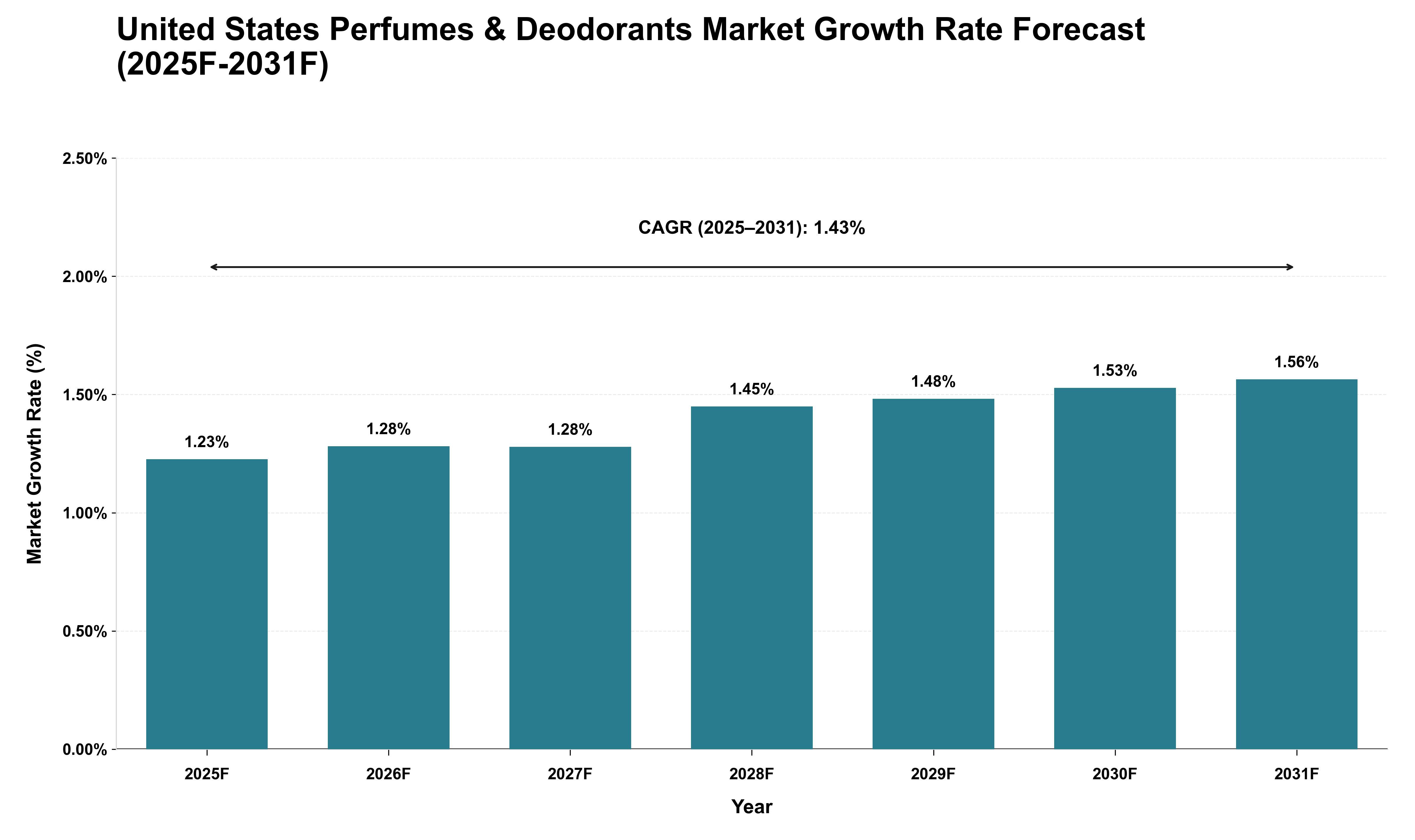
The projected growth trajectory for the United States perfumes and deodorants market will exhibit a gradual acceleration, with the annual growth rate increasing from 1.23% in 2025 to 1.56% by 2031. This trend reflects a broader macroeconomic shift towards enhanced consumer preferences for personalized and sustainable fragrance options, driven by technological advancements in formulation and packaging. As innovation continues to reshape product offerings, brands are likely to leverage digital platforms for targeted marketing and distribution, further stimulating demand. Additionally, the anticipated rise in disposable income will enable consumers to invest more in premium products, while import dependencies on raw materials may influence pricing dynamics. The cyclical nature of consumer spending on personal care items suggests that as economic conditions improve, spending on non-essential goods like perfumes and deodorants will also increase, supporting this upward growth trajectory throughout the forecast period.
Key Highlights of the Report:
- United States (US) Perfumes & Deodorants Market Outlook
- Market Size of United States (US) Perfumes & Deodorants Market, 2024
- Forecast of United States (US) Perfumes & Deodorants Market, 2026
- Historical Data and Forecast of United States (US) Perfumes & Deodorants Revenues & Volume for the Period 2021 - 2031
- United States (US) Perfumes & Deodorants Market Trend Evolution
- United States (US) Perfumes & Deodorants Market Drivers and Challenges
- United States (US) Perfumes & Deodorants Price Trends
- United States (US) Perfumes & Deodorants Porter's Five Forces
- United States (US) Perfumes & Deodorants Industry Life Cycle
- Historical Data and Forecast of United States (US) Perfumes & Deodorants Market Revenues & Volume By Product Types for the Period 2021 - 2031
- Historical Data and Forecast of United States (US) Perfumes & Deodorants Market Revenues & Volume By Deodorants for the Period 2021 - 2031
- Historical Data and Forecast of United States (US) Perfumes & Deodorants Market Revenues & Volume By Perfumes for the Period 2021 - 2031
- Historical Data and Forecast of United States (US) Perfumes & Deodorants Market Revenues & Volume By Consumer Group for the Period 2021 - 2031
- Historical Data and Forecast of United States (US) Perfumes & Deodorants Market Revenues & Volume By Men for the Period 2021 - 2031
- Historical Data and Forecast of United States (US) Perfumes & Deodorants Market Revenues & Volume By Women for the Period 2021 - 2031
- Historical Data and Forecast of United States (US) Perfumes & Deodorants Market Revenues & Volume By Unisex for the Period 2021 - 2031
- Historical Data and Forecast of United States (US) Perfumes & Deodorants Market Revenues & Volume By Distribution Channel for the Period 2021 - 2031
- Historical Data and Forecast of United States (US) Perfumes & Deodorants Market Revenues & Volume By Online for the Period 2021 - 2031
- Historical Data and Forecast of United States (US) Perfumes & Deodorants Market Revenues & Volume By Offline for the Period 2021 - 2031
- Historical Data and Forecast of United States (US) Perfumes & Deodorants Market Revenues & Volume By Price Segment for the Period 2021 - 2031
- Historical Data and Forecast of United States (US) Perfumes & Deodorants Market Revenues & Volume By Premium for the Period 2021 - 2031
- Historical Data and Forecast of United States (US) Perfumes & Deodorants Market Revenues & Volume By Mass for the Period 2021 - 2031
- United States (US) Perfumes & Deodorants Import Export Trade Statistics
- Market Opportunity Assessment By Product Types
- Market Opportunity Assessment By Consumer Group
- Market Opportunity Assessment By Distribution Channel
- Market Opportunity Assessment By Price Segment
- United States (US) Perfumes & Deodorants Top Companies Market Share
- United States (US) Perfumes & Deodorants Competitive Benchmarking By Technical and Operational Parameters
- United States (US) Perfumes & Deodorants Company Profiles
- United States (US) Perfumes & Deodorants Key Strategic Recommendations






































