United States Permanent Magnets Market Year-wise Growth Rate (2021-2031F)
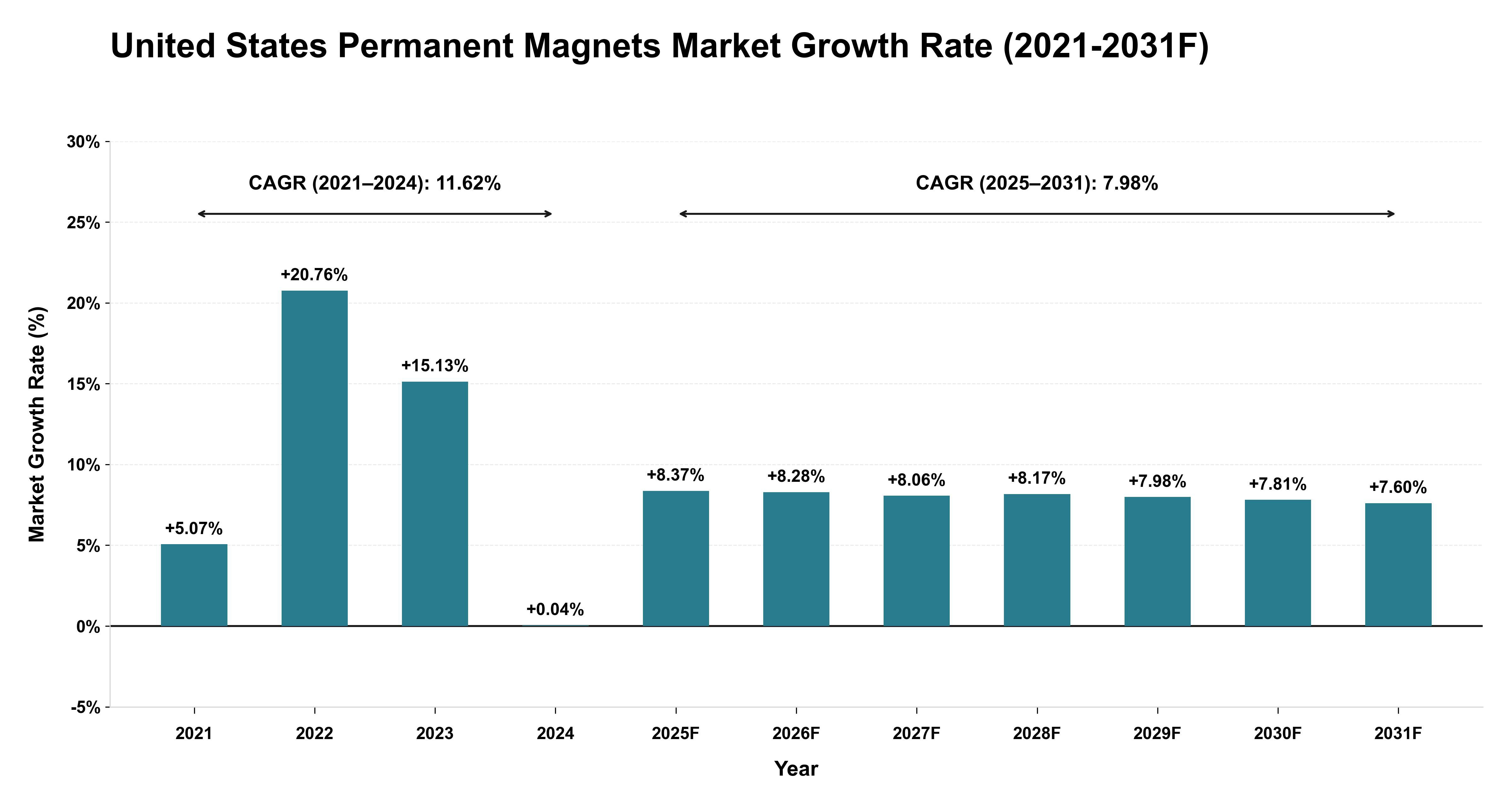
In the United States Permanent Magnets Market, the period from 2021 to 2024 witnessed a fluctuating trajectory with notable growth spikes in 2022 and 2023 at 20.76% and 15.13%, respectively, indicating increased demand likely driven by technological advancements in industries such as renewable energy, automotive, and electronics. However, growth tapered off in 2024 to nearly stagnant levels at 0.04%, potentially due to supply chain disruptions or market saturation in some segments. Looking ahead to 2025-2031, the forecasted CAGR of 7.98% suggests a more stabilized but still positive growth trend, reflecting a maturing market with steady demand from various end-use industries. The consistent annual growth rates during this period indicate a balanced market environment with sustainable demand dynamics and technological influences driving the sector forward steadily.
United States (US) Permanent Magnets Market Overview
The United States Permanent Magnets Market is experiencing steady growth driven by increasing demand across various industries such as automotive, electronics, energy, and healthcare. The market is primarily dominated by rare earth magnets such as neodymium and samarium cobalt due to their high magnetic strength. Technological advancements and innovations in magnet manufacturing processes are further fueling market growth. The automotive sector is a significant consumer of permanent magnets for applications like electric vehicle motors and sensors. Additionally, the electronics industry`s growing demand for miniaturized and efficient components is boosting the market. With a focus on sustainability and renewable energy sources, the US Permanent Magnets Market is poised for continuous expansion in the coming years.
United States (US) Permanent Magnets Market Trends
The US Permanent Magnets Market is experiencing significant growth due to the increasing demand for renewable energy sources such as wind turbines and electric vehicles. Neodymium magnets, in particular, are in high demand for their strong magnetic properties. Additionally, the adoption of permanent magnets in various industries including healthcare, automotive, and electronics is driving market growth. Technological advancements in the manufacturing process have also contributed to the market expansion by improving the efficiency and reducing costs. The market is witnessing a trend towards the development of rare-earth-free magnets to address concerns about the environmental impact of mining rare earth metals. Overall, the US Permanent Magnets Market is poised for continued growth driven by the increasing applications and advancements in magnet technologies.
United States (US) Permanent Magnets Market Challenges
In the US Permanent Magnets Market, one of the key challenges faced is the dependence on imported rare earth materials, particularly neodymium and samarium. These materials are crucial for the production of high-performance magnets used in various industries such as automotive, electronics, and renewable energy. The limited domestic production of rare earth elements makes the market vulnerable to supply chain disruptions and price fluctuations caused by geopolitical tensions or trade disputes. Additionally, the high cost of rare earth materials and concerns related to environmental sustainability in their extraction process further compound the challenges for US manufacturers in the permanent magnets industry. Developing alternative sources of rare earth materials and investing in recycling technologies could help mitigate these challenges and enhance the resilience of the US Permanent Magnets Market.
United States (US) Permanent Magnets Market Investment Opportunities
The US Permanent Magnets Market presents promising investment opportunities driven by the growing demand for energy-efficient technologies and the increasing adoption of electric vehicles (EVs) and renewable energy sources. The market is expected to witness significant growth due to the rising focus on sustainability and the need for high-performance magnets in various industries such as automotive, electronics, and healthcare. Investing in companies involved in the production and innovation of rare earth magnets, such as neodymium and samarium-cobalt magnets, could be lucrative. Additionally, with ongoing research and development efforts aimed at enhancing magnet performance and reducing costs, investing in emerging technologies like magnet recycling and alternative magnet materials could offer long-term growth potential in the US Permanent Magnets Market.
United States (US) Permanent Magnets Market Government Policy
In the United States, government policies related to the Permanent Magnets Market are primarily focused on promoting domestic production, innovation, and sustainability. The US government has implemented measures such as research and development grants, tax incentives, and trade policies to support the growth of the permanent magnets industry. Additionally, there are regulations in place to ensure environmental sustainability and responsible sourcing of raw materials for permanent magnets. The government also collaborates with industry stakeholders to foster a competitive market and enhance the global competitiveness of US-based permanent magnet manufacturers. Overall, the US government`s policies aim to drive technological advancements, create job opportunities, and secure a strong position for the US in the global permanent magnets market.
United States (US) Permanent Magnets Market Future Outlook
The United States Permanent Magnets Market is expected to witness steady growth in the coming years due to increasing demand from various industries such as automotive, electronics, and energy. The market is likely to be driven by advancements in technology, particularly in the electric vehicle sector, where permanent magnets are used in motors. Additionally, the focus on renewable energy sources like wind turbines and the growing trend of miniaturization in electronic devices will further boost the demand for permanent magnets. However, challenges such as fluctuating prices of raw materials and environmental concerns regarding mining and production processes may impact market growth. Overall, the US Permanent Magnets Market is poised for expansion, fueled by technological innovations and diverse industrial applications.
Key Highlights of the Report:
- United States (US) Permanent Magnets Market Outlook
- Market Size of United States (US) Permanent Magnets Market, 2021
- Forecast of United States (US) Permanent Magnets Market, 2031
- Historical Data and Forecast of United States (US) Permanent Magnets Revenues & Volume for the Period 2021 - 2031
- United States (US) Permanent Magnets Market Trend Evolution
- United States (US) Permanent Magnets Market Drivers and Challenges
- United States (US) Permanent Magnets Price Trends
- United States (US) Permanent Magnets Porter's Five Forces
- United States (US) Permanent Magnets Industry Life Cycle
- Historical Data and Forecast of United States (US) Permanent Magnets Market Revenues & Volume By Material for the Period 2021 - 2031
- Historical Data and Forecast of United States (US) Permanent Magnets Market Revenues & Volume By Ferrite for the Period 2021 - 2031
- Historical Data and Forecast of United States (US) Permanent Magnets Market Revenues & Volume By Neodymium Iron Boron (NdFeB) for the Period 2021 - 2031
- Historical Data and Forecast of United States (US) Permanent Magnets Market Revenues & Volume By Aluminium Nickel Cobalt (Alnico) for the Period 2021 - 2031
- Historical Data and Forecast of United States (US) Permanent Magnets Market Revenues & Volume By Samarium Cobalt (SmCo) for the Period 2021 - 2031
- Historical Data and Forecast of United States (US) Permanent Magnets Market Revenues & Volume By Applications for the Period 2021 - 2031
- Historical Data and Forecast of United States (US) Permanent Magnets Market Revenues & Volume By Automotive for the Period 2021 - 2031
- Historical Data and Forecast of United States (US) Permanent Magnets Market Revenues & Volume By Consumer Goods & Electronics for the Period 2021 - 2031
- Historical Data and Forecast of United States (US) Permanent Magnets Market Revenues & Volume By Industrial for the Period 2021 - 2031
- Historical Data and Forecast of United States (US) Permanent Magnets Market Revenues & Volume By Aerospace & Defense for the Period 2021 - 2031
- Historical Data and Forecast of United States (US) Permanent Magnets Market Revenues & Volume By Energy for the Period 2021 - 2031
- Historical Data and Forecast of United States (US) Permanent Magnets Market Revenues & Volume By Medical for the Period 2021 - 2031
- Historical Data and Forecast of United States (US) Permanent Magnets Market Revenues & Volume By Others for the Period 2021 - 2031
- United States (US) Permanent Magnets Import Export Trade Statistics
- Market Opportunity Assessment By Material
- Market Opportunity Assessment By Applications
- United States (US) Permanent Magnets Top Companies Market Share
- United States (US) Permanent Magnets Competitive Benchmarking By Technical and Operational Parameters
- United States (US) Permanent Magnets Company Profiles
- United States (US) Permanent Magnets Key Strategic Recommendations






































