United States (US) Pharmaceutical Packaging Market Summary
The united states (us) pharmaceutical packaging market was estimated at USD 177 Million in 2025 and is projected to reach USD 209 Million by 2032, growing at a CAGR of 2.7% from 2026 to 2032.
United States (US) Pharmaceutical Packaging Market Year-wise Growth Rate and Key Drivers
This graph highlights how the United States (US) Pharmaceutical Packaging Market has steadily grown over the past five years, supported by major growth factors.
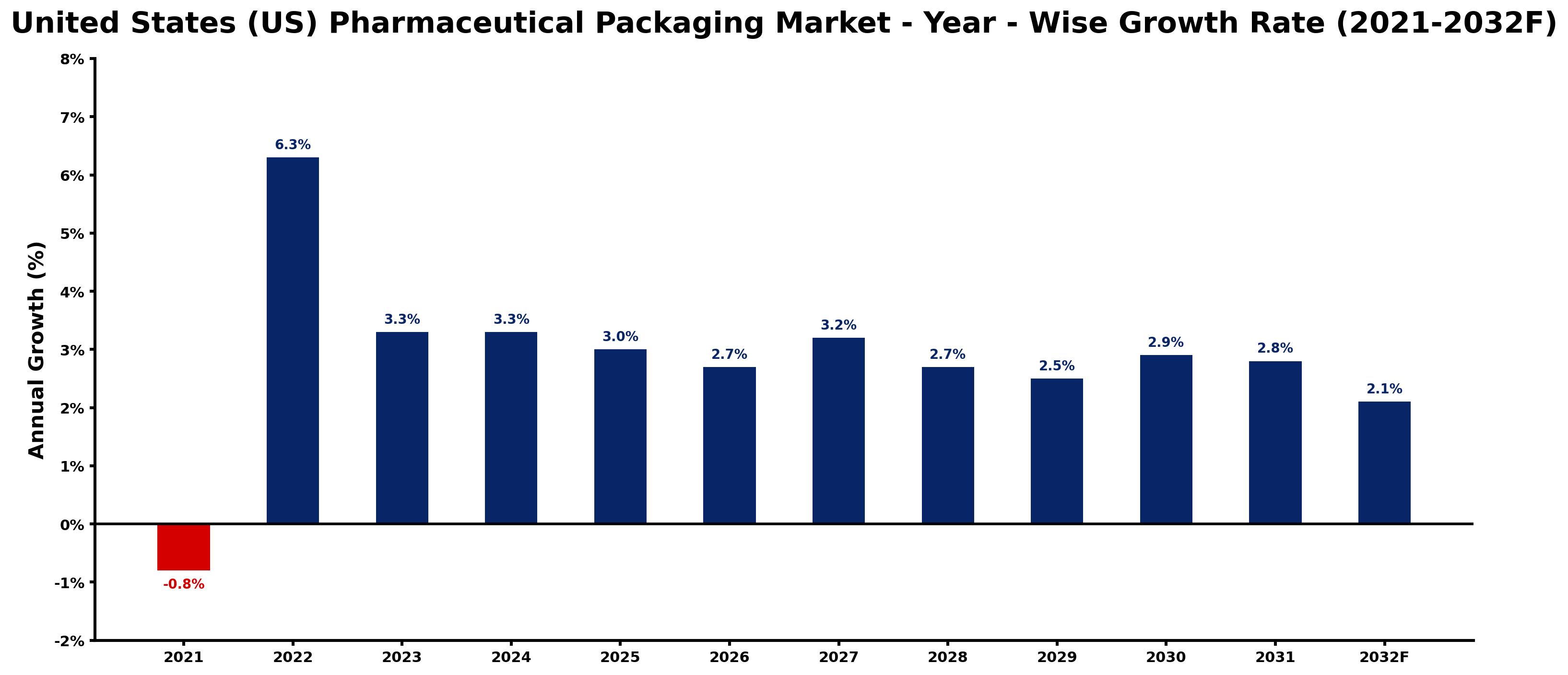
The table below presents the year wise growth rates along with the key drivers influencing the market
| Year | Growth Rate | Major Drivers |
| 2021 | -0.8% | Supply chain disruptions due to the pandemic hindered timely delivery and production of essential pharmaceutical packaging materials. |
| 2022 | 6.3% | Technological integration in packaging enhances traceability and safety for consumers and producers. |
| 2023 | 3.3% | E-commerce expansion dictates the need for resilient and efficient packaging solutions. |
| 2024 | 3.3% | Shift towards personalized medicine increases demand for specialized packaging formats. |
| 2025 | 3.0% | Market players focus on innovative designs to differentiate products on crowded shelves. |
| 2026 | 2.7% | Increased consumer awareness regarding drug safety influences packaging specifications and materials. |
| 2027 | 3.2% | Partnerships between pharma firms and packaging suppliers foster creativity and efficiency gains. |
| 2028 | 2.7% | Digital transformation initiatives streamline production processes across pharmaceutical packaging sectors. |
| 2029 | 2.5% | Global supply chain disruptions prompt domestic manufacturing and localized packaging solutions. |
| 2030 | 2.9% | Adoption of smart packaging technologies enhances user engagement and product tracking. |
| 2031 | 2.8% | Aging populations increase the need for user-friendly and accessible pharmaceutical packaging. |
| 2032 | 2.1% | Sustainability goals drive innovation in materials, reducing environmental impact of packaging. |
Note - Market size estimations and growth projections presented in this report are based on 6Wresearch's advanced forecasting approach, validated with industry datasets as of June 2026.
United States (US) Pharmaceutical Packaging Market Synopsis
The United States (US) Pharmaceutical Packaging Market is projected to reach 2.7% and witness significant growth during the forecast period (2026-2032). This market is critical to the healthcare supply chain, ensuring that pharmaceutical products are delivered safely and effectively. Regulatory compliance, technological advancements, and a growing emphasis on patient safety are central to the evolution of this sector.
United States (US) Pharmaceutical Packaging Market Growth Drivers
Several key factors are driving growth within the United States (US) Pharmaceutical Packaging Market. First, the increasing demand for innovative packaging solutions necessitated by the rise in pharmaceutical production is pushing manufacturers to explore new materials and technologies. Second, the need for compliance with stringent serialization and track-and-trace regulations is becoming more pronounced, requiring enhanced packaging capabilities.
- The proliferation of chronic diseases necessitates more pharmaceutical products, thereby increasing packaging demands.
- Heightened focus on patient safety has led to the adoption of child-resistant and tamper-evident packaging to protect consumers.
- Environmental concerns are prompting manufacturers to seek sustainable and recyclable packaging materials.
- Technological innovations such as smart packaging are improving supply chain efficiency and enhancing product security.
- Regulatory pressures from entities like the FDA are driving investments in quality and safety improvements across packaging operations.
United States (US) Pharmaceutical Packaging Market Trends and Opportunities
The United States (US) Pharmaceutical Packaging Market is witnessing numerous trends that present both opportunities and challenges. A notable trend is the shift towards sustainability; manufacturers are increasingly focused on developing eco-friendly packaging solutions. As part of this movement, there is a growing demand for recyclable and biodegradable materials, which aligns with evolving consumer preferences.
- Technological advancements are paving the way for smart packaging solutions, including RFID tracking for improved inventory management.
- Personalized medicine is driving the need for tailored packaging solutions, which can cater to specific patient requirements regarding dosage and delivery.
- Child-resistant packaging designs are becoming a standard expectation, enhancing user safety and regulatory compliance.
- Companies are exploring automation and digitalization in packaging processes to streamline operations and reduce costs.
- Rising investments in anti-counterfeiting measures are fostering the development of advanced packaging technologies that verify product authenticity.
United States (US) Pharmaceutical Packaging Market Challenges and Restraints
Despite its growth prospects, the United States (US) Pharmaceutical Packaging Market faces several challenges. Chief among these are the stringent regulations imposed by the FDA, which demand adherence to high standards of safety and efficacy. This contributes to increased operational costs for manufacturers, who are required to invest heavily in compliance measures.
- The complexity of packaging designs, necessary to accommodate various forms of medication, can increase manufacturing challenges and costs.
- The increasing demand for sustainable packaging solutions puts pressure on manufacturers to innovate while managing cost constraints.
- Fierce market competition necessitates continuous improvement in packaging efficiency and quality without compromising compliance.
- Counterfeit pharmaceuticals pose a significant threat, requiring additional investment in security features and tracking technologies.
- Supply chain disruptions can impact the availability of raw materials, affecting production timelines and overall efficiency.
United States (US) Pharmaceutical Packaging Market Government Investment and Initiatives
Government policies play a crucial role in shaping the United States (US) Pharmaceutical Packaging Market. The FDA sets rigorous standards for packaging materials and procedures, emphasizing the need for child-resistant designs and accurate labeling to prevent misuse. Initiatives like the Drug Supply Chain Security Act (DSCSA) establish a framework for the serialization and traceability of pharmaceutical products, which helps to combat counterfeiting.
- Public funding is directed towards research and development of innovative packaging technologies aimed at enhancing product safety.
- Government incentives are encouraging the adoption of environmentally friendly packaging practices.
- Regulatory bodies are continually updating packaging guidelines to align with advancing technology and evolving market needs.
- Collaborative efforts between government agencies and industry stakeholders are fostering a robust framework for compliance and safety.
- Investment in public health initiatives indirectly influences packaging standards and expectations within the pharmaceutical sector.
United States (US) Pharmaceutical Packaging Market Latest Developments (May 2025 - June 2026)
In recent months, the United States (US) Pharmaceutical Packaging Market has been marked by significant developments reflecting shifts towards innovation and compliance. Stakeholders are increasingly adopting digital solutions that streamline packaging operations, contributing to efficiency gains. There has also been a noticeable rise in the incorporation of smart technologies, enhancing the capabilities of packaging to monitor conditions and convey information about product integrity.
- Emerging smart technologies are being integrated into packaging to enhance traceability and safety.
- Major initiatives focus on developing eco-friendly packaging materials that cater to both regulatory requirements and consumer preferences.
- Industry responses to the rising prevalence of counterfeit drugs have spurred new packaging security measures.
- There is an ongoing push towards personalized medication solutions, creating an impetus for customized packaging formats.
- Collaborative industry standards are being established to enhance compliance and ensure product quality throughout the supply chain.
United States (US) Pharmaceutical Packaging Market - Key Attractiveness of the Report
- 10 Years of Market Numbers
- Historical Data Starting from 2022 to 2025
- Base Year: 2025
- Forecast Data until 2032
- Key Performance Indicators Impacting the Market
- Major Upcoming Developments and Projects
Key Highlights of the Report:
- United States (US) Pharmaceutical Packaging Market Outlook
- Market Size of United States (US) Pharmaceutical Packaging Market, 2025
- Forecast of United States (US) Pharmaceutical Packaging Market, 2032F
- Historical Data and Forecast of United States (US) Pharmaceutical Packaging Revenues & Volume for the Period 2022-2032F
- United States (US) Pharmaceutical Packaging Market Trend Evolution
- United States (US) Pharmaceutical Packaging Market Drivers and Challenges
- United States (US) Pharmaceutical Packaging Price Trends
- United States (US) Pharmaceutical Packaging Porter's Five Forces
- United States (US) Pharmaceutical Packaging Industry Life Cycle
- Historical Data and Forecast of United States (US) Pharmaceutical Packaging Market Revenues & Volume By Material Types for the Period 2022-2032F
- Historical Data and Forecast of United States (US) Pharmaceutical Packaging Market Revenues & Volume By Plastics & Polymers for the Period 2022-2032F
- Historical Data and Forecast of United States (US) Pharmaceutical Packaging Market Revenues & Volume By Paper & Paperboard for the Period 2022-2032F
- Historical Data and Forecast of United States (US) Pharmaceutical Packaging Market Revenues & Volume By Glass for the Period 2022-2032F
- Historical Data and Forecast of United States (US) Pharmaceutical Packaging Market Revenues & Volume By Aluminum Foil for the Period 2022-2032F
- Historical Data and Forecast of United States (US) Pharmaceutical Packaging Market Revenues & Volume By Others for the Period 2022-2032F
- Historical Data and Forecast of United States (US) Pharmaceutical Packaging Market Revenues & Volume By Product Types for the Period 2022-2032F
- Historical Data and Forecast of United States (US) Pharmaceutical Packaging Market Revenues & Volume By Primary Pharmaceutical Packaging for the Period 2022-2032F
- Historical Data and Forecast of United States (US) Pharmaceutical Packaging Market Revenues & Volume By Secondary Pharmaceutical Packaging for the Period 2022-2032F
- Historical Data and Forecast of United States (US) Pharmaceutical Packaging Market Revenues & Volume By Tertiary Pharmaceutical Packaging for the Period 2022-2032F
- Historical Data and Forecast of United States (US) Pharmaceutical Packaging Market Revenues & Volume By End-users for the Period 2022-2032F
- Historical Data and Forecast of United States (US) Pharmaceutical Packaging Market Revenues & Volume By Pharmaceutical Manufacturing for the Period 2022-2032F
- Historical Data and Forecast of United States (US) Pharmaceutical Packaging Market Revenues & Volume By Retail Pharmacy for the Period 2022-2032F
- Historical Data and Forecast of United States (US) Pharmaceutical Packaging Market Revenues & Volume By Contract Packaging for the Period 2022-2032F
- Historical Data and Forecast of United States (US) Pharmaceutical Packaging Market Revenues & Volume By Institutional Pharmacy for the Period 2022-2032F
- Historical Data and Forecast of United States (US) Pharmaceutical Packaging Market Revenues & Volume By Others for the Period 2022-2032F
- United States (US) Pharmaceutical Packaging Import Export Trade Statistics
- Market Opportunity Assessment By Material Types
- Market Opportunity Assessment By Product Types
- Market Opportunity Assessment By End-users
- United States (US) Pharmaceutical Packaging Top Companies Market Share
- United States (US) Pharmaceutical Packaging Competitive Benchmarking By Technical and Operational Parameters
- United States (US) Pharmaceutical Packaging Company Profiles
- United States (US) Pharmaceutical Packaging Key Strategic Recommendations






































