United States (US) Planting Equipment Market Size, Share & Growth Rate
The United States (US) Planting Equipment Market was estimated at USD 99 Million in 2025 and is projected to reach USD 117 Million by 2032, growing at a CAGR of 2.4% from 2026 to 2032. This growth trajectory is underpinned by the rising integration of precision agriculture practices, enabling farmers to optimize planting strategies. Additionally, the growing demand for increased crop yields, coupled with advances in planting technologies, further propels market expansion.
United States (US) Planting Equipment Market Year-wise Growth Rate and Key Drivers
This graph highlights how the United States (US) Planting Equipment Market has steadily grown over the years, supported by major growth factors.
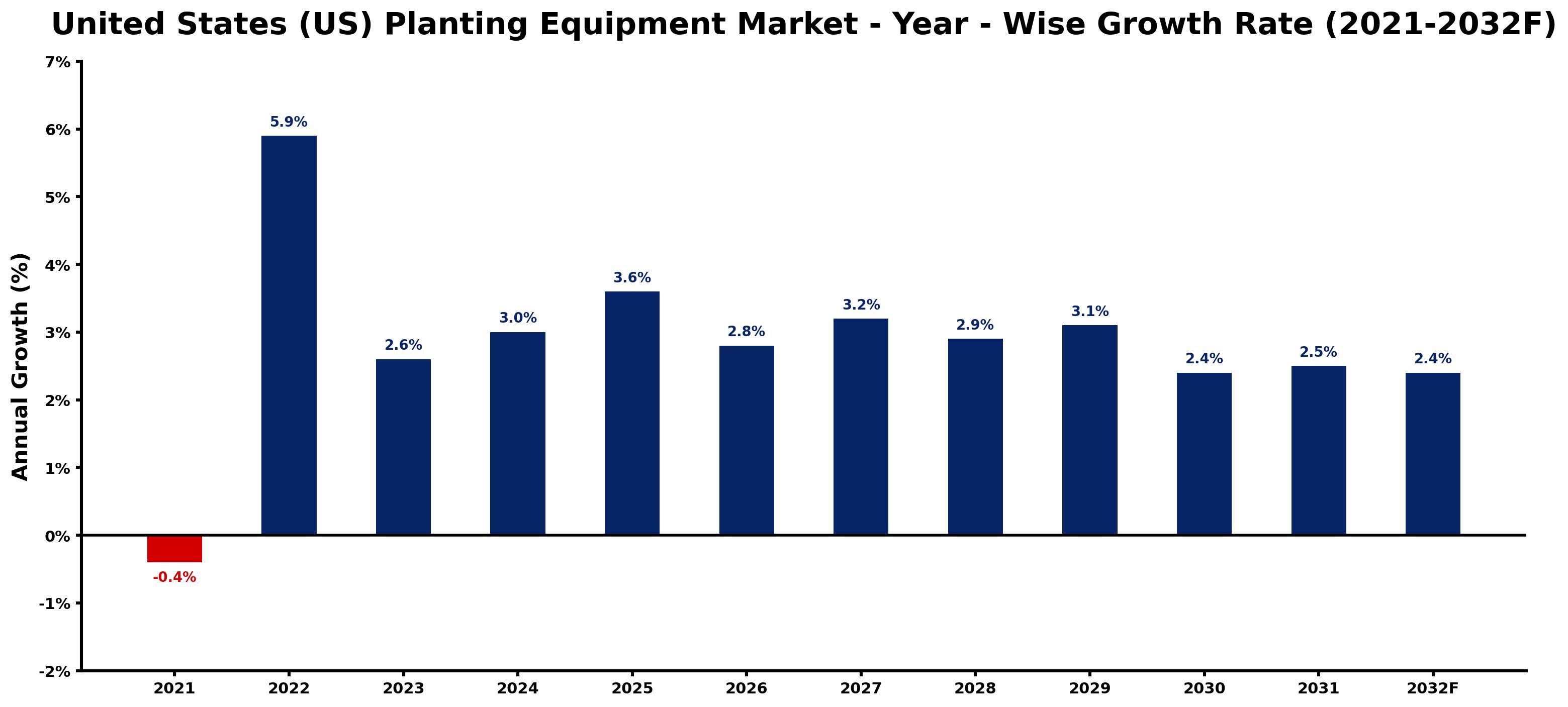
The table below presents the year‑wise growth rates along with the key drivers influencing the market
| Year | Growth Rate | Major Drivers |
| 2021 | -0.4% | Expansion of manufacturing activities |
| 2022 | 5.9% | Rising electricity demand across industries |
| 2023 | 2.6% | Government infrastructure modernization initiatives |
| 2024 | 3.0% | Growing urbanization and commercial development |
| 2025 | 3.6% | Rising electricity demand across industries |
| 2026 | 2.8% | Increasing industrial infrastructure investments |
| 2027 | 3.2% | Rising electricity demand across industries |
| 2028 | 2.9% | Increasing industrial automation investments |
| 2029 | 3.1% | Government infrastructure modernization initiatives |
| 2030 | 2.4% | Increasing industrial infrastructure investments |
| 2031 | 2.5% | Increasing industrial automation investments |
| 2032 | 2.4% | Increasing smart city development projects |
Note - Market size estimations and growth projections presented in this report are based on 6Wresearch’s advanced forecasting approach, validated with industry datasets as of June 2026.
United States (US) Planting Equipment Market Synopsis
The demand for high-speed planters and precision planting technologies is reshaping the United States Planting Equipment Market. Farmers are focusing on equipment that offers improved efficiency and reduced operational costs, particularly in the context of rising input expenses.
Moreover, the market is characterized by a significant shift towards sustainable practices, emphasizing eco-friendly planting equipment that aligns with conservation efforts. This trend is prompting manufacturers to innovate and adapt their offerings to meet modern agricultural needs.
United States (US) Planting Equipment Market Key Takeaways
- The market is evolving rapidly due to advances in technology and precision agriculture practices.
- There is an increasing emphasis on sustainable practices, impacting product development and demand.
- Investment in autonomous planting equipment is rising, reflecting a shift towards labor-saving solutions.
- Government policies significantly influence market dynamics, including subsidies and environmental regulations.
- Challenges such as high initial costs and the need for skilled operators persist, requiring strategic industry responses.
Evaluation of Restraints in United States (US) Planting Equipment Market
The United States Planting Equipment Market faces several restraints that could impede its growth. High initial investment costs for advanced planting machinery deter many potential buyers, particularly smaller-scale farmers. Additionally, the rapid pace of technological advancements necessitates frequent upgrades, which can be a financial burden. Fluctuating weather patterns also disrupt planting schedules, presenting operational challenges. Moreover, the shift towards eco-friendly alternatives highlights the environmental concerns associated with conventional planting methods, requiring both manufacturers and farmers to adapt quickly.
United States (US) Planting Equipment Market Trends
The transition toward precision agriculture is a defining trend in the United States Planting Equipment Market. Technologies such as GPS guidance systems and automated seed placement are becoming commonplace, enhancing planting accuracy and resource efficiency. Additionally, the integration of real-time data monitoring tools is driving farmers to optimize planting decisions, ultimately leading to higher yields and reduced input costs. The focus on sustainability is also shaping product innovations, as manufacturers develop equipment that supports no-till farming and cover cropping practices.
United States (US) Planting Equipment Market Opportunities
Significant investment opportunities lie within the United States Planting Equipment Market, particularly in the realms of high-speed planters and precision planting technologies. These innovations not only facilitate rapid planting but also allow for meticulous seed placement, ensuring optimal crop performance. Autonomous planting equipment, including self-driving tractors, is gaining momentum, with its potential to reduce labor costs while enhancing operational efficiency. As environmental sustainability becomes increasingly prioritized, there are also opportunities for investment in equipment that aligns with conservation efforts and eco-friendly farming practices.
Government Initiatives in the United States (US) Planting Equipment Market
Government policies significantly impact the United States Planting Equipment Market through various initiatives aimed at promoting sustainable agricultural practices. Agricultural subsidies help bolster farmer income, directly influencing their purchasing decisions regarding planting equipment. Additionally, regulations focused on emissions and environmental standards encourage manufacturers to innovate while adhering to sustainable guidelines. Trade agreements can further open new markets for equipment exports, positioning US manufacturers favorably on a global scale.
Future Insights of the United States (US) Planting Equipment Market
The future of the United States Planting Equipment Market looks promising, with a strong emphasis on innovation and sustainability driving growth from 2026 to 2032. Farmers are expected to increasingly adopt advanced planting solutions that enhance productivity and reduce overall costs. The ongoing push for food security will likely stimulate further investment in modern planting technologies. Nevertheless, overcoming challenges related to initial costs and ensuring widespread awareness and education among small-scale farmers will be crucial in realizing the market's full potential.
United States (US) Planting Equipment Market Latest Developments (May 2025 - June 2026)
Recent developments in the United States Planting Equipment Market reflect a heightened focus on integrating technology with sustainable practices. Manufacturers are exploring innovative designs that prioritize eco-friendliness while enhancing operational efficiency. There is also a notable increase in collaborative efforts between industry stakeholders to address the evolving needs of farmers, ensuring that advancements in planting equipment meet both productivity and environmental standards.
United States (US) Planting Equipment Market - Key Attractiveness of the Report
- 10 Years of Market Numbers
- Historical Data Starting from 2022 to 2025
- Base Year: 2025
- Forecast Data until 2032
- Key Performance Indicators Impacting the Market
- Major Upcoming Developments and Projects
Key Highlights of the Report:
- United States (US) Planting Equipment Market Outlook
- Market Size of United States (US) Planting Equipment Market, 2025
- Forecast of United States (US) Planting Equipment Market, 2032
- Historical Data and Forecast of United States (US) Planting Equipment Revenues & Volume for the Period 2022-2032F
- United States (US) Planting Equipment Market Trend Evolution
- United States (US) Planting Equipment Market Drivers and Challenges
- United States (US) Planting Equipment Price Trends
- United States (US) Planting Equipment Porter's Five Forces
- United States (US) Planting Equipment Industry Life Cycle
- Historical Data and Forecast of United States (US) Planting Equipment Market Revenues & Volume By Type for the Period 2022-2032F
- Historical Data and Forecast of United States (US) Planting Equipment Market Revenues & Volume By Air seeders for the Period 2022-2032F
- Historical Data and Forecast of United States (US) Planting Equipment Market Revenues & Volume By Seed drills for the Period 2022-2032F
- Historical Data and Forecast of United States (US) Planting Equipment Market Revenues & Volume By Planters for the Period 2022-2032F
- Historical Data and Forecast of United States (US) Planting Equipment Market Revenues & Volume By Others for the Period 2022-2032F
- Historical Data and Forecast of United States (US) Planting Equipment Market Revenues & Volume By Design for the Period 2022-2032F
- Historical Data and Forecast of United States (US) Planting Equipment Market Revenues & Volume By Mechanical for the Period 2022-2032F
- Historical Data and Forecast of United States (US) Planting Equipment Market Revenues & Volume By Automatic for the Period 2022-2032F
- Historical Data and Forecast of United States (US) Planting Equipment Market Revenues & Volume By Crop Type for the Period 2022-2032F
- Historical Data and Forecast of United States (US) Planting Equipment Market Revenues & Volume By Cereals & grains for the Period 2022-2032F
- Historical Data and Forecast of United States (US) Planting Equipment Market Revenues & Volume By Oilseeds & pulses for the Period 2022-2032F
- Historical Data and Forecast of United States (US) Planting Equipment Market Revenues & Volume By Fruits & vegetables for the Period 2022-2032F
- Historical Data and Forecast of United States (US) Planting Equipment Market Revenues & Volume By Others for the Period 2022-2032F
- United States (US) Planting Equipment Import Export Trade Statistics
- Market Opportunity Assessment By Type
- Market Opportunity Assessment By Design
- Market Opportunity Assessment By Crop Type
- United States (US) Planting Equipment Top Companies Market Share
- United States (US) Planting Equipment Competitive Benchmarking By Technical and Operational Parameters
- United States (US) Planting Equipment Company Profiles
- United States (US) Planting Equipment Key Strategic Recommendations






































