United States (US) Point Of Sale Terminals Market Size, Share & Growth Rate
The United States (US) Point Of Sale Terminals Market was estimated at USD 97 Million in 2025 and is projected to reach USD 114 Million by 2032, growing at a CAGR of 2.3% from 2026 to 2032. This steady growth trajectory is fueled by an escalating demand for efficient payment solutions and the rapid adoption of contactless technologies, as consumer preferences shift towards convenience and security. Additionally, the expansion of e-commerce and integration of advanced analytics within POS systems are pivotal in propelling market evolution.
United States (US) Point Of Sale Terminals Market Year-wise Growth Rate and Key Drivers
This graph highlights how the United States (US) Point Of Sale Terminals Market has steadily grown over the years, supported by major growth factors.
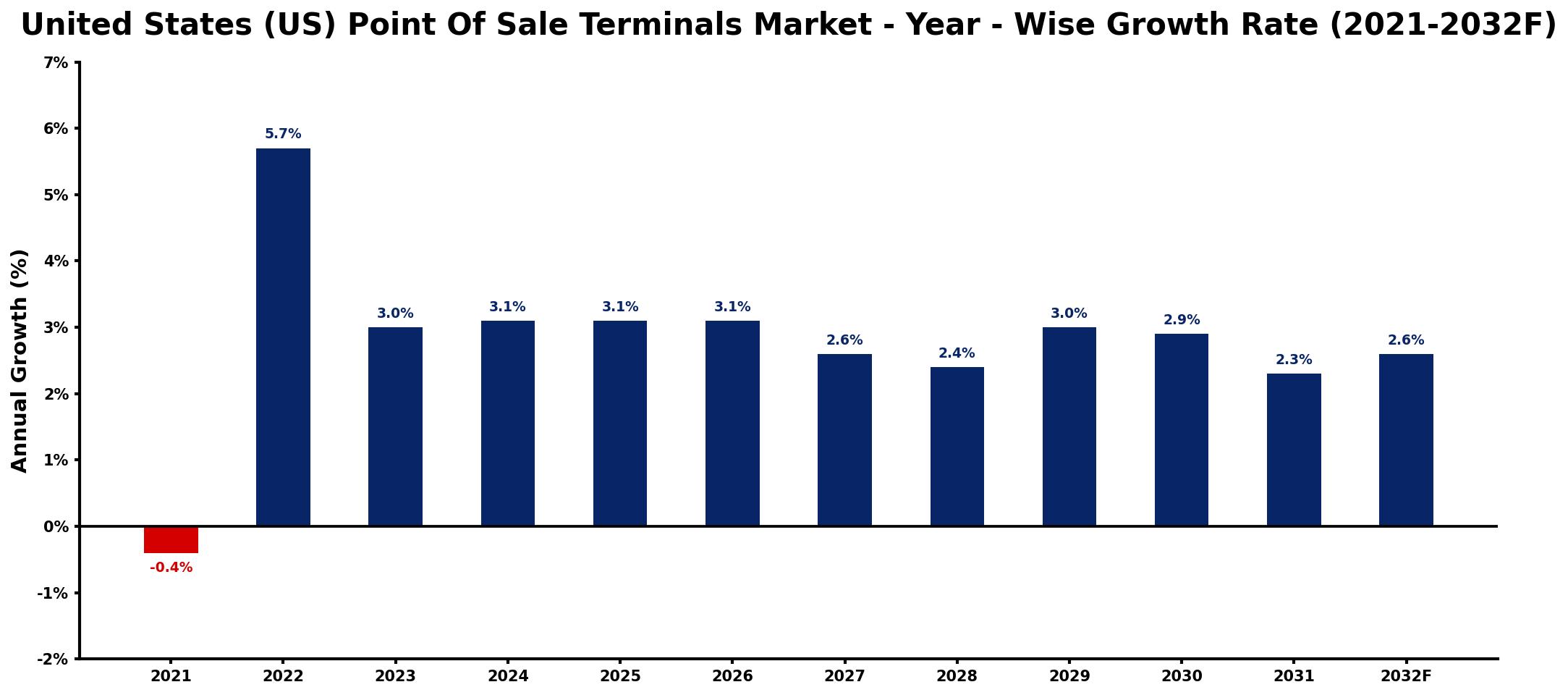
The table below presents the year‑wise growth rates along with the key drivers influencing the market
| Year | Growth Rate | Major Drivers |
| 2021 | -0.4% | reduced consumer spending patterns |
| 2022 | 5.7% | increased digital payment adoption |
| 2023 | 3.0% | rising e-commerce transactions volume |
| 2024 | 3.1% | growth in mobile wallet usage |
| 2025 | 3.1% | expansion of retail technology investments |
| 2026 | 3.1% | surge in contactless payment preference |
| 2027 | 2.6% | enhanced cybersecurity measures demand |
| 2028 | 2.4% | growing demand for integrated solutions |
| 2029 | 3.0% | increased acceptance of cryptocurrency payments |
| 2030 | 2.9% | rising export shipment volumes |
| 2031 | 2.3% | rising consumer preference for convenience |
| 2032 | 2.6% | enhanced product quality standards |
Note: Market size estimations and growth projections presented in this report are based on 6Wresearch's proprietary forecasting methodology, utilizing the latest available industry data, government publications, and primary research inputs.
United States (US) Point Of Sale Terminals Market Synopsis
The United States Point Of Sale Terminals Market is currently marked by an innovative transformation driven by technological advancements. As businesses seek to improve customer experiences, there is a notable shift towards mobile and cloud-based solutions that enhance operational efficiency and flexibility.
With the increasing implementation of EMV chip technology and the integration of analytics, companies across various sectors are re-evaluating their POS systems. This is not just a transition in technology; it represents a broader movement towards integrating payment processing with inventory management and customer relationship tools, setting the stage for enhanced business intelligence.
United States (US) Point Of Sale Terminals Market Key Takeaways
- The market is driven by the growing need for contactless payment options.
- Cloud-based POS solutions are gaining traction due to their scalability and cost-effectiveness.
- Integration of advanced analytics is crucial for improving customer engagement.
- Businesses face the challenge of staying compliant with evolving regulations.
- Innovations in mobile POS systems are reshaping traditional payment landscapes.
Evaluation of Restraints in United States (US) Point Of Sale Terminals Market
While the US Point Of Sale Terminals Market is flourishing, it grapples with certain constraints that could hinder its rapid advancement. Rapid technological evolution necessitates frequent upgrades, compelling businesses to consistently invest in new systems. This can create a financial burden, particularly for small and medium-sized enterprises. Additionally, compliance with stringent regulatory requirements, including evolving data security standards, presents a continual challenge. The complexity of integrating diverse payment methods and ensuring a seamless omnichannel experience also weighs heavily on market participants, complicating efforts to capture and retain a competitive edge.
United States (US) Point Of Sale Terminals Market Trends
A major trend in the US Point Of Sale Terminals Market is the increasing adoption of mobile POS systems, which enable transactions beyond traditional retail environments. This not only enhances customer service but also allows businesses to provide a more personalized shopping experience. Furthermore, the demand for integrated POS solutions that combine payment processing with inventory and customer management systems is on the rise. As consumers increasingly favor contactless payments and digital wallets, POS terminals equipped with NFC and biometric technology are becoming essential to meet these evolving expectations.
United States (US) Point Of Sale Terminals Market Opportunities
The landscape of the US Point Of Sale Terminals Market is ripe with investment opportunities, particularly in the realm of innovative payment solutions. With an increasing shift towards digital transactions, companies offering advanced POS terminals that are equipped for contactless payments are well-positioned for growth. Additionally, the trend towards cloud-based solutions presents a lucrative avenue for investment, as businesses seek systems that enhance flexibility and reduce operational costs. The incorporation of data analytics and customer relationship management capabilities within POS systems is also a fertile ground for investors aiming to tap into the evolving needs of retailers in the US.
Government Initiatives in the United States (US) Point Of Sale Terminals Market
The US government plays a significant role in shaping the Point Of Sale Terminals Market through various policies aimed at enhancing data security and consumer protection. Regulations such as the Payment Card Industry Data Security Standard (PCI DSS) are pivotal in guiding businesses on secure handling of payment information. Furthermore, government initiatives promoting digital payment solutions and financial inclusion are driving the adoption of advanced POS technologies. This regulatory framework not only safeguards consumers but also encourages innovation and investment in secure payment infrastructures.
Future Insights of the United States (US) Point Of Sale Terminals Market
Looking ahead, the United States Point Of Sale Terminals Market is anticipated to continue its growth through 2032. The increasing adoption of contactless payment technology and the rising demand for omnichannel retailing will significantly influence market dynamics. Advancements in AI, biometric authentication, and the expansion of mobile POS solutions are expected to usher in a new era of customer engagement and transaction efficiency. However, businesses must navigate challenges related to data security and regulatory compliance to fully capitalize on these opportunities. Overall, the market outlook remains optimistic, supported by shifting consumer preferences and technological innovations.
United States (US) Point Of Sale Terminals Market Latest Developments (2025 - 2026)
In recent months, the United States Point Of Sale Terminals Market has seen a surge in innovations aimed at enhancing user experience and transaction efficiency. Key developments include the rollout of new mobile POS applications that leverage AI for personalized customer interactions. Furthermore, several companies are investing in cloud-based platforms that streamline payment processing and inventory management. The integration of advanced security features to combat rising cyber threats is also a focal point, underscoring the market's commitment to consumer protection.
United States (US) Point Of Sale Terminals Market - Key Attractiveness of the Report
- 10 Years of Market Numbers
- Historical Data Starting from 2022 to 2025
- Base Year: 2025
- Forecast Data until 2032
- Key Performance Indicators Impacting the Market
- Major Upcoming Developments and Projects
Key Highlights of the Report:
- United States (US) Point Of Sale Terminals Market Outlook
- Market Size of United States (US) Point Of Sale Terminals Market, 2025
- Forecast of United States (US) Point Of Sale Terminals Market, 2032
- Historical Data and Forecast of United States (US) Point Of Sale Terminals Revenues & Volume for the Period 2022-2032F
- United States (US) Point Of Sale Terminals Market Trend Evolution
- United States (US) Point Of Sale Terminals Market Drivers and Challenges
- United States (US) Point Of Sale Terminals Price Trends
- United States (US) Point Of Sale Terminals Porter's Five Forces
- United States (US) Point Of Sale Terminals Industry Life Cycle
- Historical Data and Forecast of United States (US) Point Of Sale Terminals Market Revenues & Volume By Product for the Period 2022-2032F
- Historical Data and Forecast of United States (US) Point Of Sale Terminals Market Revenues & Volume By Fixed for the Period 2022-2032F
- Historical Data and Forecast of United States (US) Point Of Sale Terminals Market Revenues & Volume By Mobile for the Period 2022-2032F
- Historical Data and Forecast of United States (US) Point Of Sale Terminals Market Revenues & Volume By Component for the Period 2022-2032F
- Historical Data and Forecast of United States (US) Point Of Sale Terminals Market Revenues & Volume By Hardware for the Period 2022-2032F
- Historical Data and Forecast of United States (US) Point Of Sale Terminals Market Revenues & Volume By Software for the Period 2022-2032F
- Historical Data and Forecast of United States (US) Point Of Sale Terminals Market Revenues & Volume By Services for the Period 2022-2032F
- Historical Data and Forecast of United States (US) Point Of Sale Terminals Market Revenues & Volume By Deployment for the Period 2022-2032F
- Historical Data and Forecast of United States (US) Point Of Sale Terminals Market Revenues & Volume By Cloud for the Period 2022-2032F
- Historical Data and Forecast of United States (US) Point Of Sale Terminals Market Revenues & Volume By On-premise for the Period 2022-2032F
- Historical Data and Forecast of United States (US) Point Of Sale Terminals Market Revenues & Volume By End Use for the Period 2022-2032F
- Historical Data and Forecast of United States (US) Point Of Sale Terminals Market Revenues & Volume By Restaurants for the Period 2022-2032F
- Historical Data and Forecast of United States (US) Point Of Sale Terminals Market Revenues & Volume By Retail for the Period 2022-2032F
- Historical Data and Forecast of United States (US) Point Of Sale Terminals Market Revenues & Volume By Hospitality for the Period 2022-2032F
- Historical Data and Forecast of United States (US) Point Of Sale Terminals Market Revenues & Volume By Healthcare for the Period 2022-2032F
- Historical Data and Forecast of United States (US) Point Of Sale Terminals Market Revenues & Volume By Warehouse for the Period 2022-2032F
- Historical Data and Forecast of United States (US) Point Of Sale Terminals Market Revenues & Volume By Entertainment for the Period 2022-2032F
- Historical Data and Forecast of United States (US) Point Of Sale Terminals Market Revenues & Volume By Others for the Period 2022-2032F
- United States (US) Point Of Sale Terminals Import Export Trade Statistics
- Market Opportunity Assessment By Product
- Market Opportunity Assessment By Component
- Market Opportunity Assessment By Deployment
- Market Opportunity Assessment By End Use
- United States (US) Point Of Sale Terminals Top Companies Market Share
- United States (US) Point Of Sale Terminals Competitive Benchmarking By Technical and Operational Parameters
- United States (US) Point Of Sale Terminals Company Profiles
- United States (US) Point Of Sale Terminals Key Strategic Recommendations






































