United States (US) Projector Screen Market Top 5 Importing Countries and Market Competition (HHI) Analysis
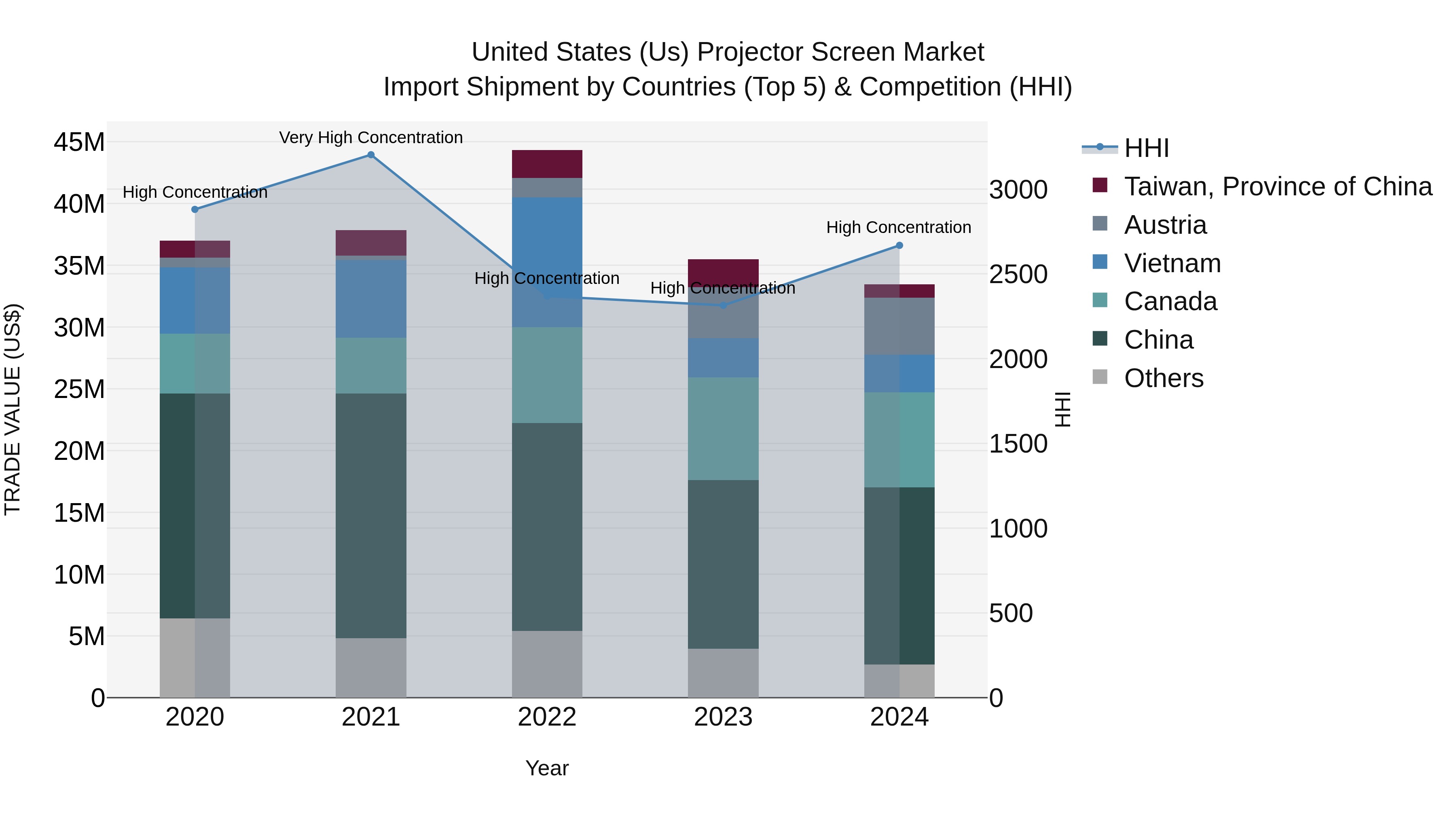
The United States continues to be a key market for projector screen imports, with China, Canada, Austria, Vietnam, and the UK leading the way in 2024. Despite a challenging economic environment, the market experienced a CAGR of -2.47% from 2020 to 2024. However, a concerning negative growth rate of -5.68% from 2023 to 2024 indicates potential challenges ahead. The high concentration of Herfindahl-Hirschman Index (HHI) in 2024 suggests a competitive landscape dominated by a few key players, emphasizing the need for strategic market positioning and differentiation within the industry.
United States (US) Projector screen Market Overview
The United States projector screen market is experiencing steady growth driven by factors such as the increasing demand for high-quality audiovisual experiences in various sectors including education, corporate, entertainment, and home theaters. The market is characterized by a wide range of product offerings including manual, electric, fixed frame, and portable projector screens catering to diverse consumer preferences. Technological advancements such as the introduction of ultra-short-throw projectors and ambient light-rejecting screens are also influencing market growth. Key players in the market are focusing on product innovation, partnerships, and strategic acquisitions to gain a competitive edge. Additionally, the trend towards smart homes and the rising popularity of outdoor entertainment setups are further fueling market expansion. The US projector screen market is expected to continue its growth trajectory in the coming years with an emphasis on enhanced viewing experiences and convenience for consumers.
United States (US) Projector screen Market Trends
The US projector screen market is experiencing several key trends. One notable trend is the increasing demand for motorized projector screens with advanced features such as remote control operation and integration with smart home systems. Another trend is the growing popularity of portable and outdoor projector screens, driven by the rise in outdoor movie nights and events. Additionally, there is a shift towards higher resolution screens to accommodate the increasing quality of projectors and content. As more consumers invest in home entertainment systems, there is a rising preference for sleeker and more aesthetically pleasing projector screen designs that blend seamlessly with modern interiors. Overall, the US projector screen market is witnessing a convergence of technology, convenience, and style to meet the evolving demands of consumers.
United States (US) Projector screen Market Challenges
In the United States projector screen market, some challenges include increasing competition from alternative display technologies such as large flat-screen TVs, declining prices of projectors leading to lower profit margins for projector screen manufacturers, and the need to constantly innovate to keep up with changing consumer preferences and technological advancements. Additionally, the impact of the COVID-19 pandemic has disrupted supply chains and led to uncertainties in demand for projector screens as remote work and virtual events have become more prevalent. Market players must also navigate regulatory issues and environmental concerns related to manufacturing processes and materials used in projector screens. Overall, companies in the US projector screen market must adapt to these challenges by focusing on product differentiation, cost-efficiency, and sustainability to remain competitive in the industry.
United States (US) Projector screen Market Investment Opportunities
The United States projector screen market offers a range of investment opportunities due to the increasing demand for high-quality audiovisual equipment in various sectors such as education, entertainment, corporate, and home theaters. With the rise of digital content consumption and the growing popularity of streaming services, there is a growing need for advanced projector screens that offer superior image quality and performance. Investors can explore opportunities in manufacturing and distributing innovative projector screen technologies, investing in companies that specialize in projection screen materials, or providing installation and maintenance services for commercial and residential clients. Additionally, the market is witnessing a shift towards motorized and automated projector screens, creating opportunities for companies that offer smart and connected solutions. Overall, the US projector screen market presents promising avenues for investment and growth in the AV industry.
United States (US) Projector screen Market Government Policy
The US government does not have specific policies targeting the projector screen market. However, related regulations and policies in the consumer electronics industry, trade agreements, and environmental standards can impact the market. For instance, tariffs on imported goods may affect the pricing of projector screens that are manufactured overseas. Additionally, regulations on product safety and energy efficiency could influence the design and features of projector screens. Trade agreements with other countries could impact the import and export of projector screens, affecting market competition. Environmental standards and initiatives promoting sustainability may also drive demand for eco-friendly projector screens. Overall, while there are no direct government policies specific to the projector screen market, broader regulations and trade dynamics play a role in shaping the industry landscape in the US.
United States (US) Projector screen Market Future Outlook
The future outlook for the United States projector screen market appears promising, driven by factors such as the growing demand for enhanced viewing experiences in both residential and commercial settings, the increasing adoption of advanced technologies like 4K and HDR, and the rise of home entertainment systems. As consumers seek larger screens for gaming, streaming, and presentations, the market is expected to witness steady growth. Additionally, the trend towards smart projectors and portable screens is likely to further fuel market expansion. However, factors such as competition from alternative display technologies like flat-panel TVs and potential supply chain disruptions could pose challenges. Overall, innovations in screen materials, designs, and features are anticipated to drive market growth and cater to evolving consumer preferences in the coming years.
Key Highlights of the Report:
- United States (US) Projector screen Market Outlook
- Market Size of United States (US) Projector screen Market, 2021
- Forecast of United States (US) Projector screen Market, 2027
- Historical Data and Forecast of United States (US) Projector screen Revenues & Volume for the Period 2018 - 2027
- United States (US) Projector screen Market Trend Evolution
- United States (US) Projector screen Market Drivers and Challenges
- United States (US) Projector screen Price Trends
- United States (US) Projector screen Porter's Five Forces
- United States (US) Projector screen Industry Life Cycle
- Historical Data and Forecast of United States (US) Projector screen Market Revenues & Volume By Type for the Period 2018 - 2027
- Historical Data and Forecast of United States (US) Projector screen Market Revenues & Volume By Wall and Ceiling for the Period 2018 - 2027
- Historical Data and Forecast of United States (US) Projector screen Market Revenues & Volume By Ceiling Recessed for the Period 2018 - 2027
- Historical Data and Forecast of United States (US) Projector screen Market Revenues & Volume By Floor Rising for the Period 2018 - 2027
- Historical Data and Forecast of United States (US) Projector screen Market Revenues & Volume By Portable for the Period 2018 - 2027
- Historical Data and Forecast of United States (US) Projector screen Market Revenues & Volume By Fixed Frame for the Period 2018 - 2027
- Historical Data and Forecast of United States (US) Projector screen Market Revenues & Volume By Others for the Period 2018 - 2027
- Historical Data and Forecast of United States (US) Projector screen Market Revenues & Volume By Application for the Period 2018 - 2027
- Historical Data and Forecast of United States (US) Projector screen Market Revenues & Volume By Professional for the Period 2018 - 2027
- Historical Data and Forecast of United States (US) Projector screen Market Revenues & Volume By Personal for the Period 2018 - 2027
- Historical Data and Forecast of United States (US) Projector screen Market Revenues & Volume By End-user for the Period 2018 - 2027
- Historical Data and Forecast of United States (US) Projector screen Market Revenues & Volume By Industries for the Period 2018 - 2027
- Historical Data and Forecast of United States (US) Projector screen Market Revenues & Volume By Government for the Period 2018 - 2027
- Historical Data and Forecast of United States (US) Projector screen Market Revenues & Volume By Commercial for the Period 2018 - 2027
- Historical Data and Forecast of United States (US) Projector screen Market Revenues & Volume By Others for the Period 2018 - 2027
- Historical Data and Forecast of United States (US) Projector screen Market Revenues & Volume By Industry Verticals for the Period 2018 - 2027
- Historical Data and Forecast of United States (US) Projector screen Market Revenues & Volume By Building & Construction for the Period 2018 - 2027
- Historical Data and Forecast of United States (US) Projector screen Market Revenues & Volume By IT & Telecom for the Period 2018 - 2027
- Historical Data and Forecast of United States (US) Projector screen Market Revenues & Volume By Healthcare for the Period 2018 - 2027
- Historical Data and Forecast of United States (US) Projector screen Market Revenues & Volume By Aerospace & Defense for the Period 2018 - 2027
- Historical Data and Forecast of United States (US) Projector screen Market Revenues & Volume By Industrial for the Period 2018 - 2027
- Historical Data and Forecast of United States (US) Projector screen Market Revenues & Volume By Others for the Period 2018 - 2027
- United States (US) Projector screen Import Export Trade Statistics
- Market Opportunity Assessment By Type
- Market Opportunity Assessment By Application
- Market Opportunity Assessment By End-user
- Market Opportunity Assessment By Industry Verticals
- United States (US) Projector screen Top Companies Market Share
- United States (US) Projector screen Competitive Benchmarking By Technical and Operational Parameters
- United States (US) Projector screen Company Profiles
- United States (US) Projector screen Key Strategic Recommendations






































