United States (US) Public Cloud Market Size & Growth Rate (2026-2032)
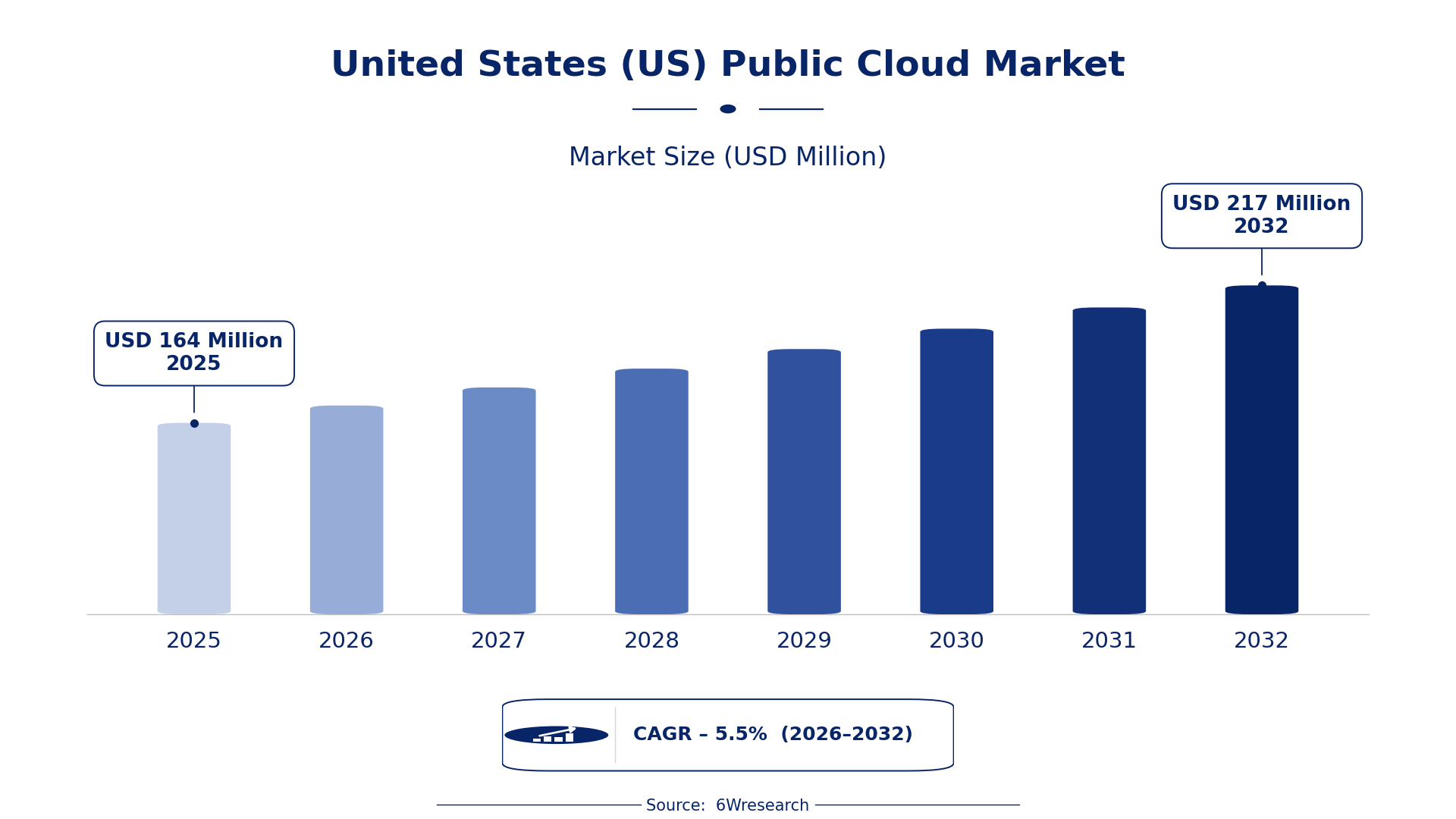
The United States (US) Public Cloud Market was estimated at USD 164 Million in 2025 and is projected to reach USD 217 Million by 2032, growing at a CAGR of 5.5% from 2026 to 2032.
United States (US) Public Cloud Market Synopsis
The demand for public cloud services in the United States is surging as businesses across sectors recognize the need for enhanced scalability and cost efficiency. This rapid adoption is particularly pronounced among enterprises transitioning to remote work models, which has become a critical factor in their operational strategies.
Major cloud service providers are expanding their offerings to include specialized services that cater to specific industry needs, reflecting the growing importance of tailored solutions. As organizations increasingly embrace digital transformation initiatives, the public cloud market is set to become an integral component of their technology stack.
United States (US) Public Cloud Market Year-wise Growth Rate and Key Drivers
This graph illustrates the annual growth rates of the United States (US) Public Cloud Market from 2021 to 2032, highlighting a steady upward trajectory and projected expansion over the forecast period.
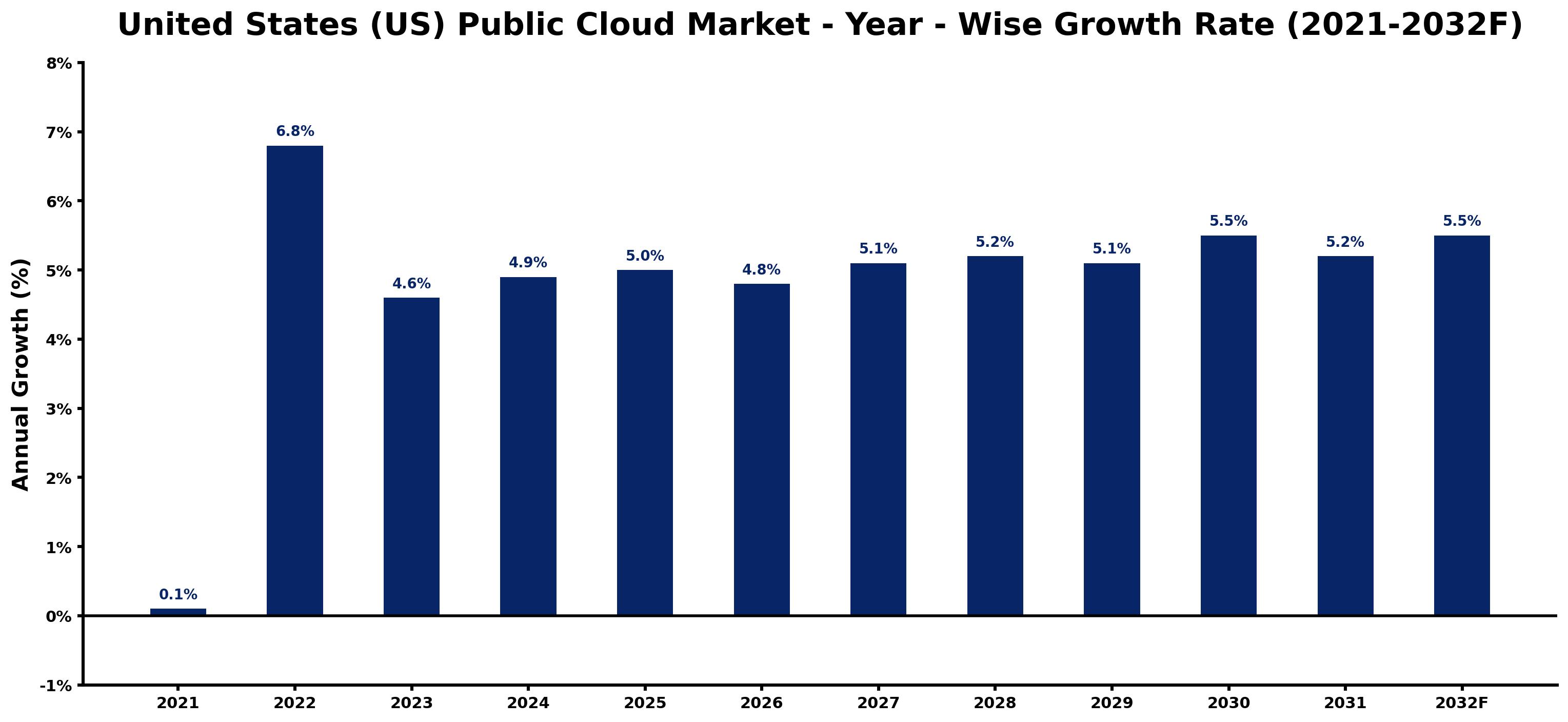
The table below presents the year‑wise growth rates along with the key drivers influencing the market
| Year | Growth Rate | Major Drivers |
| 2021 | 0.1% | Increased remote work drove initial cloud adoption. |
| 2022 | 6.8% | AWS and Microsoft Azure expanded service offerings. |
| 2023 | 4.6% | Corporate digital transformation accelerated cloud integrations. |
| 2024 | 4.9% | Data privacy regulations boosted cloud compliance solutions. |
| 2025 | 5.0% | Companies shifted to hybrid cloud for flexibility. |
| 2026 | 4.8% | Increased investment in AI-driven cloud technologies. |
| 2027 | 5.1% | SaaS demand surged among small and medium enterprises. |
| 2028 | 5.2% | Government cloud-first policy influenced public sector adoption. |
| 2029 | 5.1% | 5G rollout amplified edge computing cloud services. |
| 2030 | 5.5% | Rise in subscription models increased cloud spending. |
| 2031 | 5.2% | Growing cybersecurity threats led to enhanced cloud security. |
| 2032 | 5.5% | Emergence of new cloud startups drove innovation. |
Note: Market size estimations and growth projections presented in this report are based on 6Wresearch's proprietary forecasting methodology, utilizing the latest available industry data, government publications, and primary research inputs.
United States (US) Public Cloud Market Key Takeaways
Below are some of the specific key takeaways from the market, including:
- The ongoing shift toward hybrid and multi-cloud environments is reshaping IT infrastructure strategies.
- Security and compliance concerns continue to drive investments in advanced cloud security measures.
- Increased collaboration tools and platforms are gaining traction due to the rise in remote work.
- Companies specializing in cloud analytics and AI are emerging as key players in the ecosystem.
- The regulatory landscape is evolving, prompting businesses to adapt quickly to new compliance requirements.
Evaluation of Restraints in United States (US) Public Cloud Market
Despite the impressive growth trajectory, the United States Public Cloud Market faces notable challenges that could impede its expansion. Data security remains a top concern for organizations looking to migrate sensitive workloads to the cloud. Many are hesitant to fully embrace public cloud solutions due to fears of data breaches and potential regulatory pitfalls.
on top of that, the complexity of regulatory compliance can deter firms from adopting cloud services, as they navigate laws such as GDPR and HIPAA. Vendor lock-in also poses a risk, making it difficult for organizations to switch providers once they’ve made substantial investments in a particular platform. These factors necessitate careful planning and evaluation of security and compliance strategies for organizations considering public cloud adoption.
United States (US) Public Cloud Market Trends
The current trend is a pronounced shift towards hybrid and multi-cloud strategies, allowing businesses to optimize their IT resources and reduce reliance on a single provider. on top of that, organizations are increasingly prioritizing data security, driving cloud providers to enhance their security offerings to alleviate client concerns.
The rise of artificial intelligence and machine learning technologies is also influencing the market, enabling more sophisticated data analysis and service personalization. As digital transformation accelerates, businesses are seeking specialized cloud solutions tailored to sectors such as healthcare, finance, and e-commerce, reflecting the diverse needs of a modern economy.
United States (US) Public Cloud Market Opportunities
Investment opportunities abound in the US Public Cloud Market, particularly in areas like Software as a Service (SaaS), Infrastructure as a Service (IaaS), and Platform as a Service (PaaS). Enterprises are increasingly turning to leading cloud service providers for flexible and scalable solutions that drive operational efficiency.
Companies focused on cloud security, data analytics, and artificial intelligence are particularly well-positioned for growth, as demand for these services continues to rise. With businesses fully embracing remote work capabilities and digital transformation, the public cloud market remains a fertile ground for innovative growth and investment.
Government Initiatives in the United States (US) Public Cloud Market
The regulatory environment surrounding the US Public Cloud Market is shaping its growth trajectory significantly. Government policies aimed at enhancing cybersecurity and promoting cloud adoption are fostering a more favorable environment for both public and private sectors. These initiatives not only streamline operations but also ensure compliance with emerging regulations.
- A recent initiative, the Federal Risk and Authorization Management Program (FedRAMP), establishes security standards for cloud services, thereby encouraging trust in cloud solutions among federal agencies.
- Currently, a Cloud First policy is in place, urging government agencies to prioritize cloud solutions in their IT investments, which is driving public sector demand for cloud services.
- The National Institute of Standards and Technology (NIST) is actively working on new guidelines to promote interoperability and security across cloud platforms.
- A planned public-private partnership aims to enhance the digital infrastructure by 2028, which is expected to boost cloud service accessibility across various sectors.
Future Insights of the United States (US) Public Cloud Market
Looking ahead to 2026-2032, the outlook for the US Public Cloud Market is optimistic, with substantial growth expected as organizations continue to embrace cloud solutions. The drive towards digital transformation will intensify, with cloud services becoming central to operational strategies across various industries.
Emerging technologies such as AI, machine learning, and edge computing will further propel market expansion, enabling businesses to harness the full potential of their data. As competition among service providers escalates, innovation will remain a key differentiator, influencing market dynamics and shaping future trends.
United States (US) Public Cloud Market Latest Developments
In the last year, the United States Public Cloud Market has witnessed several pivotal developments that signal its evolution. Companies have been ramping up their service offerings to meet the growing demands for security, flexibility, and specialized solutions tailored to various industries.
- A major technology vendor launched a new cloud security platform in Q1 2025, designed to address the increasing concerns around data privacy and compliance.
- An ongoing initiative aims to enhance cloud service interoperability, fostering better integration across different platforms, which began in late 2025 and remains in progress.
- A regional operator is expected to roll out a new suite of cloud-based collaboration tools by mid-2026, targeting remote teams to improve productivity.
- By early 2025, a cloud analytics service tailored for healthcare providers is planned to be introduced, focusing on improving patient data management.
United States (US) Public Cloud Market - Key Attractiveness of the Report
- 10 Years of Market Numbers
- Historical Data Starting from 2022 to 2025
- Base Year: 2025
- Forecast Data until 2032
- Key Performance Indicators Impacting the Market
- Major Upcoming Developments and Projects
Key Highlights of the Report:
- United States (US) Public Cloud Market Outlook
- Market Size of United States (US) Public Cloud Market, 2025
- Forecast of United States (US) Public Cloud Market, 2032
- Historical Data and Forecast of United States (US) Public Cloud Revenues & Volume for the Period 2022-2032F
- United States (US) Public Cloud Market Trend Evolution
- United States (US) Public Cloud Market Drivers and Challenges
- United States (US) Public Cloud Price Trends
- United States (US) Public Cloud Porter's Five Forces
- United States (US) Public Cloud Industry Life Cycle
- Historical Data and Forecast of United States (US) Public Cloud Market Revenues & Volume By Service Model for the Period 2022-2032F
- Historical Data and Forecast of United States (US) Public Cloud Market Revenues & Volume By Infrastructure as a Service for the Period 2022-2032F
- Historical Data and Forecast of United States (US) Public Cloud Market Revenues & Volume By Platform as a Service for the Period 2022-2032F
- Historical Data and Forecast of United States (US) Public Cloud Market Revenues & Volume By Software as a Service for the Period 2022-2032F
- Historical Data and Forecast of United States (US) Public Cloud Market Revenues & Volume By Organization Size Large enterprises for the Period 2022-2032F
- Historical Data and Forecast of United States (US) Public Cloud Market Revenues & Volume By Small for the Period 2022-2032F
- Historical Data and Forecast of United States (US) Public Cloud Market Revenues & Volume By Medium Enterprises SMEs for the Period 2022-2032F
- Historical Data and Forecast of United States (US) Public Cloud Market Revenues & Volume By Verticals for the Period 2022-2032F
- Historical Data and Forecast of United States (US) Public Cloud Market Revenues & Volume By BFSI for the Period 2022-2032F
- Historical Data and Forecast of United States (US) Public Cloud Market Revenues & Volume By Telecommunication for the Period 2022-2032F
- Historical Data and Forecast of United States (US) Public Cloud Market Revenues & Volume By IT & ITeS for the Period 2022-2032F
- Historical Data and Forecast of United States (US) Public Cloud Market Revenues & Volume By Government & Public Sector for the Period 2022-2032F
- Historical Data and Forecast of United States (US) Public Cloud Market Revenues & Volume By Retail & Consumer Goods for the Period 2022-2032F
- Historical Data and Forecast of United States (US) Public Cloud Market Revenues & Volume By Manufacturing for the Period 2022-2032F
- Historical Data and Forecast of United States (US) Public Cloud Market Revenues & Volume By Energy & Utility for the Period 2022-2032F
- Historical Data and Forecast of United States (US) Public Cloud Market Revenues & Volume By Media & Entertainment for the Period 2022-2032F
- United States (US) Public Cloud Import Export Trade Statistics
- Market Opportunity Assessment By Service Model
- Market Opportunity Assessment By Organization Size Large enterprises
- Market Opportunity Assessment By Verticals
- United States (US) Public Cloud Top Companies Market Share
- United States (US) Public Cloud Competitive Benchmarking By Technical and Operational Parameters
- United States (US) Public Cloud Company Profiles
- United States (US) Public Cloud Key Strategic Recommendations






































