United States (US) Semiconductor Foundry Market Size, Share & Growth Rate
The United States (US) Semiconductor Foundry Market was estimated at USD 166 Million in 2025 and is projected to reach USD 196 Million by 2032, growing at a CAGR of 2.4% from 2026 to 2032. This growth is primarily driven by the surging demand for advanced manufacturing processes and cutting-edge semiconductor technologies, particularly in sectors like automotive and telecommunications. Additionally, as companies increasingly adopt AI, IoT, and 5G technologies, US foundries are expected to play a pivotal role in meeting the evolving needs of the market.
United States (US) Semiconductor Foundry Market Year-wise Growth Rate and Key Drivers
This graph highlights how the United States (US) Semiconductor Foundry Market has steadily grown over the years, supported by major growth factors.
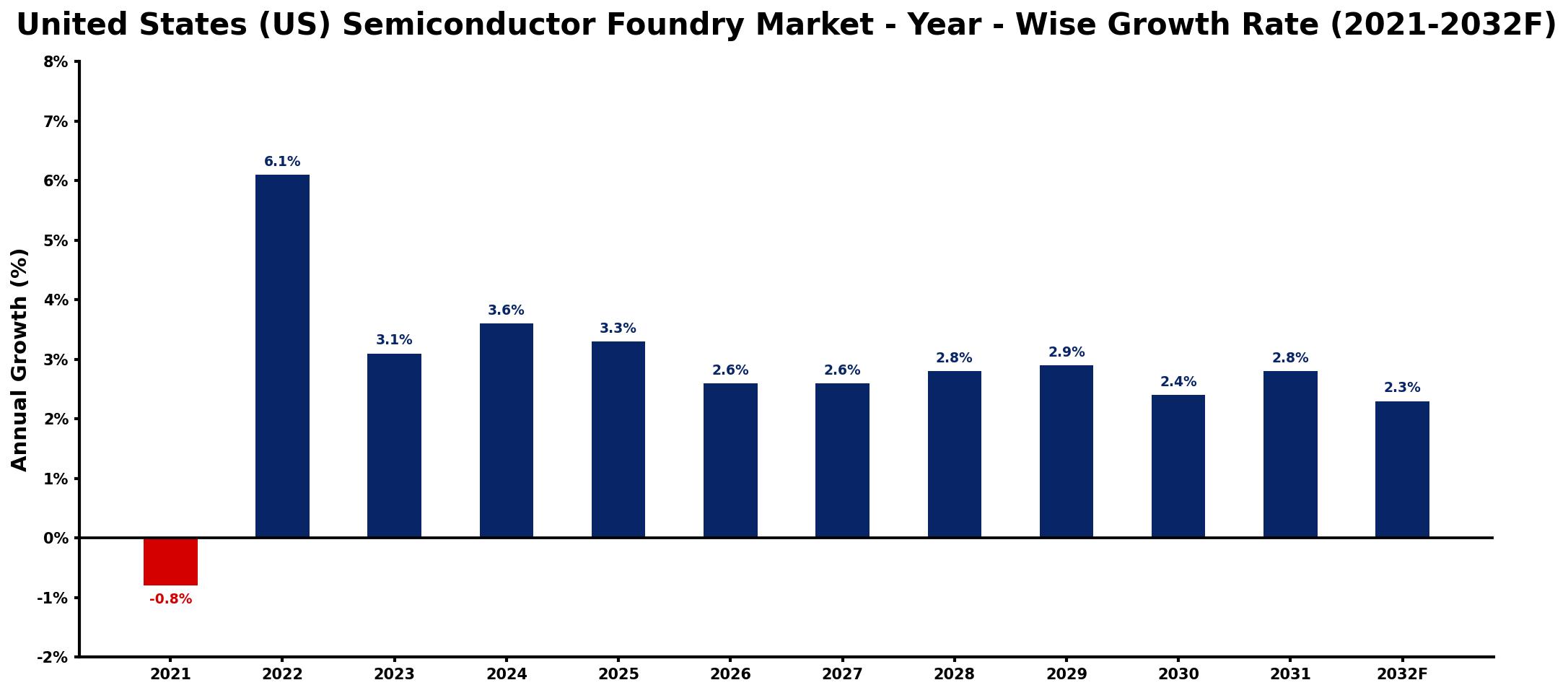
The table below presents the year‑wise growth rates along with the key drivers influencing the market
| Year | Growth Rate | Major Drivers |
| 2021 | -0.8% | decreased global demand for electronics |
| 2022 | 6.1% | increased investment in technology infrastructure |
| 2023 | 3.1% | rising demand for AI applications |
| 2024 | 3.6% | expansion of 5G network rollout |
| 2025 | 3.3% | growth in electric vehicle production |
| 2026 | 2.6% | increased consumer electronics sales |
| 2027 | 2.6% | adoption of IoT devices surging |
| 2028 | 2.8% | strengthening international trade flows |
| 2029 | 2.9% | improved processing technologies adoption |
| 2030 | 2.4% | increased government funding for tech |
| 2031 | 2.8% | growing downstream application demand |
| 2032 | 2.3% | rising end-use demand growth |
Note: Market size estimations and growth projections presented in this report are based on 6Wresearch's proprietary forecasting methodology, utilizing the latest available industry data, government publications, and primary research inputs.
United States (US) Semiconductor Foundry Market Synopsis
The US Semiconductor Foundry Market is undergoing a transformative phase, marked by increased competition and innovation. As consumer electronics and automotive industries drive the need for more sophisticated chips, domestic foundries are responding with advanced manufacturing capabilities. This strategic evolution is positioning the US as a central hub in the global semiconductor landscape.
Market players are heavily investing in R&D to enhance their technological prowess, facilitating breakthroughs in areas such as quantum computing and next-gen automotive electronics. This robust investment underscores a commitment to not only meeting current demand but also anticipating future technological shifts.
United States (US) Semiconductor Foundry Market Key Takeaways
- The US Semiconductor Foundry Market is essential for supporting the growing demand for advanced semiconductor technologies.
- Investment in R&D remains a focal point for US foundries, propelling innovation in cutting-edge manufacturing processes.
- Outsourcing semiconductor production to domestic foundries is gaining traction, driven by the need for specialized expertise.
- Government initiatives are increasingly aimed at bolstering domestic semiconductor manufacturing capabilities.
- Collaboration between semiconductor companies and foundries is essential to tackle complex design challenges.
Evaluation of Restraints in United States (US) Semiconductor Foundry Market
While the US Semiconductor Foundry Market demonstrates a promising trajectory, several significant restraints hinder its expansion. Intense competition from established players in regions such as Taiwan and South Korea presents a formidable challenge, as these countries often benefit from lower operational costs and advanced technologies. Additionally, the substantial capital investment required to establish and maintain semiconductor fabrication facilities can deter new entrants from joining the market.
Furthermore, the protection of intellectual property remains a critical issue, as foundries must navigate the complexities of cybersecurity threats alongside the need to safeguard proprietary technologies. Fluctuations in global demand for semiconductor products also create an environment of volatility, compelling US foundries to remain agile in adapting to market changes.
United States (US) Semiconductor Foundry Market Trends
The landscape of the US Semiconductor Foundry Market is shaped by several noteworthy trends. A key trend is the escalating demand for advanced manufacturing processes, particularly in 5nm and 7nm nodes, as industries embrace AI and IoT technologies. Additionally, the automotive sector is increasingly demanding specialized chips for electric vehicles and autonomous driving systems, propelling foundries to innovate continually.
Moreover, there is a marked shift towards increased collaboration between semiconductor companies and foundries, facilitating shared expertise in overcoming technical challenges linked to shrinking process nodes and design complexities. This collaborative spirit is becoming vital in navigating the rapid advancements in semiconductor technologies.
United States (US) Semiconductor Foundry Market Opportunities
Investment opportunities within the US Semiconductor Foundry Market are burgeoning, driven by the rising demand for semiconductor devices across diverse industries. With applications spanning automotive, consumer electronics, and telecommunications, foundries are strategically positioned to capitalize on these expanding markets. The momentum behind advanced technologies like 5G and AI highlights the pivotal role of semiconductor foundries in producing high-performance chips.
Furthermore, government support aimed at enhancing domestic semiconductor manufacturing creates a conducive environment for investment. Potential growth areas include firms specializing in next-gen manufacturing processes, as well as those fostering strategic partnerships to leverage emerging market opportunities.
Government Initiatives in the United States (US) Semiconductor Foundry Market
The US government has recognized the importance of bolstering the domestic semiconductor foundry market and has initiated several supportive policies. Initiatives like the CHIPS for America Act are designed to enhance semiconductor research, design, and manufacturing capabilities, thereby reducing dependency on foreign suppliers. Public-private partnerships have also been encouraged, aiming to stimulate technological innovation and investment within the semiconductor landscape.
These governmental efforts not only aim to enhance national security but also strive to reinforce economic competitiveness and supply chain resilience within the semiconductor foundry market.
Future Insights of the United States (US) Semiconductor Foundry Market
Looking ahead to 2026-2032, the US Semiconductor Foundry Market is positioned for significant growth, propelled by the rising demand for advanced technologies such as 5G, AI, and IoT. The ongoing global semiconductor shortage further underscores the importance of US foundries in satisfying market needs. Initiatives like the CHIPS Act are expected to bolster domestic manufacturing capabilities, fostering innovation and ensuring the US retains a competitive edge in the global semiconductor landscape.
As firms continue to focus on R&D and explore next-generation technologies, the trajectory for the US Semiconductor Foundry Market appears optimistic, affirming its role as a linchpin in the global semiconductor supply chain.
United States (US) Semiconductor Foundry Market Latest Developments (2025 - 2026)
Recent developments in the US Semiconductor Foundry Market reflect a dynamic industry environment, with an emphasis on advanced manufacturing and innovation. Companies are ramping up efforts to invest in next-gen manufacturing processes, including the latest chip architectures essential for burgeoning technologies. Collaborative efforts are increasingly prioritized, with semiconductor companies and foundries working closely to address complex technical challenges and streamline production processes.
Furthermore, the policy landscape is evolving to provide enhanced support for domestic semiconductor manufacturing initiatives, paving the way for robust investments and a more resilient supply chain.
United States (US) Semiconductor Foundry Market - Key Attractiveness of the Report
- 10 Years of Market Numbers
- Historical Data Starting from 2022 to 2025
- Base Year: 2025
- Forecast Data until 2032
- Key Performance Indicators Impacting the Market
- Major Upcoming Developments and Projects
Key Highlights of the Report:
- United States (US) Semiconductor Foundry Market Outlook
- Market Size of United States (US) Semiconductor Foundry Market, 2025
- Forecast of United States (US) Semiconductor Foundry Market, 2032
- Historical Data and Forecast of United States (US) Semiconductor Foundry Revenues & Volume for the Period 2022-2032F
- United States (US) Semiconductor Foundry Market Trend Evolution
- United States (US) Semiconductor Foundry Market Drivers and Challenges
- United States (US) Semiconductor Foundry Price Trends
- United States (US) Semiconductor Foundry Porter's Five Forces
- United States (US) Semiconductor Foundry Industry Life Cycle
- Historical Data and Forecast of United States (US) Semiconductor Foundry Market Revenues & Volume By Technology Node for the Period 2022-2032F
- Historical Data and Forecast of United States (US) Semiconductor Foundry Market Revenues & Volume By 10/7/5 nm for the Period 2022-2032F
- Historical Data and Forecast of United States (US) Semiconductor Foundry Market Revenues & Volume By 16/14 nm for the Period 2022-2032F
- Historical Data and Forecast of United States (US) Semiconductor Foundry Market Revenues & Volume By 20 nm for the Period 2022-2032F
- Historical Data and Forecast of United States (US) Semiconductor Foundry Market Revenues & Volume By 28 nm for the Period 2022-2032F
- Historical Data and Forecast of United States (US) Semiconductor Foundry Market Revenues & Volume By 45/40 nm for the Period 2022-2032F
- Historical Data and Forecast of United States (US) Semiconductor Foundry Market Revenues & Volume By 65 nm for the Period 2022-2032F
- Historical Data and Forecast of United States (US) Semiconductor Foundry Market Revenues & Volume By Other for the Period 2022-2032F
- Historical Data and Forecast of United States (US) Semiconductor Foundry Market Revenues & Volume By Application for the Period 2022-2032F
- Historical Data and Forecast of United States (US) Semiconductor Foundry Market Revenues & Volume By Consumer Electronics and Communication for the Period 2022-2032F
- Historical Data and Forecast of United States (US) Semiconductor Foundry Market Revenues & Volume By Automotive for the Period 2022-2032F
- Historical Data and Forecast of United States (US) Semiconductor Foundry Market Revenues & Volume By Industrial for the Period 2022-2032F
- Historical Data and Forecast of United States (US) Semiconductor Foundry Market Revenues & Volume By HPC for the Period 2022-2032F
- Historical Data and Forecast of United States (US) Semiconductor Foundry Market Revenues & Volume By Other Applications for the Period 2022-2032F
- United States (US) Semiconductor Foundry Import Export Trade Statistics
- Market Opportunity Assessment By Technology Node
- Market Opportunity Assessment By Application
- United States (US) Semiconductor Foundry Top Companies Market Share
- United States (US) Semiconductor Foundry Competitive Benchmarking By Technical and Operational Parameters
- United States (US) Semiconductor Foundry Company Profiles
- United States (US) Semiconductor Foundry Key Strategic Recommendations






































