United States (US) Silk Yarn Market Size, Share & Growth Rate
The United States (US) Silk Yarn Market was estimated at USD 146 Million in 2025 and is projected to reach USD 171 Million by 2032, growing at a CAGR of 2.3% from 2026 to 2032. This growth is primarily driven by a rising consumer preference for luxury textiles and a significant shift towards sustainable and ethically sourced materials. As fashion trends increasingly favor natural fibers, silk yarns unique qualities have positioned it well in a competitive marketplace.
United States (US) Silk Yarn Market Year-wise Growth Rate and Key Drivers
This graph highlights how the United States (US) Silk Yarn Market has steadily grown over the years, supported by major growth factors.
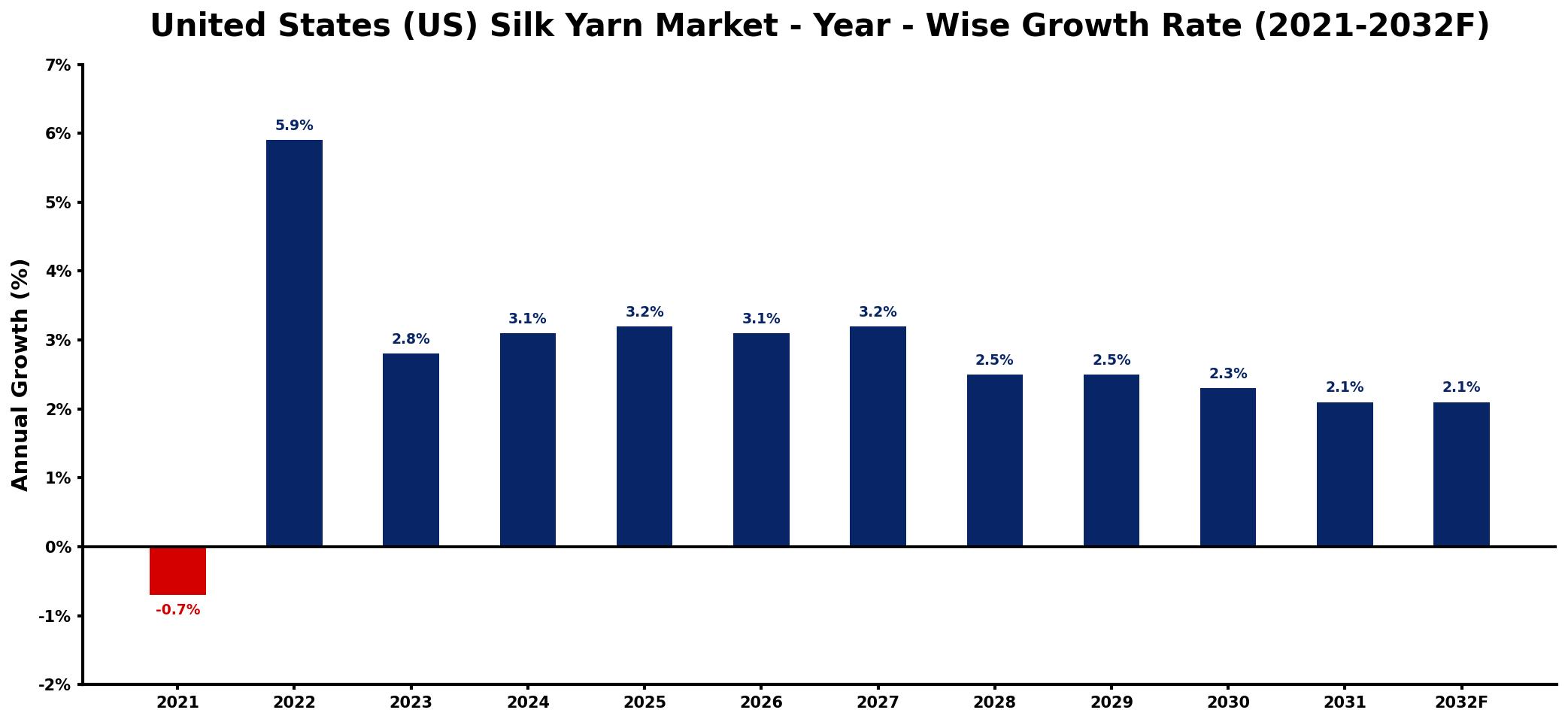
The table below presents the year‑wise growth rates along with the key drivers influencing the market
| Year | Growth Rate | Major Drivers |
| 2021 | -0.7% | Supply chain disruptions impact production |
| 2022 | 5.9% | Rising demand from fashion industry |
| 2023 | 2.8% | Increased investment in textile technology |
| 2024 | 3.1% | Growth in eco-friendly materials adoption |
| 2025 | 3.2% | Expansion of luxury textile market |
| 2026 | 3.1% | expanding healthcare application demand |
| 2027 | 3.2% | Surge in online retail channels |
| 2028 | 2.5% | Growing popularity of artisanal crafts |
| 2029 | 2.5% | Enhanced marketing strategies drive awareness |
| 2030 | 2.3% | Emergence of innovative design trends |
| 2031 | 2.1% | Increasing collaboration among manufacturers |
| 2032 | 2.1% | Development of new production techniques |
Note: Market size estimations and growth projections presented in this report are based on 6Wresearch's proprietary forecasting methodology, utilizing the latest available industry data, government publications, and primary research inputs.
United States (US) Silk Yarn Market Synopsis
The current momentum in the United States silk yarn market is being propelled by the escalating demand for high-end, sustainable textiles. As consumers become more conscious of their purchasing decisions, the allure of silks softness and luster plays a critical role in its desirability across various applications.
Moreover, the increasing interest in artisanal and handcrafted products signifies a shift towards unique, premium offerings. This has led to a resurgence in small-scale producers who focus on quality and sustainability, further solidifying the silk yarns standing in the market.
United States (US) Silk Yarn Market Key Takeaways
- The market is increasingly driven by consumer demand for luxury and sustainable textiles.
- There is a notable rise in interest for handcrafted silk products from small-scale producers.
- Innovative blends of silk with other natural fibers are enhancing product offerings.
- Strategic investments in eco-friendly practices can provide a competitive edge in the market.
- Consumer awareness regarding ethical sourcing is reshaping purchasing patterns.
Evaluation of Restraints in United States (US) Silk Yarn Market
Despite its promising outlook, the US silk yarn market encounters several hurdles that may limit growth. Chief among these is the fierce competition from synthetic fibers, which often offer lower prices and broader availability. Additionally, the volatility of raw material prices, influenced by external factors such as climate conditions affecting silk production, can pose a significant challenge for manufacturers. Furthermore, the limited awareness surrounding silks production process can impact consumer perceptions of its sustainability, making effective marketing and education critical for overcoming these barriers.
United States (US) Silk Yarn Market Trends
In the current landscape, the preference for sustainable and eco-friendly materials is a prominent trend shaping the US silk yarn market. This is matched by an increasing desire for premium-quality products, as consumers gravitate towards textiles that offer both aesthetic appeal and ethical value. The trend towards innovative blends is also gaining traction, with producers experimenting with various natural fibers to enhance silk's functionality and environmental impact.
United States (US) Silk Yarn Market Opportunities
Investment opportunities within the US silk yarn market are abundant, particularly as consumers prioritize sustainable luxury products. Establishing connections with domestic silk farms to source high-quality raw materials presents a viable avenue for vertical integration. Additionally, collaborations with fashion designers can facilitate market expansion and diversification. The rise in eco-conscious consumerism further opens niches within the market for ethically sourced silk products.
Government Initiatives in the United States (US) Silk Yarn Market
While there are no specific policies tailored exclusively to the silk yarn market, broader trade regulations and textile tariffs play a crucial role in shaping industry dynamics. The US government supports domestic textile producers through initiatives designed to promote local sourcing and manufacturing. Such policies can enhance the competitive landscape, encouraging a focus on quality and sustainability in production practices.
Future Insights of the United States (US) Silk Yarn Market
Looking ahead to 2026-2032, the United States silk yarn market is poised for steady expansion, driven by the continuous pursuit of luxury and sustainability among consumers. The growing inclination towards unique and high-quality textiles suggests that silk yarn will continue to captivate a niche market eager for refined products. As technology advances and production techniques become more innovative, manufacturers are likely to adapt to evolving consumer preferences, reinforcing a positive market outlook.
United States (US) Silk Yarn Market Latest Developments (2025 - 2026)
Recent developments in the United States silk yarn market indicate a strong shift towards sustainability, with manufacturers increasingly adopting eco-friendly practices. The focus on innovation is evident, with several companies exploring new blends of silk and sustainable materials. This period has also seen a rise in collaborations between textile mills and fashion brands, promoting artisanal craftsmanship and elevating the profile of silk yarn in luxury markets.
United States (US) Silk Yarn Market - Key Attractiveness of the Report
- 10 Years of Market Numbers
- Historical Data Starting from 2022 to 2025
- Base Year: 2025
- Forecast Data until 2032
- Key Performance Indicators Impacting the Market
- Major Upcoming Developments and Projects
Key Highlights of the Report:
- United States (US) Silk Yarn Market Outlook
- Market Size of United States (US) Silk Yarn Market, 2025
- Forecast of United States (US) Silk Yarn Market, 2032
- Historical Data and Forecast of United States (US) Silk Yarn Revenues & Volume for the Period 2022-2032F
- United States (US) Silk Yarn Market Trend Evolution
- United States (US) Silk Yarn Market Drivers and Challenges
- United States (US) Silk Yarn Price Trends
- United States (US) Silk Yarn Porter's Five Forces
- United States (US) Silk Yarn Industry Life Cycle
- Historical Data and Forecast of United States (US) Silk Yarn Market Revenues & Volume By Production Analysis for the Period 2022-2032F
- Historical Data and Forecast of United States (US) Silk Yarn Market Revenues & Volume By Volume for the Period 2022-2032F
- Historical Data and Forecast of United States (US) Silk Yarn Market Revenues & Volume By Consumption Analysis for the Period 2022-2032F
- Historical Data and Forecast of United States (US) Silk Yarn Market Revenues & Volume By Value for the Period 2022-2032F
- Historical Data and Forecast of United States (US) Silk Yarn Market Revenues & Volume By Volume for the Period 2022-2032F
- Historical Data and Forecast of United States (US) Silk Yarn Market Revenues & Volume By Export Analysis for the Period 2022-2032F
- Historical Data and Forecast of United States (US) Silk Yarn Market Revenues & Volume By Value for the Period 2022-2032F
- Historical Data and Forecast of United States (US) Silk Yarn Market Revenues & Volume By Volume for the Period 2022-2032F
- Historical Data and Forecast of United States (US) Silk Yarn Market Revenues & Volume By Import Analysis for the Period 2022-2032F
- Historical Data and Forecast of United States (US) Silk Yarn Market Revenues & Volume By Value for the Period 2022-2032F
- Historical Data and Forecast of United States (US) Silk Yarn Market Revenues & Volume By Volume for the Period 2022-2032F
- United States (US) Silk Yarn Import Export Trade Statistics
- Market Opportunity Assessment By Production Analysis
- Market Opportunity Assessment By Consumption Analysis
- Market Opportunity Assessment By Export Analysis
- Market Opportunity Assessment By Import Analysis
- United States (US) Silk Yarn Top Companies Market Share
- United States (US) Silk Yarn Competitive Benchmarking By Technical and Operational Parameters
- United States (US) Silk Yarn Company Profiles
- United States (US) Silk Yarn Key Strategic Recommendations






































