United States (US) Smart Retail Market Size, Share & Growth Rate
The United States (US) Smart Retail Market was estimated at USD 445 Million in 2025 and is projected to reach USD 608 Million by 2032, growing at a CAGR of 4.6% from 2026 to 2032. This growth trajectory is predominantly fueled by an increasing reliance on AI technologies, IoT devices, and data analytics in retail operations. As consumer preferences evolve toward enhanced shopping experiences, retailers are investing in smart solutions to remain competitive and to meet the rising demand for personalized and contactless service.
United States (US) Smart Retail Market Year-wise Growth Rate and Key Drivers
This graph highlights how the United States (US) Smart Retail Market has steadily grown over the years, supported by major growth factors.
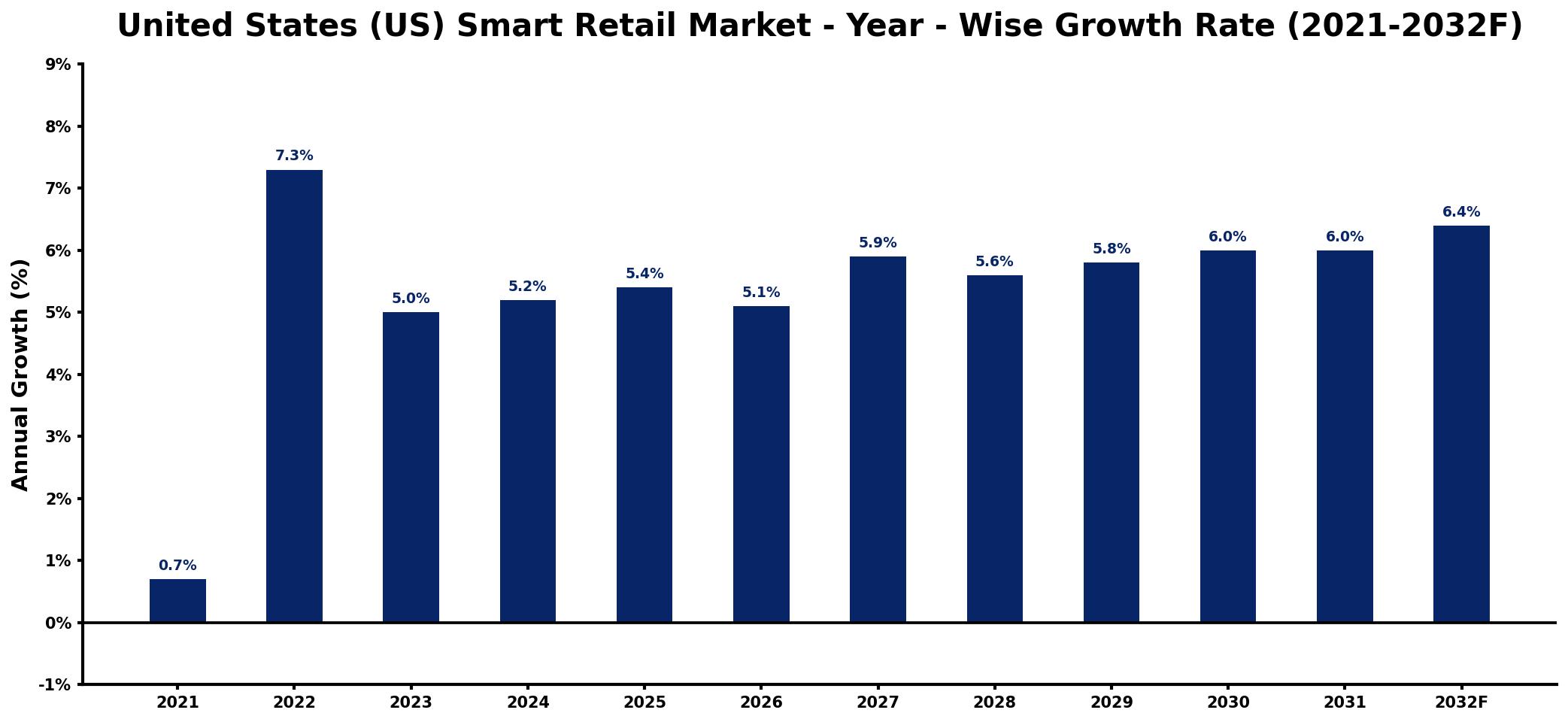
The table below presents the year‑wise growth rates along with the key drivers influencing the market
| Year | Growth Rate | Major Drivers |
| 2021 | 0.7% | Emerging technologies adoption accelerates growth |
| 2022 | 7.3% | Increased consumer demand for automation |
| 2023 | 5.0% | Investment in digital infrastructure rises |
| 2024 | 5.2% | Data analytics utilization enhances efficiency |
| 2025 | 5.4% | strengthening underlying market demand |
| 2026 | 5.1% | growing downstream application demand |
| 2027 | 5.9% | Sustainability initiatives attract new investments |
| 2028 | 5.6% | Omnichannel strategies gain widespread acceptance |
| 2029 | 5.8% | Personalization trends drive market evolution |
| 2030 | 6.0% | strengthening international trade flows |
| 2031 | 6.0% | Collaboration among tech firms strengthens |
| 2032 | 6.4% | increased domestic production output |
Note: Market size estimations and growth projections presented in this report are based on 6Wresearch's proprietary forecasting methodology, utilizing the latest available industry data, government publications, and primary research inputs.
United States (US) Smart Retail Market Synopsis
In recent years, the US Smart Retail Market has gained significant momentum, driven by rapid technological advancements. Retailers are increasingly implementing smart technologies, including AI-powered analytics and IoT devices, to improve operational efficiency and customer satisfaction. The landscape is becoming more sophisticated as solutions like smart shelves and cashier-less checkouts are adopted to streamline operations.
The COVID-19 pandemic acted as a catalyst, accelerating the shift toward smart retail technologies. As retailers navigated unprecedented challenges, the need for contactless solutions and data-driven insights became paramount. The market is now characterized by an array of innovative solutions tailored to improve customer interactions and optimize inventory management.
United States (US) Smart Retail Market Key Takeaways
- The market is experiencing robust growth due to technological advancements and changing consumer behaviors.
- Smart retail solutions enhance customer experience while optimizing operational efficiency.
- The COVID-19 pandemic has significantly sped up the adoption of smart retail technologies.
- Key technological trends include AI analytics, IoT integration, and personalized marketing strategies.
- Sustainability initiatives are driving the demand for energy-efficient smart retail solutions.
Evaluation of Restraints in United States (US) Smart Retail Market
Despite the promising growth, the US Smart Retail Market faces notable restraints that could hinder its expansion. Data security and privacy concerns remain paramount, as retailers grapple with the collection and analysis of sensitive customer information. Additionally, integrating advanced technologies into existing systems can present significant challenges, requiring both time and resources. The high upfront costs of implementing smart retail solutions can deter smaller retailers from entering the market, while the ongoing need for skilled personnel further complicates the landscape.
United States (US) Smart Retail Market Trends
A multitude of trends are shaping the US Smart Retail Market. The adoption of AI and machine learning technologies allows retailers to leverage vast amounts of data for personalized marketing strategies. The rise of cashierless stores and smart shelves facilitates seamless transactions, enhancing the shopping experience. Sustainability is increasingly influencing technology adoption, as retailers implement solutions that minimize energy consumption and waste. Furthermore, the emergence of omni-channel strategies is becoming prevalent, blurring the lines between online and offline retail.
United States (US) Smart Retail Market Opportunities
The US Smart Retail Market presents numerous growth opportunities across various sectors. Significant investment potential exists in the development of smart payment systems, robust inventory management solutions, and personalized marketing platforms. Retailers are eager for innovative technologies that streamline operations, enhance customer engagement, and drive sales. The integration of online and offline shopping experiences stands out as a pivotal area for future growth, with an increasing demand for seamless interactions and engagement across different channels.
Government Initiatives in the United States (US) Smart Retail Market
The US government has introduced several policies aimed at fostering the growth of the Smart Retail Market. Key initiatives focus on enhancing cybersecurity measures and promoting data privacy regulations, creating a safer environment for both retailers and consumers. Efforts to stimulate innovation in technology are also underway, with a push for public-private partnerships aimed at advancing smart retail solutions. These initiatives help streamline the adoption of smart technologies and bolster the market's competitiveness.
Future Insights of the United States (US) Smart Retail Market
Looking ahead to 2026-2032, the US Smart Retail Market is set to flourish, propelled by ongoing technological advancements and evolving consumer expectations. Retailers will continue to prioritize the integration of AI, IoT, and data analytics to optimize operations and deliver personalized services. The emphasis on contactless shopping experiences, interactive displays, and immersive digital environments will further redefine consumer engagement. As the landscape evolves, investment in innovative smart retail technologies will be crucial for maintaining competitive advantage and fostering growth across the industry.
United States (US) Smart Retail Market Latest Developments (2025 - 2026)
Recent trends indicate a strong shift toward more interactive and consumer-centric retail solutions in the Smart Retail Market. Retailers are increasingly leveraging advanced analytics to refine customer engagement strategies. The implementation of innovative technologies, including enhanced inventory tracking and smarter payment systems, is becoming commonplace. Additionally, sustainability remains a key focus, with many companies adopting eco-friendly solutions to meet consumer demands for responsible retail practices.
United States (US) Smart Retail Market - Key Attractiveness of the Report
- 10 Years of Market Numbers
- Historical Data Starting from 2022 to 2025
- Base Year: 2025
- Forecast Data until 2032
- Key Performance Indicators Impacting the Market
- Major Upcoming Developments and Projects
Key Highlights of the Report:
- United States (US) Smart Retail Market Outlook
- Market Size of United States (US) Smart Retail Market, 2025
- Forecast of United States (US) Smart Retail Market, 2032
- Historical Data and Forecast of United States (US) Smart Retail Revenues & Volume for the Period 2022-2032F
- United States (US) Smart Retail Market Trend Evolution
- United States (US) Smart Retail Market Drivers and Challenges
- United States (US) Smart Retail Price Trends
- United States (US) Smart Retail Porter's Five Forces
- United States (US) Smart Retail Industry Life Cycle
- Historical Data and Forecast of United States (US) Smart Retail Market Revenues & Volume By System for the Period 2022-2032F
- Historical Data and Forecast of United States (US) Smart Retail Market Revenues & Volume By Digital Signage Solutions for the Period 2022-2032F
- Historical Data and Forecast of United States (US) Smart Retail Market Revenues & Volume By Smart Labels for the Period 2022-2032F
- Historical Data and Forecast of United States (US) Smart Retail Market Revenues & Volume By Smart Payment Systems for the Period 2022-2032F
- Historical Data and Forecast of United States (US) Smart Retail Market Revenues & Volume By Intelligent Vending Machines for the Period 2022-2032F
- Historical Data and Forecast of United States (US) Smart Retail Market Revenues & Volume By Augmented Reality Solutions for the Period 2022-2032F
- Historical Data and Forecast of United States (US) Smart Retail Market Revenues & Volume By Virtual Reality Solutions for the Period 2022-2032F
- Historical Data and Forecast of United States (US) Smart Retail Market Revenues & Volume By POS Solutions for the Period 2022-2032F
- Historical Data and Forecast of United States (US) Digital Signage Solutions Smart Retail Market Revenues & Volume By Smart Carts for the Period 2022-2032F
- Historical Data and Forecast of United States (US) Smart Retail Market Revenues & Volume By Application for the Period 2022-2032F
- Historical Data and Forecast of United States (US) Smart Retail Market Revenues & Volume By Foot-traffic Monitoring for the Period 2022-2032F
- Historical Data and Forecast of United States (US) Smart Retail Market Revenues & Volume By Inventory Management for the Period 2022-2032F
- Historical Data and Forecast of United States (US) Smart Retail Market Revenues & Volume By Loyalty Management and Payment for the Period 2022-2032F
- Historical Data and Forecast of United States (US) Smart Retail Market Revenues & Volume By Predictive Equipment Maintenance for the Period 2022-2032F
- Historical Data and Forecast of United States (US) Smart Retail Market Revenues & Volume By Brand Protection for the Period 2022-2032F
- Historical Data and Forecast of United States (US) Smart Retail Market Revenues & Volume By Smart Fitting Rooms for the Period 2022-2032F
- Historical Data and Forecast of United States (US) Smart Retail Market Revenues & Volume By Retail Offering for the Period 2022-2032F
- Historical Data and Forecast of United States (US) Smart Retail Market Revenues & Volume By Apparel and Accessories for the Period 2022-2032F
- Historical Data and Forecast of United States (US) Smart Retail Market Revenues & Volume By Fast-moving Consumer Goods for the Period 2022-2032F
- Historical Data and Forecast of United States (US) Smart Retail Market Revenues & Volume By Hardlines and Leisure Goods for the Period 2022-2032F
- Historical Data and Forecast of United States (US) Smart Retail Market Revenues & Volume By Others for the Period 2022-2032F
- United States (US) Smart Retail Import Export Trade Statistics
- Market Opportunity Assessment By System
- Market Opportunity Assessment By Application
- Market Opportunity Assessment By Retail Offering
- United States (US) Smart Retail Top Companies Market Share
- United States (US) Smart Retail Competitive Benchmarking By Technical and Operational Parameters
- United States (US) Smart Retail Company Profiles
- United States (US) Smart Retail Key Strategic Recommendations






































