United States (US) Trolley Market Size, Share & Growth Rate
The United States (US) Trolley Market was estimated at USD 203 Million in 2025 and is projected to reach USD 242 Million by 2032, growing at a CAGR of 2.5% from 2026 to 2032. This growth is primarily fueled by an increasing emphasis on urban sustainability, as cities seek to reduce congestion and pollution through more eco-friendly transit options. As trolley systems are modernized and integrated with cutting-edge technology, their appeal to both residents and visitors continues to rise, solidifying their role in the future of urban transport.
United States (US) Trolley Market Year-wise Growth Rate and Key Drivers
This graph highlights how the United States (US) Trolley Market has steadily grown over the years, supported by major growth factors.
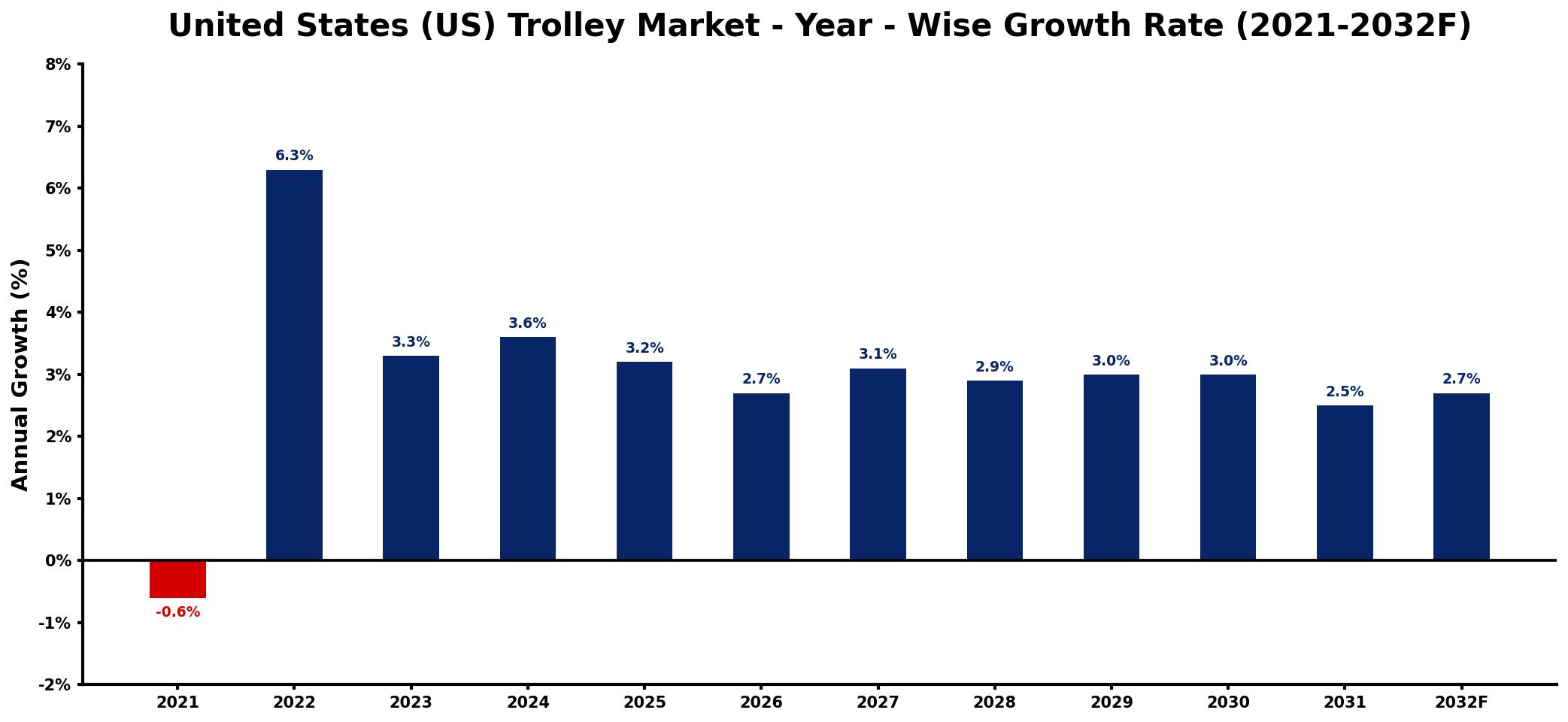
The table below presents the year‑wise growth rates along with the key drivers influencing the market
| Year | Growth Rate | Major Drivers |
| 2021 | -0.6% | Supply chain disruptions affecting production |
| 2022 | 6.3% | Increased consumer preference for mobility |
| 2023 | 3.3% | Rising urbanization driving demand |
| 2024 | 3.6% | Growth in e-commerce logistics requirements |
| 2025 | 3.2% | Expansion of public transport initiatives |
| 2026 | 2.7% | Increased investments in sustainable solutions |
| 2027 | 3.1% | enhanced product quality standards |
| 2028 | 2.9% | rising infrastructure development spending |
| 2029 | 3.0% | Technological advancements enhancing efficiency |
| 2030 | 3.0% | Rising demand for eco-friendly options |
| 2031 | 2.5% | rising procurement volume requirements |
| 2032 | 2.7% | Increasing adoption of automated solutions |
Note: Market size estimations and growth projections presented in this report are based on 6Wresearch's proprietary forecasting methodology, utilizing the latest available industry data, government publications, and primary research inputs.
United States (US) Trolley Market Synopsis
Currently, the US trolley market is undergoing a renaissance, driven by an increased recognition of the benefits these systems offer in urban areas. Cities like San Francisco and Philadelphia highlight how trolleys can enhance urban mobility while reducing carbon footprints, attracting both daily commuters and tourists alike.
The demand for modernized trolley systems is being underscored by advancements in technology, particularly in the development of electric trolleys and low-floor models that enhance accessibility. As urban areas continue to grow, trolleys are positioned as an effective solution to the challenges of urban transportation, emphasizing convenience and sustainability.
United States (US) Trolley Market Key Takeaways
- The US trolley market is on an upward trajectory, driven by urbanization and sustainability trends.
- Advancements in trolley technology are reshaping the market landscape, making trolleys more appealing to modern consumers.
- Competition from alternative transport modes poses challenges that trolleys must navigate to maintain relevance.
- Growing interest in historical and themed trolley tours presents unique opportunities for market expansion.
- Government initiatives and funding programs can bolster trolley infrastructure development and public transport enhancement.
Evaluation of Restraints in United States (US) Trolley Market
Despite its potential, the US trolley market faces significant restraints that can hinder its growth. The competition from more flexible transport options, such as buses and ride-sharing services, presents a challenge to trolley systems, which often have fixed routes and limited schedules. Aging infrastructure is another pressing issue, requiring considerable investment for maintenance and modernization. These factors can create budget constraints for operators and limit their capacity to adapt to the preferences of younger generations who are increasingly tech-oriented.
United States (US) Trolley Market Trends
The US trolley market is characterized by several emerging trends. A shift towards electric trolleys is gaining momentum, as municipalities prioritize environmentally-friendly transport options. Additionally, technological integration such as onboard Wi-Fi, USB charging, and real-time tracking systems is enhancing the passenger experience. Furthermore, there is a growing demand for themed trolley tours, which appeal to tourists seeking unique and nostalgic experiences in cities rich in history. These trends indicate a market that is actively evolving to meet the changing needs of consumers.
United States (US) Trolley Market Opportunities
The evolving landscape of the US trolley market presents numerous investment opportunities. There is a significant demand for the manufacturing of new trolley vehicles, particularly those that emphasize sustainability and technological innovation. Infrastructure development and maintenance services also represent a critical area for investment. Additionally, partnerships with municipalities seeking to enhance their public transportation networks can yield strategic advantages for stakeholders in the market. As environmental considerations take center stage, the potential for growth in electric and smart trolley systems is particularly noteworthy.
Government Initiatives in the United States (US) Trolley Market
While there are no specific policies exclusively targeting the trolley market, existing transportation regulations and federal initiatives play a crucial role in shaping its development. For instance, programs like the Transportation Investment Generating Economic Recovery (TIGER) grants provide essential funding for infrastructure projects. Local governments also influence trolley operations through permitting and route planning. Overall, the trolley market benefits from a broader framework of transportation policies that align with public transit expansion and sustainability goals.
Future Insights of the United States (US) Trolley Market
Looking ahead to 2026-2032, the future of the US trolley market appears promising. The ongoing trends of urbanization and environmental sustainability will likely bolster demand for trolley systems as cities seek effective solutions to mitigate traffic congestion and enhance public transit. Technological advancements, particularly in electrification and smart systems, will further attract a diverse range of passengers. As communities invest in their transportation infrastructure, trolleys will play a pivotal role in shaping the urban transit landscape.
United States (US) Trolley Market Latest Developments (2025 - 2026)
Recent developments in the US trolley market indicate a shift towards modernized systems, with several cities initiating pilot programs to test electric trolleys. Furthermore, advancements in connectivity and customer experience technologies are being prioritized, with operators focusing on integrating smart features into trolley operations. Cities are exploring collaborations with technology firms to enhance real-time tracking and passenger communication. The emphasis on historical trolley tours is also gaining traction, presenting opportunities for operators to cater to the growing demand for unique travel experiences.
United States (US) Trolley Market - Key Attractiveness of the Report
- 10 Years of Market Numbers
- Historical Data Starting from 2022 to 2025
- Base Year: 2025
- Forecast Data until 2032
- Key Performance Indicators Impacting the Market
- Major Upcoming Developments and Projects
Key Highlights of the Report:
- United States (US) Trolley Market Outlook
- Market Size of United States (US) Trolley Market, 2025
- Forecast of United States (US) Trolley Market, 2032
- Historical Data and Forecast of United States (US) Trolley Revenues & Volume for the Period 2022-2032F
- United States (US) Trolley Market Trend Evolution
- United States (US) Trolley Market Drivers and Challenges
- United States (US) Trolley Price Trends
- United States (US) Trolley Porter's Five Forces
- United States (US) Trolley Industry Life Cycle
- Historical Data and Forecast of United States (US) Trolley Market Revenues & Volume By Product for the Period 2022-2032F
- Historical Data and Forecast of United States (US) Trolley Market Revenues & Volume By Manual for the Period 2022-2032F
- Historical Data and Forecast of United States (US) Trolley Market Revenues & Volume By Electric for the Period 2022-2032F
- Historical Data and Forecast of United States (US) Trolley Market Revenues & Volume By Application for the Period 2022-2032F
- Historical Data and Forecast of United States (US) Trolley Market Revenues & Volume By Commercial for the Period 2022-2032F
- Historical Data and Forecast of United States (US) Trolley Market Revenues & Volume By Non-commercial for the Period 2022-2032F
- Historical Data and Forecast of United States (US) Trolley Market Revenues & Volume By Distribution for the Period 2022-2032F
- Historical Data and Forecast of United States (US) Trolley Market Revenues & Volume By Offline for the Period 2022-2032F
- Historical Data and Forecast of United States (US) Trolley Market Revenues & Volume By Online for the Period 2022-2032F
- United States (US) Trolley Import Export Trade Statistics
- Market Opportunity Assessment By Product
- Market Opportunity Assessment By Application
- Market Opportunity Assessment By Distribution
- United States (US) Trolley Top Companies Market Share
- United States (US) Trolley Competitive Benchmarking By Technical and Operational Parameters
- United States (US) Trolley Company Profiles
- United States (US) Trolley Key Strategic Recommendations






































