United States (US) Underwater Concrete Market Size, Share & Growth Rate
The United States (US) Underwater Concrete Market was estimated at USD 211 Million in 2025 and is projected to reach USD 249 Million by 2032, growing at a CAGR of 2.4% from 2026 to 2032. This growth trajectory is being driven by increasing infrastructure development projects across various sectors, particularly in coastal regions and urban areas facing flooding challenges. Additionally, the emphasis on repairing and maintaining aging underwater structures further fuels the demand for specialized underwater concrete solutions.
United States (US) Underwater Concrete Market Year-wise Growth Rate and Key Drivers
This graph highlights how the United States (US) Underwater Concrete Market has steadily grown over the years, supported by major growth factors.
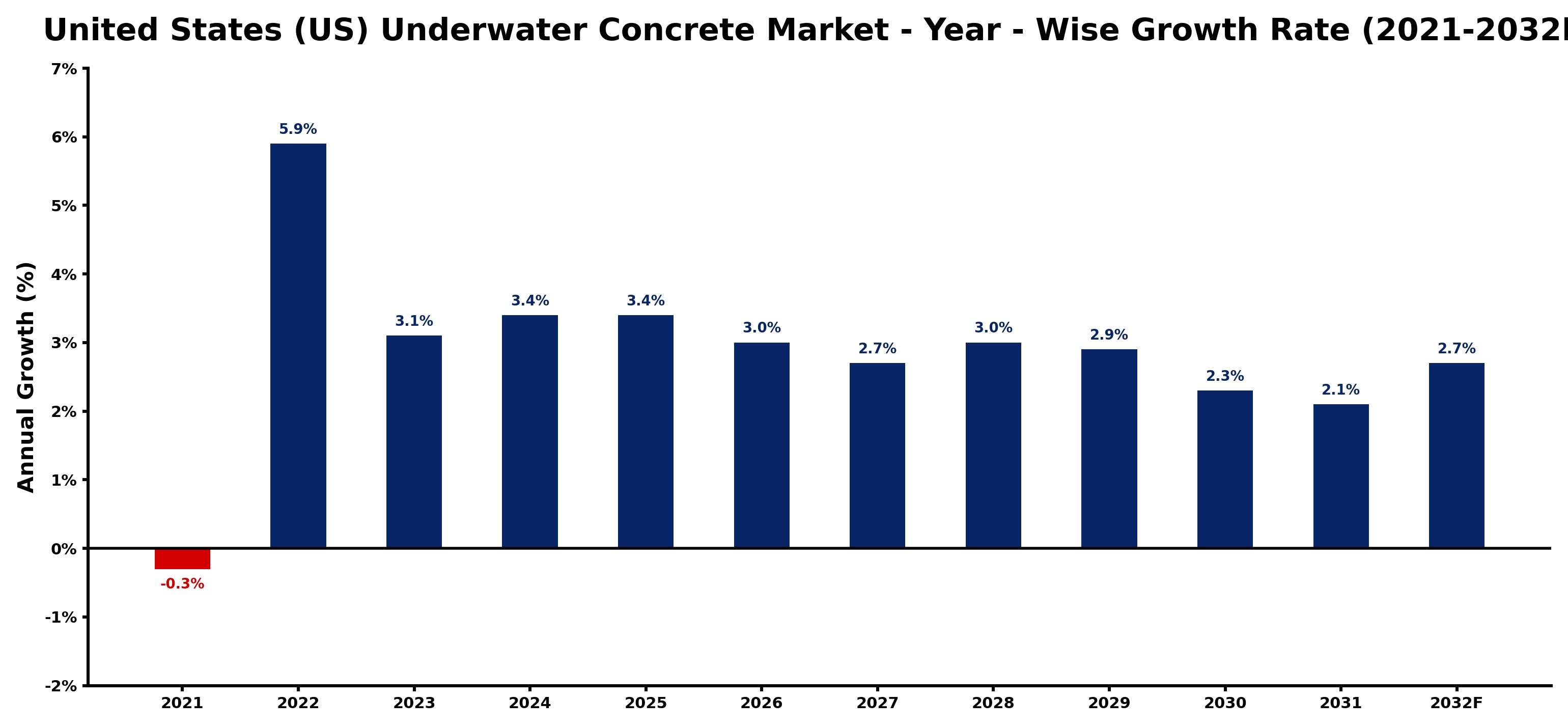
The table below presents the year‑wise growth rates along with the key drivers influencing the market
| Year | Growth Rate | Major Drivers |
| 2021 | -0.3% | Supply chain disruptions hindered underwater concrete project timelines |
| 2022 | 5.9% | Improved manufacturing efficiency enhanced underwater concrete project delivery timelines |
| 2023 | 3.1% | Supply chain investments boost underwater concrete production capacity enhancements |
| 2024 | 3.4% | Infrastructure project renewals boost demand for underwater concrete solutions |
| 2025 | 3.4% | Infrastructure projects boost demand for specialized underwater concrete solutions |
| 2026 | 3.0% | Modernized underwater construction methods boosted concrete supply chain efficiency |
| 2027 | 2.7% | Infrastructure projects bolstered demand for specialized underwater concrete solutions |
| 2028 | 3.0% | Export driven demand for underwater structures fuels concrete production growth |
| 2029 | 2.9% | Infrastructure projects drove demand for specialized underwater concrete applications |
| 2030 | 2.3% | Advanced robotics adoption improved underwater concrete placement precision |
| 2031 | 2.1% | Domestic underwater construction projects demand advanced concrete mix innovations |
| 2032 | 2.7% | Export driven infrastructure projects boost demand for underwater concrete supplies |
Note - Market size estimations and growth projections presented in this report are based on 6Wresearch’s advanced forecasting approach, validated with industry datasets as of June 2026.
United States (US) Underwater Concrete Market Synopsis
The most significant force currently shaping the US underwater concrete market is the surge in infrastructure investments aimed at enhancing durability and resilience. This focus is particularly evident in regions that require robust solutions for bridges, ports, and other critical underwater infrastructures.
Moreover, the transition toward more sustainable construction methods is another defining aspect of the market. With growing attention on eco-friendly formulations, industry stakeholders are keenly exploring innovative products that minimize environmental impacts while maximizing structural longevity.
United States (US) Underwater Concrete Market Key Takeaways
- Steady growth driven by increased infrastructure development and urbanization.
- Rising demand for underwater repair and maintenance of aging structures.
- Focus on sustainability with eco-friendly formulations gaining traction.
- Challenges include logistical complexities and regulatory requirements in underwater construction.
- Investment opportunities in advanced formulations and construction technologies are emerging.
Evaluation of Restraints in United States (US) Underwater Concrete Market
Despite its promising growth, the US underwater concrete market faces several restraints. The technical complexity of underwater concrete application poses significant challenges. The logistical difficulties, especially in terms of placing and curing the concrete, often require specialized equipment and a skilled workforce. Furthermore, environmental factors like water currents and tides can impact the quality and durability of the installations. The regulatory landscape adds another layer of complexity, as compliance with stringent environmental standards and obtaining necessary permits can extend project timelines and increase costs. Overall, these factors necessitate thorough planning and expertise, which can be resource-intensive.
United States (US) Underwater Concrete Market Trends
Current trends in the US underwater concrete market highlight the increasing investment in offshore wind energy projects and marine transportation infrastructure. This investment is leading to a heightened demand for innovative concrete solutions that can withstand harsh underwater conditions. Additionally, there is a noticeable shift towards sustainable practices; companies are now developing formulations that not only improve strength and durability but also reduce environmental impact. This alignment with sustainability reflects broader societal goals, positioning the industry for long-term growth.
United States (US) Underwater Concrete Market Opportunities
The market presents compelling opportunities for growth and investment. With the rising demand for durable underwater infrastructure solutions, there is a significant opportunity for companies specializing in innovative concrete technologies. Investors looking to enter this sector could benefit from focusing on advanced formulations that enhance both performance and sustainability. Furthermore, engaging in research and development initiatives aimed at improving underwater construction techniques could yield long-term returns. The ongoing urbanization and the urgent need for infrastructure resilience create a ripe environment for strategic investments.
Government Initiatives in the United States (US) Underwater Concrete Market
While the United States government does not have policies specifically targeted at the underwater concrete market, it does influence the sector through regulations enforced by agencies like the Environmental Protection Agency (EPA) and the Army Corps of Engineers. These agencies establish critical standards for environmental protection that indirectly affect underwater construction projects. Moreover, federal and state investments in infrastructure projects are pivotal, as they stimulate demand for underwater concrete solutions and encourage innovations in eco-friendly materials and methods.
Future Insights of the United States (US) Underwater Concrete Market
Looking ahead to 2026-2032, the United States underwater concrete market appears poised for continued growth. The increasing commitment to infrastructure development projects, particularly in coastal regions prone to flooding, is expected to drive demand for high-quality underwater concrete solutions. Moreover, advancements in technology and a focus on sustainable construction practices will likely shape the future landscape of the market. The necessity for repair and rehabilitation of existing underwater structures will further solidify market expansion, presenting substantial opportunities for manufacturers and other stakeholders involved in this specialized industry.
United States (US) Underwater Concrete Market Latest Developments (May 2025 - June 2026)
In recent months, the US underwater concrete market has seen an uptick in projects centered on the expansion of marine transportation infrastructure and investment in renewable energy installations. Companies are actively pursuing the development of new underwater concrete formulations designed to address specific environmental challenges. Additionally, there has been a significant interest in partnerships aimed at enhancing research and development initiatives that focus on sustainable practices and innovative construction techniques. These developments point to a dynamic shift in the market as stakeholders adapt to evolving demands and technological advancements.
United States (US) Underwater Concrete Market - Key Attractiveness of the Report
- 10 Years of Market Numbers
- Historical Data Starting from 2022 to 2025
- Base Year: 2025
- Forecast Data until 2032
- Key Performance Indicators Impacting the Market
- Major Upcoming Developments and Projects
Key Highlights of the Report:
- United States (US) Underwater Concrete Market Outlook
- Market Size of United States (US) Underwater Concrete Market, 2025
- Forecast of United States (US) Underwater Concrete Market, 2032
- Historical Data and Forecast of United States (US) Underwater Concrete Revenues & Volume for the Period 2022-2032F
- United States (US) Underwater Concrete Market Trend Evolution
- United States (US) Underwater Concrete Market Drivers and Challenges
- United States (US) Underwater Concrete Price Trends
- United States (US) Underwater Concrete Porter's Five Forces
- United States (US) Underwater Concrete Industry Life Cycle
- Historical Data and Forecast of United States (US) Underwater Concrete Market Revenues & Volume By Raw Material for the Period 2022-2032F
- Historical Data and Forecast of United States (US) Underwater Concrete Market Revenues & Volume By Admixtures for the Period 2022-2032F
- Historical Data and Forecast of United States (US) Underwater Concrete Market Revenues & Volume By Aggregates for the Period 2022-2032F
- Historical Data and Forecast of United States (US) Underwater Concrete Market Revenues & Volume By Cement for the Period 2022-2032F
- Historical Data and Forecast of United States (US) Underwater Concrete Market Revenues & Volume By Others for the Period 2022-2032F
- Historical Data and Forecast of United States (US) Underwater Concrete Market Revenues & Volume By Application for the Period 2022-2032F
- Historical Data and Forecast of United States (US) Underwater Concrete Market Revenues & Volume By Hydropower for the Period 2022-2032F
- Historical Data and Forecast of United States (US) Underwater Concrete Market Revenues & Volume By Marine for the Period 2022-2032F
- Historical Data and Forecast of United States (US) Underwater Concrete Market Revenues & Volume By Shore protection for the Period 2022-2032F
- Historical Data and Forecast of United States (US) Underwater Concrete Market Revenues & Volume By Underwater repairs for the Period 2022-2032F
- Historical Data and Forecast of United States (US) Underwater Concrete Market Revenues & Volume By Tunnels for the Period 2022-2032F
- Historical Data and Forecast of United States (US) Underwater Concrete Market Revenues & Volume By Swimming pools for the Period 2022-2032F
- Historical Data and Forecast of United States (US) Underwater Concrete Market Revenues & Volume By Others for the Period 2022-2032F
- United States (US) Underwater Concrete Import Export Trade Statistics
- Market Opportunity Assessment By Raw Material
- Market Opportunity Assessment By Application
- United States (US) Underwater Concrete Top Companies Market Share
- United States (US) Underwater Concrete Competitive Benchmarking By Technical and Operational Parameters
- United States (US) Underwater Concrete Company Profiles
- United States (US) Underwater Concrete Key Strategic Recommendations






































