United States (US) Urodynamic Equipment Market Size, Share & Growth Rate
The United States (US) Urodynamic Equipment Market was estimated at USD 109 Million in 2025 and is projected to reach USD 127 Million by 2032, growing at a CAGR of 2.2% from 2026 to 2032. This trajectory is primarily driven by the rising prevalence of urological disorders and an increasing elderly population, both of which necessitate advanced diagnostic and monitoring solutions. Furthermore, the growing awareness among healthcare providers and patients regarding the benefits of urodynamic testing is expected to bolster market growth.
United States (US) Urodynamic Equipment Market Year-wise Growth Rate and Key Drivers
This graph highlights how the United States (US) Urodynamic Equipment Market has steadily grown over the years, supported by major growth factors.
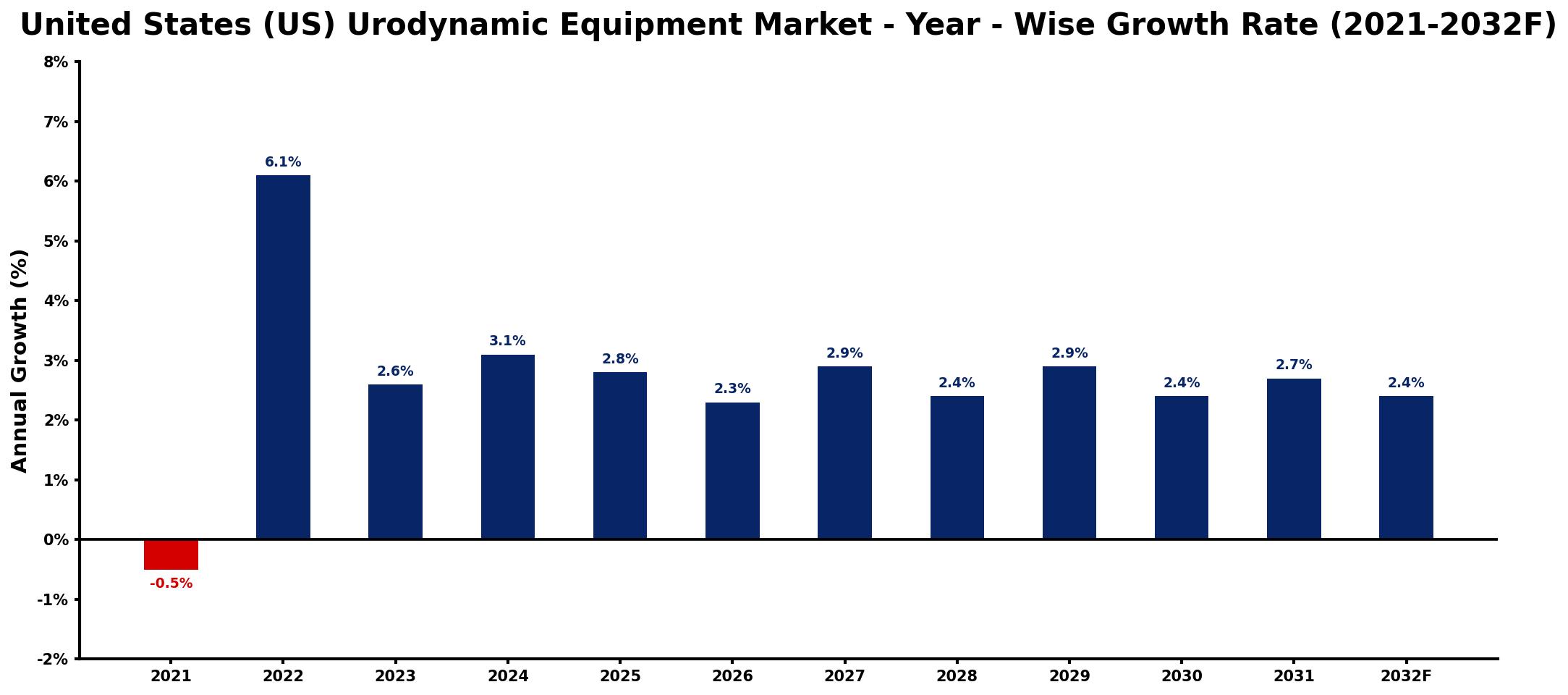
The table below presents the year‑wise growth rates along with the key drivers influencing the market
| Year | Growth Rate | Major Drivers |
| 2021 | -0.5% | decreased healthcare spending on diagnostics |
| 2022 | 6.1% | rising awareness of urinary disorders |
| 2023 | 2.6% | advancements in diagnostic technologies |
| 2024 | 3.1% | increased investment in research |
| 2025 | 2.8% | growing elderly population requiring services |
| 2026 | 2.3% | expansion of outpatient treatment facilities |
| 2027 | 2.9% | increased prevalence of obesity issues |
| 2028 | 2.4% | enhanced training for healthcare professionals |
| 2029 | 2.9% | improvements in telehealth services adoption |
| 2030 | 2.4% | increased capital investment inflows |
| 2031 | 2.7% | increased overall sector activity |
| 2032 | 2.4% | increased government healthcare funding |
Note: Market size estimations and growth projections presented in this report are based on 6Wresearch's proprietary forecasting methodology, utilizing the latest available industry data, government publications, and primary research inputs.
United States (US) Urodynamic Equipment Market Synopsis
A significant force currently shaping the United States Urodynamic Equipment Market is the surging incidence of urinary incontinence and other related urological conditions. This increase amplifies the demand for precise diagnostic tools that can effectively assess bladder and urethral function, thereby improving patient outcomes.
In addition, technological advancements play a critical role in the market's evolution. Innovations such as wireless urodynamic systems, portable devices, and video urodynamics enhance patient comfort while improving the accuracy of test results. As these technologies become more integrated into clinical practice, they are set to drive further growth.
United States (US) Urodynamic Equipment Market Key Takeaways
- The market is driven by increasing rates of urological disorders and heightened awareness of urodynamic testing.
- Technological innovations are reshaping the diagnostic landscape, providing better patient outcomes.
- Wireless and portable devices are becoming more prevalent, catering to a demand for flexibility and convenience.
- Investment opportunities exist in developing user-friendly, cost-effective diagnostic solutions.
- Regulatory frameworks by the FDA and reimbursement policies influence market dynamics and accessibility.
Evaluation of Restraints in United States (US) Urodynamic Equipment Market
The US Urodynamic Equipment Market faces several restraints that could impede its growth. One prominent challenge is the high cost associated with urodynamic equipment, which may deter healthcare facilities, particularly those operating with tight budgets, from investing in these necessary diagnostic tools. Additionally, the market is marked by intense competition from established players, complicating market entry for new companies. Regulatory hurdles can also slow product approval processes, hindering timely access to innovative solutions. Moreover, reimbursement uncertainties and evolving healthcare policies may pose further challenges to manufacturers navigating this complex environment.
United States (US) Urodynamic Equipment Market Trends
Current trends in the US Urodynamic Equipment Market reveal a significant shift towards non-invasive and user-friendly technologies. Portable and wireless devices are gaining traction as they allow healthcare providers greater flexibility in conducting assessments, which is particularly beneficial in outpatient settings. Additionally, the integration of advanced analytics and data management features within urodynamic systems is enhancing diagnostic accuracy and patient management capabilities. There is also a growing emphasis on the adoption of video urodynamics, which provides comprehensive insights into bladder function.
United States (US) Urodynamic Equipment Market Opportunities
The landscape of the US Urodynamic Equipment Market presents numerous investment opportunities, primarily due to the increasing prevalence of urological disorders among the aging population. Companies are encouraged to invest in innovative technologies that not only provide accurate diagnostics but also facilitate personalized treatment pathways. Moreover, partnerships with healthcare institutions can amplify market penetration while enhancing brand credibility. Exploring advancements in minimally invasive urodynamic procedures and the design of user-centric diagnostic devices represents further avenues for growth.
Government Initiatives in the United States (US) Urodynamic Equipment Market
Government policies significantly influence the United States Urodynamic Equipment Market, particularly through regulatory oversight and reimbursement frameworks. The Food and Drug Administration (FDA) mandates safety and effectiveness standards for urodynamic devices, which ensures that patients receive high-quality care. Furthermore, Medicare and Medicaid reimbursement for urodynamic procedures shapes purchasing decisions among healthcare providers, making it easier to justify investments in urodynamic technologies. Overall, government initiatives prioritize patient safety, quality assurance, and improved access to urodynamic testing services.
Future Insights of the United States (US) Urodynamic Equipment Market
Looking ahead to 2026-2032, the United States Urodynamic Equipment Market is anticipated to maintain a steady growth trajectory. The ongoing rise in urological disorders, compounded by an increasingly informed patient population that recognizes the importance of early diagnosis, will drive demand for urodynamic testing. Innovations in diagnostic equipment, particularly portable and wireless technologies, will continue to improve accessibility and patient comfort. These factors collectively position the market for significant advancements, facilitating better healthcare outcomes in urological care.
United States (US) Urodynamic Equipment Market Latest Developments (2025 - 2026)
Recent developments in the US Urodynamic Equipment Market indicate a heightened focus on technological advancements and enhanced patient-centric solutions. Companies are increasingly exploring collaborations with healthcare providers to facilitate the adoption of innovative diagnostic technologies. Furthermore, investments in research and development are yielding advanced urodynamic systems that incorporate real-time data analytics, leading to improved patient management strategies. These trends reflect a broader commitment to enhancing diagnostic accuracy while optimizing treatment efficacy.
United States (US) Urodynamic Equipment Market - Key Attractiveness of the Report
- 10 Years of Market Numbers
- Historical Data Starting from 2022 to 2025
- Base Year: 2025
- Forecast Data until 2032
- Key Performance Indicators Impacting the Market
- Major Upcoming Developments and Projects
Key Highlights of the Report:
- United States (US) Urodynamic Equipment Market Outlook
- Market Size of United States (US) Urodynamic Equipment Market, 2025
- Forecast of United States (US) Urodynamic Equipment Market, 2032
- Historical Data and Forecast of United States (US) Urodynamic Equipment Revenues & Volume for the Period 2022-2032F
- United States (US) Urodynamic Equipment Market Trend Evolution
- United States (US) Urodynamic Equipment Market Drivers and Challenges
- United States (US) Urodynamic Equipment Price Trends
- United States (US) Urodynamic Equipment Porter's Five Forces
- United States (US) Urodynamic Equipment Industry Life Cycle
- Historical Data and Forecast of United States (US) Urodynamic Equipment Market Revenues & Volume By Product Type for the Period 2022-2032F
- Historical Data and Forecast of United States (US) Urodynamic Equipment Market Revenues & Volume By Urodynamic Equipment for the Period 2022-2032F
- Historical Data and Forecast of United States (US) Urodynamic Equipment Market Revenues & Volume By Urodynamic Consumables for the Period 2022-2032F
- Historical Data and Forecast of United States (US) Urodynamic Equipment Market Revenues & Volume By End User for the Period 2022-2032F
- Historical Data and Forecast of United States (US) Urodynamic Equipment Market Revenues & Volume By Hospitals for the Period 2022-2032F
- Historical Data and Forecast of United States (US) Urodynamic Equipment Market Revenues & Volume By Ambulatory Centers for the Period 2022-2032F
- Historical Data and Forecast of United States (US) Urodynamic Equipment Market Revenues & Volume By Diagnostic Centers for the Period 2022-2032F
- Historical Data and Forecast of United States (US) Urodynamic Equipment Market Revenues & Volume By Others for the Period 2022-2032F
- United States (US) Urodynamic Equipment Import Export Trade Statistics
- Market Opportunity Assessment By Product Type
- Market Opportunity Assessment By End User
- United States (US) Urodynamic Equipment Top Companies Market Share
- United States (US) Urodynamic Equipment Competitive Benchmarking By Technical and Operational Parameters
- United States (US) Urodynamic Equipment Company Profiles
- United States (US) Urodynamic Equipment Key Strategic Recommendations






































