United States of America Winding Wire Market Size Growth Rate
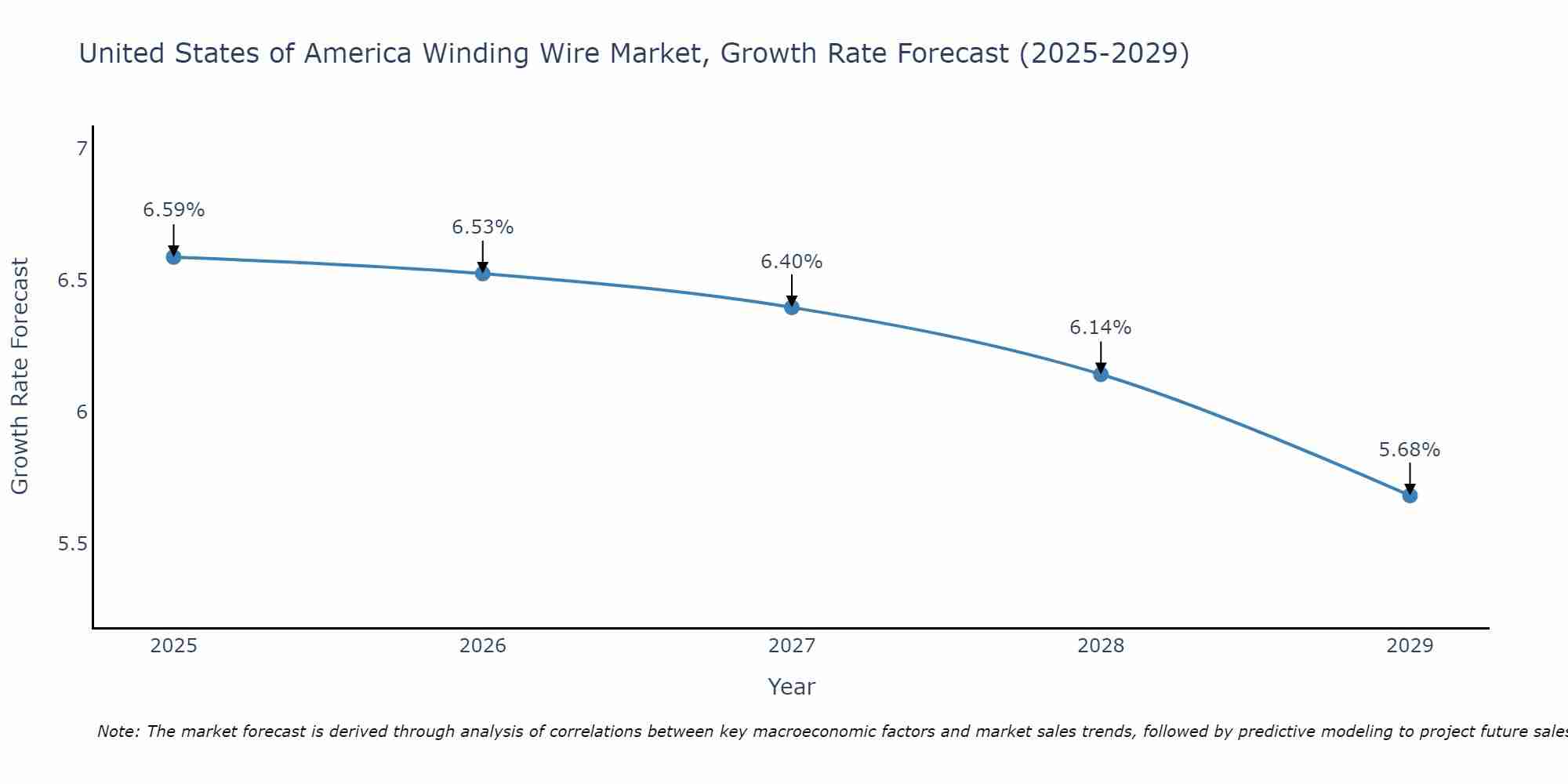
The United States of America Winding Wire Market could see a tapering of growth rates over 2025 to 2029. Starting high at 6.59% in 2025, the market steadily declines to 5.68% by 2029.
United States (US) Winding Wire Market Overview
The United States winding wire market is a key segment of the electrical industry, encompassing the production and distribution of various types of insulated wires used in transformers, motors, generators, and other electrical applications. The market is driven by the growing demand for electricity, industrial automation, and the increasing adoption of electric vehicles and renewable energy sources. Copper and aluminum are the primary materials used in winding wire production, with copper being preferred for its superior conductivity. The market is characterized by the presence of both domestic manufacturers and international players, offering a wide range of products to meet diverse customer needs. Technological advancements in wire insulation and manufacturing processes, along with stringent regulations regarding energy efficiency, are shaping the future of the US winding wire market.
United States (US) Winding Wire Market Trends
The United States winding wire market is experiencing several notable trends. The demand for energy-efficient technologies is driving the market towards the adoption of high-quality and efficient winding wires for various applications including transformers, motors, and generators. Additionally, the increasing focus on renewable energy sources such as wind and solar power is boosting the demand for winding wires in the US. Technological advancements in the manufacturing processes are leading to the development of innovative winding wire products that offer improved performance and durability. Moreover, the growing automotive sector in the US is also contributing to the demand for winding wires used in electric vehicles. Overall, the US winding wire market is witnessing a shift towards sustainable and high-performance products to meet the evolving industry requirements.
United States (US) Winding Wire Market Challenges
In the US Winding Wire Market, one of the key challenges faced is the increasing raw material costs, particularly copper and aluminum, which are essential components in the production of winding wire. Fluctuations in the prices of these raw materials can significantly impact the overall production costs for manufacturers, potentially leading to reduced profit margins. Another challenge is the growing competition from overseas manufacturers offering lower-priced winding wire products, putting pressure on domestic producers to remain competitive. Additionally, strict regulatory requirements and environmental standards in the US can add complexity and costs to the manufacturing process, further challenging companies in the winding wire market to innovate and streamline operations to stay ahead in the industry.
United States (US) Winding Wire Market Investment Opportunities
The United States Winding Wire Market offers various investment opportunities for investors looking to capitalize on the growing demand for electrical conductors in industries such as power generation, automotive, and electronics. With the increasing focus on renewable energy sources and infrastructure development, there is a rising need for high-quality winding wires for transformers, motors, and generators. Investing in companies that manufacture and supply winding wires, especially those offering innovative and sustainable products, can be a lucrative opportunity. Additionally, advancements in technology such as the development of superconducting wires and the push towards electric vehicles present further growth prospects in the US winding wire market. Conducting thorough market research and staying updated on industry trends will be crucial for investors to make informed investment decisions in this sector.
United States (US) Winding Wire Market Government Policy
Government policies related to the US Winding Wire Market primarily focus on ensuring safety standards, promoting sustainable practices, and enforcing fair competition. Regulatory bodies such as the Occupational Safety and Health Administration (OSHA) set guidelines for workplace safety in manufacturing facilities producing winding wire. Additionally, environmental regulations like the Environmental Protection Agency (EPA) restrictions on hazardous waste disposal impact the production process. In terms of trade policies, the US government may impose tariffs or quotas on imported winding wire to protect domestic manufacturers and maintain a level playing field. Overall, government policies aim to balance the interests of industry players while safeguarding consumer welfare and environmental sustainability in the US winding wire market.
United States (US) Winding Wire Market Future Outlook
The United States Winding Wire Market is expected to experience steady growth in the coming years, driven by increasing demand from various end-user industries such as electrical, automotive, and industrial machinery sectors. The market is projected to benefit from the expanding infrastructure development, rising investments in renewable energy projects, and the growing adoption of electric vehicles. Additionally, technological advancements in winding wire materials and manufacturing processes are anticipated to enhance the efficiency and performance of electric devices and equipment, further fueling market growth. However, challenges such as fluctuating raw material prices and stringent regulations regarding environmental sustainability may impact the market dynamics. Overall, the US Winding Wire Market is poised for positive growth prospects with opportunities for innovation and market expansion.
Key Highlights of the Report:
- United States (US) Winding Wire Market Outlook
- Market Size of United States (US) Winding Wire Market, 2021
- Forecast of United States (US) Winding Wire Market, 2031
- Historical Data and Forecast of United States (US) Winding Wire Revenues & Volume for the Period 2018 - 2031
- United States (US) Winding Wire Market Trend Evolution
- United States (US) Winding Wire Market Drivers and Challenges
- United States (US) Winding Wire Price Trends
- United States (US) Winding Wire Porter's Five Forces
- United States (US) Winding Wire Industry Life Cycle
- Historical Data and Forecast of United States (US) Winding Wire Market Revenues & Volume By Product for the Period 2018 - 2031
- Historical Data and Forecast of United States (US) Winding Wire Market Revenues & Volume By Copper Winding Wire for the Period 2018 - 2031
- Historical Data and Forecast of United States (US) Winding Wire Market Revenues & Volume By Aluminum Winding Wire for the Period 2018 - 2031
- United States (US) Winding Wire Import Export Trade Statistics
- Market Opportunity Assessment By Product
- United States (US) Winding Wire Top Companies Market Share
- United States (US) Winding Wire Competitive Benchmarking By Technical and Operational Parameters
- United States (US) Winding Wire Company Profiles
- United States (US) Winding Wire Key Strategic Recommendations






































