Venezuela AI in IoT Market Size & Growth Rate (2026-2032)
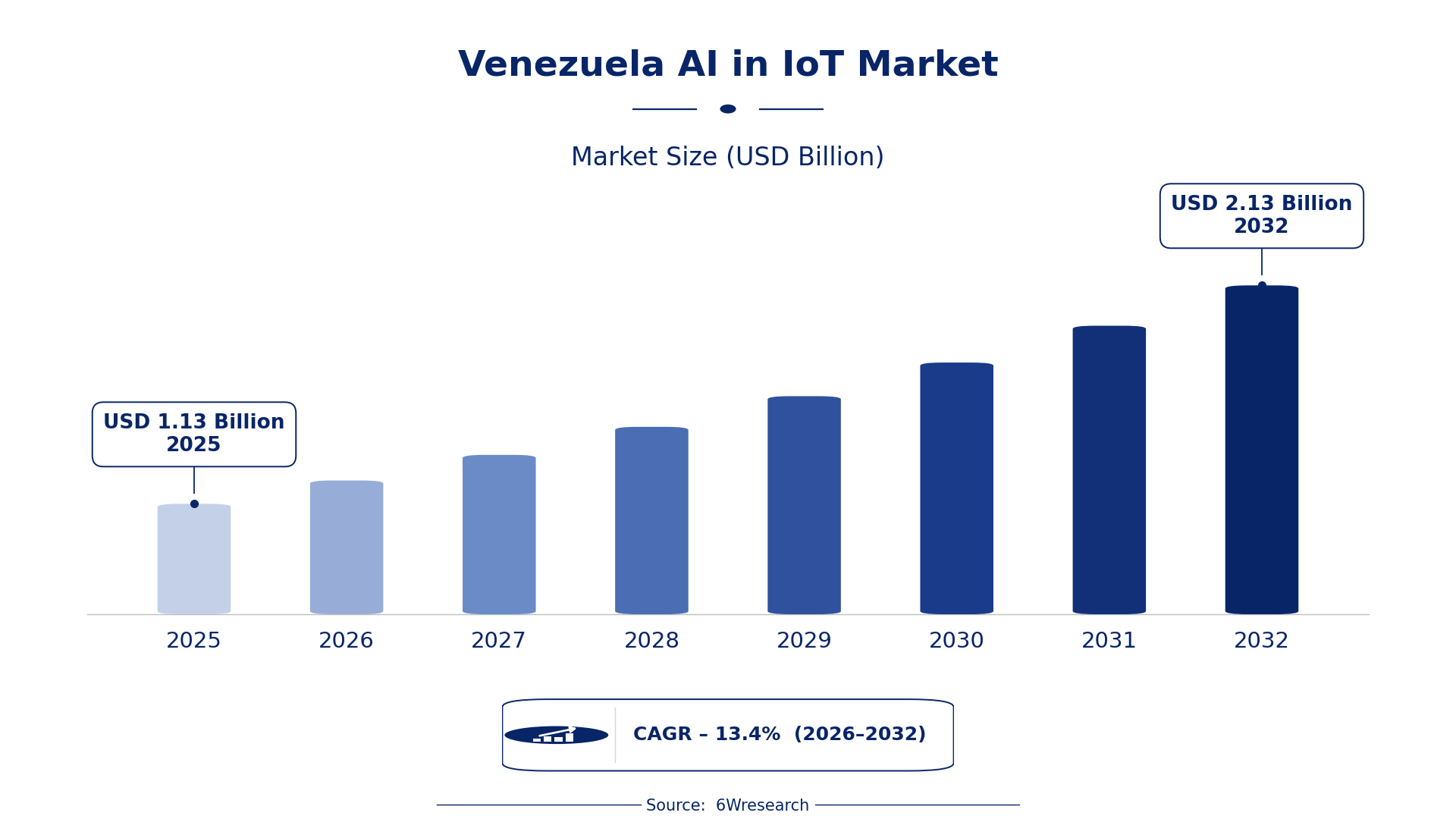
The Venezuela AI in IoT Market was estimated at USD 1129 Million in 2025 and is projected to reach USD 2134 Million by 2032, growing at a CAGR of 13.4% from 2026 to 2032.
Venezuela AI in IoT Market Synopsis
The Venezuela AI in IoT market is currently navigating a phase of cautious optimism. Key industries are beginning to recognize the potential of integrating AI with IoT, particularly in agriculture, healthcare, and manufacturing. This integration is not merely about adopting technology; it’s about reshaping operations to meet both local and global demands.
Despite facing considerable hurdles, including economic volatility and infrastructural challenges, the market is gradually finding its footing. Companies are eager to explore AI-driven IoT solutions that promise enhanced efficiency, improved data management, and innovative customer experiences.
Venezuela AI in IoT Market Year-wise Growth Rate and Key Drivers
This graph illustrates the annual growth rates of the Venezuela AI in IoT Market from 2021 to 2032, highlighting a steady upward trajectory and projected expansion over the forecast period.
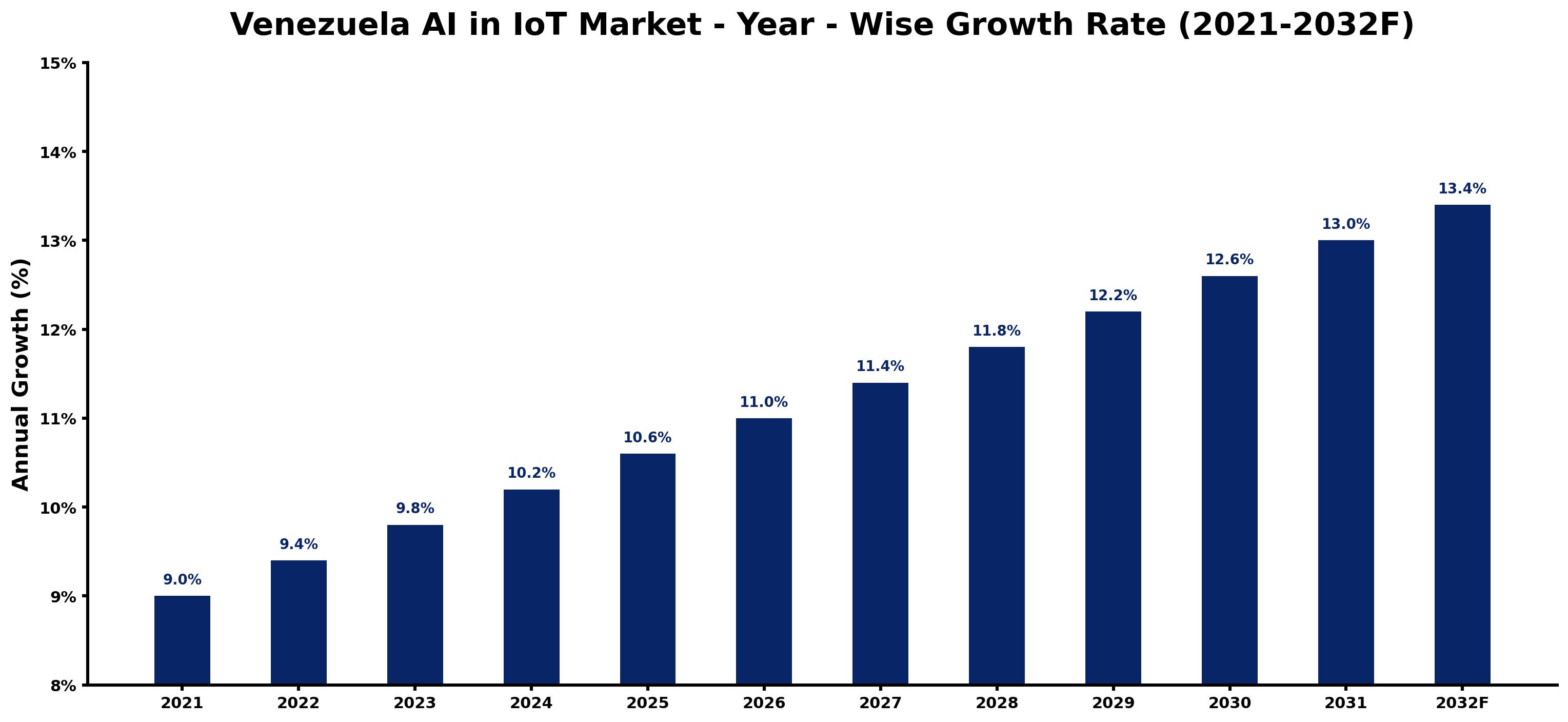
The table below presents the year‑wise growth rates along with the key drivers influencing the market
| Year | Growth Rate | Major Drivers |
| 2021 | 9.0% | Government initiatives promoting smart agriculture technologies. |
| 2022 | 9.4% | Increased demand for remote monitoring solutions amidst crisis. |
| 2023 | 9.8% | Rising smartphone penetration enhancing IoT device connectivity. |
| 2024 | 10.2% | Local startups leveraging AI for environmental monitoring. |
| 2025 | 10.6% | Emergence of fintech solutions integrating IoT in transactions. |
| 2026 | 11.0% | Adoption of AI-driven logistics solutions by local industries. |
| 2027 | 11.4% | Growing interest in smart home technologies among consumers. |
| 2028 | 11.8% | Government support for AI research in IoT applications. |
| 2029 | 12.2% | Increased urbanization driving demand for smart city solutions. |
| 2030 | 12.6% | Collaboration between universities and tech firms on IoT research. |
| 2031 | 13.0% | Rise in health-tech initiatives using IoT for patient monitoring. |
| 2032 | 13.4% | Demand for energy-efficient IoT solutions amid economic recovery. |
Note: Market size estimations and growth projections presented in this report are based on 6Wresearch's proprietary forecasting methodology, utilizing the latest available industry data, government publications, and primary research inputs.
Venezuela AI in IoT Market Key Takeaways
Below are some of the specific key takeaways from the market, including:
- There is a growing acceptance of AI in IoT technologies across multiple sectors.
- Investment in smart agriculture and healthcare solutions is particularly on the rise.
- The government is gradually recognizing the importance of digital transformation initiatives.
- Challenges remain, but innovative partnerships are emerging to overcome them.
- Real-time data analytics is becoming essential for operational efficiency.
Evaluation of Restraints in Venezuela AI in IoT Market
The Venezuela AI in IoT market faces substantial barriers that significantly limit its growth potential. The ongoing political instability and economic crises create a challenging environment for investment and deployment of advanced technologies. Issues such as hyperinflation and inconsistent regulatory frameworks deter both local and foreign investors from committing resources.
Infrastructure deficiencies, particularly in internet connectivity, further complicate the situation. This lack of reliable infrastructure hampers the ability of IoT devices to function effectively, thereby stalling the overall growth of AI in IoT applications. Addressing these challenges will require collaborative efforts from government and private sectors.
Venezuela AI in IoT Market Trends
Several noteworthy trends are shaping the Venezuela AI in IoT market. The integration of AI into IoT devices is enhancing their capabilities, allowing for smarter, more efficient operations. A notable rise in demand for real-time data analytics is evident as businesses seek to gain insights that drive decision-making.
Predictive maintenance and anomaly detection are also gaining traction, as industries look to minimize downtime and optimize performance. Alongside these advancements, there is an increasing emphasis on cybersecurity measures to safeguard IoT infrastructures from growing threats.
Venezuela AI in IoT Market Opportunities
The market offers genuine investment opportunities across several key sectors. Agriculture stands out, where AI algorithms can significantly boost crop yields and optimize resource use. Healthcare is another promising area, with the potential for AI-powered solutions to enable remote patient monitoring and improve diagnostic accuracy.
In energy management, deploying AI solutions can lead to substantial efficiency gains. Collaborations between technology providers and local businesses, alongside governmental support for digital transformation, are likely to foster further growth and innovation.
Government Initiatives in the Venezuela AI in IoT Market
The Venezuelan government has yet to establish explicit policies targeting the AI and IoT sectors. However, there is a noticeable shift towards fostering technological advancements that could support these markets. Regulatory bodies like the National Telecommunications Commission (CONATEL) are beginning to engage more actively in overseeing IoT technologies, indicating a potential opening for further development.
- A national digital infrastructure upgrade programme is currently underway, aimed at improving connectivity.
- Ongoing initiatives include workshops and training programmes focused on building local tech expertise in AI and IoT.
- Plans for a regulatory framework promoting AI development are expected to be introduced by late 2026.
- Recent discussions have taken place regarding public-private partnerships to enhance IoT deployment in urban areas.
- The government is exploring funding opportunities for startups innovating in AI technologies.
Future Insights of the Venezuela AI in IoT Market
Looking ahead, the Venezuela AI in IoT market appears to be on a path of steady growth. As industries modernize and adapt to current challenges, AI-powered IoT solutions will become increasingly integral. The demand for smarter solutions and better data management will fuel this growth.
Technological advancements, coupled with a government focus on digital transformation, signal a promising future. However, the underlying political and economic issues will continue to pose risks that need addressing to fully unlock the market's potential.
Venezuela AI in IoT Market Latest Developments
Recent industry activity in the Venezuela AI in IoT market has showcased a mixture of innovation and resilience. Various initiatives aimed at enhancing technology adoption are gaining traction, reflecting a concerted effort to leverage AI and IoT for economic betterment.
- A major technology vendor launched an AI-driven IoT platform in early 2025, targeting local businesses for enhanced operational capabilities.
- A pilot project focused on smart agriculture began in mid-2025, showcasing AI applications for crop monitoring and yield optimization.
- An initiative that started in late 2025 aims to improve cybersecurity measures for IoT devices deployed in urban environments.
- Plans for a new data analytics service, expected to roll out in Q3 2026, are underway to support businesses in real-time decision-making.
- Partnerships between local universities and tech companies have been established, focusing on research and development in AI technologies.
Venezuela AI in IoT Market - Key Attractiveness of the Report
- 10 Years of Market Numbers
- Historical Data Starting from 2022 to 2025
- Base Year: 2025
- Forecast Data until 2032
- Key Performance Indicators Impacting the Market
- Major Upcoming Developments and Projects
Key Highlights of the Report:
- Venezuela AI in IoT Market Outlook
- Market Size of Venezuela AI in IoT Market, 2025
- Forecast of Venezuela AI in IoT Market, 2032
- Historical Data and Forecast of Venezuela AI in IoT Revenues & Volume for the Period 2022-2032F
- Venezuela AI in IoT Market Trend Evolution
- Venezuela AI in IoT Market Drivers and Challenges
- Venezuela AI in IoT Price Trends
- Venezuela AI in IoT Porter's Five Forces
- Venezuela AI in IoT Industry Life Cycle
- Historical Data and Forecast of Venezuela AI in IoT Market Revenues & Volume By Component for the Period 2022-2032F
- Historical Data and Forecast of Venezuela AI in IoT Market Revenues & Volume By Platforms for the Period 2022-2032F
- Historical Data and Forecast of Venezuela AI in IoT Market Revenues & Volume By Software Solutions for the Period 2022-2032F
- Historical Data and Forecast of Venezuela AI in IoT Market Revenues & Volume By Services for the Period 2022-2032F
- Historical Data and Forecast of Venezuela AI in IoT Market Revenues & Volume By Vertical for the Period 2022-2032F
- Historical Data and Forecast of Venezuela AI in IoT Market Revenues & Volume By Manufacturing for the Period 2022-2032F
- Historical Data and Forecast of Venezuela AI in IoT Market Revenues & Volume By Energy and Utilities for the Period 2022-2032F
- Historical Data and Forecast of Venezuela AI in IoT Market Revenues & Volume By Transportation and Mobility for the Period 2022-2032F
- Historical Data and Forecast of Venezuela AI in IoT Market Revenues & Volume By BFSI for the Period 2022-2032F
- Historical Data and Forecast of Venezuela AI in IoT Market Revenues & Volume By Government and Defense for the Period 2022-2032F
- Historical Data and Forecast of Venezuela AI in IoT Market Revenues & Volume By Retail for the Period 2022-2032F
- Historical Data and Forecast of Venezuela AI in IoT Market Revenues & Volume By Healthcare and Life Sciences for the Period 2022-2032F
- Historical Data and Forecast of Venezuela AI in IoT Market Revenues & Volume By Telecom for the Period 2022-2032F
- Historical Data and Forecast of Venezuela AI in IoT Market Revenues & Volume By Technology for the Period 2022-2032F
- Historical Data and Forecast of Venezuela AI in IoT Market Revenues & Volume By ML and Deep Learning for the Period 2022-2032F
- Historical Data and Forecast of Venezuela AI in IoT Market Revenues & Volume By NLP for the Period 2022-2032F
- Venezuela AI in IoT Import Export Trade Statistics
- Market Opportunity Assessment By Component
- Market Opportunity Assessment By Vertical
- Market Opportunity Assessment By Technology
- Venezuela AI in IoT Top Companies Market Share
- Venezuela AI in IoT Competitive Benchmarking By Technical and Operational Parameters
- Venezuela AI in IoT Company Profiles
- Venezuela AI in IoT Key Strategic Recommendations






































