Venezuela Aluminum Alloys Market Size, Share & Growth Rate
The Venezuela Aluminum Alloys Market was estimated at USD 538 Million in 2025 and is projected to reach USD 783 Million by 2032, growing at a CAGR of 5.5% from 2026 to 2032. This growth is propelled by a gradual recovery from economic and political instability, particularly as demand surges in the automotive and construction sectors. Additionally, increasing investments in recycling technologies and lightweight materials are contributing to the optimistic outlook for this market.
Venezuela Aluminum Alloys Market Year-wise Growth Rate and Key Drivers
This graph highlights how the Venezuela Aluminum Alloys Market has steadily grown over the years, supported by major growth factors.
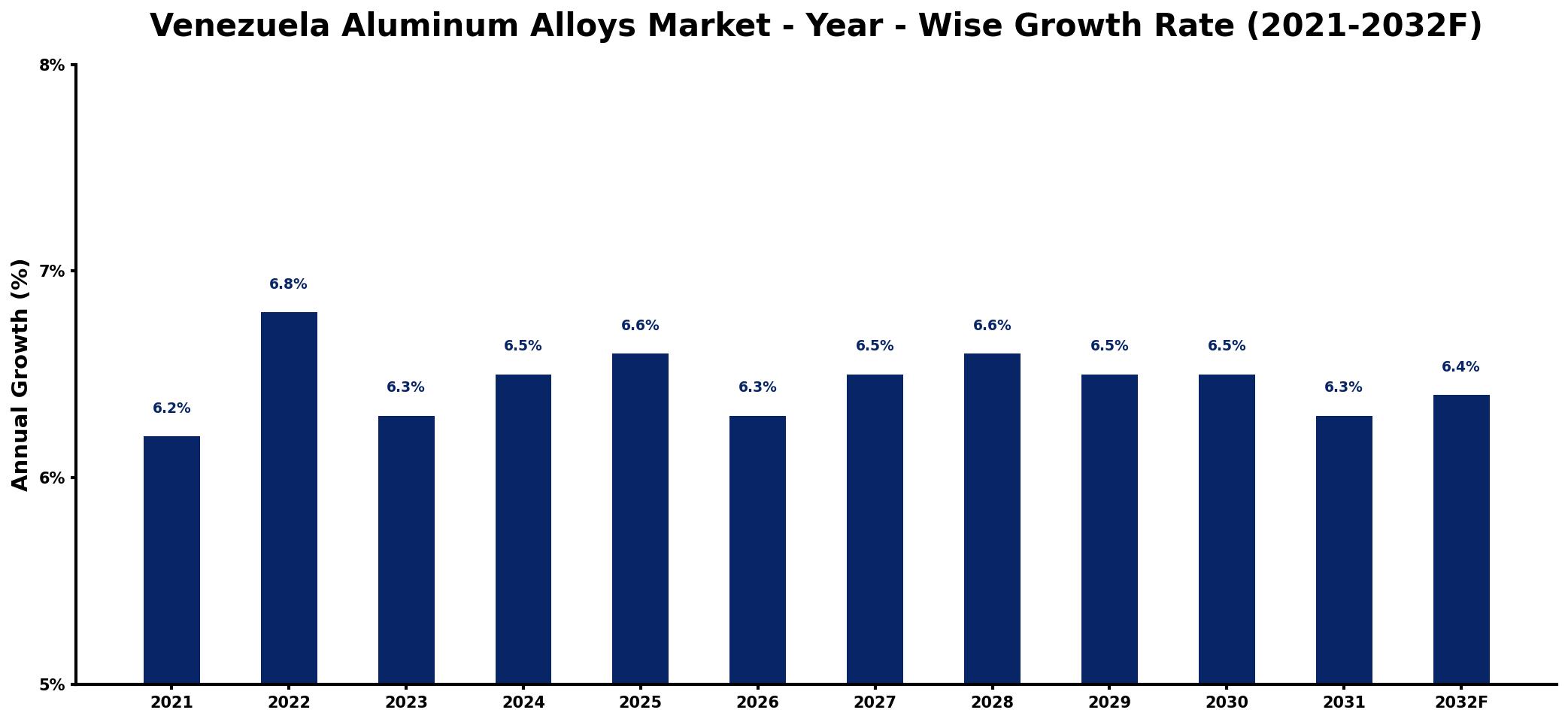
The table below presents the year‑wise growth rates along with the key drivers influencing the market
| Year | Growth Rate | Major Drivers |
| 2021 | 6.2% | Rising construction sector activity |
| 2022 | 6.8% | Increased automotive manufacturing demand |
| 2023 | 6.3% | Growing renewable energy investments |
| 2024 | 6.5% | Expanding transportation infrastructure projects |
| 2025 | 6.6% | Boost in aerospace production needs |
| 2026 | 6.3% | Surge in consumer electronics usage |
| 2027 | 6.5% | Higher demand for packaging solutions |
| 2028 | 6.6% | Increased focus on lightweight materials |
| 2029 | 6.5% | Growth in electrical component production |
| 2030 | 6.5% | Rising interest in sustainable practices |
| 2031 | 6.3% | Expansion of industrial machinery sectors |
| 2032 | 6.4% | Increased development of smart technologies |
Note: Market size estimations and growth projections presented in this report are based on 6Wresearch's proprietary forecasting methodology, utilizing the latest available industry data, government publications, and primary research inputs.
Venezuela Aluminum Alloys Market Synopsis
Political and economic stabilization is the strongest force shaping the Venezuela Aluminum Alloys Market today. As the country seeks to revitalize its industrial capabilities, the alignment of government policies with market needs will play a crucial role in determining future success.
Alongside this stabilization, the trend towards lightweight materials, especially in the automotive sector, is significantly influencing market dynamics. The demand for high-strength aluminum alloys is expected to rise as manufacturers focus on developing more fuel-efficient vehicles and durable construction materials.
Venezuela Aluminum Alloys Market Key Takeaways
- Stability in Venezuelas political climate is essential for market recovery and growth.
- Demand for lightweight aluminum alloys is being driven by automotive and construction industries.
- Investment in recycling technologies is on the rise, aligning with global sustainability trends.
- Local manufacturers are increasingly collaborating with end-users for customized solutions.
- The market is positioned for growth, provided there is continued economic stabilization.
Evaluation of Restraints in Venezuela Aluminum Alloys Market
The Venezuela Aluminum Alloys Market is impeded by a multitude of factors, including ongoing political uncertainty and an economic landscape characterized by hyperinflation. This climate has led to significant challenges such as shortages of raw materials, a lack of skilled labor, and obstacles in accessing international markets due to sanctions. Fluctuating currency exchange rates further complicate financial planning and risk management for local manufacturers. Overall, these restraints create a complex operating environment that demands strategic navigation to achieve sustained growth.
Venezuela Aluminum Alloys Market Trends
The landscape of the Venezuela Aluminum Alloys Market is evolving, driven by several notable trends. A pronounced shift towards lightweight and high-strength alloys is becoming evident, particularly in the automotive and aerospace industries, which seek to enhance fuel efficiency and performance. Additionally, there is a growing focus on sustainability, with manufacturers investing in recyclable aluminum products and innovative production processes. Collaborations between businesses are also gaining traction, allowing for the co-development of specialized alloys tailored to meet specific customer needs, thereby enhancing competitiveness.
Venezuela Aluminum Alloys Market Opportunities
Despite current challenges, substantial investment opportunities exist within the Venezuela Aluminum Alloys Market. The country is rich in bauxite reserves, a key raw material for aluminum production, providing a foundation for future growth. As industries globally increasingly prioritize lightweight and durable materials, Venezuela stands to benefit from its strategic geographical location and resource availability. Moreover, the government's focus on revitalizing the industrial sector and attracting foreign investment further enhances the market's potential for investors looking to capitalize on emerging demands.
Government Initiatives in the Venezuela Aluminum Alloys Market
The Venezuelan government has been actively implementing policies aimed at bolstering domestic production of aluminum alloys. These measures include import restrictions to reduce reliance on foreign materials, financial incentives for local manufacturers, and tariffs designed to protect the domestic industry. Additionally, efforts are underway to increase transparency and efficiency across the sector, with regulatory reforms aimed at enforcing environmental and labor standards. Such initiatives highlight a commitment to enhancing the competitive landscape of the aluminum alloys market in Venezuela.
Future Insights of the Venezuela Aluminum Alloys Market
Looking ahead to the period from 2026 to 2032, the Venezuela Aluminum Alloys Market faces a challenging yet promising trajectory. While economic and political instability may continue to suppress demand in the near term, niche opportunities within the automotive and aerospace sectors could foster growth if conditions improve. The success of local manufacturers in adapting to these trends, alongside possible government reforms, will be pivotal in navigating the forthcoming landscape of the market.
Venezuela Aluminum Alloys Market Latest Developments (2025 - 2026)
In recent months, the Venezuela Aluminum Alloys Market has seen an uptick in efforts focused on enhancing local production capacities. Manufacturers have been investing in modernizing facilities to increase output efficiency, while exploring partnerships aimed at developing new, customized alloy formulations. There has also been a noticeable shift towards implementing environmentally friendly practices in production processes, aligning with global sustainability trends. These developments indicate a concerted effort within the industry to adapt and thrive in a challenging environment.
Venezuela Aluminum Alloys Market - Key Attractiveness of the Report
- 10 Years of Market Numbers
- Historical Data Starting from 2022 to 2025
- Base Year: 2025
- Forecast Data until 2032
- Key Performance Indicators Impacting the Market
- Major Upcoming Developments and Projects
Key Highlights of the Report:
- Venezuela Aluminum Alloys Market Outlook
- Market Size of Venezuela Aluminum Alloys Market, 2025
- Forecast of Venezuela Aluminum Alloys Market, 2032
- Historical Data and Forecast of Venezuela Aluminum Alloys Revenues & Volume for the Period 2022-2032F
- Venezuela Aluminum Alloys Market Trend Evolution
- Venezuela Aluminum Alloys Market Drivers and Challenges
- Venezuela Aluminum Alloys Price Trends
- Venezuela Aluminum Alloys Porter's Five Forces
- Venezuela Aluminum Alloys Industry Life Cycle
- Historical Data and Forecast of Venezuela Aluminum Alloys Market Revenues & Volume By Process for the Period 2022-2032F
- Historical Data and Forecast of Venezuela Aluminum Alloys Market Revenues & Volume By Die Casting for the Period 2022-2032F
- Historical Data and Forecast of Venezuela Aluminum Alloys Market Revenues & Volume By Sand Casting for the Period 2022-2032F
- Historical Data and Forecast of Venezuela Aluminum Alloys Market Revenues & Volume By Permanent Mold Casting for the Period 2022-2032F
- Historical Data and Forecast of Venezuela Aluminum Alloys Market Revenues & Volume By End-use for the Period 2022-2032F
- Historical Data and Forecast of Venezuela Aluminum Alloys Market Revenues & Volume By Transportation sector for the Period 2022-2032F
- Historical Data and Forecast of Venezuela Aluminum Alloys Market Revenues & Volume By Building & Construction sector for the Period 2022-2032F
- Historical Data and Forecast of Venezuela Aluminum Alloys Market Revenues & Volume By Industrial sector for the Period 2022-2032F
- Historical Data and Forecast of Venezuela Aluminum Alloys Market Revenues & Volume By Others for the Period 2022-2032F
- Venezuela Aluminum Alloys Import Export Trade Statistics
- Market Opportunity Assessment By Process
- Market Opportunity Assessment By End-use
- Venezuela Aluminum Alloys Top Companies Market Share
- Venezuela Aluminum Alloys Competitive Benchmarking By Technical and Operational Parameters
- Venezuela Aluminum Alloys Company Profiles
- Venezuela Aluminum Alloys Key Strategic Recommendations






































