Venezuela Aviation Test Equipment Market Size, Share & Growth Rate
The Venezuela Aviation Test Equipment Market was estimated at USD 356 Million in 2025 and is projected to reach USD 505 Million by 2032, growing at a CAGR of 5.1% from 2026 to 2032. This growth is primarily driven by increased investments in aviation infrastructure and the demand for innovative testing solutions that guarantee operational safety. Additionally, the ongoing modernization of aviation services is fostering the need for advanced testing equipment that aligns with international safety standards.
Venezuela Aviation Test Equipment Market Year-wise Growth Rate and Key Drivers
This graph highlights how the Venezuela Aviation Test Equipment Market has steadily grown over the years, supported by major growth factors.
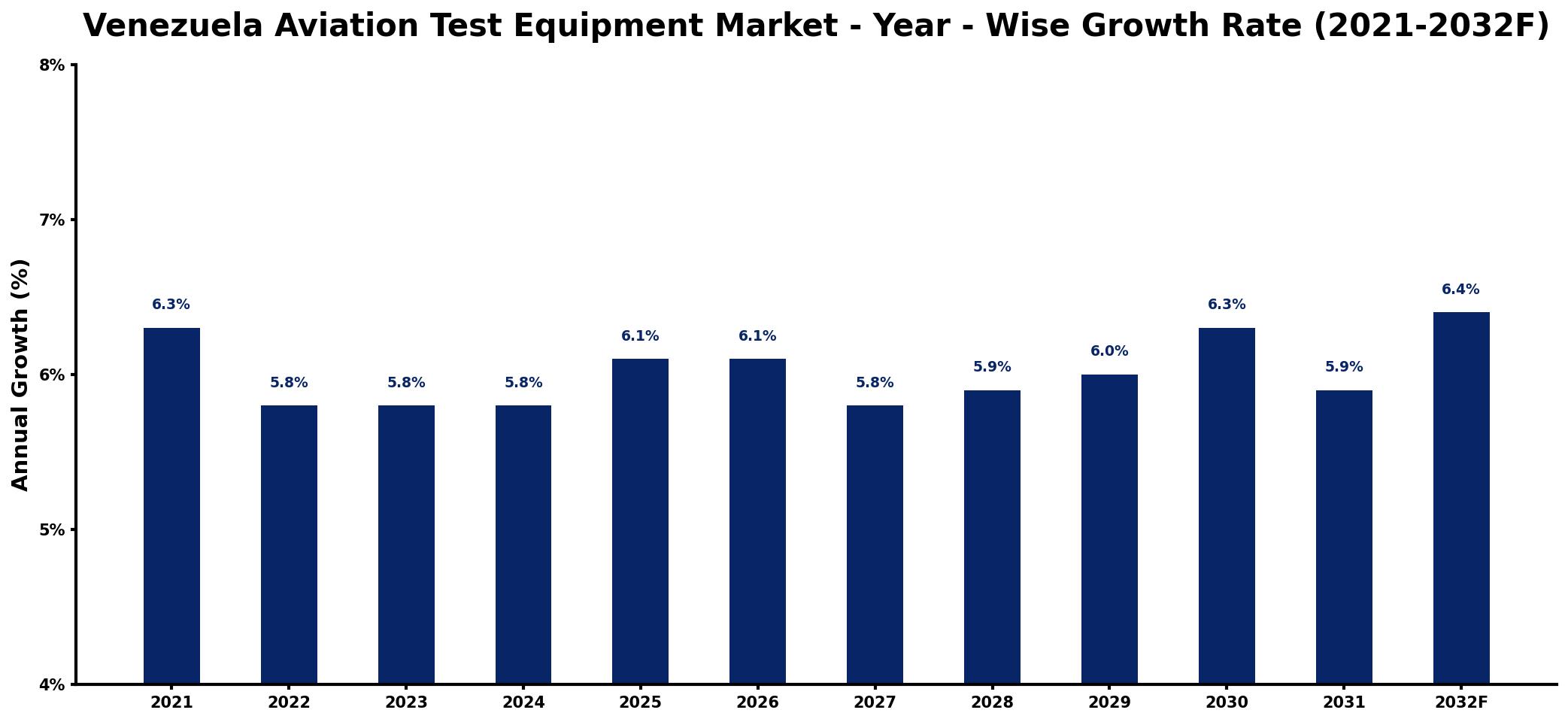
The table below presents the year‑wise growth rates along with the key drivers influencing the market
| Year | Growth Rate | Major Drivers |
| 2021 | 6.3% | Increased defense sector investments |
| 2022 | 5.8% | Growing demand for pilot training |
| 2023 | 5.8% | Expansion of local manufacturing capabilities |
| 2024 | 5.8% | Rise in commercial flight operations |
| 2025 | 6.1% | Technological advancements in simulation |
| 2026 | 6.1% | Strengthening of regulatory frameworks |
| 2027 | 5.8% | Surge in international collaborations |
| 2028 | 5.9% | Boost in educational programs |
| 2029 | 6.0% | Enhanced safety standards implementation |
| 2030 | 6.3% | Growth in maintenance service offerings |
| 2031 | 5.9% | Emergence of new training centers |
| 2032 | 6.4% | Increased focus on innovation strategies |
Note: Market size estimations and growth projections presented in this report are based on 6Wresearch's proprietary forecasting methodology, utilizing the latest available industry data, government publications, and primary research inputs.
Venezuela Aviation Test Equipment Market Synopsis
The strongest force shaping the Venezuela Aviation Test Equipment Market today is the urgent need for enhanced safety measures in aircraft operations. This need has prompted industry stakeholders to seek out advanced testing solutions that not only comply with regulations but also bolster reliability and efficiency in maintenance processes.
Compounding this is the increasing complexity of modern aircraft systems, necessitating multifunctional test equipment capable of performing a variety of tests. As airlines and maintenance facilities look to minimize downtime and reduce human error, the adoption of automated and smart testing technologies is becoming more prevalent in the market.
Venezuela Aviation Test Equipment Market Key Takeaways
- The market is poised for steady growth fueled by rising investments in the aviation sector.
- Demand for portable and IoT-enabled testing solutions is on the rise, enhancing operational efficiency.
- Economic and political challenges are constraining market development and technology access.
- Local manufacturers may emerge as key players as the market seeks reliable, domestic solutions.
- Government regulations emphasize the importance of certified equipment for maintaining aviation safety.
Evaluation of Restraints in Venezuela Aviation Test Equipment Market
The Venezuela Aviation Test Equipment Market is significantly hindered by the ongoing economic crisis and political instability that have engulfed the country for years. Limited access to foreign investment and currency has led to a stagnation in procurement of advanced test equipment, which is essential for modernizing aviation operations. Furthermore, sanctions imposed by foreign governments restrict access to cutting-edge technologies, making it challenging for local players to develop and upgrade their testing facilities effectively. This multifaceted environment creates a climate of uncertainty that discourages investment and complicates operational planning for companies involved in the aviation sector.
Venezuela Aviation Test Equipment Market Trends
The current landscape of the Venezuela Aviation Test Equipment Market is characterized by a notable shift toward innovative technology solutions. There's a pronounced trend for portable and wireless test equipment, which facilitates seamless integration into existing systems and enhances flexibility in testing procedures. Furthermore, the incorporation of IoT capabilities is gaining traction, allowing for real-time monitoring and comprehensive data analysis, which is critical for operational decision-making.
Additionally, the trend towards automation in testing processes aims to reduce human error and streamline maintenance operations. This shift not only boosts the efficiency of aircraft servicing but also aligns with global moves towards smarter aviation technologies. The market is thus evolving rapidly, indicating a clear path towards advanced solutions that can meet future demands.
Venezuela Aviation Test Equipment Market Opportunities
Significant growth and investment opportunities lie in the supply of specialized testing equipment designed to support the aviation industry's specific needs. With the increasing demand for reliable and efficient testing solutions, there is a clear market for advanced equipment such as avionics test sets and hydraulic test benches. Partnerships with local maintenance organizations can unlock avenues to supply essential testing services and equipment, thereby addressing domestic needs effectively.
Furthermore, offering training programs focused on the effective use of such equipment can enhance market penetration and foster loyalty among aviation professionals, thereby generating additional revenue streams. These strategic investments in local capacity building are crucial for sustainable growth in a market characterized by external challenges.
Government Initiatives in the Venezuela Aviation Test Equipment Market
Government policies governing the Venezuela Aviation Test Equipment Market are principally overseen by the National Institute of Civil Aeronautics (INAC) and the Ministry of Transportation. These bodies emphasize the necessity for compliance with international aviation standards, mandating the use of certified and calibrated testing equipment to ensure aircraft airworthiness. Furthermore, the government's focus on enhancing aviation safety and efficiency reflects in its regulatory frameworks, impacting how testing equipment is procured and implemented within the industry.
Future Insights of the Venezuela Aviation Test Equipment Market
The future of the Venezuela Aviation Test Equipment Market appears cautiously optimistic yet fraught with challenges. From 2026 to 2032, the market is likely to experience incremental growth driven by a revival of the aviation sector as stability returns. However, the current economic landscape may impede rapid advancements and investments. Local manufacturers could play a pivotal role in addressing domestic demands, especially as international players may face ongoing restrictions. With a focus on innovation and regulatory compliance, the market could yet emerge as a critical player in the regional aviation landscape.
Venezuela Aviation Test Equipment Market Latest Developments (2025 - 2026)
In recent months, there has been a notable uptick in efforts aimed at modernizing testing facilities within Venezuela. Industry stakeholders are exploring collaborations with local technical institutes to enhance skill sets related to advanced testing equipment. Additionally, discussions surrounding potential public-private partnerships have surfaced, indicating a collective push toward revitalizing the aviation sector. These developments reflect a growing commitment to improving aviation safety and operational efficiency amidst ongoing economic and political challenges.
Venezuela Aviation Test Equipment Market - Key Attractiveness of the Report
- 10 Years of Market Numbers
- Historical Data Starting from 2022 to 2025
- Base Year: 2025
- Forecast Data until 2032
- Key Performance Indicators Impacting the Market
- Major Upcoming Developments and Projects
Key Highlights of the Report:
- Venezuela Aviation Test Equipment Market Outlook
- Market Size of Venezuela Aviation Test Equipment Market, 2025
- Forecast of Venezuela Aviation Test Equipment Market, 2032
- Historical Data and Forecast of Venezuela Aviation Test Equipment Revenues & Volume for the Period 2022-2032F
- Venezuela Aviation Test Equipment Market Trend Evolution
- Venezuela Aviation Test Equipment Market Drivers and Challenges
- Venezuela Aviation Test Equipment Price Trends
- Venezuela Aviation Test Equipment Porter's Five Forces
- Venezuela Aviation Test Equipment Industry Life Cycle
- Historical Data and Forecast of Venezuela Aviation Test Equipment Market Revenues & Volume By Product for the Period 2022-2032F
- Historical Data and Forecast of Venezuela Aviation Test Equipment Market Revenues & Volume By Electrical Aviation Test Equipment for the Period 2022-2032F
- Historical Data and Forecast of Venezuela Aviation Test Equipment Market Revenues & Volume By Hydraulic Aviation Test Equipment for the Period 2022-2032F
- Historical Data and Forecast of Venezuela Aviation Test Equipment Market Revenues & Volume By Power Aviation Test Equipment for the Period 2022-2032F
- Historical Data and Forecast of Venezuela Aviation Test Equipment Market Revenues & Volume By Pneumatic Aviation Test Equipment for the Period 2022-2032F
- Historical Data and Forecast of Venezuela Aviation Test Equipment Market Revenues & Volume By End User for the Period 2022-2032F
- Historical Data and Forecast of Venezuela Aviation Test Equipment Market Revenues & Volume By Commercial for the Period 2022-2032F
- Historical Data and Forecast of Venezuela Aviation Test Equipment Market Revenues & Volume By Defense/Military Sector for the Period 2022-2032F
- Venezuela Aviation Test Equipment Import Export Trade Statistics
- Market Opportunity Assessment By Product
- Market Opportunity Assessment By End User
- Venezuela Aviation Test Equipment Top Companies Market Share
- Venezuela Aviation Test Equipment Competitive Benchmarking By Technical and Operational Parameters
- Venezuela Aviation Test Equipment Company Profiles
- Venezuela Aviation Test Equipment Key Strategic Recommendations






































