Venezuela Confectionery Market Summary
The venezuela confectionery market was estimated at USD 459 Million in 2025 and is projected to reach USD 608 Million by 2032, growing at a CAGR of 4.8% from 2026 to 2032.
Venezuela Confectionery Market Year-wise Growth Rate and Key Drivers
This graph highlights how the Venezuela Confectionery Market has steadily grown over the past five years, supported by major growth factors.
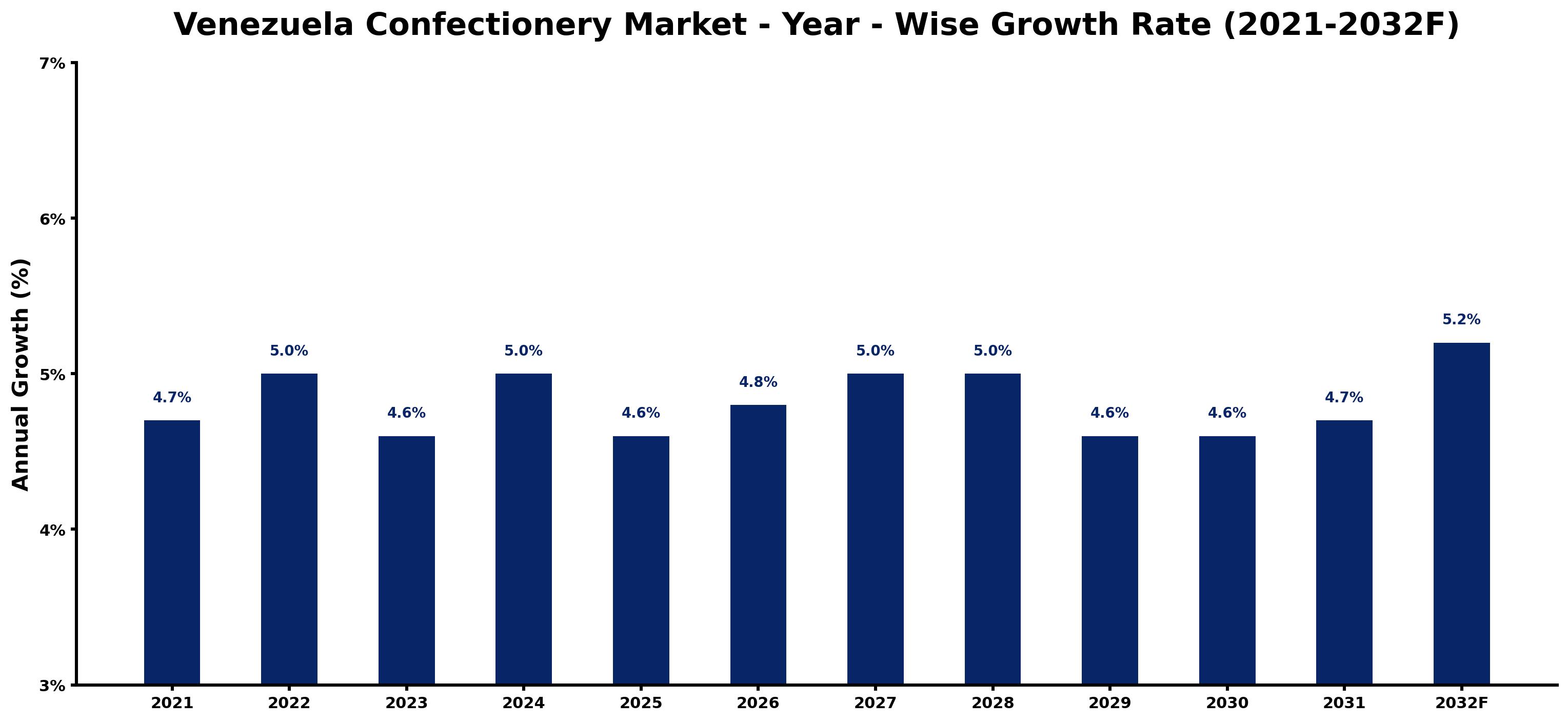
The table below presents the year wise growth rates along with the key drivers influencing the market
| Year | Growth Rate | Major Drivers |
| 2021 | 4.7% | Economic recovery began to create a more favorable environment for consumer spending. |
| 2022 | 5.0% | Increased access to international markets allowed for diverse confectionery imports. |
| 2023 | 4.6% | Local production initiatives emerged, fostering innovation within the domestic confectionery sector. |
| 2024 | 5.0% | Improved supply chain logistics helped stabilize availability of raw materials and ingredients. |
| 2025 | 4.6% | Growing presence of e-commerce platforms transformed traditional retail dynamics in confectionery sales. |
| 2026 | 4.8% | Young consumers increasingly sought premium and artisanal products, influencing market offerings. |
| 2027 | 5.0% | Health-conscious trends spurred the development of sugar-free and organic confectionery options. |
| 2028 | 5.0% | Cultural celebrations and holidays drove seasonal spikes in confectionery consumption patterns. |
| 2029 | 4.6% | Collaborations between local brands and international firms expanded product visibility significantly. |
| 2030 | 4.6% | Sustainable packaging practices gained traction, enhancing brand loyalty among environmentally-motivated consumers. |
| 2031 | 4.7% | Innovative marketing strategies targeted younger demographics, reshaping the industry landscape effectively. |
| 2032 | 5.2% | Continuous adaptation to consumer preferences ensured resilience amid changing economic conditions. |
Note - Market size estimations and growth projections presented in this report are based on 6Wresearch's advanced forecasting approach, validated with industry datasets as of June 2026.
Venezuela Confectionery Market Synopsis
The Venezuela Confectionery Market is projected to reach 4.8% and witness significant growth during the forecast period (2026-2032). The market is characterized by a wide array of sweet products, including chocolates, candies, pastries, and snacks, catering to the population's enduring inclination towards indulgent yet affordable treats. Despite enduring economic adversities, the demand for confectionery items has demonstrated resilience. This stability is attributed to the cultural affinity for sweet confections, leading both local and international manufacturers to innovate continually while addressing consumer preferences.
Venezuela Confectionery Market Trends and Opportunities
The shifting landscape of the Venezuela Confectionery Market reveals a pronounced trend towards healthier and premium confectionery options. As consumers become increasingly health-conscious, there is a notable surge in demand for products that are low in sugar, devoid of artificial additives, and offer functional health benefits, such as added vitamins or minerals. Furthermore, artisanal and luxury chocolates, along with unique flavor profiles, are gaining traction among consumers seeking premium experiences. The growing interest in sustainable and locally-sourced confectionery products is also evident, reflecting a shift towards ethical consumerism. Manufacturers are compelled to innovate and adapt, introducing a variety of product offerings to capture the changing market dynamics.
Venezuela Confectionery Market Challenges and Restraints
The Venezuela Confectionery Market faces multifaceted challenges stemming from economic instability and hyperinflation, which have resulted in reduced purchasing power among consumers. This decrease impacts discretionary spending on non-essential items such as sweets. Additionally, supply chain disruptions and raw material shortages, exacerbated by import restrictions, hinder production capabilities within the confectionery sector. Furthermore, ongoing political unrest adds another layer of complexity, leading to uncertainties that affect market operations. These compounding challenges necessitate that confectionery companies devise strategic responses to navigate the intricacies of the Venezuelan business environment.
Venezuela Confectionery Market Investment Opportunities
Despite the challenges, the Venezuela Confectionery Market presents several investment opportunities for growth and expansion. One promising avenue is the development of innovative product lines that align with evolving consumer tastes, particularly in the realm of healthier and premium confectionery items. Investing in research and development can pave the way for new flavors and enhanced packaging that resonate with contemporary consumer choices. Expanding distribution channels, both online and offline, can also broaden market reach and tap into the growing demand for confectionery products within the country. Additionally, manufacturers can explore export opportunities to neighboring Latin American markets, leveraging the unique flavors and products developed for the local consumer base. Overall, strategic investments in product innovation and distribution could unlock significant potential in this dynamic market.
Venezuela Confectionery Market Government Investment and Initiatives
Government policies significantly influence the Venezuela Confectionery Market, especially in light of the ongoing economic challenges. The Venezuelan government has instituted price controls on essential food products, including confectionery, to combat inflation and maintain affordability for consumers. However, these price controls inadvertently pose challenges for manufacturers, as they struggle to balance profitability while adhering to mandated price structures. Furthermore, import restrictions and currency controls have impacted the sourcing of raw materials, creating obstacles for production. In response to these challenges, the government has taken initiatives to promote local production through various subsidies and support programs. These interventions aim to foster domestic industry growth and reduce reliance on imports, which could stabilize the market environment in the long run.
Venezuela Confectionery Market Latest Developments (May 2025 - June 2026)
Recent developments within the Venezuela Confectionery Market from May 2025 to June 2026 indicate a continuous adaptation to the prevailing economic conditions. Industry players have been focusing on enhancing product lines to include healthier and more premium offerings in response to consumer demand. Furthermore, there has been increased collaboration among local manufacturers to share resources and manage supply chain issues more effectively. Innovations in packaging design have also emerged, aimed at attracting consumers while ensuring product quality. Additionally, there are indications of a gradual increase in interest from foreign investors within the confectionery sector, highlighting potential optimism amidst the existing challenges. Overall, these developments suggest a proactive approach by market participants to capitalize on opportunities and navigate the economic landscape.
Venezuela Confectionery Market - Key Attractiveness of the Report
- 10 Years of Market Numbers
- Historical Data Starting from 2022 to 2025
- Base Year: 2025
- Forecast Data until 2032
- Key Performance Indicators Impacting the Market
- Major Upcoming Developments and Projects
Key Highlights of the Report:
- Venezuela Confectionery Market Outlook
- Market Size of Venezuela Confectionery Market, 2025
- Forecast of Venezuela Confectionery Market, 2032F
- Historical Data and Forecast of Venezuela Confectionery Revenues & Volume for the Period 2022-2032F
- Venezuela Confectionery Market Trend Evolution
- Venezuela Confectionery Market Drivers and Challenges
- Venezuela Confectionery Price Trends
- Venezuela Confectionery Porter's Five Forces
- Venezuela Confectionery Industry Life Cycle
- Historical Data and Forecast of Venezuela Confectionery Market Revenues & Volume By Type for the Period 2022-2032F
- Historical Data and Forecast of Venezuela Confectionery Market Revenues & Volume By Sugar for the Period 2022-2032F
- Historical Data and Forecast of Venezuela Confectionery Market Revenues & Volume By Chocolate for the Period 2022-2032F
- Historical Data and Forecast of Venezuela Confectionery Market Revenues & Volume By Fine Bakery Wares for the Period 2022-2032F
- Historical Data and Forecast of Venezuela Confectionery Market Revenues & Volume By Others for the Period 2022-2032F
- Historical Data and Forecast of Venezuela Confectionery Market Revenues & Volume By Distribution Channel for the Period 2022-2032F
- Historical Data and Forecast of Venezuela Confectionery Market Revenues & Volume By Supermarket/Hypermarket for the Period 2022-2032F
- Historical Data and Forecast of Venezuela Confectionery Market Revenues & Volume By Specialist Retailers for the Period 2022-2032F
- Historical Data and Forecast of Venezuela Confectionery Market Revenues & Volume By Online Retail Stores for the Period 2022-2032F
- Historical Data and Forecast of Venezuela Confectionery Market Revenues & Volume By Convenience Stores for the Period 2022-2032F
- Historical Data and Forecast of Venezuela Confectionery Market Revenues & Volume By Other Distribution Channels for the Period 2022-2032F
- Venezuela Confectionery Import Export Trade Statistics
- Market Opportunity Assessment By Type
- Market Opportunity Assessment By Distribution Channel
- Venezuela Confectionery Top Companies Market Share
- Venezuela Confectionery Competitive Benchmarking By Technical and Operational Parameters
- Venezuela Confectionery Company Profiles
- Venezuela Confectionery Key Strategic Recommendations






































