Venezuela Edible Flakes Market Size, Share & Growth Rate
The Venezuela Edible Flakes Market was estimated at USD 315 Million in 2025 and is projected to reach USD 419 Million by 2032, growing at a CAGR of 4.2% from 2026 to 2032. This upward trajectory is driven by an increasing consumer preference for convenient and nutritious breakfast options, as health awareness continues to rise among Venezuelans. Moreover, innovations in product flavoring and enhancements in packaging are further fueling growth as companies strive to meet the evolving tastes and demands of local consumers.
Venezuela Edible Flakes Market Year-wise Growth Rate and Key Drivers
This graph highlights how the Venezuela Edible Flakes Market has steadily grown over the years, supported by major growth factors.
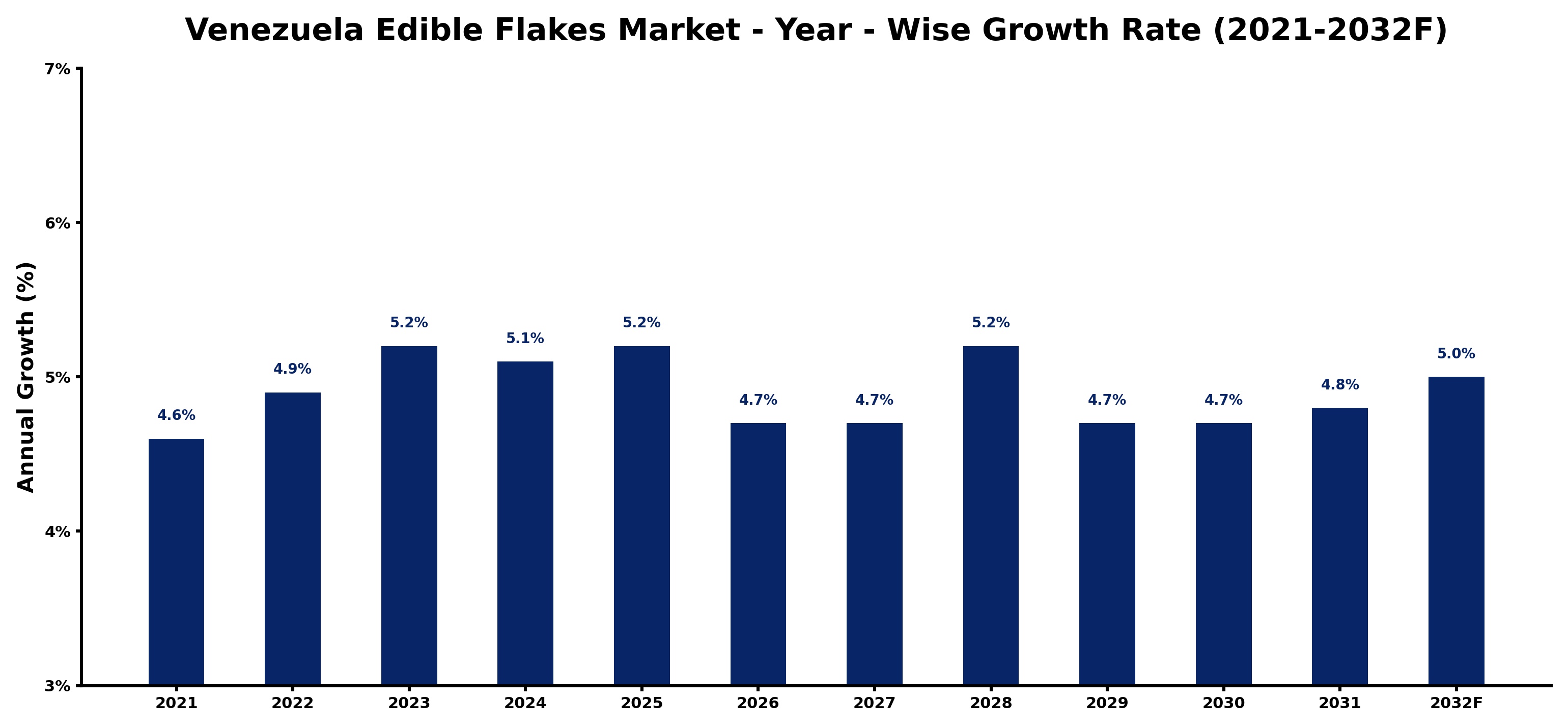
The table below presents the year‑wise growth rates along with the key drivers influencing the market
| Year | Growth Rate | Major Drivers |
| 2021 | 4.6% | Consumer demand for convenience increased |
| 2022 | 4.9% | Health trends favored nutritious options |
| 2023 | 5.2% | Innovative flavors attracted new customers |
| 2024 | 5.1% | Sustainability practices gained traction |
| 2025 | 5.2% | Local sourcing enhanced product appeal |
| 2026 | 4.7% | Export opportunities expanded market reach |
| 2027 | 4.7% | Culinary trends influenced product development |
| 2028 | 5.2% | Increased marketing efforts drove awareness |
| 2029 | 4.7% | Collaborations with chefs enhanced credibility |
| 2030 | 4.7% | E-commerce growth improved accessibility |
| 2031 | 4.8% | Nutritional education influenced purchasing decisions |
| 2032 | 5.0% | Product quality improvements attracted loyalty |
Note - Market size estimations and growth projections presented in this report are based on 6Wresearch’s advanced forecasting approach, validated with industry datasets as of June 2026.
Venezuela Edible Flakes Market Synopsis
The demand for edible flakes in Venezuela is significantly influenced by the bustling lifestyles of consumers, who prioritize quick meal solutions. Products like corn, rice, and wheat flakes are not only a staple but are also evolving with fortified options that cater to health-conscious individuals seeking balance in their diets.
Supply dynamics in the Venezuela Edible Flakes Market are complex, shaped by both domestic production and international imports. Given the country's economic challenges, local producers are innovating to stay competitive, while the government's price controls aim to maintain affordability amidst rising production costs.
Venezuela Edible Flakes Market Key Takeaways
- The market is witnessing a surge in demand for healthier and more convenient breakfast options.
- Economic factors significantly affect consumer purchasing power and overall market dynamics.
- Product innovation and diversification are crucial for companies to remain competitive.
- Government interventions, such as subsidies and price controls, shape market operations.
- Investment opportunities exist in developing fortified and flavored edible flakes catering to health trends.
Evaluation of Restraints in Venezuela Edible Flakes Market
The Venezuela Edible Flakes Market faces several significant restraints that hinder its potential growth. Economic instability, characterized by hyperinflation and currency devaluation, has negatively affected consumer purchasing power. Furthermore, political unrest adds layers of uncertainty, complicating supply chains and distribution networks. These factors create a challenging environment for manufacturers, who must navigate rising production costs while struggling to meet fluctuating demand. As a result, accurately forecasting market trends has become increasingly difficult, impacting strategic planning and investment decisions.
Venezuela Edible Flakes Market Trends
The current trends within the Venezuela Edible Flakes Market reflect a strong consumer shift toward healthier products, with an emphasis on whole grains and low sugar options. Flavored varieties are gaining traction, appealing to a younger demographic eager for tasty, nutritious breakfasts. Manufacturers are also leveraging advancements in technology to enhance product quality and freshness, pushing towards a more innovative approach in their offerings. Additionally, sustainability trends are starting to influence packaging decisions as consumers become more environmentally conscious.
Venezuela Edible Flakes Market Opportunities
Investment opportunities in the Venezuela Edible Flakes Market are abundant, particularly in segments emphasizing health and convenience. With a growing consumer base shifting towards plant-based diets, companies can explore the production of fortified and flavored edible flakes that align with these preferences. The potential for innovative marketing strategies and partnerships with health-focused organizations presents further avenues for growth, allowing businesses to effectively capture and engage their target audiences.
Government Initiatives in the Venezuela Edible Flakes Market
Government policies significantly influence the Venezuela Edible Flakes Market, particularly through price controls and import restrictions. By regulating prices on essential food items, the government aims to ensure that basic nutritional products remain affordable for the general populace. These policies are complemented by subsidies designed to bolster local production, thereby enhancing food security in a volatile economic landscape. However, the effectiveness of these initiatives is often undermined by ongoing inflation and political instability, which continue to challenge market stability.
Future Insights of the Venezuela Edible Flakes Market
Looking ahead to the 2026-2032 period, the Venezuela Edible Flakes Market is poised for a complex journey. While economic and political uncertainties may present substantial challenges, the underlying demand for nutritious breakfast options suggests potential resilience. Companies that can adapt to the changing landscape and innovate effectively will likely capture significant market share. Strategic investments in production capabilities and enhanced marketing strategies will be essential for navigating the obstacles and opportunities that arise in this evolving market.
Venezuela Edible Flakes Market Latest Developments (May 2025 - June 2026)
Recent developments in the Venezuela Edible Flakes Market indicate a renewed focus on product innovation, with several manufacturers exploring new flavor profiles to attract consumers. Additionally, companies are adjusting their marketing strategies to emphasize health benefits, responding to the rising consumer demand for nutritious options. Collaborations between local producers and international suppliers are also becoming more common, aimed at improving distribution channels and product availability amidst the challenging economic environment.
Venezuela Edible Flakes Market - Key Attractiveness of the Report
- 10 Years of Market Numbers
- Historical Data Starting from 2022 to 2025
- Base Year: 2025
- Forecast Data until 2032
- Key Performance Indicators Impacting the Market
- Major Upcoming Developments and Projects
Key Highlights of the Report:
- Venezuela Edible Flakes Market Outlook
- Market Size of Venezuela Edible Flakes Market, 2025
- Forecast of Venezuela Edible Flakes Market, 2032
- Historical Data and Forecast of Venezuela Edible Flakes Revenues & Volume for the Period 2022-2032F
- Venezuela Edible Flakes Market Trend Evolution
- Venezuela Edible Flakes Market Drivers and Challenges
- Venezuela Edible Flakes Price Trends
- Venezuela Edible Flakes Porter's Five Forces
- Venezuela Edible Flakes Industry Life Cycle
- Historical Data and Forecast of Venezuela Edible Flakes Market Revenues & Volume By Product for the Period 2022-2032F
- Historical Data and Forecast of Venezuela Edible Flakes Market Revenues & Volume By Corn flakes for the Period 2022-2032F
- Historical Data and Forecast of Venezuela Edible Flakes Market Revenues & Volume By Wheat flakes for the Period 2022-2032F
- Historical Data and Forecast of Venezuela Edible Flakes Market Revenues & Volume By Rice flakes for the Period 2022-2032F
- Historical Data and Forecast of Venezuela Edible Flakes Market Revenues & Volume By Flakey oats for the Period 2022-2032F
- Historical Data and Forecast of Venezuela Edible Flakes Market Revenues & Volume By Others for the Period 2022-2032F
- Historical Data and Forecast of Venezuela Edible Flakes Market Revenues & Volume By Distribution Channel for the Period 2022-2032F
- Historical Data and Forecast of Venezuela Edible Flakes Market Revenues & Volume By Supermarkets & hypermarkets for the Period 2022-2032F
- Historical Data and Forecast of Venezuela Edible Flakes Market Revenues & Volume By Convenience stores for the Period 2022-2032F
- Historical Data and Forecast of Venezuela Edible Flakes Market Revenues & Volume By Online retailers for the Period 2022-2032F
- Venezuela Edible Flakes Import Export Trade Statistics
- Market Opportunity Assessment By Product
- Market Opportunity Assessment By Distribution Channel
- Venezuela Edible Flakes Top Companies Market Share
- Venezuela Edible Flakes Competitive Benchmarking By Technical and Operational Parameters
- Venezuela Edible Flakes Company Profiles
- Venezuela Edible Flakes Key Strategic Recommendations






































