Venezuela Hospitality Furniture Market Size, Share & Growth Rate
The Venezuela Hospitality Furniture Market was estimated at USD 363 Million in 2025 and is projected to reach USD 507 Million by 2032, growing at a CAGR of 4.9% from 2026 to 2032. This anticipated growth is largely driven by a rebound in tourism, as the sector seeks to enhance guest experiences through stylish and durable furniture options. As the landscape evolves, the demand for modern designs and sustainable materials continues to gain traction, positioning this market for gradual recovery and growth.
Venezuela Hospitality Furniture Market Year-wise Growth Rate and Key Drivers
This graph highlights how the Venezuela Hospitality Furniture Market has steadily grown over the years, supported by major growth factors.
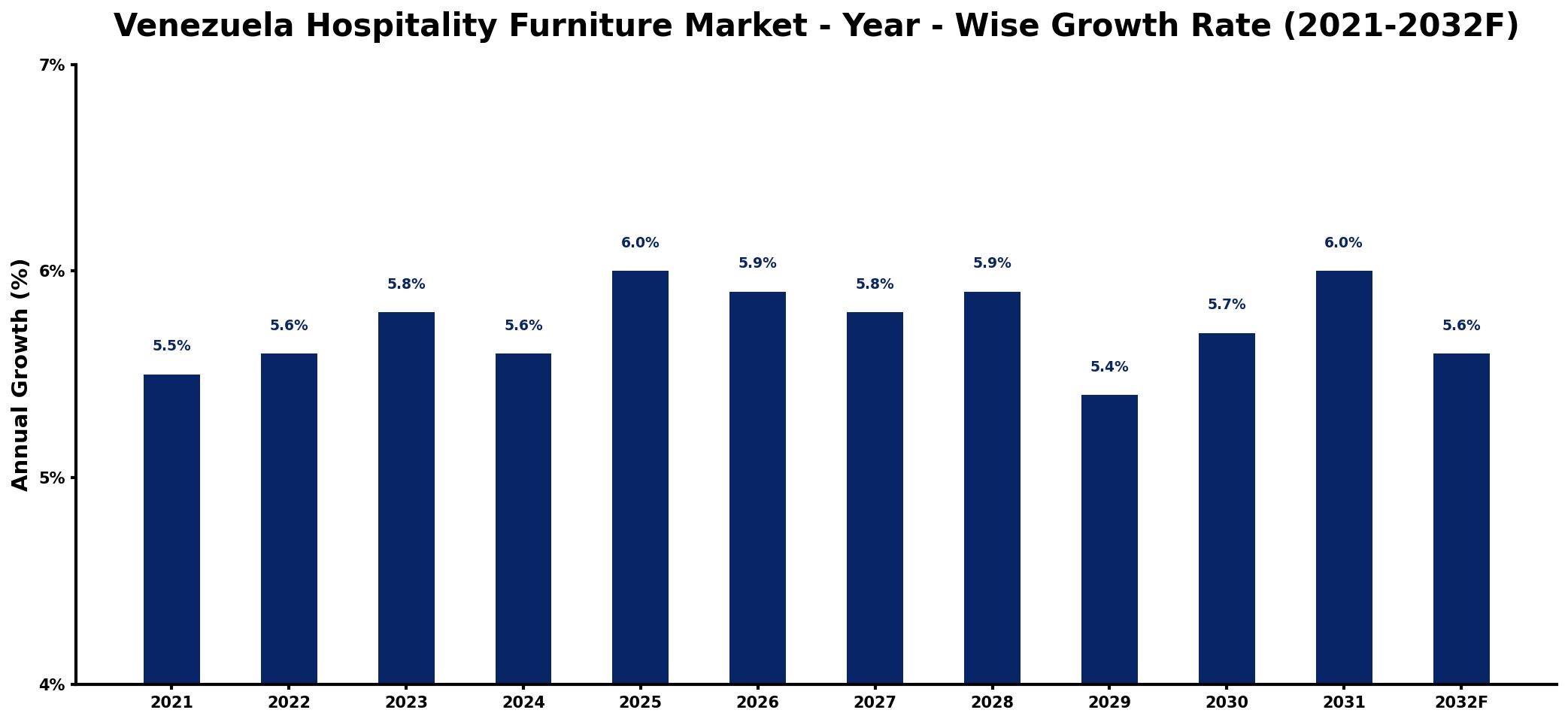
The table below presents the year‑wise growth rates along with the key drivers influencing the market
| Year | Growth Rate | Major Drivers |
| 2021 | 5.5% | Rising tourism boosting accommodation demand |
| 2022 | 5.6% | Increased local investments in infrastructure |
| 2023 | 5.8% | Growing expatriate community enhancing services |
| 2024 | 5.6% | Expansion of international hotel chains |
| 2025 | 6.0% | Improved economic stability encouraging spending |
| 2026 | 5.9% | Emerging dining experiences attracting visitors |
| 2027 | 5.8% | Enhanced online booking platforms popularity |
| 2028 | 5.9% | Cultural events driving visitor interest |
| 2029 | 5.4% | Sustainability trends influencing consumer choices |
| 2030 | 5.7% | Government incentives for tourism development |
| 2031 | 6.0% | Technological advancements in guest services |
| 2032 | 5.6% | Rising demand for unique accommodations |
Note: Market size estimations and growth projections presented in this report are based on 6Wresearch's proprietary forecasting methodology, utilizing the latest available industry data, government publications, and primary research inputs.
Venezuela Hospitality Furniture Market Synopsis
The Venezuela hospitality furniture market is navigating a complex landscape marked by economic challenges yet shows signs of positive momentum driven by an emerging tourism sector. Local manufacturers are increasingly competing with international brands, contributing to a richer array of options for hospitality businesses.
In response to both local and global trends, the market is shifting towards modern and eco-friendly designs that align with current consumer preferences. Customization is becoming a pivotal aspect, allowing hotels and restaurants to reflect their unique themes while catering to the evolving tastes of discerning guests.
Venezuela Hospitality Furniture Market Key Takeaways
- Increasing demand for sustainable and durable furniture options aligns with global eco-conscious trends.
- Customization capabilities are essential as hoteliers seek to differentiate their offerings through unique designs.
- Economic recovery in the tourism sector is expected to bolster furniture demand despite current instability.
- Modern technology integration in furniture, such as charging stations, is becoming more prevalent.
- Investors are exploring opportunities in both luxury and budget-friendly segments to meet diverse market needs.
Evaluation of Restraints in Venezuela Hospitality Furniture Market
The Venezuelan hospitality furniture market grapples with significant constraints stemming from the country's economic instability and fluctuating inflation rates. Such challenges create an unpredictable business environment that complicates accurate cost forecasting and hinders investment in high-quality furniture. Furthermore, the intertwining political uncertainties and social unrest can delay or derail expansion plans, thereby affecting overall market demand.
Strict import restrictions and currency controls further limit the availability of essential materials and imported products, which is critical for achieving diverse and high-quality offerings. Consequently, companies must navigate these obstacles carefully while developing strategies that address both immediate challenges and long-term growth potential.
Venezuela Hospitality Furniture Market Trends
Emerging trends in the Venezuela hospitality furniture market indicate a clear shift towards more contemporary and eco-friendly designs. Hoteliers are increasingly prioritizing sustainable materials and production methods, reflecting a broader commitment to environmental responsibility. Additionally, the incorporation of technology into furniture designs is gaining traction, as establishments look to enhance the guest experience through practical yet stylish solutions.
The rise of boutique hotels and upscale accommodations is catalyzing a greater emphasis on creating memorable guest experiences. This trend not only involves aesthetics but also functionality, making customizable and innovative designs a focal point for many hospitality businesses.
Venezuela Hospitality Furniture Market Opportunities
Despite existing challenges, the Venezuela hospitality furniture market offers several investment opportunities. Upscale and luxury brands can position themselves to cater to the increasing demand for high-end furnishings in luxury accommodations and restaurants. Collaborations with local manufacturers to produce culturally-inspired custom furniture can create a unique selling point, appealing to both domestic and international clientele.
Moreover, focusing on eco-friendly furniture solutions can attract environmentally conscious consumers, aligning with global trends towards responsible sourcing. By addressing the evolving preferences of the hospitality sector, investors can capitalize on the market's recovery and future growth.
Government Initiatives in the Venezuela Hospitality Furniture Market
Government policies impacting the Venezuela hospitality furniture market primarily focus on import regulations, currency controls, and economic stability measures. While strict import regulations can hinder the availability of international products, the governments focus on economic reforms may eventually facilitate better conditions for both manufacturers and consumers. Ensuring a stable business environment through sensible economic measures can encourage investment and innovation within the hospitality furniture sector.
Future Insights of the Venezuela Hospitality Furniture Market
Looking ahead to 2026-2032, the Venezuela hospitality furniture market is poised for gradual recovery, contingent on improvements in the economic and political landscape. Should tourism levels rise, businesses are likely to invest more in quality furniture that meets both aesthetic and durability standards. The ongoing evolution towards sustainable, customizable solutions will also play a pivotal role in shaping future demand and guiding product development in this dynamic market.
Venezuela Hospitality Furniture Market Latest Developments (2025 - 2026)
Recent industry developments in the Venezuela hospitality furniture market indicate a growing interest in innovative and customizable solutions. Many businesses are exploring unique designs that reflect local culture while integrating modern technology features. Additionally, collaborations between international and local manufacturers are increasing, which aims to enhance product variety and cater to diverse customer preferences.
Venezuela Hospitality Furniture Market - Key Attractiveness of the Report
- 10 Years of Market Numbers
- Historical Data Starting from 2022 to 2025
- Base Year: 2025
- Forecast Data until 2032
- Key Performance Indicators Impacting the Market
- Major Upcoming Developments and Projects
Key Highlights of the Report:
- Venezuela Hospitality Furniture Market Outlook
- Market Size of Venezuela Hospitality Furniture Market, 2025
- Forecast of Venezuela Hospitality Furniture Market, 2032
- Historical Data and Forecast of Venezuela Hospitality Furniture Revenues & Volume for the Period 2022-2032F
- Venezuela Hospitality Furniture Market Trend Evolution
- Venezuela Hospitality Furniture Market Drivers and Challenges
- Venezuela Hospitality Furniture Price Trends
- Venezuela Hospitality Furniture Porter's Five Forces
- Venezuela Hospitality Furniture Industry Life Cycle
- Historical Data and Forecast of Venezuela Hospitality Furniture Market Revenues & Volume By Type for the Period 2022-2032F
- Historical Data and Forecast of Venezuela Hospitality Furniture Market Revenues & Volume By Wooden Furniture for the Period 2022-2032F
- Historical Data and Forecast of Venezuela Hospitality Furniture Market Revenues & Volume By Leather & Fabric Furniture for the Period 2022-2032F
- Historical Data and Forecast of Venezuela Hospitality Furniture Market Revenues & Volume By Metal Furniture for the Period 2022-2032F
- Historical Data and Forecast of Venezuela Hospitality Furniture Market Revenues & Volume By Others for the Period 2022-2032F
- Historical Data and Forecast of Venezuela Hospitality Furniture Market Revenues & Volume By Applications for the Period 2022-2032F
- Historical Data and Forecast of Venezuela Hospitality Furniture Market Revenues & Volume By Economy Hotel for the Period 2022-2032F
- Historical Data and Forecast of Venezuela Hospitality Furniture Market Revenues & Volume By Extended-stay Hotel for the Period 2022-2032F
- Historical Data and Forecast of Venezuela Hospitality Furniture Market Revenues & Volume By Full-service Hotel for the Period 2022-2032F
- Historical Data and Forecast of Venezuela Hospitality Furniture Market Revenues & Volume By Luxury Hotel for the Period 2022-2032F
- Historical Data and Forecast of Venezuela Hospitality Furniture Market Revenues & Volume By Others for the Period 2022-2032F
- Historical Data and Forecast of Venezuela Hospitality Furniture Market Revenues & Volume By Industry Vertical for the Period 2022-2032F
- Historical Data and Forecast of Venezuela Hospitality Furniture Market Revenues & Volume By Hotels & Restaurants for the Period 2022-2032F
- Historical Data and Forecast of Venezuela Hospitality Furniture Market Revenues & Volume By Public Places for the Period 2022-2032F
- Historical Data and Forecast of Venezuela Hospitality Furniture Market Revenues & Volume By Corporate Offices for the Period 2022-2032F
- Historical Data and Forecast of Venezuela Hospitality Furniture Market Revenues & Volume By Others for the Period 2022-2032F
- Venezuela Hospitality Furniture Import Export Trade Statistics
- Market Opportunity Assessment By Type
- Market Opportunity Assessment By Applications
- Market Opportunity Assessment By Industry Vertical
- Venezuela Hospitality Furniture Top Companies Market Share
- Venezuela Hospitality Furniture Competitive Benchmarking By Technical and Operational Parameters
- Venezuela Hospitality Furniture Company Profiles
- Venezuela Hospitality Furniture Key Strategic Recommendations






































