Venezuela Lipstick Market Size, Share & Growth Rate
The Venezuela Lipstick Market was estimated at USD 346 Million in 2025 and is projected to reach USD 457 Million by 2032, growing at a CAGR of 4.1% from 2026 to 2032. This growth trajectory is driven by consumers' increasing focus on self-expression through cosmetics, as well as a rising preference for affordable beauty products amidst economic challenges. Additionally, the market is witnessing an expanding awareness of health and sustainability, which is leading to a shift towards natural and organic lipstick formulations.
Venezuela Lipstick Market Year-wise Growth Rate and Key Drivers
This graph highlights how the Venezuela Lipstick Market has steadily grown over the years, supported by major growth factors.
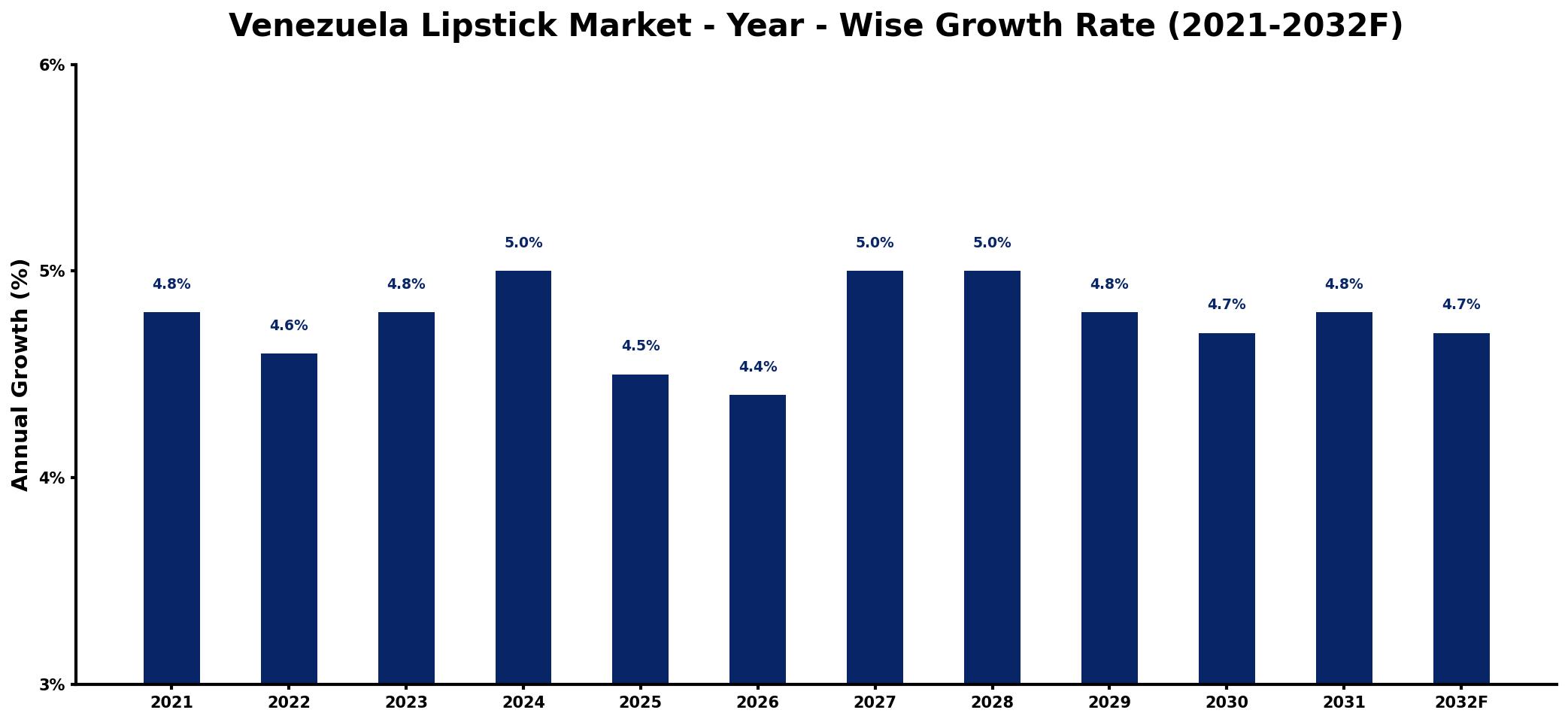
The table below presents the year‑wise growth rates along with the key drivers influencing the market
| Year | Growth Rate | Major Drivers |
| 2021 | 4.8% | Rising consumer beauty interest |
| 2022 | 4.6% | Increased disposable income growth |
| 2023 | 4.8% | Expansion of retail distribution channels |
| 2024 | 5.0% | Growing influence of social media |
| 2025 | 4.5% | Emerging local beauty brands surge |
| 2026 | 4.4% | Innovative marketing strategies adopted |
| 2027 | 5.0% | Strengthened e-commerce platforms development |
| 2028 | 5.0% | Collaborations with influencers increase |
| 2029 | 4.8% | Sustainable product demand rises |
| 2030 | 4.7% | Enhanced product variety availability |
| 2031 | 4.8% | Growing awareness of beauty trends |
| 2032 | 4.7% | Investment in beauty education programs |
Note: Market size estimations and growth projections presented in this report are based on 6Wresearch's proprietary forecasting methodology, utilizing the latest available industry data, government publications, and primary research inputs.
Venezuela Lipstick Market Synopsis
In recent years, the Venezuela lipstick market has showcased remarkable resilience, fueled by a growing consumer base that views cosmetics as essential for self-care. Despite the ongoing economic instability, Venezuelans continue to prioritize beauty products, with lipsticks playing a central role in their grooming routines.
International brands maintain a solid presence in the market, while local brands are gaining traction by offering affordable options without compromising quality. The popularity of bold colors and long-lasting formulations reflects the diverse preferences of Venezuelan consumers, driving demand for innovative products in this challenging landscape.
Venezuela Lipstick Market Key Takeaways
- The market is characterized by a growing demand for affordable yet high-quality lipstick options.
- Natural and organic lipstick formulations are gaining momentum among health-conscious consumers.
- Influencer marketing and social media significantly influence consumer purchasing decisions.
- Bold colors, particularly reds and purples, remain top choices among Venezuelan consumers.
- Economic instability continues to impact consumer purchasing power, shaping market dynamics.
Evaluation of Restraints in Venezuela Lipstick Market
The Venezuelan lipstick market faces significant restraints stemming from the country's economic turmoil. High inflation rates and currency devaluation have drastically affected consumer purchasing power, leading to a decline in demand for non-essential beauty products. Additionally, political and social unrest creates an uncertain business environment, limiting the operational capabilities of cosmetic companies. Trade restrictions and limited access to raw materials further complicate the supply chain, placing additional hurdles for brands aiming to thrive in this challenging market.
Venezuela Lipstick Market Trends
Current trends in the Venezuela lipstick market include a clear consumer preference for long-lasting and matte lipsticks. This demand is reflective of a broader shift towards products that can withstand the rigors of daily life while offering a polished, non-shiny appearance. Furthermore, there is an increasing interest in natural ingredients, with consumers actively seeking products that avoid harmful chemicals. The influence of social media and beauty influencers continues to shape the purchasing landscape, with bold and vibrant color palettes remaining in high demand.
Venezuela Lipstick Market Opportunities
Despite the economic challenges, the Venezuela lipstick market offers potential growth opportunities, particularly for affordable and local brands that resonate with price-conscious consumers. The expansion of online sales channels presents an avenue for brands to reach a wider audience, circumventing some of the traditional distribution challenges. Additionally, tapping into the growing trend of natural and organic lipstick formulations could position companies favorably amidst rising consumer health awareness.
Government Initiatives in the Venezuela Lipstick Market
Government policies significantly influence the Venezuela lipstick market, primarily through import regulations and price controls. The Venezuelan government has implemented strict import controls to encourage domestic production and reduce reliance on foreign brands. Price controls are also established to maintain consumer affordability for cosmetic products, including lipsticks. However, foreign exchange restrictions complicate access to essential raw materials, making it challenging for both local and international companies to operate effectively in the market.
Future Insights of the Venezuela Lipstick Market
Looking ahead to 2026-2032, the Venezuela lipstick market is expected to navigate a complex landscape marked by economic and political instability. While the ongoing hyperinflation and currency fluctuations may restrain overall growth, opportunities for niche brands that focus on affordability and quality remain. Companies that align their offerings with consumer preferences, especially in terms of bold colors and sustainable formulations, are more likely to succeed as the market continues to evolve. Overall, a cautious but strategic approach will be essential for brands aiming to thrive in this unpredictable environment.
Venezuela Lipstick Market Latest Developments (2025 - 2026)
In the period from & to June 2026, the Venezuela lipstick market has witnessed a surge in local brand initiatives, focusing on affordability and quality to cater to the evolving consumer landscape. Many brands are increasingly utilizing social media platforms for marketing, significantly driving engagement and consumer interest. Additionally, as consumers become more discerning about product ingredients, several companies have begun to reformulate their offerings to emphasize natural and organic components, reflecting a broader trend towards health-conscious beauty.
Venezuela Lipstick Market - Key Attractiveness of the Report
- 10 Years of Market Numbers
- Historical Data Starting from 2022 to 2025
- Base Year: 2025
- Forecast Data until 2032
- Key Performance Indicators Impacting the Market
- Major Upcoming Developments and Projects
Key Highlights of the Report:
- Venezuela Lipstick Market Outlook
- Market Size of Venezuela Lipstick Market, 2025
- Forecast of Venezuela Lipstick Market, 2032
- Historical Data and Forecast of Venezuela Lipstick Revenues & Volume for the Period 2022-2032F
- Venezuela Lipstick Market Trend Evolution
- Venezuela Lipstick Market Drivers and Challenges
- Venezuela Lipstick Price Trends
- Venezuela Lipstick Porter's Five Forces
- Venezuela Lipstick Industry Life Cycle
- Historical Data and Forecast of Venezuela Lipstick Market Revenues & Volume By Product Type for the Period 2022-2032F
- Historical Data and Forecast of Venezuela Lipstick Market Revenues & Volume By Matte for the Period 2022-2032F
- Historical Data and Forecast of Venezuela Lipstick Market Revenues & Volume By Glossy for the Period 2022-2032F
- Historical Data and Forecast of Venezuela Lipstick Market Revenues & Volume By Lip Powder for the Period 2022-2032F
- Historical Data and Forecast of Venezuela Lipstick Market Revenues & Volume By Others for the Period 2022-2032F
- Historical Data and Forecast of Venezuela Lipstick Market Revenues & Volume By Form for the Period 2022-2032F
- Historical Data and Forecast of Venezuela Lipstick Market Revenues & Volume By Stick for the Period 2022-2032F
- Historical Data and Forecast of Venezuela Lipstick Market Revenues & Volume By Liquid for the Period 2022-2032F
- Historical Data and Forecast of Venezuela Lipstick Market Revenues & Volume By Palette for the Period 2022-2032F
- Historical Data and Forecast of Venezuela Lipstick Market Revenues & Volume By Distribution Channel for the Period 2022-2032F
- Historical Data and Forecast of Venezuela Lipstick Market Revenues & Volume By Supermarkets/hypermarkets for the Period 2022-2032F
- Historical Data and Forecast of Venezuela Lipstick Market Revenues & Volume By Specialty Stores for the Period 2022-2032F
- Historical Data and Forecast of Venezuela Lipstick Market Revenues & Volume By Online Stores for the Period 2022-2032F
- Venezuela Lipstick Import Export Trade Statistics
- Market Opportunity Assessment By Product Type
- Market Opportunity Assessment By Form
- Market Opportunity Assessment By Distribution Channel
- Venezuela Lipstick Top Companies Market Share
- Venezuela Lipstick Competitive Benchmarking By Technical and Operational Parameters
- Venezuela Lipstick Company Profiles
- Venezuela Lipstick Key Strategic Recommendations






































