Venezuela Natural Fragrance Market Size, Share & Growth Rate
The Venezuela Natural Fragrance Market was estimated at USD 192 Million in 2025 and is projected to reach USD 256 Million by 2032, growing at a CAGR of 4.2% from 2026 to 2032. This growth trajectory is driven by a notable shift in consumer preference towards natural and organic products, fueled by increasing awareness of health and environmental impacts associated with synthetic fragrances. As local brands embrace the country's extensive biodiversity, they offer distinctive products that resonate with the ethos of sustainability and wellness.
Venezuela Natural Fragrance Market Year-wise Growth Rate and Key Drivers
This graph highlights how the Venezuela Natural Fragrance Market has steadily grown over the years, supported by major growth factors.
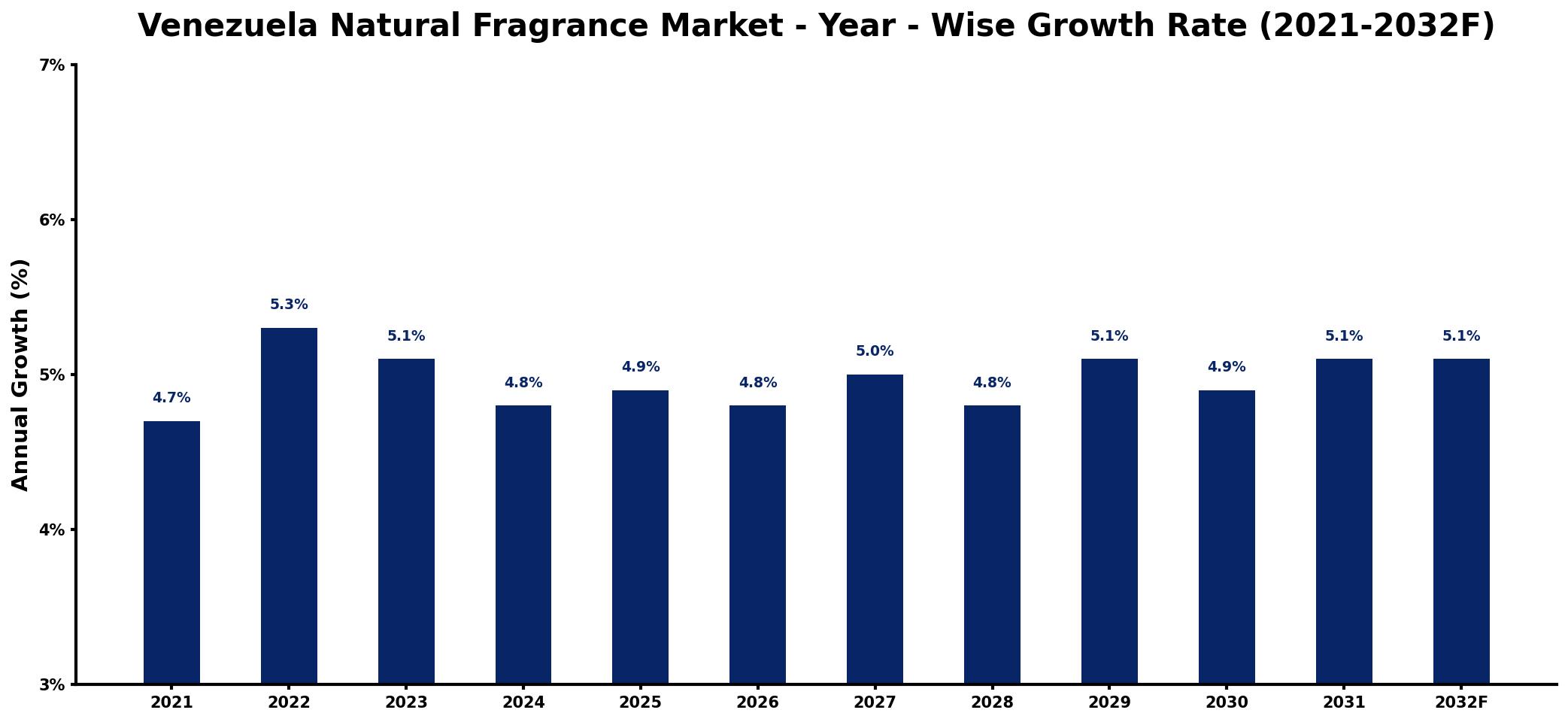
The table below presents the year‑wise growth rates along with the key drivers influencing the market
| Year | Growth Rate | Major Drivers |
| 2021 | 4.7% | Rising consumer interest in wellness |
| 2022 | 5.3% | Increased investments in sustainability |
| 2023 | 5.1% | Growth of online shopping platforms |
| 2024 | 4.8% | Expansion of retail distribution channels |
| 2025 | 4.9% | Emergence of eco-conscious brands |
| 2026 | 4.8% | Strengthening of local supply chains |
| 2027 | 5.0% | Boost in organic ingredient sourcing |
| 2028 | 4.8% | Heightened awareness of health benefits |
| 2029 | 5.1% | Surge in experiential marketing strategies |
| 2030 | 4.9% | Development of innovative packaging solutions |
| 2031 | 5.1% | Increased collaboration with influencers |
| 2032 | 5.1% | Diversification of product offerings |
Note: Market size estimations and growth projections presented in this report are based on 6Wresearch's proprietary forecasting methodology, utilizing the latest available industry data, government publications, and primary research inputs.
Venezuela Natural Fragrance Market Synopsis
In Venezuela, the demand for natural fragrances is closely tied to the growing consumer inclination towards products derived from locally sourced ingredients. This market benefits from an abundance of native plants and flowers, enabling brands to create unique fragrance offerings that reflect the rich cultural and botanical heritage of the region.
Moreover, a strong emphasis on ethical sourcing and eco-friendly practices is defining this market's landscape. As companies increasingly adopt sustainable practices, they are not only addressing consumer demand but also contributing to local communities by supporting artisans and farmers involved in the fragrance supply chain.
Venezuela Natural Fragrance Market Key Takeaways
- Increasing consumer preference for natural and organic products drives market growth.
- Unique fragrance profiles derived from Venezuela's rich biodiversity are gaining traction.
- Artisanal brands are emerging, focusing on handcrafted and small-batch production.
- Companies emphasize sustainability, ethical sourcing, and eco-friendly packaging.
- Despite economic challenges, a resilience in wellness-focused purchasing behavior is observed.
Evaluation of Restraints in Venezuela Natural Fragrance Market
Several factors currently restrain the growth of the Venezuela Natural Fragrance Market. Economic instability and currency devaluation significantly affect consumers' purchasing power, making luxury items less attainable. Moreover, the ongoing political and social unrest creates an unpredictable business environment, often leading to supply chain disruptions. Limited access to quality raw materials, compounded by import restrictions, further complicates production capabilities for local fragrance manufacturers, inhibiting their ability to capitalize on rising consumer demand.
Venezuela Natural Fragrance Market Trends
The market is witnessing a pronounced trend towards the incorporation of locally sourced, eco-friendly ingredients in fragrance formulations. Consumers increasingly favor scents derived from natural essential oils and botanical extracts, signaling a shift toward organic products. Additionally, there's a burgeoning interest in exotic and unique scents that capture the essence of Venezuela's tropical environment, including fragrances inspired by native flora and fauna.
Artisanal fragrances are becoming increasingly popular as discerning consumers look for authentic and personalized experiences in their purchases. This growing desire for transparency and ethical practices is prompting brands to highlight their commitment to sustainable sourcing, thereby appealing to environmentally-conscious buyers.
Venezuela Natural Fragrance Market Opportunities
Investment opportunities in the Venezuela Natural Fragrance Market are substantial, particularly as consumers demand more natural and sustainable products. The wealth of biodiversity provides a unique opportunity to develop fragrances from local botanicals, which can significantly enhance brand appeal. Collaborating with local farmers to establish sustainable supply chains can also yield mutual benefits, promoting local economies while ensuring quality ingredients for fragrance production. As global interest in eco-friendly products continues to rise, Venezuelas producers are well-positioned to capitalize on this trend.
Government Initiatives in the Venezuela Natural Fragrance Market
The Venezuelan government is actively fostering the development of the Natural Fragrance Market through initiatives aimed at supporting domestic production. Policies have been implemented to provide assistance to local farmers and producers, including subsidies and access to financing. Additionally, there are regulations in place to encourage sustainable practices within the fragrance industry, focusing on responsible sourcing and the preservation of biodiversity. These governmental efforts are crucial in stabilizing the market and enhancing the prospects for local fragrance businesses.
Future Insights of the Venezuela Natural Fragrance Market
Looking ahead to the period from 2026 to 2032, the future of the Venezuela Natural Fragrance Market is expected to evolve amidst ongoing challenges. Despite economic and political hurdles, the sustained global movement towards natural and sustainable products offers a pathway for recovery and growth. Local producers who can navigate these obstacles effectively while innovating their marketing strategies to target niche consumer segments will likely find significant opportunities. As the wellness trend continues to influence consumer behavior, the demand for natural fragrances is poised for resurgence.
Venezuela Natural Fragrance Market Latest Developments (2025 - 2026)
Recent developments in the Venezuela Natural Fragrance Market indicate a growing emphasis on innovative marketing and branding strategies. Several local businesses are beginning to collaborate with international distributors to expand their reach beyond domestic borders. The trend towards eco-friendly and sustainable practices is becoming more pronounced, with companies increasingly adopting greener packaging solutions. These shifts suggest a proactive approach by local brands in adapting to both consumer expectations and the overall market environment.
Venezuela Natural Fragrance Market - Key Attractiveness of the Report
- 10 Years of Market Numbers
- Historical Data Starting from 2022 to 2025
- Base Year: 2025
- Forecast Data until 2032
- Key Performance Indicators Impacting the Market
- Major Upcoming Developments and Projects
Key Highlights of the Report:
- Venezuela Natural Fragrance Market Outlook
- Market Size of Venezuela Natural Fragrance Market, 2025
- Forecast of Venezuela Natural Fragrance Market, 2032
- Historical Data and Forecast of Venezuela Natural Fragrance Revenues & Volume for the Period 2022-2032F
- Venezuela Natural Fragrance Market Trend Evolution
- Venezuela Natural Fragrance Market Drivers and Challenges
- Venezuela Natural Fragrance Price Trends
- Venezuela Natural Fragrance Porter's Five Forces
- Venezuela Natural Fragrance Industry Life Cycle
- Historical Data and Forecast of Venezuela Natural Fragrance Market Revenues & Volume By Ingredient for the Period 2022-2032F
- Historical Data and Forecast of Venezuela Natural Fragrance Market Revenues & Volume By Essential Oils for the Period 2022-2032F
- Historical Data and Forecast of Venezuela Natural Fragrance Market Revenues & Volume By Natural Extracts for the Period 2022-2032F
- Historical Data and Forecast of Venezuela Natural Fragrance Market Revenues & Volume By Type for the Period 2022-2032F
- Historical Data and Forecast of Venezuela Natural Fragrance Market Revenues & Volume By Top note for the Period 2022-2032F
- Historical Data and Forecast of Venezuela Natural Fragrance Market Revenues & Volume By Middle Note for the Period 2022-2032F
- Historical Data and Forecast of Venezuela Natural Fragrance Market Revenues & Volume By Base Note for the Period 2022-2032F
- Historical Data and Forecast of Venezuela Natural Fragrance Market Revenues & Volume By Application for the Period 2022-2032F
- Historical Data and Forecast of Venezuela Natural Fragrance Market Revenues & Volume By Fine Fragrances for the Period 2022-2032F
- Historical Data and Forecast of Venezuela Natural Fragrance Market Revenues & Volume By Personal Care & Cosmetics for the Period 2022-2032F
- Historical Data and Forecast of Venezuela Natural Fragrance Market Revenues & Volume By Household Care for the Period 2022-2032F
- Venezuela Natural Fragrance Import Export Trade Statistics
- Market Opportunity Assessment By Ingredient
- Market Opportunity Assessment By Type
- Market Opportunity Assessment By Application
- Venezuela Natural Fragrance Top Companies Market Share
- Venezuela Natural Fragrance Competitive Benchmarking By Technical and Operational Parameters
- Venezuela Natural Fragrance Company Profiles
- Venezuela Natural Fragrance Key Strategic Recommendations






































