Venezuela Natural Stone Slab Market Size, Share & Growth Rate
The Venezuela Natural Stone Slab Market was estimated at USD 1228 Million in 2025 and is projected to reach USD 1758 Million by 2032, growing at a CAGR of 5.3% from 2026 to 2032. This growth trajectory is primarily driven by the resurgence of construction and renovation activities in both residential and commercial sectors. The increasing consumer preference for natural stone materials such as granite and marble, known for their durability and aesthetic appeal, further fuels this upward trend.
Venezuela Natural Stone Slab Market Year-wise Growth Rate and Key Drivers
This graph highlights how the Venezuela Natural Stone Slab Market has steadily grown over the years, supported by major growth factors.
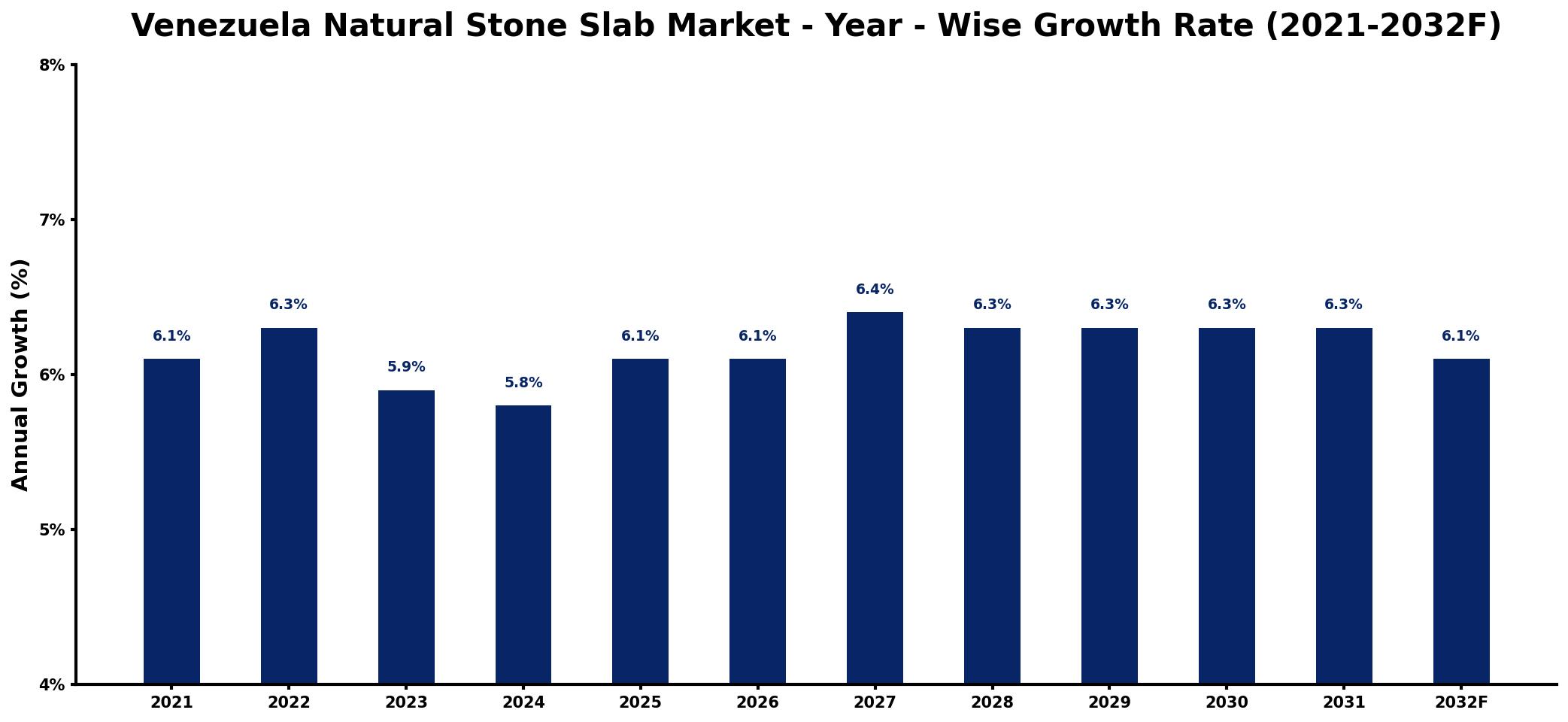
The table below presents the year‑wise growth rates along with the key drivers influencing the market
| Year | Growth Rate | Major Drivers |
| 2021 | 6.1% | Increased construction project investments |
| 2022 | 6.3% | Rising demand for luxury finishes |
| 2023 | 5.9% | Growth in residential renovations market |
| 2024 | 5.8% | Expansion of commercial real estate |
| 2025 | 6.1% | Surge in export opportunities emerging |
| 2026 | 6.1% | Higher consumer spending on decor |
| 2027 | 6.4% | Innovations in design and technology |
| 2028 | 6.3% | Strengthening of local manufacturing capabilities |
| 2029 | 6.3% | Increased urbanization driving demand |
| 2030 | 6.3% | Emerging trends in sustainable building |
| 2031 | 6.3% | Growing interest in custom designs |
| 2032 | 6.1% | Enhanced distribution network efficiency |
Note: Market size estimations and growth projections presented in this report are based on 6Wresearch's proprietary forecasting methodology, utilizing the latest available industry data, government publications, and primary research inputs.
Venezuela Natural Stone Slab Market Synopsis
The current strongest force shaping the Venezuela Natural Stone Slab Market is the shift toward higher-quality and premium stone varieties. Consumers are increasingly drawn to exotic options like onyx and quartzite, which are appreciated not just for their luxurious appearance but also for their resilience in various applications.
Additionally, theres a growing emphasis on sustainability, with more consumers opting for locally sourced stone products. This trend towards environmentally friendly practices is redefining the market dynamics, as suppliers innovate to meet changing consumer preferences for craftsmanship and customization.
Venezuela Natural Stone Slab Market Key Takeaways
- Consistent demand for natural stone slabs is driven by residential and commercial construction projects.
- Growing popularity of exotic stone varieties signifies a shift towards higher-value products in the market.
- Sustainability and local sourcing practices are increasingly influencing purchasing decisions among consumers.
- Investment opportunities exist in local quarries and partnerships with construction firms to secure raw materials.
- Government policies, though challenging, aim to protect the domestic stone industry from international competition.
Evaluation of Restraints in Venezuela Natural Stone Slab Market
The Venezuela Natural Stone Slab Market faces significant restraints stemming from the countrys economic climate. The prevailing political instability and hyperinflation result in currency devaluation, which adversely impacts purchasing power and demand for luxury goods like natural stone slabs. Moreover, trade restrictions and sanctions limit access to essential raw materials and advanced production equipment, further constraining the industry's capacity to meet both domestic and international demand. Infrastructure issues, including inconsistent electricity supply and transport challenges, exacerbate these operational hurdles for market players.
Venezuela Natural Stone Slab Market Trends
Recent trends in the Venezuela Natural Stone Slab Market indicate a marked increase in the demand for high-quality, exotic stone varieties. This aligns with a broader trend towards luxury in home improvement projects, particularly in affluent residential areas and upscale commercial developments. Suppliers are increasingly focusing on quality, craftsmanship, and customization to appeal to discerning consumers. In addition, there is a pronounced move towards environmentally sustainable practices, prompting manufacturers to adopt greener approaches to sourcing and production.
Venezuela Natural Stone Slab Market Opportunities
Investment opportunities abound in the Venezuela Natural Stone Slab Market, particularly for those seeking to establish partnerships with local quarries. By securing access to a steady supply of raw materials, investors can capitalize on the growing demand for high-quality natural stone. Furthermore, there is significant potential for technological investments that enhance production efficiency and product quality. Collaborations with local construction companies and real estate developers present avenues for supplying natural stone slabs for their diverse projects, paving the way for long-term growth and profitability.
Government Initiatives in the Venezuela Natural Stone Slab Market
Government policy towards the natural stone slab industry in Venezuela is heavily influenced by the nation's economic and political landscape. Measures such as export quotas and mining restrictions aim to control production and maintain a competitive local industry. Tariffs imposed on imported stone slabs are intended to protect domestic producers. However, these policies have seen mixed effectiveness due to ongoing instability, impacting the market's potential growth.
Future Insights of the Venezuela Natural Stone Slab Market
Looking ahead to 2026-2032, the Venezuela Natural Stone Slab Market holds potential for recovery and growth, contingent upon political and economic stabilization. Increased construction activities, fueled by the rebuilding of infrastructure and a renewed interest in luxury renovations, could bolster market demand significantly. Industry players must remain agile and responsive to the evolving landscape, leveraging opportunities to innovate and differentiate their offerings in a competitive market.
Venezuela Natural Stone Slab Market Latest Developments (2025 - 2026)
Recent developments in the Venezuela Natural Stone Slab Market showcase a focus on improving local production capabilities and sustainability practices. Industry stakeholders are beginning to implement more environmentally friendly extraction methods and enhancing supply chain efficiency. Additionally, there is a noticeable increase in partnerships between local quarries and construction firms aiming to revitalize the market amid ongoing economic challenges. This collaborative approach is expected to foster innovation and expand the markets reach in both domestic and international arenas.
Venezuela Natural Stone Slab Market - Key Attractiveness of the Report
- 10 Years of Market Numbers
- Historical Data Starting from 2022 to 2025
- Base Year: 2025
- Forecast Data until 2032
- Key Performance Indicators Impacting the Market
- Major Upcoming Developments and Projects
Key Highlights of the Report:
- Venezuela Natural Stone Slab Market Outlook
- Market Size of Venezuela Natural Stone Slab Market, 2025
- Forecast of Venezuela Natural Stone Slab Market, 2032
- Historical Data and Forecast of Venezuela Natural Stone Slab Revenues & Volume for the Period 2022-2032F
- Venezuela Natural Stone Slab Market Trend Evolution
- Venezuela Natural Stone Slab Market Drivers and Challenges
- Venezuela Natural Stone Slab Price Trends
- Venezuela Natural Stone Slab Porter's Five Forces
- Venezuela Natural Stone Slab Industry Life Cycle
- Historical Data and Forecast of Venezuela Natural Stone Slab Market Revenues & Volume By Product for the Period 2022-2032F
- Historical Data and Forecast of Venezuela Natural Stone Slab Market Revenues & Volume By Granite for the Period 2022-2032F
- Historical Data and Forecast of Venezuela Natural Stone Slab Market Revenues & Volume By Limestone for the Period 2022-2032F
- Historical Data and Forecast of Venezuela Natural Stone Slab Market Revenues & Volume By Travertine for the Period 2022-2032F
- Historical Data and Forecast of Venezuela Natural Stone Slab Market Revenues & Volume By Others for the Period 2022-2032F
- Historical Data and Forecast of Venezuela Natural Stone Slab Market Revenues & Volume By Application for the Period 2022-2032F
- Historical Data and Forecast of Venezuela Natural Stone Slab Market Revenues & Volume By Residential for the Period 2022-2032F
- Historical Data and Forecast of Venezuela Natural Stone Slab Market Revenues & Volume By Commercial for the Period 2022-2032F
- Venezuela Natural Stone Slab Import Export Trade Statistics
- Market Opportunity Assessment By Product
- Market Opportunity Assessment By Application
- Venezuela Natural Stone Slab Top Companies Market Share
- Venezuela Natural Stone Slab Competitive Benchmarking By Technical and Operational Parameters
- Venezuela Natural Stone Slab Company Profiles
- Venezuela Natural Stone Slab Key Strategic Recommendations






































