Venezuela Real Estate Market Size, Share & Growth Rate
The Venezuela Real Estate Market was estimated at USD 354 Million in 2025 and is projected to reach USD 485 Million by 2032, growing at a CAGR of 4.6% from 2026 to 2032. This growth trajectory is primarily driven by a combination of decreasing property values due to the ongoing economic crisis, alongside an increasing demand from international investors who view the market's low entry point as an opportunity. Additionally, the resilience of the rental market amidst economic uncertainties indicates potential stability within specific segments.
Venezuela Real Estate Market Year-wise Growth Rate and Key Drivers
This graph highlights how the Venezuela Real Estate Market has steadily grown over the years, supported by major growth factors.
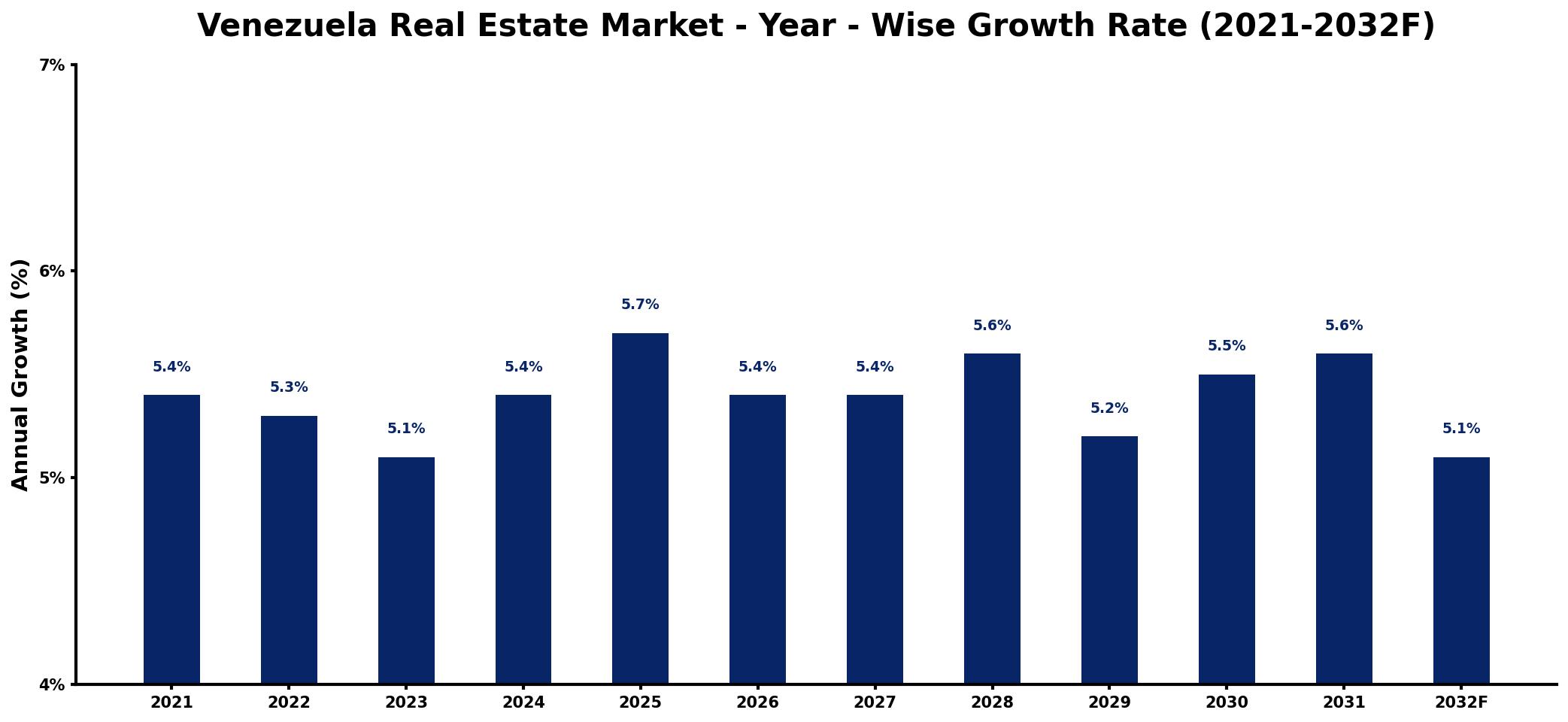
The table below presents the year‑wise growth rates along with the key drivers influencing the market
| Year | Growth Rate | Major Drivers |
| 2021 | 5.4% | Rising foreign investment interest |
| 2022 | 5.3% | Increased urban population growth |
| 2023 | 5.1% | Expansion of housing developments |
| 2024 | 5.4% | Growing demand for rentals |
| 2025 | 5.7% | Improved infrastructure projects initiated |
| 2026 | 5.4% | Higher consumer purchasing power |
| 2027 | 5.4% | Increased tourism boosting demand |
| 2028 | 5.6% | Strengthened financial lending options |
| 2029 | 5.2% | Emergence of eco-friendly projects |
| 2030 | 5.5% | Technological advancements enhancing construction |
| 2031 | 5.6% | Government incentives for buyers |
| 2032 | 5.1% | Diversification of investment portfolios |
Note: Market size estimations and growth projections presented in this report are based on 6Wresearch's proprietary forecasting methodology, utilizing the latest available industry data, government publications, and primary research inputs.
Venezuela Real Estate Market Synopsis
The current landscape of the Venezuela real estate market reflects a notable excess of available properties. Many homeowners find themselves unable to sell their assets at reasonable prices, pushing more individuals towards renting. This dynamic has contributed to a burgeoning rental market, especially in urban centers where expatriates and locals seek flexibility amid economic instability.
Prime luxury properties, particularly in key areas of Caracas, continue to see demand, defying broader market trends. These properties attract buyers who are eager to make acquisitions at significantly lower prices compared to pre-crisis values, fostering a unique niche amidst the prevailing economic turmoil.
Venezuela Real Estate Market Key Takeaways
- The market is experiencing a decline in property values as a result of hyperinflation and political instability.
- There is a growing preference for rental options among locals and expatriates due to economic uncertainties.
- Luxury properties in prime locations remain attractive to some investors, despite the overall market volatility.
- Potential exists for high returns on investment in distressed properties as the market stabilizes.
- The government's regulations heavily influence market dynamics, particularly concerning foreign investment and property transactions.
Evaluation of Restraints in Venezuela Real Estate Market
The Venezuela real estate market is heavily constrained by pervasive economic factors, including hyperinflation and an unstable political climate. These elements have rendered accurate property pricing exceedingly difficult for both buyers and sellers. The uncertainty has led to a marked decrease in foreign investment, further exacerbated by government policies that create barriers for international investors. Access to financing remains limited, leaving many prospective buyers unable to enter the market and stagnating growth in property sales.
Venezuela Real Estate Market Trends
Emerging trends in the Venezuela real estate market highlight a shift towards rental properties as many citizens and newcomers seek flexibility amidst uncertainty. Additionally, international interest in commercial real estate within urban centers is on the rise, as investors target undervalued properties with potential for significant appreciation. Digital platforms are also becoming more relevant for property transactions, enabling wider access to listings and fostering better transparency in an otherwise opaque market.
Venezuela Real Estate Market Opportunities
Investment opportunities are increasingly concentrated in major cities like Caracas, where the demand for both residential and commercial spaces persists despite economic challenges. Potential exists in acquiring distressed properties for refurbishment and subsequent resale or rental. Additionally, the tourism sector, particularly in destinations like Margarita Island, shows promise for growth, creating opportunities in vacation rentals or hospitality investments. Investors equipped with local insights and a keen understanding of the market's complexities stand to capitalize on these unique opportunities.
Government Initiatives in the Venezuela Real Estate Market
Government policies in Venezuela have significantly shaped the real estate landscape. Recent measures include rental price controls and restrictions on property sales to foreigners aimed at maintaining affordable housing for low-income citizens. Additionally, the government has prioritized social housing programs to address severe shortages. However, the overall economic instability and regulatory environment complicate the potential for robust growth, leaving investors to navigate a challenging landscape.
Future Insights of the Venezuela Real Estate Market
Looking ahead to 2026-2032, the Venezuela real estate market is positioned at a critical juncture. Should the government implement essential economic reforms and political stabilization measures, there may be a path towards recovery and renewed investor confidence. Demand for affordable housing and public infrastructure development projects could serve as catalysts for revitalization. However, stakeholders must remain vigilant, carefully assessing the evolving political and economic context to strategically position themselves in this fluid market.
Venezuela Real Estate Market Latest Developments (2025 - 2026)
Recent months have witnessed increasing discussions around potential government reforms aimed at revitalizing the real estate sector, focusing on enhancing transparency and easing restrictions for foreign investors. Additionally, fluctuations in rental demand are reflecting shifts in expatriate patterns, as more individuals are choosing to relocate to Venezuela, drawn by lower living costs. Such developments indicate an evolving landscape, one that investors should closely monitor as opportunities emerge in an otherwise turbulent market.
Venezuela Real Estate Market - Key Attractiveness of the Report
- 10 Years of Market Numbers
- Historical Data Starting from 2022 to 2025
- Base Year: 2025
- Forecast Data until 2032
- Key Performance Indicators Impacting the Market
- Major Upcoming Developments and Projects
Key Highlights of the Report:
- Venezuela Real Estate Market Outlook
- Market Size of Venezuela Real Estate Market, 2025
- Forecast of Venezuela Real Estate Market, 2032
- Historical Data and Forecast of Venezuela Real Estate Revenues & Volume for the Period 2022-2032F
- Venezuela Real Estate Market Trend Evolution
- Venezuela Real Estate Market Drivers and Challenges
- Venezuela Real Estate Price Trends
- Venezuela Real Estate Porter's Five Forces
- Venezuela Real Estate Industry Life Cycle
- Historical Data and Forecast of Venezuela Real Estate Market Revenues & Volume By Property for the Period 2022-2032F
- Historical Data and Forecast of Venezuela Real Estate Market Revenues & Volume By Residential for the Period 2022-2032F
- Historical Data and Forecast of Venezuela Real Estate Market Revenues & Volume By Commercial for the Period 2022-2032F
- Historical Data and Forecast of Venezuela Real Estate Market Revenues & Volume By Industrial for the Period 2022-2032F
- Historical Data and Forecast of Venezuela Real Estate Market Revenues & Volume By Land for the Period 2022-2032F
- Historical Data and Forecast of Venezuela Real Estate Market Revenues & Volume By Others for the Period 2022-2032F
- Historical Data and Forecast of Venezuela Real Estate Market Revenues & Volume By Type for the Period 2022-2032F
- Historical Data and Forecast of Venezuela Real Estate Market Revenues & Volume By Sales for the Period 2022-2032F
- Historical Data and Forecast of Venezuela Real Estate Market Revenues & Volume By Rental for the Period 2022-2032F
- Historical Data and Forecast of Venezuela Real Estate Market Revenues & Volume By Lease for the Period 2022-2032F
- Venezuela Real Estate Import Export Trade Statistics
- Market Opportunity Assessment By Property
- Market Opportunity Assessment By Type
- Venezuela Real Estate Top Companies Market Share
- Venezuela Real Estate Competitive Benchmarking By Technical and Operational Parameters
- Venezuela Real Estate Company Profiles
- Venezuela Real Estate Key Strategic Recommendations






































