Venezuela Silicon Alloys Market Size, Share & Growth Rate
The Venezuela Silicon Alloys Market was estimated at USD 224 Million in 2025 and is projected to reach USD 311 Million by 2032, growing at a CAGR of 4.8% from 2026 to 2032. This growth trajectory is primarily driven by the increasing demand for silicon alloys across key sectors such as automotive, electronics, and construction. The abundant availability of natural silicon resources in Venezuela further supports this upward trend, fostering innovations that cater to evolving industrial requirements.
Venezuela Silicon Alloys Market Year-wise Growth Rate and Key Drivers
This graph highlights how the Venezuela Silicon Alloys Market has steadily grown over the years, supported by major growth factors.
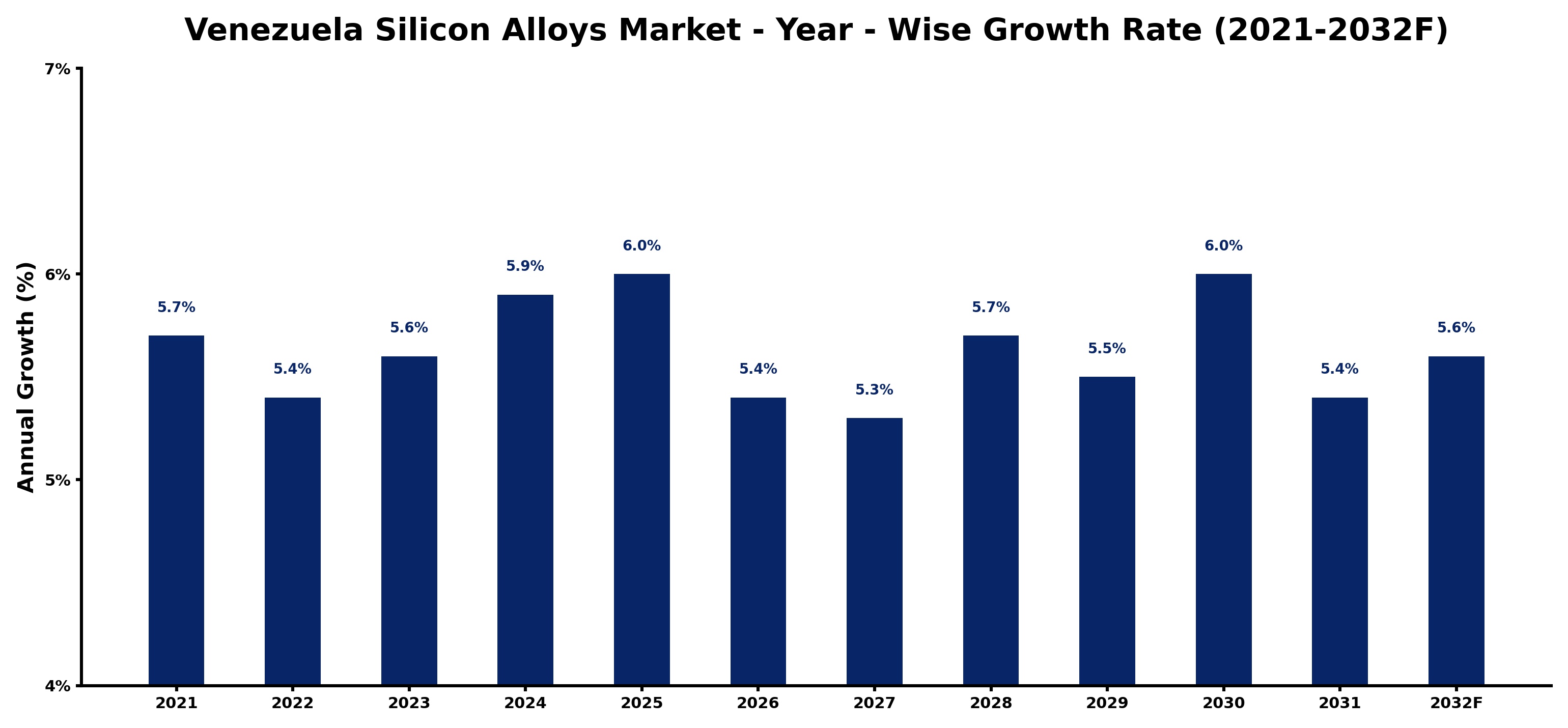
The table below presents the year‑wise growth rates along with the key drivers influencing the market
| Year | Growth Rate | Major Drivers |
| 2021 | 5.7% | Regional silicon alloy plants optimize output through technology upgrades |
| 2022 | 5.4% | Increased oilfield investments boosted silicon alloys for energy sector |
| 2023 | 5.6% | Increased silicon alloy demand drives domestic steel manufacturing upgrades |
| 2024 | 5.9% | Silicon alloy manufacturing investments boosted local infrastructure development projects |
| 2025 | 6.0% | Technology adoption in smelting operations boosts alloy production efficiency |
| 2026 | 5.4% | Silicon alloy plant upgrades boosted local metallurgical production capacity |
| 2027 | 5.3% | Local mining operations expanded capacity for silicon alloy production |
| 2028 | 5.7% | Silicon alloy manufacturers optimize processes for export market competitiveness |
| 2029 | 5.5% | Expanded capacity in silicon alloy plants boosts local manufacturing resilience |
| 2030 | 6.0% | Higher metallurgical investments boosted silicon alloy production capacity |
| 2031 | 5.4% | Plant upgrades in silicon alloy production boost output capabilities |
| 2032 | 5.6% | Smart manufacturing technologies boost Venezuela's silicon alloy production efficiency |
Note - Market size estimations and growth projections presented in this report are based on 6Wresearch’s advanced forecasting approach, validated with industry datasets as of June 2026.
Venezuela Silicon Alloys Market Synopsis
The strongest force shaping the Venezuela Silicon Alloys Market today is the expanding industrial applications of silicon alloys, particularly in the automotive and electronics sectors. As manufacturers seek to enhance the performance and efficiency of their products, the demand for high-quality silicon alloys with improved properties is escalating.
Additionally, the rising focus on sustainability and energy efficiency is prompting the adoption of silicon alloys in the production of solar panels and electric vehicles. As Venezuela continues to navigate its complex political and economic landscape, these trends present both challenges and opportunities for stakeholders in the silicon alloys sector.
Venezuela Silicon Alloys Market Key Takeaways
- The market is on a growth path, driven by increasing demand from automotive and electronics industries.
- Venezuela's rich natural resources provide a competitive edge in silicon availability.
- Technological advancements are crucial for manufacturers seeking to enhance product offerings.
- Government policies aim to bolster domestic production and reduce import reliance.
- Investment opportunities exist, despite political and economic uncertainties.
Evaluation of Restraints in Venezuela Silicon Alloys Market
Several real constraints are holding back the growth of the Venezuela Silicon Alloys Market. Political instability, coupled with international sanctions, has created an unpredictable business environment. This has hindered access to essential raw materials and financing, making it challenging for manufacturers to maintain consistent production levels. Additionally, the fluctuating currency exchange rates and rising inflation are creating significant uncertainties regarding pricing and profitability. Infrastructure deficiencies and a shortage of skilled labor further complicate the operational landscape, posing ongoing challenges to market competitiveness.
Venezuela Silicon Alloys Market Trends
The current and emerging trends in the Venezuela Silicon Alloys Market highlight a shift towards the development of high-quality silicon alloys that meet stringent industrial standards. Companies are increasingly investing in research and development to innovate new products tailored to the unique needs of the automotive and electronics sectors. Furthermore, the emphasis on sustainability is spurring greater adoption of silicon alloys in renewable energy technologies such as solar panels and electric vehicles, reflecting the industry's commitment to reducing environmental impact.
Venezuela Silicon Alloys Market Opportunities
Investment opportunities in the Venezuela Silicon Alloys Market are significant, primarily driven by the country's rich deposits of silicon, iron, and manganese. With the ongoing growth in demand across various sectors, investors have the potential to capitalize on the export market, particularly given Venezuela's strategic geographical location. As industries globally pivot towards green technologies, there is an increasing market for silicon alloys in renewable energy applications, promising lucrative avenues for forward-thinking investors willing to navigate the existing complexities.
Government Initiatives in the Venezuela Silicon Alloys Market
Government initiatives in Venezuela have been focused on fostering domestic production of silicon alloys while minimizing dependence on imports. Policies such as import restrictions and export incentives aim to support local manufacturers. Furthermore, regulations are being implemented to ensure sustainable production processes that align with environmental standards. These measures are intended to enhance the local supply chain and stimulate industrial growth, contributing to job creation and economic stability.
Future Insights of the Venezuela Silicon Alloys Market
Looking ahead to 2026-2032, the Venezuela Silicon Alloys Market is expected to experience continued volatility amid political and economic uncertainties. While the potential for growth exists, it is heavily contingent upon the government's ability to implement structural reforms and attract foreign investment. Strategic partnerships and technological advancements will be essential for overcoming existing challenges. Industry players must engage in thorough risk management and strategic planning to adapt to the changing landscape and seize available opportunities for growth.
Venezuela Silicon Alloys Market Latest Developments (May 2025 - June 2026)
Recent developments in the Venezuela Silicon Alloys Market indicate a growing interest in enhancing production capabilities and developing innovative products. Manufacturers are increasingly focusing on research initiatives to create silicon alloys with superior properties. There is also a trend towards collaboration between domestic companies and international partners to share technology and best practices. These advancements signal a positive shift in the market, albeit still influenced by the underlying political and economic conditions.
Venezuela Silicon Alloys Market - Key Attractiveness of the Report
- 10 Years of Market Numbers
- Historical Data Starting from 2022 to 2025
- Base Year: 2025
- Forecast Data until 2032
- Key Performance Indicators Impacting the Market
- Major Upcoming Developments and Projects
Key Highlights of the Report:
- Venezuela Silicon Alloys Market Outlook
- Market Size of Venezuela Silicon Alloys Market, 2025
- Forecast of Venezuela Silicon Alloys Market, 2032
- Historical Data and Forecast of Venezuela Silicon Alloys Revenues & Volume for the Period 2022-2032F
- Venezuela Silicon Alloys Market Trend Evolution
- Venezuela Silicon Alloys Market Drivers and Challenges
- Venezuela Silicon Alloys Price Trends
- Venezuela Silicon Alloys Porter's Five Forces
- Venezuela Silicon Alloys Industry Life Cycle
- Historical Data and Forecast of Venezuela Silicon Alloys Market Revenues & Volume By Type for the Period 2022-2032F
- Historical Data and Forecast of Venezuela Silicon Alloys Market Revenues & Volume By Ferrosilicon for the Period 2022-2032F
- Historical Data and Forecast of Venezuela Silicon Alloys Market Revenues & Volume By Deoxidizers for the Period 2022-2032F
- Historical Data and Forecast of Venezuela Silicon Alloys Market Revenues & Volume By Inoculants for the Period 2022-2032F
- Historical Data and Forecast of Venezuela Silicon Alloys Market Revenues & Volume By Others for the Period 2022-2032F
- Historical Data and Forecast of Venezuela Silicon Alloys Market Revenues & Volume By Application for the Period 2022-2032F
- Historical Data and Forecast of Venezuela Silicon Alloys Market Revenues & Volume By Carbon Steel & Other Alloy Steel for the Period 2022-2032F
- Historical Data and Forecast of Venezuela Silicon Alloys Market Revenues & Volume By Stainless Steel for the Period 2022-2032F
- Historical Data and Forecast of Venezuela Silicon Alloys Market Revenues & Volume By Electrical Steel for the Period 2022-2032F
- Historical Data and Forecast of Venezuela Silicon Alloys Market Revenues & Volume By Cast Iron for the Period 2022-2032F
- Historical Data and Forecast of Venezuela Silicon Alloys Market Revenues & Volume By Others for the Period 2022-2032F
- Venezuela Silicon Alloys Import Export Trade Statistics
- Market Opportunity Assessment By Type
- Market Opportunity Assessment By Application
- Venezuela Silicon Alloys Top Companies Market Share
- Venezuela Silicon Alloys Competitive Benchmarking By Technical and Operational Parameters
- Venezuela Silicon Alloys Company Profiles
- Venezuela Silicon Alloys Key Strategic Recommendations






































