Venezuela Steam Turbine Market Size, Share & Growth Rate
The Venezuela Steam Turbine Market was estimated at USD 1253 Million in 2025 and is projected to reach USD 1822 Million by 2032, growing at a CAGR of 5.5% from 2026 to 2032. This positive trajectory is primarily driven by the countrys essential reliance on steam turbines for power generation within its thermal power plants. As Venezuela looks to rejuvenate its aging energy infrastructure amidst economic challenges, the need for efficient and modern steam turbine solutions becomes increasingly critical.
Venezuela Steam Turbine Market Year-wise Growth Rate and Key Drivers
This graph highlights how the Venezuela Steam Turbine Market has steadily grown over the years, supported by major growth factors.
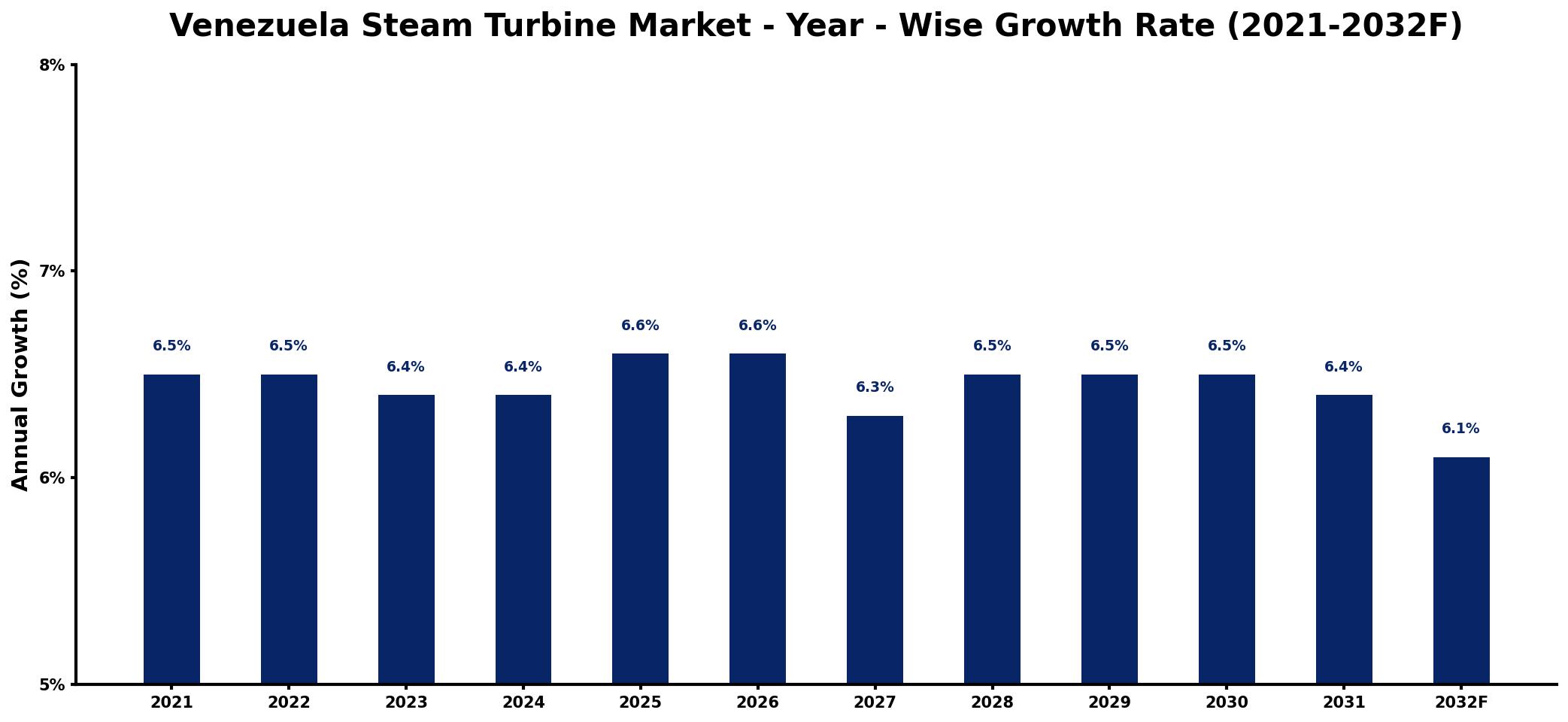
The table below presents the year‑wise growth rates along with the key drivers influencing the market
| Year | Growth Rate | Major Drivers |
| 2021 | 6.5% | Increased energy sector investments |
| 2022 | 6.5% | Growing demand for renewable energy |
| 2023 | 6.4% | Expansion of industrial operations |
| 2024 | 6.4% | Rising electricity consumption rates |
| 2025 | 6.6% | Boost in infrastructure development projects |
| 2026 | 6.6% | Enhanced power generation capacity |
| 2027 | 6.3% | Strengthened maintenance service contracts |
| 2028 | 6.5% | Innovations in energy efficiency |
| 2029 | 6.5% | Increased foreign direct investments |
| 2030 | 6.5% | Growth in manufacturing capabilities |
| 2031 | 6.4% | Higher government energy initiatives |
| 2032 | 6.1% | Strengthened regional energy cooperation |
Note: Market size estimations and growth projections presented in this report are based on 6Wresearch's proprietary forecasting methodology, utilizing the latest available industry data, government publications, and primary research inputs.
Venezuela Steam Turbine Market Synopsis
In recent years, the Venezuela steam turbine market has struggled under the weight of political and economic instability, impacting both investment and infrastructure development. However, a gradual shift towards prioritizing efficient technologies in power generation presents a glimmer of hope for future growth, particularly as the demand for cleaner energy sources rises.
While current conditions appear daunting due to hyperinflation and inadequate maintenance of existing plants, the long-term outlook suggests potential opportunities for investors willing to navigate the challenging landscape. With a pressing need to upgrade and modernize facilities, there may be a renewed focus on reliable steam turbine technologies, especially those integrating renewable energy sources.
Venezuela Steam Turbine Market Key Takeaways
- The market is projected to grow significantly despite economic instability.
- Increasing demand for efficient steam turbines is driven by a push for modernization.
- Political reforms could influence future investments and market dynamics.
- Technological innovation focusing on sustainability is gaining traction.
- Strategic partnerships with local firms may facilitate market entry for new players.
Evaluation of Restraints in Venezuela Steam Turbine Market
The Venezuela steam turbine market is currently encumbered by several real constraints. Chief among these are the ongoing political crises and economic hardships that have severely limited investment opportunities and infrastructure advancements. The lack of skilled labor and inadequate training programs further exacerbate the situation, resulting in outdated systems unable to meet modern energy demands. Additionally, the government's stringent controls over the energy sector create uncertainty, leading to hesitation among potential investors. Overall, these factors contribute to a stagnation that hampers both growth and development prospects for the market.
Venezuela Steam Turbine Market Trends
The Venezuela steam turbine market is experiencing significant trends emphasizing efficiency and sustainability. There's an increased demand for advanced steam turbine technologies that integrate seamlessly with renewable energy sources, reflecting a global movement toward greener solutions. Moreover, digitalization and automation are becoming key focal points, as they promise to enhance operational efficiency and reduce maintenance costs. The market is also seeing a notable interest in combined heat and power (CHP) systems, which leverage waste heat, further amplifying energy efficiency. As stakeholders seek to navigate the complexities of energy production in Venezuela, these trends are essential in shaping future demand.
Venezuela Steam Turbine Market Opportunities
Despite the numerous challenges, the Venezuela steam turbine market presents several genuine growth opportunities. With the urgent need for infrastructure upgrades and the modernization of existing power plants, there is a clear demand for new, efficient steam turbine technologies. Opportunities exist in advanced supply solutions and maintenance services, particularly for firms willing to collaborate with local entities. Furthermore, as Venezuela pivots towards expanding its renewable energy capabilities, there is potential for investment in hybrid power generation systems that utilize steam turbines to complement wind and solar resources.
Government Initiatives in the Venezuela Steam Turbine Market
Government policies impacting the Venezuela steam turbine market have historically been shaped by the country's political landscape and economic challenges. Efforts to prioritize local production and reduce import dependence have been initiated, though the effectiveness of these policies is often undermined by corruption and mismanagement. Moving forward, it is crucial for policymakers to implement reforms that encourage foreign investment and technological transfers, which can ultimately enhance domestic capabilities in the steam turbine sector. Continued emphasis on investment in infrastructure and training will also be necessary for the market to regain momentum.
Future Insights of the Venezuela Steam Turbine Market
Looking ahead from 2026 to 2032, the Venezuela steam turbine market faces a multifaceted landscape characterized by both risk and potential opportunity. If political and economic conditions stabilize, we could witness a significant revival of investments in the energy sector, leading to enhanced demand for modern steam turbines. The transition towards more sustainable energy generation methods, coupled with the modernization of aging infrastructure, will likely drive this market's evolution. However, a careful approach to navigating existing uncertainties will be paramount for any progress to materialize effectively.
Venezuela Steam Turbine Market Latest Developments (2025 - 2026)
Recent developments in the Venezuela steam turbine market reflect a gradual shift towards modern energy solutions, with increased discussions around potential partnerships aimed at upgrading existing power facilities. There have been preliminary efforts to introduce advanced technologies that improve efficiency and reduce environmental impact. Moreover, various stakeholders are exploring digitalization initiatives to enhance operational performance, highlighting a collective move towards a more innovative and sustainable future in the energy landscape.
Venezuela Steam Turbine Market - Key Attractiveness of the Report
- 10 Years of Market Numbers
- Historical Data Starting from 2022 to 2025
- Base Year: 2025
- Forecast Data until 2032
- Key Performance Indicators Impacting the Market
- Major Upcoming Developments and Projects
Key Highlights of the Report:
- Venezuela Steam Turbine Market Outlook
- Market Size of Venezuela Steam Turbine Market, 2025
- Forecast of Venezuela Steam Turbine Market, 2032
- Historical Data and Forecast of Venezuela Steam Turbine Revenues & Volume for the Period 2022-2032F
- Venezuela Steam Turbine Market Trend Evolution
- Venezuela Steam Turbine Market Drivers and Challenges
- Venezuela Steam Turbine Price Trends
- Venezuela Steam Turbine Porter's Five Forces
- Venezuela Steam Turbine Industry Life Cycle
- Historical Data and Forecast of Venezuela Steam Turbine Market Revenues & Volume By Design for the Period 2022-2032F
- Historical Data and Forecast of Venezuela Steam Turbine Market Revenues & Volume By Reaction for the Period 2022-2032F
- Historical Data and Forecast of Venezuela Steam Turbine Market Revenues & Volume By Impulse for the Period 2022-2032F
- Historical Data and Forecast of Venezuela Steam Turbine Market Revenues & Volume By End Use Industry for the Period 2022-2032F
- Historical Data and Forecast of Venezuela Steam Turbine Market Revenues & Volume By Others for the Period 2022-2032F
- Historical Data and Forecast of Venezuela Steam Turbine Market Revenues & Volume By Power Generation for the Period 2022-2032F
- Historical Data and Forecast of Venezuela Steam Turbine Market Revenues & Volume By Petrochemical for the Period 2022-2032F
- Historical Data and Forecast of Venezuela Steam Turbine Market Revenues & Volume By Oil And Gas for the Period 2022-2032F
- Venezuela Steam Turbine Import Export Trade Statistics
- Market Opportunity Assessment By Design
- Market Opportunity Assessment By End Use Industry
- Venezuela Steam Turbine Top Companies Market Share
- Venezuela Steam Turbine Competitive Benchmarking By Technical and Operational Parameters
- Venezuela Steam Turbine Company Profiles
- Venezuela Steam Turbine Key Strategic Recommendations






































