Venezuela Tea Market Size, Share & Growth Rate
The Venezuela Tea Market was estimated at USD 447 Million in 2025 and is projected to reach USD 631 Million by 2032, growing at a CAGR of 5.0% from 2026 to 2032. This growth trajectory is largely driven by an increasing consumer shift towards health and wellness, resulting in heightened demand for herbal and specialty teas. Moreover, the resilience of local tea brands in adapting to market challenges has bolstered consumer trust and preference, further solidifying the market's potential.
Venezuela Tea Market Year-wise Growth Rate and Key Drivers
This graph highlights how the Venezuela Tea Market has steadily grown over the years, supported by major growth factors.
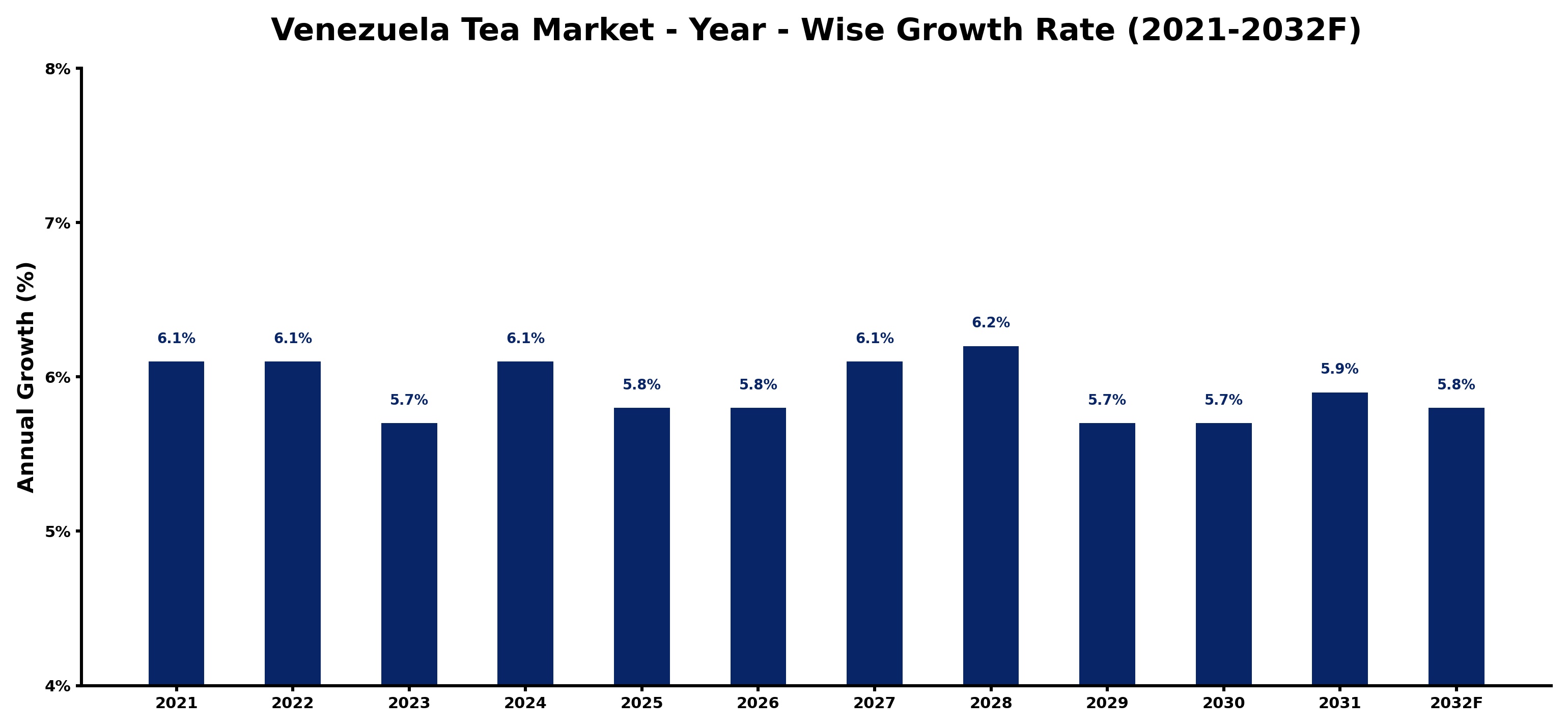
The table below presents the year‑wise growth rates along with the key drivers influencing the market
| Year | Growth Rate | Major Drivers |
| 2021 | 6.1% | Health consciousness drove tea consumption |
| 2022 | 6.1% | Sustainable sourcing gained popularity |
| 2023 | 5.7% | Innovative flavors attracted consumers |
| 2024 | 6.1% | Increased local production capabilities |
| 2025 | 5.8% | Tea culture events promoted awareness |
| 2026 | 5.8% | Online retail channels expanded reach |
| 2027 | 6.1% | Organic tea demand surged upward |
| 2028 | 6.2% | Social media marketing enhanced visibility |
| 2029 | 5.7% | Collaborations with local brands increased |
| 2030 | 5.7% | Export opportunities opened new markets |
| 2031 | 5.9% | Functional teas gained consumer interest |
| 2032 | 5.8% | Diverse packaging options attracted buyers |
Note - Market size estimations and growth projections presented in this report are based on 6Wresearch’s advanced forecasting approach, validated with industry datasets as of June 2026.
Venezuela Tea Market Synopsis
The Venezuela tea market is currently witnessing a robust demand for both traditional and herbal teas, fueled by a growing awareness of health and wellness among consumers. Notably, black tea continues to dominate, yet the popularity of herbal and specialty teas is rapidly increasing as consumers explore options offering perceived health benefits.
Retail channels are evolving, with supermarkets and specialty shops leading the way, while online platforms gain traction among younger consumers. The market shows resilience despite economic challenges, as Venezuelans increasingly seek healthier beverage alternatives.
Venezuela Tea Market Key Takeaways
- The market is shifting towards herbal and specialty teas driven by health-conscious consumers.
- Online sales are on the rise, with an increasing preference for convenience among shoppers.
- Domestic tea production is being prioritized due to government policies aimed at reducing imports.
- Investment opportunities exist in high-quality specialty teas and sustainable production practices.
- Economic instability remains a concern, impacting pricing and accessibility of imported teas.
Evaluation of Restraints in Venezuela Tea Market
The Venezuela Tea Market contends with significant restraints that limit its full potential. Economic instability and persistent inflation lead to fluctuating prices for imported tea products, presenting challenges for both consumers and businesses. The limited access to foreign currency restricts the ability of local companies to import high-quality teas, which affects product offerings. Furthermore, the political climate contributes to consumer uncertainty, impacting overall purchasing power and demand.
Venezuela Tea Market Trends
Emerging trends are reshaping the Venezuela Tea Market, with a notable rise in consumer interest in herbal and specialty teas that offer health benefits such as immune support and detoxification. Younger consumers are driving demand for unique blends and flavors, propelling brands to innovate their product lines. The trend towards online shopping continues to grow, as convenience becomes increasingly important, further shifting traditional retail dynamics.
Venezuela Tea Market Opportunities
There are significant growth opportunities within the Venezuela Tea Market, particularly in the specialty and gourmet tea segments. As health-conscious consumers seek higher-quality products, brands that can deliver unique and beneficial blends stand to gain. Additionally, the expansion of e-commerce platforms presents a lucrative avenue for reaching a broader customer base. Sustainable and organic tea production practices are also gaining traction, appealing to a growing demographic of environmentally aware consumers.
Government Initiatives in the Venezuela Tea Market
The Venezuelan government has enacted policies focused on promoting local tea production while discouraging imports. This includes import restrictions and tariffs on foreign tea products to foster domestic industry growth. Additionally, subsidies for local producers are intended to support self-sufficiency, while price controls on tea products aim to enhance affordability for consumers. These measures reflect the government's commitment to strengthening the local economy amid ongoing challenges.
Future Insights of the Venezuela Tea Market
The outlook for the Venezuela Tea Market from 2026 to 2032 presents a mix of challenges and opportunities. While ongoing economic and political instability poses risks, there is a clear trend towards healthier beverage choices, which could stimulate market growth. Companies that can adapt to this evolving landscape and align their offerings with consumer preferences are well-positioned for success. Collaboration with local producers and innovation in product development will be critical for navigating the future of this dynamic market.
Venezuela Tea Market Latest Developments (May 2025 - June 2026)
Recent developments in the Venezuela Tea Market indicate a continued focus on local production, with an increasing number of players entering the herbal tea segment. Innovations in flavors and blends are emerging as brands seek to appeal to health-conscious consumers. The rise of e-commerce has prompted traditional retailers to enhance their online presence, ensuring they remain competitive in a rapidly changing market landscape.
Venezuela Tea Market - Key Attractiveness of the Report
- 10 Years of Market Numbers
- Historical Data Starting from 2022 to 2025
- Base Year: 2025
- Forecast Data until 2032
- Key Performance Indicators Impacting the Market
- Major Upcoming Developments and Projects
Key Highlights of the Report:
- Venezuela Tea Market Outlook
- Market Size of Venezuela Tea Market, 2025
- Forecast of Venezuela Tea Market, 2032
- Historical Data and Forecast of Venezuela Tea Revenues & Volume for the Period 2022-2032F
- Venezuela Tea Market Trend Evolution
- Venezuela Tea Market Drivers and Challenges
- Venezuela Tea Price Trends
- Venezuela Tea Porter's Five Forces
- Venezuela Tea Industry Life Cycle
- Historical Data and Forecast of Venezuela Tea Market Revenues & Volume By Type for the Period 2022-2032F
- Historical Data and Forecast of Venezuela Tea Market Revenues & Volume By Green Tea for the Period 2022-2032F
- Historical Data and Forecast of Venezuela Tea Market Revenues & Volume By Black Tea for the Period 2022-2032F
- Historical Data and Forecast of Venezuela Tea Market Revenues & Volume By Oolong Tea for the Period 2022-2032F
- Historical Data and Forecast of Venezuela Tea Market Revenues & Volume By Fruit/Herbal Tea for the Period 2022-2032F
- Historical Data and Forecast of Venezuela Tea Market Revenues & Volume By Others for the Period 2022-2032F
- Historical Data and Forecast of Venezuela Tea Market Revenues & Volume By Packaging for the Period 2022-2032F
- Historical Data and Forecast of Venezuela Tea Market Revenues & Volume By Plastic Containers for the Period 2022-2032F
- Historical Data and Forecast of Venezuela Tea Market Revenues & Volume By Loose Tea for the Period 2022-2032F
- Historical Data and Forecast of Venezuela Tea Market Revenues & Volume By Paperboards for the Period 2022-2032F
- Historical Data and Forecast of Venezuela Tea Market Revenues & Volume By Aluminum Tins for the Period 2022-2032F
- Historical Data and Forecast of Venezuela Tea Market Revenues & Volume By Tea Bags for the Period 2022-2032F
- Historical Data and Forecast of Venezuela Tea Market Revenues & Volume By Distribution Channel for the Period 2022-2032F
- Historical Data and Forecast of Venezuela Tea Market Revenues & Volume By Supermarkets/Hypermarkets for the Period 2022-2032F
- Historical Data and Forecast of Venezuela Tea Market Revenues & Volume By Specialty Stores for the Period 2022-2032F
- Historical Data and Forecast of Venezuela Tea Market Revenues & Volume By Convenience Stores for the Period 2022-2032F
- Historical Data and Forecast of Venezuela Tea Market Revenues & Volume By Online Stores for the Period 2022-2032F
- Historical Data and Forecast of Venezuela Tea Market Revenues & Volume By Others for the Period 2022-2032F
- Historical Data and Forecast of Venezuela Tea Market Revenues & Volume By Application for the Period 2022-2032F
- Historical Data and Forecast of Venezuela Tea Market Revenues & Volume By Residential for the Period 2022-2032F
- Historical Data and Forecast of Venezuela Tea Market Revenues & Volume By Commercial for the Period 2022-2032F
- Venezuela Tea Import Export Trade Statistics
- Market Opportunity Assessment By Type
- Market Opportunity Assessment By Packaging
- Market Opportunity Assessment By Distribution Channel
- Market Opportunity Assessment By Application
- Venezuela Tea Top Companies Market Share
- Venezuela Tea Competitive Benchmarking By Technical and Operational Parameters
- Venezuela Tea Company Profiles
- Venezuela Tea Key Strategic Recommendations






































