Venezuela Vetiver Oil Market Size, Share & Growth Rate
The Venezuela Vetiver Oil Market was estimated at USD 835 Million in 2025 and is projected to reach USD 1192 Million by 2032, growing at a CAGR of 5.2% from 2026 to 2032. This growth is primarily driven by increasing global demand for natural and organic personal care products, with consumers gravitating towards eco-friendly alternatives. Moreover, as the fragrance and aromatherapy sectors expand, the appreciation for vetiver oil's unique scent and therapeutic properties further propels market growth.
Venezuela Vetiver Oil Market Year-wise Growth Rate and Key Drivers
This graph highlights how the Venezuela Vetiver Oil Market has steadily grown over the years, supported by major growth factors.
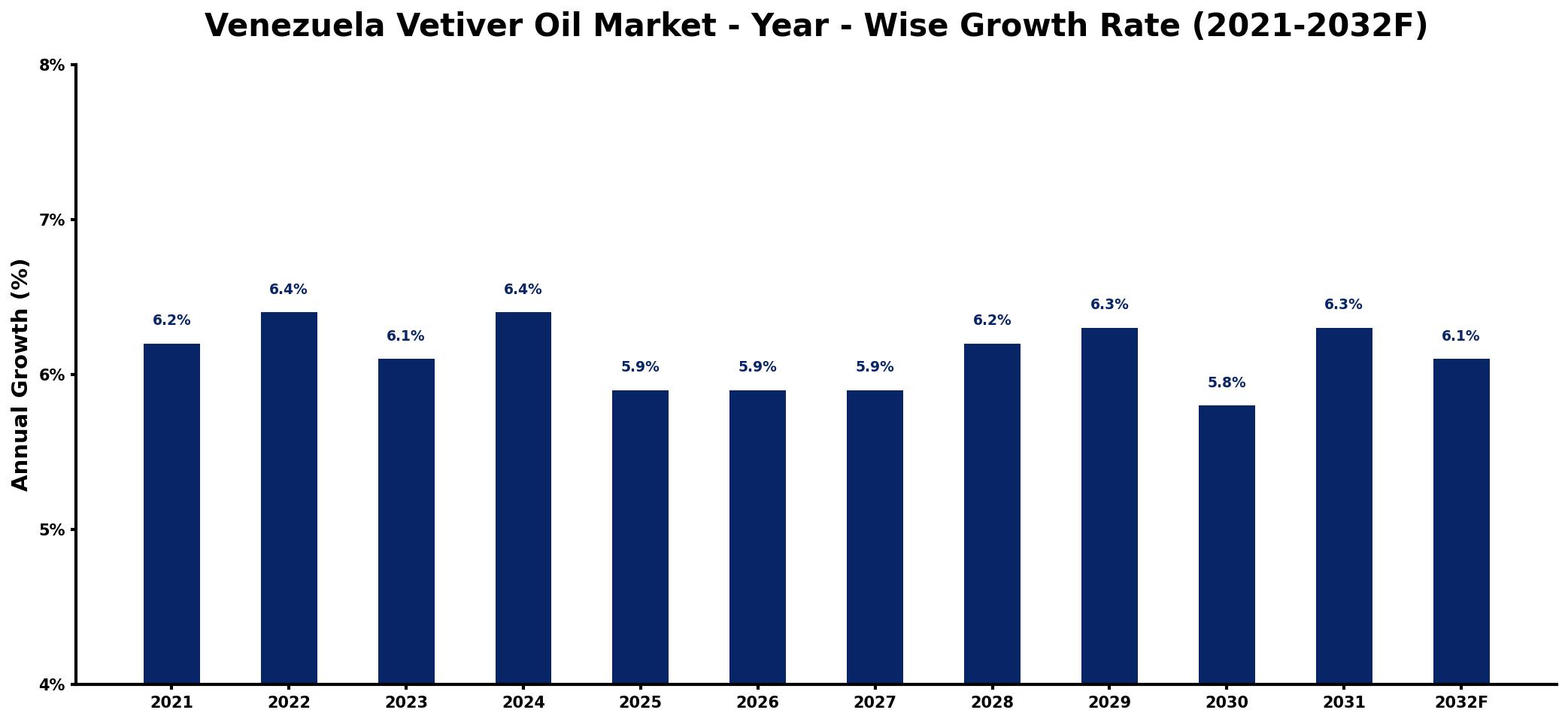
The table below presents the year‑wise growth rates along with the key drivers influencing the market
| Year | Growth Rate | Major Drivers |
| 2021 | 6.2% | Rising demand for natural fragrances |
| 2022 | 6.4% | Growth in organic skincare products |
| 2023 | 6.1% | Expansion of wellness industry offerings |
| 2024 | 6.4% | Increased interest in aromatherapy products |
| 2025 | 5.9% | Higher investments in sustainable sourcing |
| 2026 | 5.9% | Boost in cosmetic formulation innovations |
| 2027 | 5.9% | Growing popularity of holistic health |
| 2028 | 6.2% | Surge in eco-friendly packaging solutions |
| 2029 | 6.3% | Increased application in perfumery sector |
| 2030 | 5.8% | Shift towards natural ingredient sourcing |
| 2031 | 6.3% | increased overall sector activity |
| 2032 | 6.1% | Rising consumer awareness on sustainability |
Note: Market size estimations and growth projections presented in this report are based on 6Wresearch's proprietary forecasting methodology, utilizing the latest available industry data, government publications, and primary research inputs.
Venezuela Vetiver Oil Market Synopsis
Currently, the Venezuela Vetiver Oil market stands as a specialized niche, distinctively characterized by its limited production yet significant potential. Despite facing challenges due to the economic landscape, the unique climatic conditions of Venezuela favor the cultivation of the Vetiveria zizanioides plant, positioning the country as a valuable contributor to the essential oils sector.
The growing inclination of consumers towards sustainable and organic products has catalyzed a shift in the beauty and personal care industries, where vetiver oil is increasingly favored for its grounding aroma and diverse applications. As a result, stakeholders in this niche market are presented with various opportunities to enhance production and broaden their market reach.
Venezuela Vetiver Oil Market Key Takeaways
- The Venezuela Vetiver Oil market is projected for significant growth, driven by rising global demand for natural products.
- Despite its small size, the market's potential is bolstered by the therapeutic benefits and applications of vetiver oil in aromatherapy.
- Political and economic factors pose challenges, but sustainable practices can strengthen market resilience.
- Strategic investments in cultivation and processing can lead to enhanced productivity and quality.
- The government's support through policies and incentives is crucial for market expansion and international competitiveness.
Evaluation of Restraints in Venezuela Vetiver Oil Market
The Venezuela Vetiver Oil market faces considerable restraints stemming from the political and economic instability within the country. This instability has led to erratic currency fluctuations and significant challenges in conducting business operations. Furthermore, the lack of modern agricultural infrastructure inhibits the production capabilities of local farmers, making it difficult to meet both domestic and international demand. Limited access to technology and efficient farming practices continues to hinder the potential productivity of vetiver cultivation, compounding these challenges and impacting the quality of output.
Venezuela Vetiver Oil Market Trends
Currently, there is a discernible trend towards natural and organic products, with consumers increasingly favoring vetiver oil for its eco-friendly attributes. The fragrance industry is witnessing a surge in the use of vetiver oil, as perfumers and manufacturers incorporate its rich, earthy aroma into their compositions. Additionally, the therapeutic properties associated with vetiver oil, especially its calming effects, are fueling demand in the wellness and aromatherapy sectors. As clean beauty trends gain momentum, stakeholders are positioned to leverage these consumer preferences to promote Venezuelan vetiver oil as a premium ingredient.
Venezuela Vetiver Oil Market Opportunities
The Venezuelan climate presents a significant opportunity for investment in vetiver oil production, particularly as global interest in natural essential oils rises. Investors can explore partnerships with local farmers to enhance cultivation practices and increase yield. Moreover, there is ample room for the development of modern extraction technologies that would improve the efficiency and quality of production. Focusing on sustainability and adhering to international quality standards will not only attract eco-conscious consumers but also potentially open up new export markets for Venezuelan vetiver oil.
Government Initiatives in the Venezuela Vetiver Oil Market
Government policies in Venezuela are geared towards bolstering the vetiver oil industry. Initiatives include providing subsidies to local farmers to incentivize vetiver cultivation and improve production practices. The government is also focused on enforcing quality regulations to ensure that the vetiver oil produced meets international standards, enhancing its competitiveness on a global scale. Additionally, trade agreements aimed at facilitating export opportunities are being explored to expand market access for Venezuelan products.
Future Insights of the Venezuela Vetiver Oil Market
Looking ahead to the period from 2026 to 2032, the Venezuela Vetiver Oil market is set to navigate both opportunities and challenges. The increasing global inclination towards natural and organic products serves as a catalyst for growth, yet the political and economic environment may pose obstacles to production consistency and export capabilities. Stakeholders must be strategic in addressing these challenges while capitalizing on the expanding fragrance and wellness markets, thus positioning themselves to take advantage of the emerging demand for vetiver oil both domestically and internationally.
Venezuela Vetiver Oil Market Latest Developments (2025 - 2026)
Recent developments in the Venezuela Vetiver Oil market indicate a strengthening focus on sustainable practices among local producers. There has been a notable shift towards adopting modern agricultural methods and improving production quality. Additionally, increased collaboration between local farmers and international partners is emerging, aimed at enhancing market access and expanding distribution channels. These trends signal a proactive approach to overcoming market challenges and aligning with global consumer preferences.
Venezuela Vetiver Oil Market - Key Attractiveness of the Report
- 10 Years of Market Numbers
- Historical Data Starting from 2022 to 2025
- Base Year: 2025
- Forecast Data until 2032
- Key Performance Indicators Impacting the Market
- Major Upcoming Developments and Projects
Key Highlights of the Report:
- Venezuela Vetiver Oil Market Outlook
- Market Size of Venezuela Vetiver Oil Market, 2025
- Forecast of Venezuela Vetiver Oil Market, 2032
- Historical Data and Forecast of Venezuela Vetiver Oil Revenues & Volume for the Period 2022-2032F
- Venezuela Vetiver Oil Market Trend Evolution
- Venezuela Vetiver Oil Market Drivers and Challenges
- Venezuela Vetiver Oil Price Trends
- Venezuela Vetiver Oil Porter's Five Forces
- Venezuela Vetiver Oil Industry Life Cycle
- Historical Data and Forecast of Venezuela Vetiver Oil Market Revenues & Volume By Application for the Period 2022-2032F
- Historical Data and Forecast of Venezuela Vetiver Oil Market Revenues & Volume By Medical for the Period 2022-2032F
- Historical Data and Forecast of Venezuela Vetiver Oil Market Revenues & Volume By Food & Beverage for the Period 2022-2032F
- Historical Data and Forecast of Venezuela Vetiver Oil Market Revenues & Volume By Spa & Relaxation for the Period 2022-2032F
- Venezuela Vetiver Oil Import Export Trade Statistics
- Market Opportunity Assessment By Application
- Venezuela Vetiver Oil Top Companies Market Share
- Venezuela Vetiver Oil Competitive Benchmarking By Technical and Operational Parameters
- Venezuela Vetiver Oil Company Profiles
- Venezuela Vetiver Oil Key Strategic Recommendations






































