Vietnam 5G Radio Access Network Market Growth Rate
According to 6Wresearch internal databases and industry insights, the Vietnam 5G Radio Access Network (RAN) Market is projected to grow at a steady compound annual growth rate (CAGR) of 24.81% during the forecast period 2026–2032.
Vietnam 5G Radio Access Network Market Year-wise Growth Rate and Key Drivers
This graph illustrates the annual growth trend of the Vietnam 5G Radio Access Network Market from 2021 to 2032 , highlighting a steady upward trajectory and projected market expansion over the forecast period.
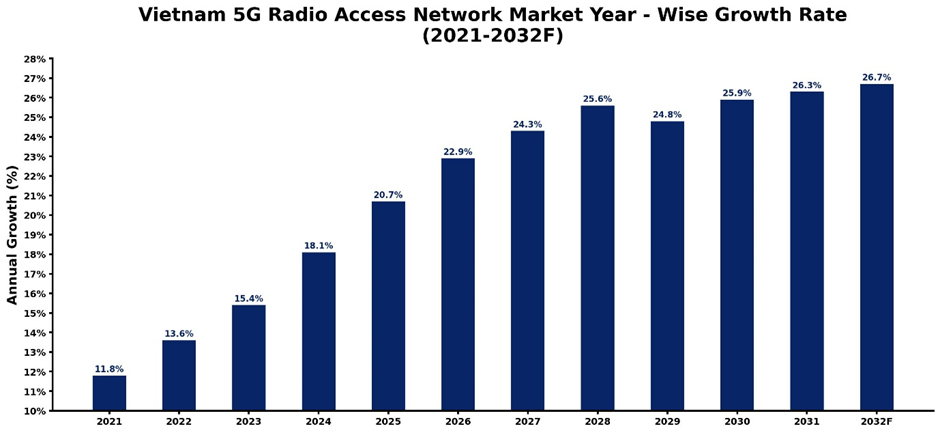
The table below summarizes the historical and forecasted growth rates along with concise, industry-aligned market drivers.
| Year | Estimated Growth (%) | Market Rationale |
| 2021 | 11.8% | Pilot deployments and some NSA implementations in big cities. |
| 2022 | 13.6% | Development of pilot networks and initial infrastructure readiness program. |
| 2023 | 15.4% | More extensive industrial trials and mid band spectrum activities. |
| 2024 | 18.1% | The beginning of commercial roll-out via Massive MIMO and sub 6 GHz. |
| 2025 | 20.7% | Sudden expansion of 5G urban coverage and increase of base stations. |
| 2026 | 22.9% | The densification and early use of cloud RAN. |
| 2027 | 24.3% | Shift to SA 5G and introduction of Open RAN technology. |
| 2028 | 25.6% | More extensive use of Open RAN and virtualization for smart infrastructure. |
| 2029 | 24.8% | The market will stabilize with the focus on improvements. |
| 2030 | 25.9% | Broadening of rural coverage using low band spectrum and cost-effective RAN. |
| 2031 | 26.3% | Optimization and further development to 5G-Advanced and AI. |
| 2032 | 26.7% | Mature cloud-native RAN ecosystem with full SA deployment. |
Topics Covered in the Vietnam 5G Radio Access Network Market Report
The Vietnam 5G Radio Access Network Industry report covers the market by RAN type, frequency, and deployment type. The report provides a detailed analysis of ongoing market trends, opportunities/high-growth areas, and market drivers that will help stakeholders align strategies based on current and future market dynamics.
Vietnam 5G Radio Access Network Market Highlights
| Report Name | Vietnam 5G Radio Access Network Market |
| Forecast period | 2026-2032 |
| CAGR | 24.81% |
| Growing Sector | Open RAN and Cloud-based Architectures |
Vietnam 5G Radio Access Network Market Synopsis
The Vietnam 5G Radio Access Network (RAN) Market represents the crucial underlying hardware and software architecture which links up users’ equipment, such as mobile phones, industrial Internet-of-things modules, and self-driving cars, to the core telecommunication network. This product line includes remote radio units (RRUs), baseband units (BBUs), active antenna units (AAUs), disaggregated distributed units (DUs), and centralized units (CUs). These systems handle complex radio frequencies, execute massive MIMO (Multiple-Input Multiple-Output) beamforming calculations, and manage the localized cellular traffic distribution.
Evaluation of Growth Drivers in Vietnam 5G Radio Access Network Market (2026–2032)
Below are some major drivers and their influence on the market dynamics:
| Drivers | Primary Segment Affected | Why It Matters (Evidence) |
| Rapid Urban Traffic Densification | Centralized RAN | Massive data traffic growth requires centralizing baseband processing to maximize spectral efficiency and lower power consumption. |
| Industrial Smart Factory Automation | On-Premise Deployment | High-precision automated robotics and real-time manufacturing assets require local, low-latency cell infrastructure to avoid processing delays. |
| Multi-Vendor Cost Optimization | Open RAN | Telecom operators are migrating away from single-vendor proprietary hardware to disaggregated architectures to slash deployment costs. |
| Fixed Wireless Access (FWA) Demand | Sub-6 GHz Frequency | Broadening residential and enterprise broadband access across rural corridors drives massive deployment of mid-band radio cells. |
| Ultra-Low Latency App Delivery | Virtualized RAN | Cloud-native baseband processing software enables operator networks to scale dynamically based on real-time enterprise workloads. |
Vietnam 5G Radio Access Network Market is projected to grow at an impressive CAGR of 24.81% during 2026–2032, supported by aggressive network modernization programs, expansion of Open RAN ecosystems, and increasing deployment of cloud-native RAN solutions that enable flexible, scalable, and cost-efficient telecom infrastructure across both urban and industrial regions. The government-backed digital transformation initiatives and the telecom policy reforms are also accelerating the pace of the 5G rollouts across the country especially in the key economic zones and the export-driven industrial clusters. In conjunction with the rising investments from the global telecom vendors and the infrastructure providers, the Vietnam 5G radio access network market growth is expected to proliferate throughout the forecast period.
Evaluation of Restraints in Vietnam 5G Radio Access Network Market
Below are some major restraints and their influence on the market dynamics:
| Restraints | Primary Segment Affected | What This Means (Evidence) |
| High Capital Expenditure Burdens | Centralized RAN | Setting up dense macro cell structures and purchasing proprietary active antenna equipment limits rapid network expansion. |
| Severe High Frequency Attenuation | mmWave Frequency | Higher frequency bands face massive structural signal loss when encountering heavy concrete structures, requiring costly cell densification. |
| Interoperability Testing Hurdles | Open RAN | Mixing and matching hardware and software components from different vendors often causes software integration delays during setup. |
| Legacy Site Retrofitting Costs | On-Premise Deployment | Upgrading old 3G/4G tower cell sites to host heavy 5G massive MIMO active antennas requires substantial structural reinforcement. |
| Telecom Engineer Deficits | Cloud-based Deployment | A noticeable shortage of local software-defined networking experts delays cloud-native network configurations. |
Vietnam 5G Radio Access Network Market Challenges
Some of the challenges affecting the market growth includes the high infrastructure deployment costs, interoperability challenges among the multi-vendor Open RAN technologies, and reliance on the imported telecommunication hardware components. Besides, the lack of the skilled engineers in RF engineering and network virtualization limits the progress towards cloud-native RAN systems. It is also not economically feasible to roll out rural coverage as the return on investment is minimal in these low-density areas. Moreover, the process of upgrading the old tower stations in order to accommodate the heavy and power massive MIMO antennas will be expensive.
Vietnam 5G Radio Access Network Market Trends
Main trends driving the dynamics of Vietnam 5G Radio Access Network Market:
- Growing Emergence of AI-Driven SON: Carriers are rapidly implementing machine learning systems within the RAN layer. It allows for real-time predictive beamforming, automatic traffic load balancing, and power saving, reducing the amount of power consumed by cells by 20%.
- Rise of "Made in Vietnam" 5G Hardware: Industrial conglomerates from Vietnam have already created their own 5G gNodeB base stations and software cores. These developments in internal technology make the country less dependent on external sources of hardware and improve its security.
- Maturity of Commercial 5G SA Network Slicing: Telecom companies are using dedicated standalone RAN hardware to slice cellular capabilities into virtual sub-networks. Thus, telecom companies can provide guaranteed latency requirements and data speed for their enterprise customers.
Investment Opportunities in the Vietnam 5G Radio Access Network Market
Some lucrative investment opportunities in the Vietnam 5G Radio Access Network Industry includes:
- Small Cells Densification Solutions Development: There is a lot of opportunity to develop and install small cells infrastructure in dense urban areas and commercial office buildings to close gaps in connectivity provided by macrocell towers.
- Local Manufacturing of Open RAN Software: Local manufacturing of open RAN software, such as Radio Intelligent Controllers (RIC) architecture that is cloud native, provides high-profit opportunities as local operators will switch to disintegrated architecture.
- Fiber-to-the-Tower (FTTT) Backhaul Infrastructure Development: With the development of thousands of 5G RAN nodes, it is necessary to invest in developing high-capacity fiber backhaul infrastructure to transport large amounts of data from towers to central points of processing.
Top 5 Leading Players in Vietnam 5G Radio Access Network Market
Below is a comprehensive list of major companies contributing to the growth of Vietnam 5G Radio Access Network Market:
1. Viettel High Technology Industries (Viettel High Tech)
| Company Name | Viettel High Technology Industries (Viettel High Tech) |
|---|---|
| Established Year | 2011 |
| Headquarters | Hanoi, Vietnam |
| Official Website | Click Here |
Viettel High Tech is the foundational R&D arm of Viettel Group. The company stands out in the market by developing and manufacturing proprietary "Make in Vietnam" 5G RAN equipment.
2. Ericsson Vietnam
| Company Name | Ericsson Vietnam |
|---|---|
| Established Year | 1876 (Local operations since 1993) |
| Headquarters | Stockholm, Sweden (Local branch in Hanoi) |
| Official Website | Click Here |
Ericsson provides premium radio units, massive MIMO active antennas, and advanced cloud RAN configurations, playing a key role in the rapid expansion of nationwide standalone 5G coverage.
3. Nokia Vietnam
| Company Name | Nokia Vietnam |
|---|---|
| Established Year | 1865 (Local operations active for decades) |
| Headquarters | Espoo, Finland (Local branch in Ho Chi Minh City) |
| Official Website | Click Here |
The company focuses heavily on expanding network infrastructure across key economic zones, offering high-capacity mid-band radio cells and flexible virtualized baseband systems.
4. Huawei Vietnam
| Company Name | Huawei Vietnam |
|---|---|
| Established Year | 1987 (Local operations since 1998) |
| Headquarters | Shenzhen, China (Local branch in Hanoi) |
| Official Website | Click Here |
The firm provides high-performance hardware configurations that help domestic transport networks manage growing mobile data volumes.
5. VNPT Technology
| Company Name | VNPT Technology |
|---|---|
| Established Year | 2011 |
| Headquarters | Hanoi, Vietnam |
| Official Website | Click Here |
The firm focuses on developing specialized broadband communication devices, IoT gateways, and localized small cell solutions tailored for integration within municipal networks and smart urban zones.
Government Initiatives Being Implemented in the Vietnam 5G Radio Access Network Market
Some of the current government-led initiatives adopted in the Vietnam 5G RAN market include:
5G National Deployment Project (2025-2030): An initiative that aims at fast-tracking RAN deployment nationally, with a view to making 5G more accessible without having to heavily rely on LTE networks.
Deployment of Smart Cities RAN: This is about installing small cell network infrastructure for traffic management and surveillance in cities like Hanoi and Ho Chi Minh City.
Open RAN Pilot Programs: These are government-sponsored projects, involving telecoms, in order to develop an open vendor-neutral RAN ecosystem.
Industry Parks 5G RAN Installations: Installing 5G RAN network infrastructure in industrial parks to enhance Industry 4.0.
Future Insights of the Vietnam 5G Radio Access Network Market
Vietnam 5G Radio Access Network Industry will experience deeper transition from the current state of proprietary and vendor-centric hardware infrastructure to flexible and software-driven Open RAN systems. By 2032, disaggregated multi-vendor hardware solutions will be the norm in regional industrial clusters, reducing hardware expenses and making it easy for local companies to add custom software modules. Under the continued government subsidies and rapid development of the local high technology industry, the 5G RAN market will create a robust network for the future digital economy of Vietnam.
Market Segmentation Analysis
The report offers a comprehensive study of the following market segments and their leading categories:
By RAN Type - Centralized RAN Dominates, Open RAN Set for Rapid Expansion
According to Bhawna Singh, Assistant Manager, 6Wresearch, Centratralized RAN (C-RAN) solutions secured a dominant 58.40% share of the Vietnam 5G RAN market value in 2025. This dominant position is driven by telecom operators prioritizing large-scale deployments that centralize baseband processing units to cut energy consumption, improve spectrum reuse, and simplify maintenance across dense cities.
Conversely, Open RAN (O-RAN) solutions are projected to advance at a stellar CAGR of 27.65% during 2026–2032. This rapid growth is fueled by increasing operator demands for flexible multi-vendor hardware options and the active development of open-source radio components under domestic technology initiatives.
By Deployment Type - On-Premise Type Dominates the Market Value
By deployment type, on-premise hardware deployments accounted for 54.60% of the market share in 2025. Telecom operators and large state enterprises favor physical on-premise base stations and local server architectures to guarantee absolute network reliability, maximum security, and direct control over critical communications.
On the other hand, cloud-based RAN deployments are expected to register an impressive CAGR of 26.89% over the forecast period, appealing to operators looking to scale capacity dynamically through cloud-native software rather than deploying expensive physical hardware.
Note: Market size estimations and growth projections presented in this report are based on 6Wresearch’s advanced forecasting approach, validated with industry datasets as of June 2026.
Key Attractiveness of the Report:
- 10 Years of Market Numbers
- Historical Data Starting from 2022 to 2025
- Base Year: 2025
- Forecast Data until 2032
- Key Performance Indicators Impacting the Market
- Major Upcoming Developments and Projects
Key Highlights of the Report:
- Vietnam 5G Radio Access Network Market Outlook
- Market Size of Vietnam 5G Radio Access Network Market, 2025
- Forecast of Vietnam 5G Radio Access Network Market, 2032
- Historical Data and Forecast of Vietnam 5G Radio Access Network Revenues & Volume for the Period 2022-2032
- Vietnam 5G Radio Access Network Market Trend Evolution
- Vietnam 5G Radio Access Network Market Drivers and Challenges
- Vietnam 5G Radio Access Network Price Trends
- Vietnam 5G Radio Access Network Porter's Five Forces
- Vietnam 5G Radio Access Network Industry Life Cycle
- Historical Data and Forecast of Vietnam 5G Radio Access Network Market Revenues & Volume By RAN Type for the Period 2022-2032
- Historical Data and Forecast of Vietnam 5G Radio Access Network Market Revenues & Volume By Centralized RAN for the Period 2022-2032
- Historical Data and Forecast of Vietnam 5G Radio Access Network Market Revenues & Volume By Open RAN for the Period 2022-2032
- Historical Data and Forecast of Vietnam 5G Radio Access Network Market Revenues & Volume By Virtualized RAN for the Period 2022-2032
- Historical Data and Forecast of Vietnam 5G Radio Access Network Market Revenues & Volume By Distributed RAN for the Period 2022-2032
- Historical Data and Forecast of Vietnam 5G Radio Access Network Market Revenues & Volume By Frequency for the Period 2022-2032
- Historical Data and Forecast of Vietnam 5G Radio Access Network Market Revenues & Volume By Sub-6 GHz for the Period 2022-2032
- Historical Data and Forecast of Vietnam 5G Radio Access Network Market Revenues & Volume By mmWave for the Period 2022-2032
- Historical Data and Forecast of Vietnam 5G Radio Access Network Market Revenues & Volume By 26-39 GHz for the Period 2022-2032
- Historical Data and Forecast of Vietnam 5G Radio Access Network Market Revenues & Volume By Above 39 GHz for the Period 2022-2032
- Historical Data and Forecast of Vietnam 5G Radio Access Network Market Revenues & Volume By Deployment Type for the Period 2022-2032
- Historical Data and Forecast of Vietnam 5G Radio Access Network Market Revenues & Volume By Cloud-based for the Period 2022-2032
- Historical Data and Forecast of Vietnam 5G Radio Access Network Market Revenues & Volume By Hybrid for the Period 2022-2032
- Historical Data and Forecast of Vietnam 5G Radio Access Network Market Revenues & Volume By Software-defined for the Period 2022-2032
- Historical Data and Forecast of Vietnam 5G Radio Access Network Market Revenues & Volume By On-Premise for the Period 2022-2032
- Vietnam 5G Radio Access Network Import Export Trade Statistics
- Market Opportunity Assessment By RAN Type
- Market Opportunity Assessment By Frequency
- Market Opportunity Assessment By Deployment Type
- Vietnam 5G Radio Access Network Top Companies Market Share
- Vietnam 5G Radio Access Network Competitive Benchmarking By Technical and Operational Parameters
- Vietnam 5G Radio Access Network Company Profiles
- Vietnam 5G Radio Access Network Key Strategic Recommendations
Market Covered
The report offers an extensive study of the following market segments:
By RAN Type
- Centralized RAN
- Open RAN
- Virtualized RAN
- Distributed RAN
By Frequency
- Sub-6 GHz
- mmWave
- 26-39 GHz
- Above 39 GHz
By Deployment Type
- Cloud-based
- Hybrid
- Software-defined
- On-Premise






































