Vietnam Ablation Device Market (2026-2032) | Outlook, Competitive, Industry, Demand, Revenue, Trends, Growth, Investment Trends, Challenges, Companies, Value, Competition, Segments, Share, Strategic Insights, Strategy, Supply, Restraints, Pricing Analysis, Opportunities, Drivers, Consumer Insights, Forecast, Size, Segmentation, Analysis
Market Forecast By Device Type (Radiofrequency Ablation Devices, Laser Ablation Devices, Cryoablation Devices, Microwave Ablation Devices), By Treatment Type (Cardiac Ablation, Tumor Removal, Tissue Ablation, Minimally Invasive), By End User (Hospitals/Clinics, Oncology Centers, Medical Centers, Specialty Clinics) And Competitive Landscape
| Product Code: ETC11700980 | Publication Date: Apr 2025 | Updated Date: May 2026 | Product Type: Market Research Report | |
| Publisher: 6Wresearch | Author: Bhawna Singh | No. of Pages: 65 | No. of Figures: 34 | No. of Tables: 19 |
Vietnam Ablation Device Market Growth Rate
According to 6Wresearch internal database and industry insights, the Vietnam Ablation Device Market is estimated to grow at a compound annual growth rate (CAGR) of 8.9% during the forecast period (2026-2032).
Vietnam Ablation Device Market Year-wise Growth Rate and Key Drivers
This graph highlights how the Vietnam Ablation Device Market has steadily grown over the past five years, supported by major growth factors.
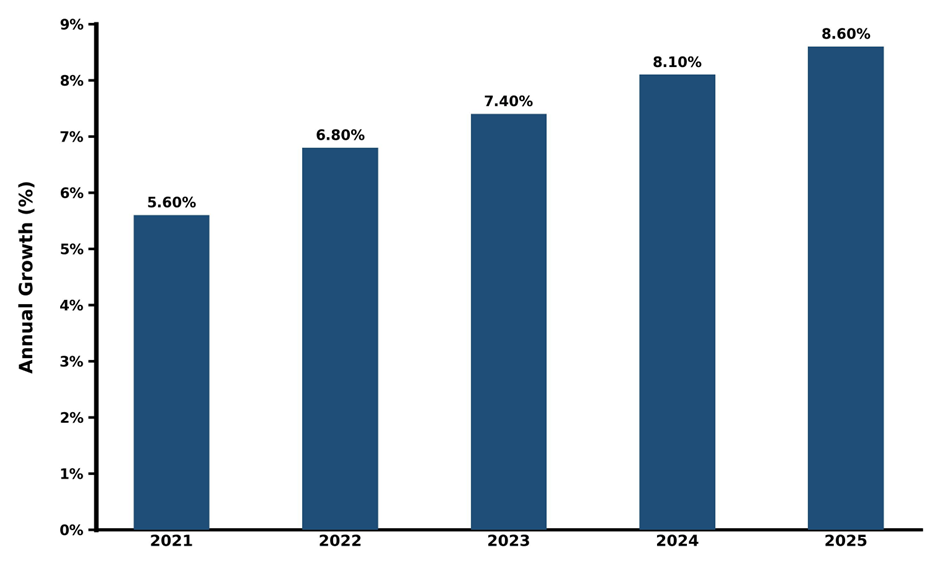
The table below presents the year‑wise growth rates along with the key drivers influencing the market
| Year | Est. Annual Growth (%) | Growth Drivers |
| 2021 | 5.6% | Early use of ablation technology and incremental upgrading of tertiary hospitals. |
| 2022 | 6.8% | High awareness about minimally invasive procedures and better insurance coverages. |
| 2023 | 7.4% | Growth of private health care segment and higher incidence of chronic diseases. |
| 2024 | 8.1% | Growth in cardiac and oncology procedures and improved hospital equipment procurement. |
| 2025 | 8.6% | Surge in hospital investments and increasing adoption of advanced ablation systems. |
Topics Covered in the Vietnam Ablation Device Market Report
Vietnam Ablation Device Market report covers the market Device Type, Treatment Type, and End User. This report provides an unbiased and detailed analysis of ongoing market trends, opportunities, and drivers, which help stakeholders devise and align their strategies according to the current and future market dynamics.
Vietnam Ablation Device Market Highlights
| Report Name | Vietnam Ablation Device Market |
| Forecast period | 2026-2032 |
| CAGR | 8.9% |
| Growing Sector | Healthcare |
Vietnam Ablation Device Market Overview
Vietnam Ablation Device Market is projected to grow at remarkable rate due to surging demand for minimally invasive treatment procedures across cardiology, oncology, and pain management applications. Hospitals and specialty clinics are increasingly shifting from conventional surgery to ablation-based therapies due to reduced recovery time and improved clinical outcomes. In addition to this, an increasing occurrence of various health complications like atrial fibrillation, liver cancer, lung cancer, and thyroid disease is playing a crucial role in promoting the use of ablation devices throughout Vietnam.
Evaluation of Growth Drivers in Vietnam Ablation Device Market (2026–2032)
Below are some major drivers and their influence on the market dynamics:
| Drivers | Primary Segment Affected | Why It Matters (Evidence) |
| Rising Chronic Diseases | Cardiac & Oncology Ablation | Increasing incidence of cancer and heart disorders is driving procedural demand. |
| Shift Toward Minimally Invasive Procedures | Hospitals & Specialty Clinics | Patients prefer faster recovery and lower surgical risks. |
| Healthcare Infrastructure Development | Medical Centers | Expansion of modern hospitals increases device adoption. |
| Technological Advancements | RF, Cryo, Microwave Devices | Improved precision and safety of ablation technologies. |
| Growing Medical Tourism | Oncology & Cardiac Treatment | Vietnam is emerging as a cost-effective treatment destination. |
Vietnam Ablation Devices Market will witness a healthy growth rate of 8.9% during the forecast period (2026-2032), owing to steady advancements within the healthcare sector coupled with increased volumes of procedures within various medical specialties. The market will witness further growth due to increasing adoption of next-generation energy-based ablation devices, especially in tertiary care hospitals located in cities like Ho Chi Minh City, Hanoi, and Da Nang. The growing trend towards minimal invasiveness within interventional procedures is proving to be highly beneficial for patients, helping them recover faster, and avoiding post-operative complications.
Evaluation of Restraints in Vietnam Ablation Device Market
Below are some major restraints and their influence on the market dynamics:
| Restraints | Primary Segment Affected | What This Means (Evidence) |
| High Device Costs | Hospitals & Clinics | Advanced ablation systems require significant capital investment. |
| Limited Skilled Professionals | Treatment Execution | The lack of electrophysiologists and oncologists is an obstacle. |
| Regulatory Approval Delays | Device Imports | Longer time periods needed for regulatory approvals. |
| Uneven Healthcare Access | Rural Healthcare Facilities | Modern techniques are available only in city hospitals. |
| Maintenance & Operational Complexity | Advanced Ablation Systems | Need for special services and technicians. |
Vietnam Ablation Device Market Challenges
Despite steady growth, the Vietnam Ablation Device Industry faces challenges such as high procedural costs, shortage of skilled healthcare professionals, and uneven access to advanced treatment technologies. Additionally, dependence on imported medical devices increases procurement costs for hospitals. However, ongoing healthcare reforms and foreign investment in medical infrastructure are expected to gradually address these challenges.
Vietnam Ablation Device Market Trends
The following are some significant trends affecting the dynamics of the Vietnam Ablation Device Market:
- Increasing Cases of Cardiac Ablation: There is an increase in the incidence of atrial fibrillation, which increases the need for RF and cryoablation in cardiology units.
- Use of Microwave Ablation in Oncology: The use of microwave ablation for treating tumors of the lungs and liver is on the rise owing to greater efficiency and accuracy.
- Oncological Transition Towards Minimally-Invasive Ablation: Hospitals are shifting from conventional surgery as a means of removing cancers towards ablating tumors.
- Rise in Demand in the Private Health Care Segment: Hospitals belonging to the private health care sector are resorting to using advanced ablation machines to attract rich patients.
Investment Opportunities in Vietnam Ablation Device Industry
The potential investments opportunities for the Vietnam Ablation Device Market are:
- Development of Hospital Infrastructures: Spending more money on the construction of hospital infrastructures boosts demand for ablation devices, especially in the urban cities of Hanoi and Ho Chi Minh City.
- Local Manufacturing Facilities: Establishment of local production units reduces dependence on imported technology and minimizes expenses.
- Training & Skill Development Centers: Establishing specialized training institutes for electrophysiology and oncology procedures can support market expansion.
- Digital Integration in Medical Devices: Investment in AI-based imaging and navigation systems enhances procedural precision and efficiency.
Top 5 Leading Players in Vietnam Ablation Device Market
Below is a list of leading players contributing to the Vietnam Ablation Device Market Growth:
1. Medtronic
| Company Name | Medtronic |
| Established Year | 1949 |
| Headquarters | Dublin, Ireland |
| Official Website | Click Here |
Medtronic is a global leader in medical technology offering advanced cardiac and surgical ablation systems. In Vietnam, the company is widely used in electrophysiology labs for treating arrhythmias and cardiac disorders.
2. Boston Scientific
| Company Name | Boston Scientific |
| Established Year | 1979 |
| Headquarters | Massachusetts, USA |
| Official Website | Click Here |
In Vietnam, the company is known for its strong presence in hospital-based cardiac rhythm management and electrophysiology solutions.
3. Abbott Laboratories
| Company Name | Abbott Laboratories |
| Established Year | 1888 |
| Headquarters | Illinois, USA |
| Official Website | Click Here |
In Vietnam, Abbott plays a key role in supporting hospitals with advanced diagnostic and treatment technologies for cardiovascular diseases.
4. Johnson & Johnson (Biosense Webster)
| Company Name | Johnson & Johnson (Biosense Webster) |
| Established Year | 1886 |
| Headquarters | California, USA |
| Official Website | Click Here |
Through its Biosense Webster division, Johnson & Johnson provides innovative cardiac mapping and ablation technologies.
5. Olympus Corporation
| Company Name | Olympus Corporation |
| Established Year | 1919 |
| Headquarters | Tokyo, Japan |
| Official Website | Click Here |
Olympus specializes in minimally invasive medical technologies including ablation systems used in oncology and endoscopic procedures.
Government Initiatives in Vietnam Ablation Device Market
The Vietnamese government has been increasingly investing in enhancing the healthcare infrastructure through several policies:
- National Medical Equipment Modernization Program: Targeting installation of state-of-the-art diagnostic and surgical equipment in provincial and national hospitals, including ablation devices.
- Public and Private Sector Healthcare Collaboration: Promoting investments by foreign companies in hospital infrastructure, which would facilitate the implementation of sophisticated medical equipment.
- Health Insurance Program for Critical Care Services: Providing health insurance coverages for patients undergoing critical care, such as heart diseases and cancers, where ablation technology can be used.
Future Insights of the Vietnam Ablation Device Market
Vietnam Ablation Device Industry is projected to have robust growth attributed to increasing number of diseases, increased healthcare spending, and modernization of hospitals. The implementation of sophisticated technologies, such as microwave and cryoablation machines, would further improve effectiveness. Besides, government healthcare policies and private sector involvement would largely contribute to improved market penetration.
Market Segmentation Analysis
The report offers a comprehensive study of the following market segments and their leading categories:
By Device Type – Radiofrequency Ablation Devices Dominate the Market
Radiofrequency ablation devices are expected to dominate the Vietnam Ablation Device Market Share due to their widespread use in cardiac arrhythmia treatment and oncology procedures. Their cost-effectiveness, clinical reliability, and long-standing adoption in hospitals make them the preferred choice among healthcare providers. Increasing cases of atrial fibrillation and tumor-related conditions further strengthen RF ablation demand.
By Treatment Type – Cardiac Ablation to Lead the Market
According to Sumit, Senior Research Analyst, 6Wresearch, Cardiac ablation is expected to grow due to the rising prevalence of cardiovascular diseases in Vietnam. Hospitals increasingly prefer ablation techniques for treating arrhythmias due to they offer faster recovery and reduced complications compared to traditional surgery. Growing awareness among patients and improved hospital infrastructure are further boosting adoption.
Key Attractiveness of the Report:
- 10 Years of Market Numbers
- Historical Data Starting from 2022 to 2025
- Base Year: 2025
- Forecast Data until 2032
- Key Performance Indicators Impacting the Market
- Major Upcoming Developments and Projects
Key Highlights of the Report:
- Vietnam Ablation Device Market Outlook
- Market Size of Vietnam Ablation Device Market, 2025
- Forecast of Vietnam Ablation Device Market, 2032
- Historical Data and Forecast of Vietnam Ablation Device Revenues & Volume for the Period 2022- 2032
- Vietnam Ablation Device Market Trend Evolution
- Vietnam Ablation Device Market Drivers and Challenges
- Vietnam Ablation Device Price Trends
- Vietnam Ablation Device Porter's Five Forces
- Vietnam Ablation Device Industry Life Cycle
- Historical Data and Forecast of Vietnam Ablation Device Market Revenues & Volume By Device Type for the Period 2022- 2032
- Historical Data and Forecast of Vietnam Ablation Device Market Revenues & Volume By Radiofrequency Ablation Devices for the Period 2022- 2032
- Historical Data and Forecast of Vietnam Ablation Device Market Revenues & Volume By Laser Ablation Devices for the Period 2022- 2032
- Historical Data and Forecast of Vietnam Ablation Device Market Revenues & Volume By Cryoablation Devices for the Period 2022- 2032
- Historical Data and Forecast of Vietnam Ablation Device Market Revenues & Volume By Microwave Ablation Devices for the Period 2022- 2032
- Historical Data and Forecast of Vietnam Ablation Device Market Revenues & Volume By Treatment Type for the Period 2022- 2032
- Historical Data and Forecast of Vietnam Ablation Device Market Revenues & Volume By Cardiac Ablation for the Period 2022- 2032
- Historical Data and Forecast of Vietnam Ablation Device Market Revenues & Volume By Tumor Removal for the Period 2022- 2032
- Historical Data and Forecast of Vietnam Ablation Device Market Revenues & Volume By Tissue Ablation for the Period 2022- 2032
- Historical Data and Forecast of Vietnam Ablation Device Market Revenues & Volume By Minimally Invasive for the Period 2022- 2032
- Historical Data and Forecast of Vietnam Ablation Device Market Revenues & Volume By End User for the Period 2022- 2032
- Historical Data and Forecast of Vietnam Ablation Device Market Revenues & Volume By Hospitals/Clinics for the Period 2022- 2032
- Historical Data and Forecast of Vietnam Ablation Device Market Revenues & Volume By Oncology Centers for the Period 2022- 2032
- Historical Data and Forecast of Vietnam Ablation Device Market Revenues & Volume By Medical Centers for the Period 2022- 2032
- Historical Data and Forecast of Vietnam Ablation Device Market Revenues & Volume By Specialty Clinics for the Period 2022- 2032
- Vietnam Ablation Device Import Export Trade Statistics
- Market Opportunity Assessment By Device Type
- Market Opportunity Assessment By Treatment Type
- Market Opportunity Assessment By End User
- Vietnam Ablation Device Top Companies Market Share
- Vietnam Ablation Device Competitive Benchmarking By Technical and Operational Parameters
- Vietnam Ablation Device Company Profiles
- Vietnam Ablation Device Key Strategic Recommendations
Market Covered
The report offers an extensive study of the following market segments:
By Device Type
- Radiofrequency Ablation Devices
- Laser Ablation Devices
- Cryoablation Devices
- Microwave Ablation Devices
By Treatment Type
- Cardiac Ablation
- Tumor Removal
- Tissue Ablation
- Minimally Invasive
By End User
- Hospitals/Clinics
- Oncology Centers
- Medical Centers
- Specialty Clinics
Vietnam Ablation Device Market (2026-2032) : FAQs
Vietnam Ablation Device Market is expected to grow at a CAGR of 8.9% during 2026–2032, driven by increasing adoption of minimally invasive procedures.
Key opportunities include hospital infrastructure development, digital healthcare integration, and training centers for medical professionals.
Some of the obstacles to Vietnam Ablation Device Market include costly devices, skilled professional shortages, regulatory hindrances, and restricted reach in the rural areas.
In general, hospital modernization programs and public-private partnerships to improve access to advanced medical technologies are the major initiatives.
6Wresearch actively monitors the Vietnam Ablation Device Market and publishes its comprehensive annual report, highlighting emerging trends, growth drivers, revenue analysis, and forecast outlook. Our insights help businesses to make data-backed strategic decisions with ongoing market dynamics. Our analysts track relevent industries related to the Vietnam Ablation Device Market, allowing our clients with actionable intelligence and reliable forecasts tailored to emerging regional needs.
Yes, we provide customisation as per your requirements. To learn more, feel free to contact us on sales@6wresearch.com
| 1 Executive Summary |
| 2 Introduction |
| 2.1 Key Highlights of the Report |
| 2.2 Report Description |
| 2.3 Market Scope & Segmentation |
| 2.4 Research Methodology |
| 2.5 Assumptions |
| 3 Vietnam Ablation Device Market Overview |
| 3.1 Vietnam Country Macro Economic Indicators |
| 3.2 Vietnam Ablation Device Market Revenues & Volume, 2022 & 2032F |
| 3.3 Vietnam Ablation Device Market - Industry Life Cycle |
| 3.4 Vietnam Ablation Device Market - Porter's Five Forces |
| 3.5 Vietnam Ablation Device Market Revenues & Volume Share, By Device Type, 2022 & 2032F |
| 3.6 Vietnam Ablation Device Market Revenues & Volume Share, By Treatment Type, 2022 & 2032F |
| 3.7 Vietnam Ablation Device Market Revenues & Volume Share, By End User, 2022 & 2032F |
| 4 Vietnam Ablation Device Market Dynamics |
| 4.1 Impact Analysis |
| 4.2 Market Drivers |
| 4.3 Market Restraints |
| 5 Vietnam Ablation Device Market Trends |
| 6 Vietnam Ablation Device Market, By Types |
| 6.1 Vietnam Ablation Device Market, By Device Type |
| 6.1.1 Overview and Analysis |
| 6.1.2 Vietnam Ablation Device Market Revenues & Volume, By Device Type, 2022 - 2032F |
| 6.1.3 Vietnam Ablation Device Market Revenues & Volume, By Radiofrequency Ablation Devices, 2022 - 2032F |
| 6.1.4 Vietnam Ablation Device Market Revenues & Volume, By Laser Ablation Devices, 2022 - 2032F |
| 6.1.5 Vietnam Ablation Device Market Revenues & Volume, By Cryoablation Devices, 2022 - 2032F |
| 6.1.6 Vietnam Ablation Device Market Revenues & Volume, By Microwave Ablation Devices, 2022 - 2032F |
| 6.2 Vietnam Ablation Device Market, By Treatment Type |
| 6.2.1 Overview and Analysis |
| 6.2.2 Vietnam Ablation Device Market Revenues & Volume, By Cardiac Ablation, 2022 - 2032F |
| 6.2.3 Vietnam Ablation Device Market Revenues & Volume, By Tumor Removal, 2022 - 2032F |
| 6.2.4 Vietnam Ablation Device Market Revenues & Volume, By Tissue Ablation, 2022 - 2032F |
| 6.2.5 Vietnam Ablation Device Market Revenues & Volume, By Minimally Invasive, 2022 - 2032F |
| 6.3 Vietnam Ablation Device Market, By End User |
| 6.3.1 Overview and Analysis |
| 6.3.2 Vietnam Ablation Device Market Revenues & Volume, By Hospitals/Clinics, 2022 - 2032F |
| 6.3.3 Vietnam Ablation Device Market Revenues & Volume, By Oncology Centers, 2022 - 2032F |
| 6.3.4 Vietnam Ablation Device Market Revenues & Volume, By Medical Centers, 2022 - 2032F |
| 6.3.5 Vietnam Ablation Device Market Revenues & Volume, By Specialty Clinics, 2022 - 2032F |
| 7 Vietnam Ablation Device Market Import-Export Trade Statistics |
| 7.1 Vietnam Ablation Device Market Export to Major Countries |
| 7.2 Vietnam Ablation Device Market Imports from Major Countries |
| 8 Vietnam Ablation Device Market Key Performance Indicators |
| 9 Vietnam Ablation Device Market - Opportunity Assessment |
| 9.1 Vietnam Ablation Device Market Opportunity Assessment, By Device Type, 2022 & 2032F |
| 9.2 Vietnam Ablation Device Market Opportunity Assessment, By Treatment Type, 2022 & 2032F |
| 9.3 Vietnam Ablation Device Market Opportunity Assessment, By End User, 2022 & 2032F |
| 10 Vietnam Ablation Device Market - Competitive Landscape |
| 10.1 Vietnam Ablation Device Market Revenue Share, By Companies, 2025 |
| 10.2 Vietnam Ablation Device Market Competitive Benchmarking, By Operating and Technical Parameters |
| 11 Company Profiles |
| 12 Recommendations |
| 13 Disclaimer |
Global Go To Market Strategy - 2030
Export potential enables firms to identify high-growth global markets with greater confidence by combining advanced trade intelligence with a structured quantitative methodology. The framework analyzes emerging demand trends and country-level import patterns while integrating macroeconomic and trade datasets such as GDP and population forecasts, bilateral import–export flows, tariff structures, elasticity differentials between developed and developing economies, geographic distance, and import demand projections. Using weighted trade values from 2020–2024 as the base period to project country-to-country export potential for 2030, these inputs are operationalized through calculated drivers such as gravity model parameters, tariff impact factors, and projected GDP per-capita growth. Through an analysis of hidden potentials, demand hotspots, and market conditions that are most favorable to success, this method enables firms to focus on target countries, maximize returns, and global expansion with data, backed by accuracy.
By factoring in the projected importer demand gap that is currently unmet and could be potential opportunity, it identifies the potential for the Exporter (Country) among 190 countries, against the general trade analysis, which identifies the biggest importer or exporter.
To discover high-growth global markets and optimize your business strategy:
Click Here
Pricing
- Single User License$ 1,995
- Department License$ 2,400
- Site License$ 3,120
- Global License$ 3,795

Leadership Perspectives from Industry Events
Search
Thought Leadership and Analyst Meet





Our Clients








6WResearch In News
- Doha a strategic location for EV manufacturing hub: IPA Qatar
- Demand for luxury TVs surging in the GCC, says Samsung
- Empowering Growth: The Thriving Journey of Bangladesh’s Cable Industry
- Demand for luxury TVs surging in the GCC, says Samsung
- Video call with a traditional healer? Once unthinkable, it’s now common in South Africa
- Intelligent Buildings To Smooth GCC’s Path To Net Zero
Latest Reports
- Taiwan Airport Wireless Infrastructure Market (2026-2032)
- Vietnam Airport Wireless Infrastructure Market (2026-2032)
- Thailand Airport Wireless Infrastructure Market (2026-2032)
- South Korea Airport Wireless Infrastructure Market (2026-2032)
- Romania Airport Wireless Infrastructure Market (2026-2032)
- Qatar Airport Wireless Infrastructure Market (2026-2032)
- Philippines Airport Wireless Infrastructure Market (2026-2032)
- Japan Airport Wireless Infrastructure Market (2026-2032)
- Taiwan Airport Winter Services Market (2026-2032)
- Vietnam Airport Winter Services Market (2026-2032)
Industry Events and Analyst Meet

HIMTEX 2026

India Refining Summit 2026

India EV Show 2026

EV tech India Expo 2026

Auto Tech Asia 2026
Whitepaper
- Middle East & Africa Commercial Security Market Click here to view more.
- Middle East & Africa Fire Safety Systems & Equipment Market Click here to view more.
- GCC Drone Market Click here to view more.
- Middle East Lighting Fixture Market Click here to view more.
- GCC Physical & Perimeter Security Market Click here to view more.


