Vietnam Acetone Market Growth Rate
According to 6Wresearch internal databases and industry insights, the Vietnam Acetone Market is projected to grow at a steady compound annual growth rate (CAGR) of 6.40% during the forecast period 2026–2032.
Vietnam Acetone Market Year-wise Growth Rate and Key Drivers (2022-2032)
This tracking illustrates the annual growth rates of the Vietnam Acetone Market from 2022 to 2032, highlighting a steady upward trajectory and projected market expansion over the forecast period.
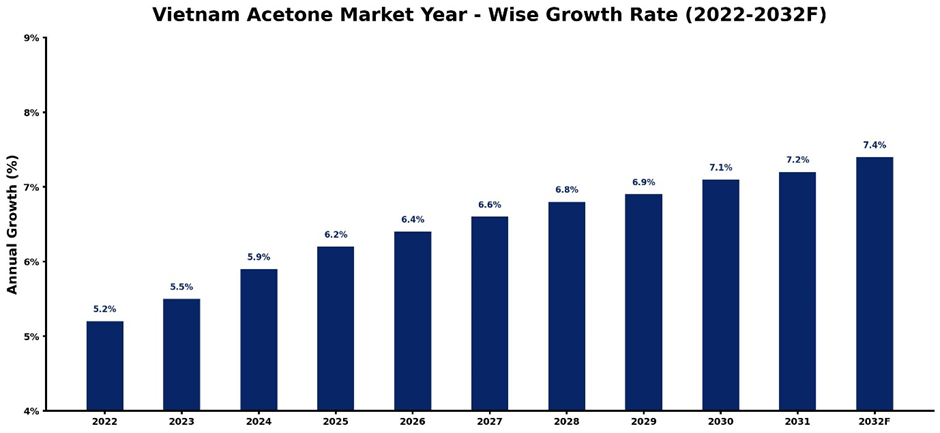
The following table summarizes the historical and forecasted growth rates of the Vietnam Acetone Market, along with the rationale behind each year’s performance.
Topics Covered in the Vietnam Acetone Market Report
The Vietnam Acetone Industry report covers the market by application and end-use. It further provides a detailed analysis of ongoing market trends, structural opportunities, and market drivers that assist stakeholders in aligning commercial strategies based on current and future market dynamics.
Vietnam Acetone Market Highlights
| Report Name | Vietnam Acetone Market |
| Forecast period | 2026-2032 |
| CAGR | 6.40% |
| Growing Sector | Paints & Coatings |
Vietnam Acetone Market Synopsis
The Vietnam Acetone Market can be considered a highly dynamic and volatile market in terms of its presence within the country’s chemicals industry. The acetone, which is referred to as the dimethyl ketone, is a colorless and highly volatile organic solvent, known for its high solvency and miscibility with water. Structurally, more than 95% of global acetone is co-produced alongside phenol via the cumene hydroperoxide process. As its supply is inherently linked to phenol production rather than standalone solvent economics, the market frequently experiences sharp pricing fluctuations and prompt regional tightness.
Evaluation of Growth Drivers in the Vietnam Acetone Market (2026–2032)
Below are the major drivers shifting the market dynamics across key channels:
| Drivers | Primary Segment Affected | Why It Matters (Evidence) |
| EV Lightweighting & Optical Sheet Demands | Plastics & MMA | Rapid growth in EV components is increasing demand for high-clarity PMMA panels and MMA intermediates. |
| Regulatory Classifications Exempted from VOC | Industrial Paints and Coatings | Acetone has replaced aromatic solvents that are not exempt from VOC regulations due to lower compliance costs. |
| Cleaning of Micro Components in Electronics | Electrical & Electronics | Highly precise electronic circuit board manufacturing is fueling demand for chemicals with very low residue. |
| Urbanization and Household Formulation | Cosmetics & Adhesives | Middle class spending is driving demand for cosmetics and adhesives. |
| API Localization Policies | Pharmaceuticals | Vietnam’s push for pharmaceutical self-sufficiency is supporting steady demand for technical-grade extraction solvents. |
The Vietnam Acetone Market is anticipated to expand reliably at a CAGR of 6.40% during the forecast period of (2026–2032). This growth is securely anchored by industrial manufacturing extensions in the northern and southern key economic zones, moving away from simple discretionary solvent usage toward advanced polymer intermediate integration. Rising domestic production of consumer goods, automotive components, electronic products, and construction materials has strengthened solvent demand, while government initiatives promoting industrial parks and petrochemical investments continue to create long-term growth opportunities.
Evaluation of Restraints in the Vietnam Acetone Market
Below are some major restraints and their structural influence on the market dynamics:
| Restraints | Primary Segment Affected | What This Means (Evidence) |
| Changing Raw Material & Co-Product Prices | Fuel Distribution | Margins depend upon the price and production volume of cumene and phenol. |
| Stringent Chemical Storage & Fire Safety Regulations | Supply Chain / Warehousing | Low flashpoint of acetone means there are high costs involved in handling and storing the material safely. |
| Increasing Demand For Alternatives To Solvents | Paint & Coating | There is increased demand for alternatives to solvents from green building laws. |
| Development Of Green Solvents Technology | Downstream Industrial Users | Increase in bio-fermented acetone is creating disruptions in traditional supply chain of petrochemicals. |
| Logistics In Importing | The Regulatory Bodies | Port congestion and anti-dumping tests are causing supply shortages and pricing instabilities. |
Among the key issues faced by the acetone market of Vietnam is the dependency of its manufacturers on the importation of petrochemical feedstocks, rendering the market susceptible to price fluctuations of global crude oil prices. Environmental regulations focusing on the reduction of VOC emissions have prompted the industry to consider eco-friendly alternatives for their solvent needs, possibly restraining the use of traditional acetone in some areas. Furthermore, rising freight rates, growing environmental concerns, and stiff competition from bio-based solvents are among other hurdles faced by the domestic producers of acetone. However, steady growth in industries is anticipated to overcome such limitations.
Vietnam Acetone Market Trends
Key trends shaping the Vietnam acetone market growth are outlined below:
- Purity Differentiation for Electronics: Escalating reliance on sub-ppb (parts per billion) purity-grade acetone variations explicitly filtered for semiconductor and micro-display substrate rinsing.
- Shifting Supply Network: The local supply networks are shifting from direct and longer-term Western business agreements towards flexible and short-sea shipping from the large Northeast Asian gateways in order to reduce any disruptions to supply.
- Environmentally-Friendly Packaging and Circular Logistics: Utilization of returnable intermediate bulk containers (IBCs) by local distributors to meet carbon reduction objectives for industrial sectors.
- Blend of Acetone Derived from Bio-Based Sources: First trial blends by the high-end consumer care brands to target environmentally-minded consumers.
Investment Opportunities in the Vietnam Acetone Market
Below is an outline of promising investment opportunities in the Vietnam Acetone Market:
- Setting up Dedicated Plants for High Purity Purification: There are high profit expectations from investments in dedicated purification plants in Vietnam that can transform regular technical grade acetone into high purity electronics grade products.
- Hazardous Chemicals Storage Warehousing: Leveraging on the existing lack of adequate hazardous chemicals storage facilities near industrial areas such as Binh Duong and Bac Ninh.
- Direct Application through BPA and Epoxy Resin Compounds: Establishing local compounding plants which use bulk acetone to manufacture downstream BPA and epoxy resins in Vietnam.
Top Players in the Vietnam Acetone Market
A list of leading companies operating in the Vietnam acetone market is presented below:
1. Mitsubishi Chemical
| Company Name | Mitsubishi Chemical |
|---|---|
| Established | 1933 |
| Headquarters | Tokyo, Japan |
| Official Website | Click Here |
Mitsubishi Chemical supplies industrial chemicals, specialty solvents, and petrochemical intermediates to Vietnam's manufacturing sector.
2. Kumho P&B Chemicals
| Company Name | Kumho P&B Chemicals |
|---|---|
| Established | 2000 |
| Headquarters | Seoul, South Korea |
| Official Website | Click Here |
Kumho P&B Chemicals is among Asia's major acetone and phenol producers, supplying high-quality acetone for BPA, MMA, coatings, and industrial solvent applications across Southeast Asia, including Vietnam.
3. INEOS Phenol
| Company Name | INEOS Phenol |
|---|---|
| Established | 1998 |
| Headquarters | London, United Kingdom |
| Official Website | Click Here |
INEOS Phenol manufactures phenol and acetone for global industrial markets. Its products are widely used in engineering plastics, pharmaceuticals, coatings, adhesives, and specialty chemicals.
4. Mitsui Chemicals
| Company Name | Mitsui Chemicals |
|---|---|
| Established | 1997 |
| Headquarters | Tokyo, Japan |
| Official Website | Click Here |
Mitsui Chemicals supplies petrochemical products, specialty chemicals, and industrial solvents used in plastics, automotive components, electronics manufacturing, and chemical processing industries.
5. Shell Chemicals
| Company Name | Shell Chemicals |
|---|---|
| Established | 1907 |
| Headquarters | London, United Kingdom |
| Official Website | Click Here |
Shell Chemicals produces petrochemical feedstocks and industrial solvents, including acetone-related products, supporting downstream manufacturing industries throughout the Asia-Pacific region.
Government Initiatives Being Implemented in the Vietnam Acetone Market
The development of the chemical manufacturing industry in Vietnam by the Vietnamese government is a continuous process through Vietnam Chemical Industry Development Strategy to 2030 with Vision to 2040 that aims at modernizing chemical manufacturing facilities and improving environmental protection laws. Policies promoting the expansion of industrial parks, incentives for investing in petrochemical manufacturing, and free trade agreements like EVFTA and CPTPP have helped attract foreign direct investments in downstream chemical manufacturing industries. For instance, the establishment of petrochemical clusters and industrial parks in southern Vietnam by the government has allowed investments in manufacturing plastics, coatings, and other specialty chemicals, thus benefiting acetone demand.
Future Insights of the Vietnam Acetone Market
Looking toward 2032, the Vietnam Acetone Market will increasingly transform from an undifferentiated bulk chemical commodity sector into a highly segmented, quality-driven marketplace. As local manufacturers scale their capacities up the value chain, demand for general industrial-grade solvents will stabilize, while specialty-grade segments will experience rapid expansion. The market will likely achieve structural balance through automated logistics networks and closer integration with regional ASEAN petrochemical giants, cushioning local end-users against extreme international price volatility.
Market Segmentation Analysis
This report presents a detailed analysis of the market segments along with their leading categories.
By Application - Market Dominated by Solvents, Bisphenol A (BPA) Set for Rapid Expansion
According to Sumit Sagar, Senior Research Analyst, 6Wresearch, the Solvent segment secured a dominant 42.82% of the Vietnam Acetone market value in 2025, driven by the persistent requirement for highly effective dissolving agents across the booming construction coating, automotive painting, and wood finishes sectors.
Conversely, Bisphenol A (BPA) applications are projected to advance at a CAGR of 7.10% during 2026–2032. The rise is driven by the rising production of polycarbonate plastics and epoxy resins within localities, which are widely used in domestic electronics manufacturing operations and engineering works that seek to maximize local component production.
By End-Use - Paints & Coatings Lead Market, Electronics Industry Shows Rapid Growth
Based on end-use, Paints & Coatings holds dominant position in the Vietnam Acetone market in 2025 with a share of 37.35%, driven by extensive usage in industrial formulations and a booming regional furniture export industry that consumes huge quantities of volatile solvent-based formulations.
On the other hand, the Electrical & Electronics segment is expected to register a stellar CAGR of 7.45% till 2032. The stellar growth in this industry can be attributed to growing demand for high purity acetone that serves as a non-corrosive cleaning agent in the manufacture of printed circuit boards.
Note: Market size estimations and growth projections presented in this report are based on 6Wresearch's proprietary forecasting methodology, utilizing the latest available industry data, government publications, and primary research inputs.
Key Attractiveness of the Report
- 10 Years of Market Numbers
- Historical Data Starting from 2022 to 2025
- Base Year: 2025
- Forecast Data until 2032
- Key Performance Indicators Impacting the Market
- Major Upcoming Developments and Projects
Key Highlights of the Report:
- Vietnam Acetone Market Outlook
- Market Size of Vietnam Acetone Market, 2025
- Forecast of Vietnam Acetone Market, 2032
- Historical Data and Forecast of Vietnam Acetone Revenues & Volume for the Period 2022- 2032
- Vietnam Acetone Market Trend Evolution
- Vietnam Acetone Market Drivers and Challenges
- Vietnam Acetone Price Trends
- Vietnam Acetone Porter's Five Forces
- Vietnam Acetone Industry Life Cycle
- Historical Data and Forecast of Vietnam Acetone Market Revenues & Volume By Application for the Period 2022- 2032
- Historical Data and Forecast of Vietnam Acetone Market Revenues & Volume By Solvent for the Period 2022- 2032
- Historical Data and Forecast of Vietnam Acetone Market Revenues & Volume By Bisphenol A (BPA) for the Period 2022- 2032
- Historical Data and Forecast of Vietnam Acetone Market Revenues & Volume By Methyl Methacrylate (MMA) for the Period 2022- 2032
- Historical Data and Forecast of Vietnam Acetone Market Revenues & Volume By Others for the Period 2022- 2032
- Historical Data and Forecast of Vietnam Acetone Market Revenues & Volume By End-Use for the Period 2022- 2032
- Historical Data and Forecast of Vietnam Acetone Market Revenues & Volume By Paints & Coatings for the Period 2022- 2032
- Historical Data and Forecast of Vietnam Acetone Market Revenues & Volume By Plastic for the Period 2022- 2032
- Historical Data and Forecast of Vietnam Acetone Market Revenues & Volume By Automotive for the Period 2022- 2032
- Historical Data and Forecast of Vietnam Acetone Market Revenues & Volume By Adhesives for the Period 2022- 2032
- Historical Data and Forecast of Vietnam Acetone Market Revenues & Volume By Pharmaceuticals for the Period 2022- 2032
- Historical Data and Forecast of Vietnam Acetone Market Revenues & Volume By Cosmetics for the Period 2022- 2032
- Historical Data and Forecast of Vietnam Acetone Market Revenues & Volume By Electrical & Electronics for the Period 2022- 2032
- Historical Data and Forecast of Vietnam Acetone Market Revenues & Volume By Others for the Period 2022- 2032
- Vietnam Acetone Import Export Trade Statistics
- Market Opportunity Assessment By Application
- Market Opportunity Assessment By End-Use
- Vietnam Acetone Top Companies Market Share
- Vietnam Acetone Competitive Benchmarking By Technical and Operational Parameters
- Vietnam Acetone Company Profiles
- Vietnam Acetone Key Strategic Recommendations
Market Covered
The report offers an extensive study of the following market segments:
By Application
- Solvent
- Bisphenol A (BPA)
- Methyl Methacrylate (MMA)
- Others
By End-Use
- Paints & Coatings
- Electrical & Electronics
- Plastic
- Automotive
- Adhesives
- Pharmaceuticals
- Cosmetics
- Others






































