Vietnam Active Phased Array Radar Market Growth Rate
According to 6Wresearch internal databases and industry insights, the Vietnam Active Phased Array Radar Market is anticipated to register a CAGR of 8.91% during the forecast period 2026–2032.
Vietnam Active Phased Array Radar Market Year-wise Growth Rate and Key Drivers (2022–2032)
The graph illustrates the annual growth trend of the Vietnam Active Phased Array Radar Market between 2022 and 2032, highlighting a steady upward trajectory and projected market expansion over the forecast period.
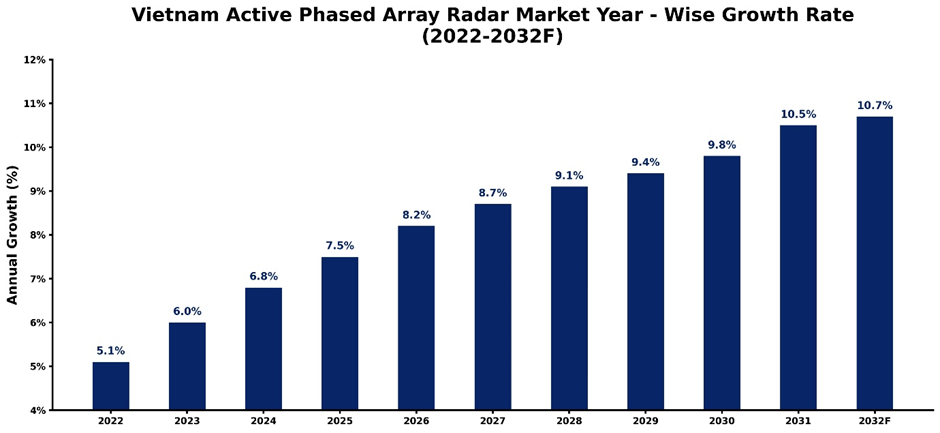
The following table summarizes the historical and forecasted growth rates of the Vietnam Active Phased Array Radar Market, along with the rationale behind each year’s performance.
| Year | Estimated Growth (%) | Market Rationale |
| 2022 | 5.1% | Recovery in defense procurement activities following post-pandemic budget normalization and increased surveillance requirements. |
| 2023 | 6% | Higher investment in coastal monitoring systems and modernization of naval communication infrastructure. |
| 2024 | 6.8% | Expansion of maritime domain awareness programs and procurement of next-generation surveillance equipment. |
| 2025 | 7.5% | Increased acquisition of AESA-enabled naval and ground surveillance radar systems under defense modernization initiatives. |
| 2026 | 8.2% | Growing deployment of digitally controlled phased array radar for integrated air defense operations. |
| 2027 | 8.7% | Rising military expenditure and enhanced border surveillance capabilities accelerate radar installations. |
| 2028 | 9.1% | Greater adoption of multifunction radar for naval vessels and strategic coastal defense systems. |
| 2029 | 9.4% | Expansion of electronic warfare preparedness and modernization of command-and-control infrastructure. |
| 2030 | 9.8% | Increasing incorporation of AI-assisted radar processing and real-time threat detection technologies. |
| 2031 | 10.5% | Continued procurement of advanced long-range surveillance systems supported by regional security priorities. |
| 2032 | 10.7% | Ongoing defense technology upgrades and stronger domestic capability development sustain market expansion. |
Topics Covered in the Vietnam Active Phased Array Radar Market Report
The Vietnam Active Phased Array Radar Market Report provides an in-depth assessment based on Type and End User. It offers detailed insights into key industry trends, growth drivers, emerging opportunities, competitive developments, and high-growth segments. The report presents an objective assessment of current dynamics and future prospects, enabling stakeholders to make informed business decisions and develop effective strategies aligned with the evolving industry landscape.
Vietnam Active Phased Array Radar Market Highlights
| Report Name | Vietnam Active Phased Array Radar Market |
| Forecast period | 2026-2032 |
| CAGR | 8.91% |
| Growing Sector | Military & Defense |
Vietnam Active Phased Array Radar Market Synopsis
The Vietnam Active Phased Array Radar Market is expected to grow at a steady pace owing to the developing defense of the country for enhancing national security, maritime domain awareness and airspace surveillance. Active phased array radar or Active Electronically Scanned Array (AESA) radar is a new radar technology that electronically steers radar beams without any mechanical movement. This permits faster target acquisition, the ability to track multiple targets simultaneously, better operational reliability and greater resistance to electronic jamming. These systems have been extensively deployed on naval ships, military aircraft, ground-based air defense platforms and long-range surveillance installations.
Evaluation of Growth Drivers in Vietnam Active Phased Array Radar Market (2026–2032)
Below are some major drivers and their influence on the market dynamics:
| Drivers | Primary Segment Affected | Why It Matters (Evidence) |
| Defense modernization programs | Military & Defense | Continuous procurement of advanced radar enhances surveillance and combat readiness. |
| Maritime security enhancement | Military & Defense | Expanding coastal monitoring strengthens demand for naval phased array radar systems. |
| Increasing use of AESA technology | Aerospace | Benefits include improved detection range and resistance to electronic warfare. |
| Local development of indigenous defense capabilities | Military & Defense | Benefits include local manufacture and technology transfer. |
| Integration with digital command-and-control systems | Civil Aviation | Network-centric surveillance improves situational awareness and operational coordination. |
Vietnam Active Phased Array Radar Market is anticipated to register robust expansion, tracking a CAGR of 8.91% during 2026–2032. The country’s defense sector continues to increase investments in next-generation surveillance technologies as the country modernizes its military infrastructure and strengthens maritime security capabilities. Active phased array radar systems are becoming increasingly important due to their ability to detect multiple airborne and maritime threats simultaneously while providing high reliability under complex operational environments.
Over the forecast period, more than 70% of planned new military radar procurements are expected to favor electronically scanned radar technologies over traditional mechanically scanned systems. Furthermore, digital beamforming-based radar systems can improve the target tracking efficiency by almost 35%. Advanced gallium nitride (GaN) based transmit/receive modules can improve the power efficiency by about 25–30% compared with conventional semiconductor technologies. Growing investments in integrated air defense networks, increasing deployment of naval surveillance platforms, and continued modernization of command-and-control infrastructure are expected to sustain robust market growth throughout the forecast period.
Evaluation of Restraints in Vietnam Active Phased Array Radar Market
Below are some major restraints and their influence on the market dynamics:
| Restraints | Primary Segment Affected | What This Means (Evidence) |
| High acquisition and lifecycle costs | Military & Defense | Large capital investments limit procurement frequency. |
| Dependence on imported critical components | Manufacturers | Semiconductor and electronic module imports increase supply chain vulnerability. |
| Integration of complex technology | Aerospace | The combination of radars with existing defense systems needs considerable engineering assistance. |
| Shortage of skilled personnel | Defense Electronics Industry | The lack of radar engineers poses difficulties in implementation and maintenance. |
| Regulation of export controls | Government Procurement | International license restrictions hinder advanced radar purchases. |
Vietnam Active Phased Array Radar Market Challenges
Despite the increased efforts by Vietnam in improving its defense mechanisms, some issues have been impacting the market. Purchasing AESA radar systems requires high investments, where the cost of maintenance can take up to 25-35% of the ownership costs throughout the entire period of the operation of the system.
In addition, numerous key parts of high-performing radar systems, such as power amplifiers made of gallium nitride, cutting-edge signal processing equipment, and semiconductor modules working at high frequencies, are still highly dependent on imports from foreign manufacturers. Moreover, integration of new radar technology with legacy command systems also demands specific engineering skills and experience, making the project's timeline grow by 15-20%.
Vietnam Active Phased Array Radar Market Trends
Emerging trends shaping the Vietnam active phased array radar market growth include the following:
- Increase in the Adoption of Multi-Function Radar Systems: The military has been developing radar systems that would be able to conduct surveillance, target tracking, missile guidance, and fire control tasks, which will help avoid equipment duplication and enhance effectiveness.
- Increasing Interest in Network-Centric Warfare: Advanced active phased-array radar systems have been becoming more and more connected to C4ISR systems, thus ensuring timely data exchange and joint defensive activities.
- Increase in the Requirement for Portable Radar Systems for the Ground: Portability, flexibility, and ability to quickly deploy radar systems make them popular among military organizations.
Investment Opportunities in the Vietnam Active Phased Array Radar Market
Promising investment avenues in the Vietnam Active Phased Array Radar Market are presented below:
- Development of Radar Software and Artificial Intelligence Analytics: The growing need for intelligent radar signal processing opens up avenues for those engaged in artificial intelligence, electronic warfare software, and analytics.
- Military Systems Integration Services: Defense contractors integrating radar systems with missile defense systems, communications systems, and command systems will be able to gain from increasing modernization efforts.
- Defense Research and Technology Partnerships: Collaboration between Vietnamese defense organizations, universities, and international technology providers is expected to accelerate innovation in radar engineering and electronic warfare capabilities.
Top Players in Vietnam Active Phased Array Radar Market
A comprehensive list of major companies operating in the Vietnam Active Phased Array Radar Market is provided below:
1. RTX Corporation (Raytheon)
| Company Name | RTX Corporation (Raytheon) |
|---|---|
| Established Year | 1922 |
| Headquarters | Arlington, Virginia, United States |
| Official Website | Click Here |
RTX Corporation is among the world's leading defense technology companies, manufacturing advanced Active Electronically Scanned Array (AESA) radar systems for air defense, naval combat, missile defense, and military aviation.
2. Thales Group
| Company Name | Thales Group |
|---|---|
| Established Year | 2000 (Origins dating back to 1893) |
| Headquarters | Paris, France |
| Official Website | Click Here |
Thales develops high-performance active phased array radar systems for naval, airborne, and ground defense applications.
3. Leonardo S.p.A.
| Company Name | Leonardo S.p.A. |
|---|---|
| Established Year | 1948 |
| Headquarters | Rome, Italy |
| Official Website | Click Here |
Leonardo manufactures advanced AESA radar solutions for fighter aircraft, naval vessels, and ground-based surveillance systems.
4. Saab AB
| Company Name | Saab AB |
|---|---|
| Established Year | 1937 |
| Headquarters | Stockholm, Sweden |
| Official Website | Click Here |
Saab specializes in long-range surveillance radar, airborne early warning systems, and naval combat radar technologies. Its phased array radar platforms are widely deployed for airspace monitoring, coastal surveillance, and integrated defense operations.
5. Lockheed Martin Corporation
| Company Name | Lockheed Martin Corporation |
|---|---|
| Established Year | 1995 (heritage dating back to 1912) |
| Headquarters | Bethesda, Maryland, United States |
| Official Website | Click Here |
Lockheed Martin develops advanced phased array radar systems supporting missile defense, tactical surveillance, and integrated air defense missions.
Government Initiatives being implemented in the Vietnam Active Phased Array Radar Market
The Vietnamese government continues to enhance the country’s defense capabilities with long-term military modernization and defense industry development programs. Vietnam has concentrated on the upgrade of surveillance infrastructure, integrated air defense networks and maritime security systems under the Resolution No. 08-NQ/TW on safeguarding the nation and the Law on National Defense (2018).
The government also promotes the Development Strategy for Vietnam’s Defense Industry to 2030 and Vision to 2045, which encourages domestic production of defense equipment, technology transfer and cooperation with foreign defense manufacturers. Vietnam also keeps investing in coastal surveillance stations, naval modernization, and digital command-and-control systems to improve maritime domain awareness in the South China Sea.
Future Insights of the Vietnam Active Phased Array Radar Market
The Vietnam Active Phased Array Radar Market is expected to witness sustained expansion as defense modernization remains a national strategic priority. The future will witness greater emphasis on the development of radars supported by artificial intelligence, multifunction AESA, long-range coastal surveillance systems, and battlefield management systems. By 2032, more than 80% of military surveillance radars procured will use digital phased arrays as opposed to traditional mechanical scanning systems.
The use of GaN-based transmit/receive modules could enable a near 30% increase in radar power efficiency, while AI-assisted target recognition technologies are expected to achieve a reduction in false target identification rates of about 35-40%. The operational capabilities will be further enhanced by increasing focus on indigenous defense manufacturing, software-defined radar platforms, cybersecurity integration, and interoperability with unmanned aerial systems.
Market Segmentation Analysis
This report presents a detailed analysis of the market segments along with their leading categories.
By Type – Digital Radar Dominates the Market with Superior Operational Capabilities
According to Bhawna Singh, Assistant Manager, 6Wresearch, Digital Radar held the dominant position in the Vietnam Active Phased Array Radar Market, accounting for an estimated 78.60% revenue share in 2025 due to growing application of AESA technology in air defense systems, ships, and land-based surveillance equipment. Nonetheless, Digital Radar Market is expected to grow with a CAGR of 8.84% in the period from 2026 to 2032 owing to military modernization drives in Vietnam.
By End User – Military & Defense Remains the Largest Revenue Contributor
The Military & Defense segment accounted for the largest share, estimated at 72.40% in 2025. The segment continues to benefit from sustained investments in national defense modernization, border surveillance, integrated air defense systems, maritime domain awareness and naval fleet upgrades. In contrast, the Military & Defense segment is expected to register a CAGR of 8.97% during 2026-2032, owing to the continuous procurement of next-generation radar systems, indigenous defense capability enhancement and increasing regional security requirements.
Note: Market size estimations and growth projections presented in this report are based on 6Wresearch's proprietary forecasting methodology, utilizing the latest available industry data, government publications, and primary research inputs.
Key Attractiveness of the Report:
- 10 Years of Market Numbers
- Historical Data Starting from 2022 to 2025
- Base Year: 2025
- Forecast Data until 2032
- Key Performance Indicators Impacting the Market
- Major Upcoming Developments and Projects
Key Highlights of the Report:
- Vietnam Active Phased Array Radar Market Outlook
- Market Size of Vietnam Active Phased Array Radar Market, 2025
- Forecast of Vietnam Active Phased Array Radar Market, 2032
- Historical Data and Forecast of Vietnam Active Phased Array Radar Revenues & Volume for the Period 2022-2032
- Vietnam Active Phased Array Radar Market Trend Evolution
- Vietnam Active Phased Array Radar Market Drivers and Challenges
- Vietnam Active Phased Array Radar Price Trends
- Vietnam Active Phased Array Radar Porter's Five Forces
- Vietnam Active Phased Array Radar Industry Life Cycle
- Historical Data and Forecast of Vietnam Active Phased Array Radar Market Revenues & Volume By Type for the Period 2022-2032
- Historical Data and Forecast of Vietnam Active Phased Array Radar Market Revenues & Volume By Analog Radar for the Period 2022-2032
- Historical Data and Forecast of Vietnam Active Phased Array Radar Market Revenues & Volume By Digital Radar for the Period 2022-2032
- Historical Data and Forecast of Vietnam Active Phased Array Radar Market Revenues & Volume By End User for the Period 2022-2032
- Historical Data and Forecast of Vietnam Active Phased Array Radar Market Revenues & Volume By Military & Defense for the Period 2022-2032
- Historical Data and Forecast of Vietnam Active Phased Array Radar Market Revenues & Volume By Aerospace for the Period 2022-2032
- Historical Data and Forecast of Vietnam Active Phased Array Radar Market Revenues & Volume By Automotive for the Period 2022-2032
- Historical Data and Forecast of Vietnam Active Phased Array Radar Market Revenues & Volume By Civil Aviation for the Period 2022-2032
- Vietnam Active Phased Array Radar Import Export Trade Statistics
- Market Opportunity Assessment By Type
- Market Opportunity Assessment By End User
- Vietnam Active Phased Array Radar Top Companies Market Share
- Vietnam Active Phased Array Radar Competitive Benchmarking By Technical and Operational Parameters
- Vietnam Active Phased Array Radar Company Profiles
- Vietnam Active Phased Array Radar Key Strategic Recommendations
Market Covered
The report offers an extensive study of the following market segments:
By Type
- Analog Radar
- Digital Radar
By End User
- Military & Defense
- Aerospace
- Automotive
- Civil Aviation






































